
What is a Category L1 Fire Alarm System? The Ultimate Guide to Maximum Life Protection

If your commercial building houses vulnerable residents or high-risk operations, a partial fire detection strategy isn't just risky; it's often a direct breach of UK safety law. We know that deciphering the 170 plus pages of the BS 5839-1:2017 British Standard feels overwhelming for most facilities managers. You need to ensure your premises in London or Kent are fully protected without overspending on hardware or suffering through weeks of disruptive installation. Many clients contact our team asking what is a category L1 fire alarm system and whether such a comprehensive level of coverage is actually mandatory for their specific site.
This guide explains why Category L1 represents the gold standard of life protection and helps you determine if your property requires this total-coverage solution for legal compliance. You'll gain a clear understanding of the technical requirements, cost expectations, and how to find an accredited partner to manage your installation. We provide a no nonsense breakdown of the regulations so you can secure your building with absolute confidence and peace of mind.
Key Takeaways
- Understand what is a category L1 fire alarm system and why it represents the highest level of automated life protection under British Standard BS 5839-1.
- Learn about the "total coverage" requirement, which mandates detector placement in every room, cupboard, and hidden void to ensure comprehensive safety.
- Identify whether your commercial premises requires an L1 system based on your professional Fire Risk Assessment and specific building evacuation needs.
- Discover the essential lifecycle of a compliant system, from meticulous design and installation to the rigorous maintenance schedules required for legal compliance.
- Gain peace of mind by partnering with an accredited fire safety expert to secure your property and protect your people across London and the South East.
Defining Category L1 Fire Alarms within the BS 5839-1 Framework
Understanding what is a category L1 fire alarm system requires looking at the highest tier of life safety protection available in the UK. This category represents a fully automated solution designed to detect fire at the earliest possible stage. It goes beyond basic legal requirements by placing detectors in every part of a building. This includes cupboards, roof voids, and cellular offices. The Regulatory Reform (Fire Safety) Order 2005 places the responsibility on the "Responsible Person" to ensure adequate protection; an L1 system offers the most robust way to meet these legal duties for high-risk or complex premises.
The primary objective of an L1 installation is to provide the earliest possible warning to occupants. By monitoring every room and void, the system detects smoke or heat long before it reaches escape routes. This extra time is critical for safe evacuation, especially in buildings with vulnerable residents or complex layouts. It differs significantly from Category M systems, which rely on manual activation, and Category P systems, which focus on protecting property rather than human life.
The British Standard BS 5839-1 Explained
The BS 5839-1 Framework serves as the primary code of practice for fire detection in UK non-domestic premises. It provides a structured methodology for designers and installers to follow. This standard ensures that systems aren't just installed, but are fit for purpose based on specific risk assessments. The framework categorises systems to help business owners understand the level of protection they're commissioning. Working with an accredited fire alarm company is essential to ensure your L1 system meets these stringent technical requirements. Quartz Empire Fire & Security Ltd maintains strict adherence to these standards to ensure your system passes every inspection and remains fully compliant.
The "L" Classification: Life Safety First
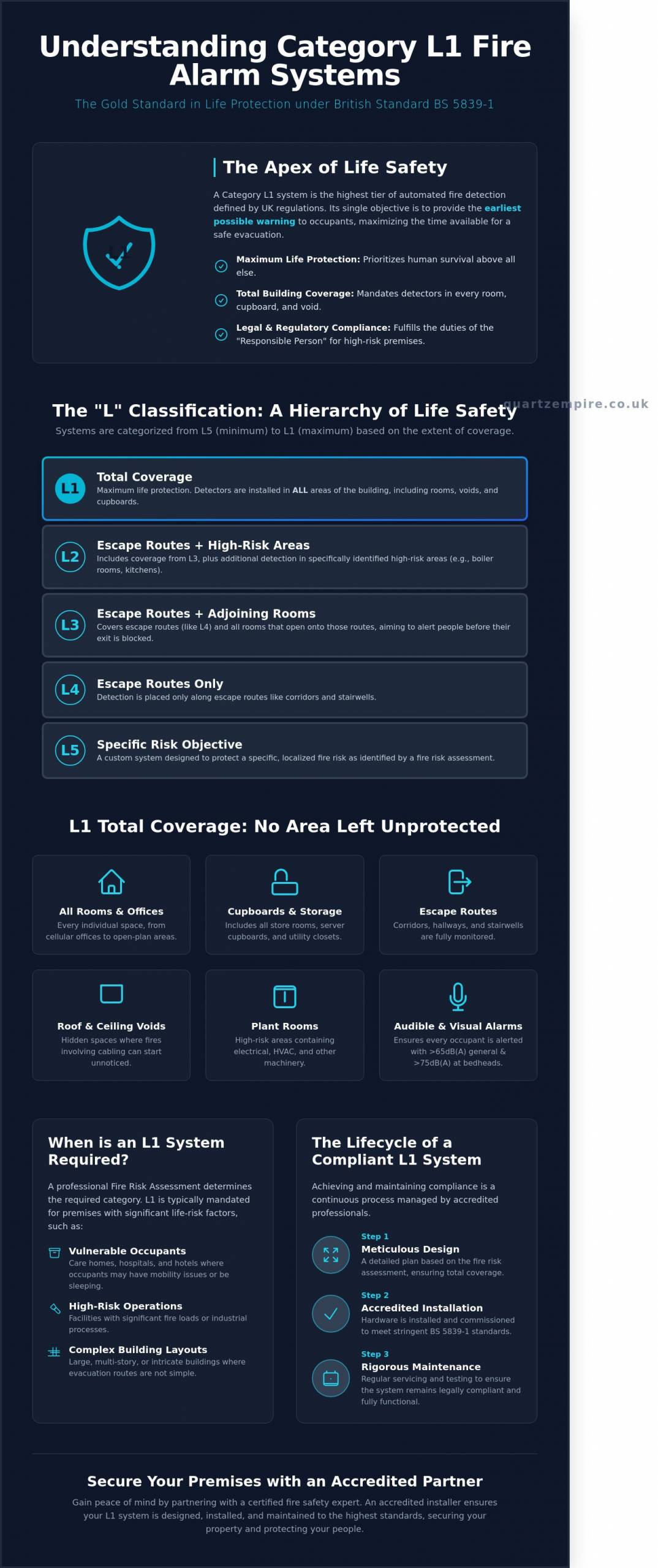
The "L" designation stands for Life Safety. While Category P systems focus on protecting the physical assets or the building structure, L systems prioritise the survival of people. The hierarchy ranges from L5, which targets specific risks, up to L1. Category L4 covers escape routes, L3 adds rooms opening onto those routes, and L2 includes high-risk areas. Category L1 is the maximum life protection category under current UK standards. It provides total coverage to ensure occupants have every second possible to evacuate safely before smoke or heat becomes life-threatening. Quartz Empire Fire & Security Ltd's no-nonsense approach ensures that when we specify an L1 system, it's because your building requires the absolute peak of safety technology.
- L1: Total coverage for maximum life safety.
- L2: Protection of escape routes and high-risk rooms.
- L3: Protection of escape routes and rooms opening onto them.
- L4: Protection of escape routes only.
- L5: Custom protection for specific fire safety objectives.
Total Coverage: Where are L1 Detectors Actually Installed?
Understanding what is a category L1 fire alarm system requires looking at the sheer scale of the installation. Unlike lower categories that focus on escape routes or specific high-risk rooms, L1 leaves nothing to chance. It's the most comprehensive level of life safety protection available under the British Standard BS 5839-1.
In a compliant L1 installation, detectors are placed in every single room and area of the building. This includes offices, hallways, store cupboards, and plant rooms. The goal is simple: ensure there are no unprotected zones where a fire could start and grow unnoticed. This level of vigilance is particularly critical for buildings with sleeping occupants, such as care homes or hotels, where early detection is the difference between a safe evacuation and a tragedy.
Beyond detection, the system ensures that every occupant is alerted. Sounders and visual beacons must be audible and visible throughout the entire premises. In a typical UK warehouse or office block, this means achieving a minimum sound level of 65dB(A), or 75dB(A) at a bedhead in residential settings.
Beyond the Main Rooms: Voids and Roof Spaces
Voids are often the most overlooked areas in a building, yet they represent a significant risk. These spaces frequently house extensive electrical cabling, server hardware, and HVAC ducting. Because people don't occupy these areas, a fire can smoulder for hours before smoke enters a main room.
UK regulations state that if a ceiling or floor void exceeds 800mm in height, it must have dedicated detection. In an L1 system, these detectors are integrated into the main fire alarm panel. This allows the system to provide precise location tracking. If a sensor triggers in a 1,200mm roof void, the panel tells the fire warden exactly where to look, saving vital minutes.
The Rare Exceptions: When is a Detector Not Required?
While L1 is "total coverage," there are very specific, rare exceptions. Small cupboards under 1m² or toilets may sometimes be excluded, but this isn't a blanket rule. A professional fire risk assessment must be conducted to justify these exclusions. The assessor will look for a lack of ignition sources and low fuel loads before permitting a gap in detection.
Even if a small room doesn't require a smoke head, the alarm must still be heard clearly inside it. If you're managing a complex site in London or the South East, you can speak with our accredited engineers to ensure your layout meets these strict requirements without unnecessary over-specification. We take a no-nonsense approach to ensure your building is both safe and fully compliant with current UK law.
Why Your Business Might Require a Category L1 System
Determining whether your property needs the highest level of protection starts with a professional Fire Risk Assessment (FRA). Under the Regulatory Reform (Fire Safety) Order 2005, every UK business must maintain a valid FRA. This document dictates the required category based on specific risks. If your building houses vulnerable people or complex industrial processes, the assessor will likely recommend an L1 setup. You need to understand what is a category L1 fire alarm system to ensure your business remains compliant and your staff stay safe. These systems provide total coverage. Detectors are placed in every part of the building, including cupboards, lift shafts, and roof voids. This level of detail is necessary when evacuation times are slow or the risk of fire spreading unnoticed is high.
Insurance providers frequently mandate L1 coverage for high-risk commercial activities to lower their liability. If your premises handle flammable materials or expensive machinery, an L1 system acts as a critical safeguard. It follows the code of practice for design, installation, commissioning and maintenance outlined in BS 5839-1. This ensures every component meets rigorous British standards. In 2023, UK fire services attended over 185,000 incidents; for businesses in Kent and London, the margin for error is zero.
High-Risk Premises: Hospitals, Hotels, and Care Homes
Buildings where people sleep are high-risk environments. In hotels or care homes, occupants might be asleep or have limited mobility when an alarm sounds. This pushes requirements toward L1 categories. L1 systems support "total evacuation" strategies by providing the earliest possible warning. For larger facilities, we install addressable systems. These allow staff to identify the exact location of a fire on a digital display immediately, saving vital seconds. Understanding what is a category L1 fire alarm system helps managers appreciate why total coverage is non-negotiable in these high-stakes environments. It ensures that even a small smoulder in a remote linen cupboard triggers an immediate response.
Complex Building Layouts and Large Offices
Multi-storey offices across London and Kent often feature intricate floor plans. When travel distance to an exit exceeds 18 metres in a high-risk area, early detection becomes a legal necessity. Total coverage prevents entrapment by alerting occupants before smoke blocks exit routes. For more information on designing these systems, see our Commercial Fire Alarm Installation guide. Expert design ensures your system is reliable and avoids the disruption of false alarms. We focus on:
- Reducing entrapment risks in windowless inner rooms.
- Compensating for long corridors where smoke travel is a concern.
- Integrating with access control to unlock fire doors automatically.
- Providing peace of mind for facilities managers overseeing 500+ employees.
Our no-nonsense approach ensures your system is certified and fit for purpose. We act as your trusted partner to maintain compliance across the South East.
The Lifecycle of an L1 System: Installation and Maintenance
Understanding what is a category L1 fire alarm system begins with a comprehensive design phase. Unlike lower-tier categories, an L1 system leaves zero room for error. Designers must map every room, cupboard, and roof void exceeding 800mm in height to ensure 100% sensor coverage across the entire building footprint. This meticulous mapping ensures that even the smallest smoulder in a remote storage area is detected before it can escalate.
Commissioning serves as the final bridge between installation and operation. It isn't a simple walk-through. It involves a rigorous test of every detector, sounder, and interface. We verify that signals reach the alarm receiving centre within 30 seconds of activation. This step confirms the system performs exactly as the original design intended, providing the high level of life safety expected from an L1 installation.
Professional Installation Standards
Installing an L1 system requires technical precision. Engineers must use fire-resistant cabling that maintains circuit integrity for at least 120 minutes during a fire event. Our engineers adopt a no-nonsense approach to installation. We don't cut corners on cable clips or junction boxes. This attention to detail prevents the 25% of false alarms typically caused by poor installation practices in complex L1 environments. Quartz Empire ensures all installations are fully compliant with building codes across Kent and London, protecting your property against both fire and unnecessary downtime.
The Legal Requirement for Regular Servicing
UK law, specifically the Regulatory Reform (Fire Safety) Order 2005, mandates that commercial fire alarms undergo a professional service at least every six months. Because what is a category L1 fire alarm system involves significantly more devices than a standard L3 setup, the maintenance programme is more demanding. A typical L1 system might have 40% more sensors to check, requiring a more focused engineering schedule.
During a service visit, our technicians perform several critical tasks to keep your site compliant:
- Battery Testing: We verify that backup batteries provide 24-hour standby capacity.
- Sensor Cleaning: Every individual smoke and heat head is cleaned to prevent dust-related faults.
- Logbook Audit: We check the fire logbook for any recurring system errors or missed weekly tests.
- Audibility Checks: We ensure sounder levels reach the required 65dB(A) in all occupied areas.
Failure to maintain these records can lead to severe consequences. Fines for non-compliance often exceed £5,000, and responsible persons can face imprisonment if negligence is proven after an incident. Regular maintenance isn't just a recommendation; it's a vital part of your legal safety strategy.
Ensure your premises remain fully compliant and protected by experts. Book your professional fire alarm service with Quartz Empire today.
Securing Your Premises with a Trusted Fire Safety Partner
Quartz Empire provides expert fire alarm installation and maintenance across the South East. Understanding what is a category L1 fire alarm system is essential for any high-risk business owner or facilities manager. An L1 system provides the highest level of life protection by covering all areas of a building with sensitive detection. Our accredited team understands these technical nuances intimately. We don't just fit devices; we design comprehensive safety strategies tailored to your specific architectural layout. From the first CAD drawing to the final commissioning certificate, we act as your dedicated safety partner. Our team manages the entire lifecycle of your system, providing 24/7 support to ensure your premises remain secure every hour of the year.
Expert Compliance in London, Kent, and the South East
Our geographical focus on London, Kent, and the South East ensures we have deep local knowledge of regional fire regulations and building types. This proximity is vital for rapid response times. We maintain a strict 4-hour emergency call-out target for our contract customers, ensuring that faults are rectified before they compromise safety. We work closely with facilities managers to streamline the compliance journey. This includes providing digital logbooks and clear maintenance schedules that satisfy both insurers and fire authorities. Having a local partner means we are familiar with the specific building archetypes in the South East, from heritage sites in Kent to modern commercial high-rises in the City of London. We simplify the complex world of fire safety, allowing you to focus on running your business while we handle the technical requirements of BS 5839-1.
Why a "No-Nonsense" Approach to Fire Safety Matters
Our brand ethos centres on clear communication and transparent, honest pricing. We believe that fire safety should be straightforward and reliable. This "no-nonsense" approach helps business owners avoid the common pitfalls of over-specified systems or hidden maintenance costs. Proper implementation of what is a category L1 fire alarm system protects your most valuable assets: your people. Under the Regulatory Reform (Fire Safety) Order 2005, the "Responsible Person" faces significant legal risks if systems fail. We mitigate these risks by providing reliable, high-quality hardware and meticulous testing. Our service includes:
- Fixed-price maintenance contracts with no hidden surcharges or surprise fees.
- Direct access to senior engineers for technical queries and site assessments.
- Reliable hardware from trusted industry leaders to ensure system longevity.
- Clear, jargon-free reporting that makes compliance easy to understand.
Ensuring the safety of your staff and visitors is a non-negotiable priority. To start your journey toward total compliance and maximum protection, Get a Quote for your next L1 project and secure your business with a partner you can trust.
Take the Next Step Toward Total Life Protection
Protecting your staff and assets requires more than just meeting the bare minimum. A Category L1 system offers the most comprehensive life safety protection available under the BS 5839-1:2017 standard. By installing detectors in every part of your building, from large floor areas to small storage cupboards, you ensure the earliest possible warning during an emergency. This level of coverage helps you meet strict legal obligations while providing total peace of mind for everyone on-site.
Understanding what is a category L1 fire alarm system is the first step toward a safer workplace. Our team of accredited fire alarm installers provides a no-nonsense approach to compliance across Kent, London, and the South East. We've helped over 500 businesses secure their premises with reliable, certified systems that stay functional for years. Don't leave your fire safety to chance when professional expertise is just a click away.
Book Your Category L1 Fire Alarm Consultation with Quartz Empire today to ensure your building remains fully protected. We're ready to help you secure your future.
Frequently Asked Questions
What is the difference between L1 and L2 fire alarm systems?
An L1 system provides the highest level of life protection by placing detectors in all areas of a building, including cupboards and roof voids. In contrast, an L2 system only covers escape routes, rooms opening onto those routes, and high-risk areas like boiler rooms. While L2 focuses on protecting the path out of the building, L1 ensures the earliest possible warning regardless of where a fire starts.
Is a Category L1 fire alarm system a legal requirement for my business?
Whether you need an L1 system depends on your specific Fire Risk Assessment as required by the Regulatory Reform (Fire Safety) Order 2005. It's typically a legal necessity for high-risk premises like large hotels, care homes, or complex healthcare facilities where evacuation takes longer. Failing to comply with your assessment's requirements can lead to unlimited fines or prison sentences for the responsible person.
How many smoke detectors are needed in an L1 system?
The number of detectors is determined by the floor area and building layout, following BS 5839-1:2017 standards which allow a 7.5-metre coverage radius for smoke detectors. This generally equates to one detector for every 100 square metres of floor space in open-plan areas. For a standard 500-square-metre office floor, you would typically need at least five detectors, plus additional units for every partitioned room and cupboard.
Do I need fire detectors in my roof space for an L1 system?
You must install detectors in any roof space or floor void that is deeper than 800mm to meet the requirements of BS 5839-1. This is a defining factor in understanding what is a category L1 fire alarm system, as it aims for total coverage of the building structure. Our expert engineers in Kent and London always inspect these hidden voids during the design phase to ensure your system remains fully compliant.
How often should a Category L1 fire alarm be serviced?
You should have your Category L1 fire alarm serviced at least every six months by a certified technician to comply with UK safety regulations. These bi-annual inspections verify that all sensors, batteries, and sounders are operational and haven't been obstructed by building changes. Regular maintenance is vital, as false alarms currently cost UK businesses roughly £1 billion each year in lost productivity and fire service charges.
Can an L1 system be wireless or must it be hardwired?
An L1 system can be either wireless or hardwired, as long as the equipment is certified to EN54 standards and installed correctly. Wireless systems are a reliable choice for heritage buildings in the South East where cabling is difficult to hide. They often reduce installation time by 30% compared to wired versions. We provide a no-nonsense assessment to help you choose the most dependable technology for your specific premises.
What happens if my business fails to install the category of system required by my Fire Risk Assessment?
If you don't install the correct category of system, your commercial insurance will likely be voided, leaving you with no financial protection after a fire. Fire authorities have the power to issue enforcement notices, and since 2023, prosecution rates for non-compliance have risen across the UK. As your trusted partner, we ensure your installation meets the exact standards required to protect your people and your legal standing.