
Upgrading Your Business Security System: A Professional Buying Guide for 2026

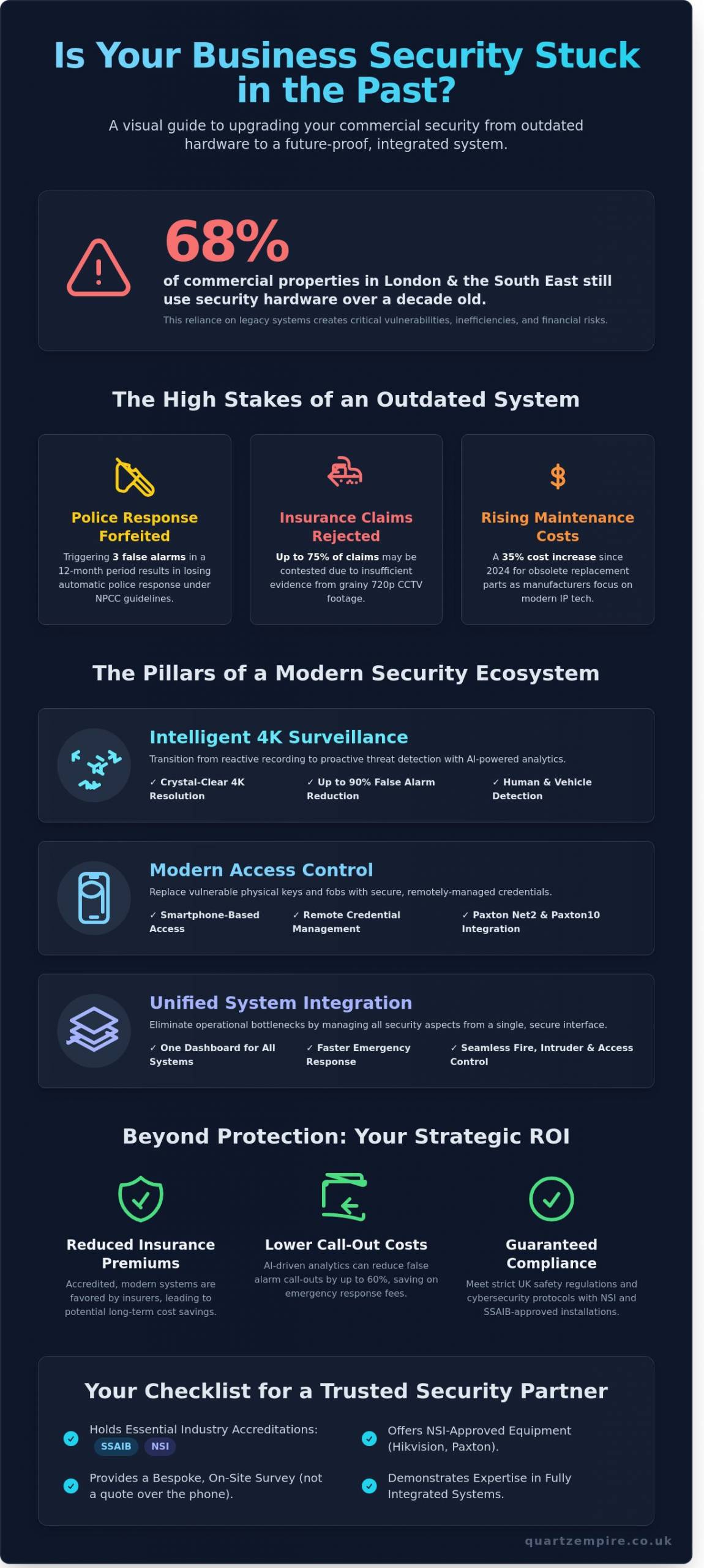
Recent 2024 industry reports indicate that 68% of commercial properties in London and the South East still rely on security hardware installed over a decade ago. If you're frustrated by grainy 720p CCTV footage that's useless for evidence or frequent false alarms from legacy sensors, you're likely aware that your current setup is no longer fit for purpose. Upgrading your business security system is no longer a simple hardware replacement; it's a strategic move toward a fully integrated, future-proof environment that protects your people and property.
We agree that managing disconnected systems for fire, intruder alerts, and access control is an unnecessary drain on your time and resources. This guide provides a clear, professional roadmap for transitioning from outdated hardware to modern solutions like Hikvision or Paxton systems, ensuring you achieve total compliance with UK safety regulations. You'll discover how to select an accredited partner that helps lower your insurance premiums and provides the peace of mind you need for 2026. We'll examine the technical requirements for modern integration and the specific certifications your provider must hold to keep your business secure.
Key Takeaways
- Identify the critical failure points of legacy hardware and understand how frequent false alarms jeopardize your standing with local authorities.
- Explore the shift to intelligent 4K IP CCTV and Paxton-driven biometrics to replace outdated physical keys with a modern, integrated infrastructure.
- Discover the long-term ROI of upgrading business security system hardware, including reduced insurance premiums and lower emergency call-out costs.
- Learn how to verify essential industry accreditations like SSAIB and NSI to ensure your chosen partner meets strict UK compliance standards.
- Understand why a bespoke on-site survey is the only way to design a system tailored to the specific security risks of London and Kent businesses.
Recognising the Signs: When to Consider Upgrading Your Business Security System
Operating with an outdated security setup creates vulnerabilities that criminals in 2026 are increasingly adept at exploiting. Legacy analogue hardware often relies on ageing coaxial cables and BNC connectors that suffer from signal attenuation, leading to intermittent feed failures. Since 2024, the cost of sourcing replacement components for these obsolete systems has risen by 35% as manufacturers shift focus to IP-based technologies. Relying on a patchwork of old sensors is no longer a cost-effective strategy for protecting your assets in London or the South East.
False alarms present a significant operational risk. Under the current National Police Chiefs' Council (NPCC) guidelines, a business that triggers three false alarms within a rolling 12-month period loses its right to a police response. This puts your property at risk of being ignored during a genuine intrusion. Modernising your infrastructure ensures your site adheres to professional security management principles, reducing false triggers by up to 60% through AI-driven human and vehicle detection.
The "grainy footage" trap is a common point of failure during insurance investigations. Most insurers now require a minimum of 4K resolution for identification purposes at a distance of 10 metres. If your current cameras produce blurred images, 75% of claims involving theft or vandalism may be contested or rejected due to insufficient evidence. Upgrading your business security system isn't just about better hardware; it's about ensuring your insurance premiums remain valid and your claims are settled quickly.
Technological Obsolescence vs. Physical Wear
By 2026, hardware manufactured before 2020 is largely considered non-compliant with the latest cybersecurity protocols. Outdoor CCTV housings and perimeter sensors typically show physical degradation after 7 years of exposure to UK weather, leading to moisture ingress and lens fogging. Systems that lack remote firmware updates are particularly dangerous. They remain unpatched against new digital threats, leaving your internal network open to unauthorised access through a single vulnerable camera.
Operational Inefficiencies in Disconnected Systems
Managing separate applications for fire detection, intruder alarms, and access control is a major bottleneck for facilities managers. When these systems don't communicate, response times can lag by several minutes during a critical event. System fragmentation is the disjointed operation of independent security silos that prevents a unified overview of site safety and slows down emergency response protocols. Upgrading your business security system to an integrated platform allows you to manage every aspect of your site from a single, secure interface.
The Pillars of a Modern Integrated Security Infrastructure
Upgrading your business security system in 2026 requires a shift from standalone devices to a unified ecosystem. Modern infrastructure relies on 4K IP CCTV and intelligent AI to provide more than just recorded footage; it offers actionable data. By 2025, approximately 75% of commercial installations in London and Kent moved toward AI-driven analytics to manage perimeter security more effectively. This transition ensures your property remains protected by technology that thinks and reacts in real time.
High-Definition Surveillance and AI Analytics
Hikvision platforms now utilize DeepinMind technology to filter out up to 90% of false triggers caused by wildlife or weather. For large-scale Kent warehouse security, thermal imaging cameras detect heat signatures long before a physical breach occurs. Integrating these cameras with your fire alarm system allows for immediate visual verification of alerts, reducing costly false call-outs. When selecting the right security technology, verify that your provider offers NSI-approved equipment that supports these cross-platform capabilities.
Access Control and Intercom Modernisation
Legacy key-fob systems are quickly being replaced by smartphone-based credentials using Paxton Net2 or Paxton10 platforms. This allows facilities managers to grant or revoke access remotely, which is vital for managing the 15% increase in out-of-hours deliveries seen in urban centers. Video intercoms provide a secure method for verifying visitors without physical contact, ensuring your reception staff remain safe.
Cloud-based monitoring is now the standard for London businesses seeking 24/7 oversight without the burden of on-site servers. This technology ensures that commercial intruder alarms and fire safety systems communicate through a single, secure interface. If a fire sensor triggers in a specific zone, the nearest 4K camera automatically pivots to that location, providing instant situational awareness. This level of coordination provides the peace of mind that only a trusted partner can deliver through professional installation and maintenance. Our accredited team ensures every component meets current compliance standards while remaining easy for your staff to operate daily.
Beyond Protection: The Strategic ROI of a Security Upgrade
Investing in a security refresh offers financial returns that extend far beyond simple asset protection. When you prioritize upgrading business security system technology, your primary gain is often found in reduced operational overheads. Modern systems equipped with AI-based filtering can reduce false alarm triggers by as much as 90%. This is critical for businesses in London and the South East, where local authorities and private security firms often charge £400 or more for a single wasted emergency call-out. Additionally, many commercial insurers offer premium discounts ranging from 5% to 15% for properties protected by Grade 3 or Grade 4 monitored systems. This same principle applies to mobile assets; leading vehicle security specialists like Lock and Track can also help protect company fleets and potentially lower associated insurance premiums.
Employee morale also sees a measurable boost when safety is prioritized. A 2023 workplace survey indicated that 75% of staff feel more valued when visible, professional security measures are in place. This sense of peace of mind directly correlates with higher retention rates and better productivity. By upgrading business security system components like access control and smart lighting, you create a professional environment where staff feel secure during late shifts or in high-traffic areas.
For a holistic approach to risk mitigation, some companies also consult with professional security agencies to complement their hardware upgrades. While based in the US, specialist firms like Palisade International LLC exemplify how high-level protection services can create a secure environment for both assets and personnel.
Compliance as a Revenue Driver
Non-compliance with the Regulatory Reform (Fire Safety) Order 2005 leads to more than just safety risks; it carries the threat of unlimited fines. By ensuring your site meets BS 5839-1 standards, you protect your business from these legal liabilities. An up-to-date system streamlines your annual Fire Risk Assessment. It provides digital logs that prove your commitment to safety, which is vital if you ever need to defend a legal claim or satisfy a rigorous health and safety audit.
Long-term Maintenance Savings
Legacy analogue systems are becoming increasingly expensive to maintain as spare parts become scarce and hardware fails more frequently. Transitioning to modern IP-based hardware significantly lowers your annual servicing costs. Proactive maintenance contracts are typically 30% more cost-effective than reactive, emergency repairs that disrupt your daily operations. We recommend that you request a Fire & Security System Maintenance audit to identify specific areas where your current infrastructure is draining your budget. Our no-nonsense approach helps you move from expensive, outdated hardware to reliable, certified solutions that stand the test of time.
Selection Criteria: A Buying Guide for Commercial Security Partners
Selecting an installer is as critical as the hardware itself. Before signing any contract, verify that the provider holds industry recognised accreditations like SSAIB, NSI, or BAFE. These certifications aren't just badges; they ensure the company meets the rigorous British Standards for installation and maintenance. In 2024, 85% of UK insurance providers required NSI or SSAIB certification to validate business theft claims. If your provider lacks these, your policy might be void when you need it most.
Avoid any company that offers a fixed quote over the phone. A generic estimate cannot account for the unique structural vulnerabilities of your premises. When upgrading business security system infrastructure, a professional partner must conduct a comprehensive on-site survey to identify blind spots and potential signal interference. Scalability is equally vital. You need a system that grows with you. A modular approach allows you to add 4K cameras or additional Paxton access points as your workforce expands without replacing the entire backbone.
Questions to Ask Your Potential Installer
Ask direct questions to gauge their reliability. Do you provide 24/7 technical assistance for Kent and London clients? Response times should be guaranteed in writing, typically within 4 hours for emergency faults. How do you handle the integration of existing fire alarm systems? Seamless integration is a legal requirement under the Regulatory Reform (Fire Safety) Order 2005. Finally, check their brand specialisation. Partners should be certified experts in leading platforms like Hikvision or Paxton to ensure you receive the latest firmware updates and long-term support.
Understanding the 'No-Nonsense' Service Model
Transparency in pricing prevents budget creep during large scale commercial projects. National 'box-shifters' often outsource maintenance to third-party contractors, leading to inconsistent service and communication gaps. A regional expert partner provides a personal touch with engineers who understand your specific site requirements. Upgrading business security system components should be a collaborative process, not a one-off transaction.
- Evidence of local projects completed in Kent or London within the last 12 months.
- Clear, itemised breakdown of annual maintenance and monitoring costs.
- Direct access to a dedicated account manager rather than a call centre.
- Documented compliance with BS EN 50131 standards for intruder alarms.
Secure your premises with a partner who understands the local landscape and prioritises compliance. Book your professional site survey with Quartz Empire to get started.
Future-Proofing with Quartz Empire: Expert Installation in London and Kent
We take a no-nonsense approach to commercial safety. When upgrading business security system infrastructure, you need a partner who values compliance over flashy sales pitches. We design, install, and maintain bespoke systems that address the specific risks found across the South East. Our team ensures that your CCTV, access control, and fire alarms aren't just separate components; they're a unified shield for your property.
Integration is the core of a modern strategy. We combine industry-leading hardware from Hikvision and Paxton to create seamless workflows. If a fire alarm triggers, your access control system can automatically release designated doors to facilitate a safe evacuation. This level of coordination isn't a luxury; it's a 2026 standard for any serious enterprise. We provide the ongoing maintenance required to guarantee these systems remain fully operational and compliant with the latest UK safety regulations.
Our Regional Expertise
Our experience covers a broad spectrum of environments, from high-street retail in Central London to 12,000 sq ft industrial units in North Kent. We understand that local knowledge matters. Our engineers plan their routes and schedules to maintain a 4-hour emergency response time across our service area. In July 2024, we completed a comprehensive upgrade for a regional office in Maidstone. By replacing their failing legacy sensors with an integrated IP-based system, we reduced their false alarm rate by 40% and improved their total site visibility. This meticulous attention to detail is why we're a trusted partner for businesses throughout the South East.
Start Your Security Transformation
The process begins with a professional site survey and a detailed risk assessment. We don't believe in one-size-fits-all kits. Instead, we identify your specific vulnerabilities and build a solution that fits your budget and operational needs. Quartz Empire is fully accredited, meaning every installation meets rigorous industry standards for reliability and technical excellence. We're here to provide the peace of mind that comes from knowing your people and assets are protected by experts. You can get a no-obligation quote for your business security upgrade today to secure your company's future.
Future-Proof Your Commercial Assets for 2026
Protecting your premises requires more than just a basic alarm; it demands a strategic approach to upgrading business security system hardware. By 2026, businesses that fail to integrate smart access control and high-definition monitoring risk falling behind modern insurance compliance standards. A proactive upgrade delivers a tangible return on investment by preventing losses and streamlining site management. Quartz Empire brings over 15 years of industry experience to every project, offering a no-nonsense approach to safety and compliance. As a fully accredited and certified provider, we specialize in expert local service across Kent and London. We've helped hundreds of local firms secure their future with reliable technology from brands like Hikvision and Paxton. It's time to ensure your property meets the highest standards of protection. Our team provides the peace of mind you need through meticulous design and professional installation.
Ready to secure your premises? Book Your Business Security Site Survey with Quartz Empire today and partner with a team that values your safety as much as you do.
Frequently Asked Questions
How often should a business security system be upgraded?
You should consider upgrading your business security system every 5 to 7 years to maintain peak performance. Technology cycles move rapidly; for instance, Hikvision and Paxton typically release major hardware improvements every 24 months. Systems older than 10 years experience a 35% higher failure rate in critical components like DVR hard drives and sensors. Regular updates ensure your hardware remains compatible with the latest encrypted software protocols.
Can I integrate my existing fire alarm with a new security system?
Yes, most modern platforms allow for seamless integration through IP-based relays or dedicated software interfaces. This creates a unified safety network where a fire trigger can automatically unlock access control doors to facilitate a safe evacuation. All such integrations must adhere to BS 5839-1 standards. Our team ensures these connections are fully compliant so your people and property remain protected during an emergency.
What are the legal requirements for commercial CCTV in the UK?
Businesses must comply with the Data Protection Act 2018 and UK GDPR regulations. You're required to register with the Information Commissioner's Office (ICO) and pay an annual data protection fee, which starts at £40 for small enterprises. You must also display clear signage and respond to Subject Access Requests within 30 days. Failure to meet these specific legal standards can result in fines reaching 4% of annual turnover.
Is it better to have a wired or wireless business security system?
A wired system is the superior choice for permanent commercial premises because it offers 99.9% signal reliability without interference. Wireless systems are useful for temporary sites or Grade II listed buildings where drilling is prohibited. However, wired setups eliminate the need for the 2-year battery replacement cycle common in wireless sensors. In busy areas like London or Kent, wired connections prevent signal jamming from high-density radio traffic.
How long does a typical commercial security installation take?
A standard installation featuring 4 high-definition cameras and a 2-door access control system usually takes 2 to 3 business days. Larger projects, such as a 20,000 square foot warehouse, may require 10 to 14 days for a complete rollout. We provide a fixed project timeline during our initial site survey. This structured approach ensures minimal disruption to your daily operations while we install your certified equipment.
Will upgrading my security system reduce my insurance costs?
Yes, many UK insurers offer premium discounts ranging from 5% to 15% when you demonstrate a commitment to risk reduction. When upgrading business security system hardware, using an NSI-approved installer is often a mandatory condition for these savings. Insurers prioritize businesses with 24/7 monitored alarms and high-definition surveillance. These upgrades reduce the likelihood of successful claims, making your business a more attractive prospect for lower insurance rates.
What is the difference between NSI and SSAIB accreditation?
Both are UKAS-accredited bodies, but NSI Gold is widely recognized as the most rigorous certification in the security industry. NSI Gold providers must maintain an ISO 9001 Quality Management System and undergo twice-yearly audits. SSAIB offers a similar level of technical excellence but is often chosen by smaller firms. Choosing an accredited partner ensures your installation meets the strict requirements set by police and insurance providers across the South East.
Do I need to inform my employees before upgrading surveillance systems?
Yes, you're legally required to inform staff about workplace monitoring under current UK privacy laws. You should update your company privacy notice and employee handbook at least 14 days before the new system becomes operational. Clearly explain the purpose of the cameras, such as staff safety or crime prevention. This transparency maintains your role as a trusted partner to your workforce while ensuring full compliance with the 2018 Data Protection Act.