
Upgrading from Analogue to IP CCTV: The Strategic Guide for UK Businesses
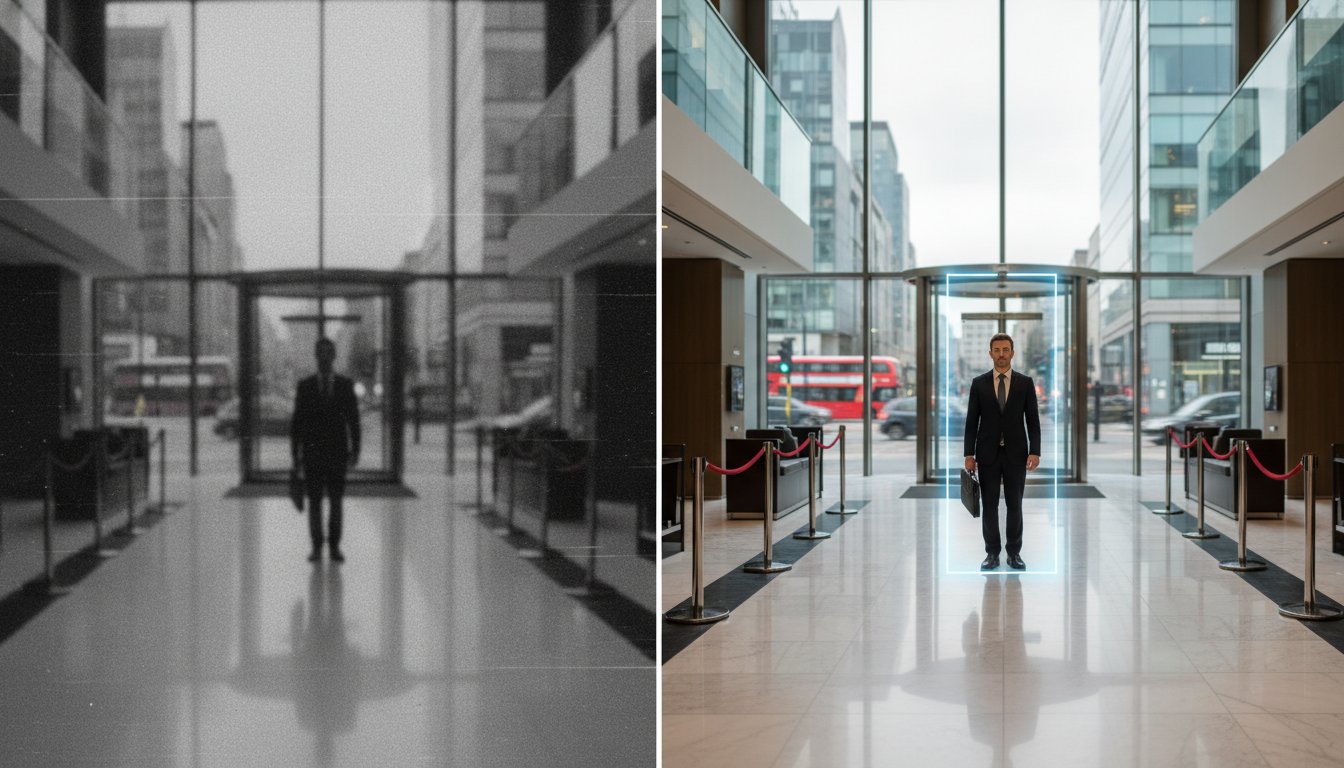
The UK CCTV market is projected to reach $22,816.6 million by 2034, driven by a rapid transition toward intelligent, high-definition systems. If your facility still relies on legacy hardware, you likely face the daily frustration of grainy footage that fails to provide clear identification during critical incidents. You understand the need for better protection, but the prospect of upgrading from analogue to ip cctv often brings concerns about the high cost of new cabling and the fear of significant operational downtime.
We recognise that a security overhaul must be both effective and financially viable for your organisation. This article provides a strategic roadmap for modernising your surveillance through hybrid migration paths that utilise your existing infrastructure. You'll learn how to achieve a high-definition system that aligns with British Standards BS EN 62676 and meets all UK GDPR requirements. We will examine the latest AI-driven analytics and cloud storage options, giving you a clear path toward a more secure and compliant commercial environment.
Key Takeaways
- Understand the transition from passive analogue recording to proactive 4K intelligence for significantly improved suspect identification.
- Learn how upgrading from analogue to ip cctv can be achieved cost-effectively by using hybrid XVR technology to repurpose existing coaxial cabling.
- Ensure your new surveillance system meets essential UK compliance standards, including BS EN 62676 and GDPR data protection requirements.
- Follow a structured, phased roadmap that prioritises high-risk areas to maintain site security while managing your capital expenditure.
- Discover the benefits of integrating your security upgrade with a professional fire risk assessment to ensure a safe and fully compliant commercial premises.
The Limitations of Analogue vs. the Intelligence of IP CCTV
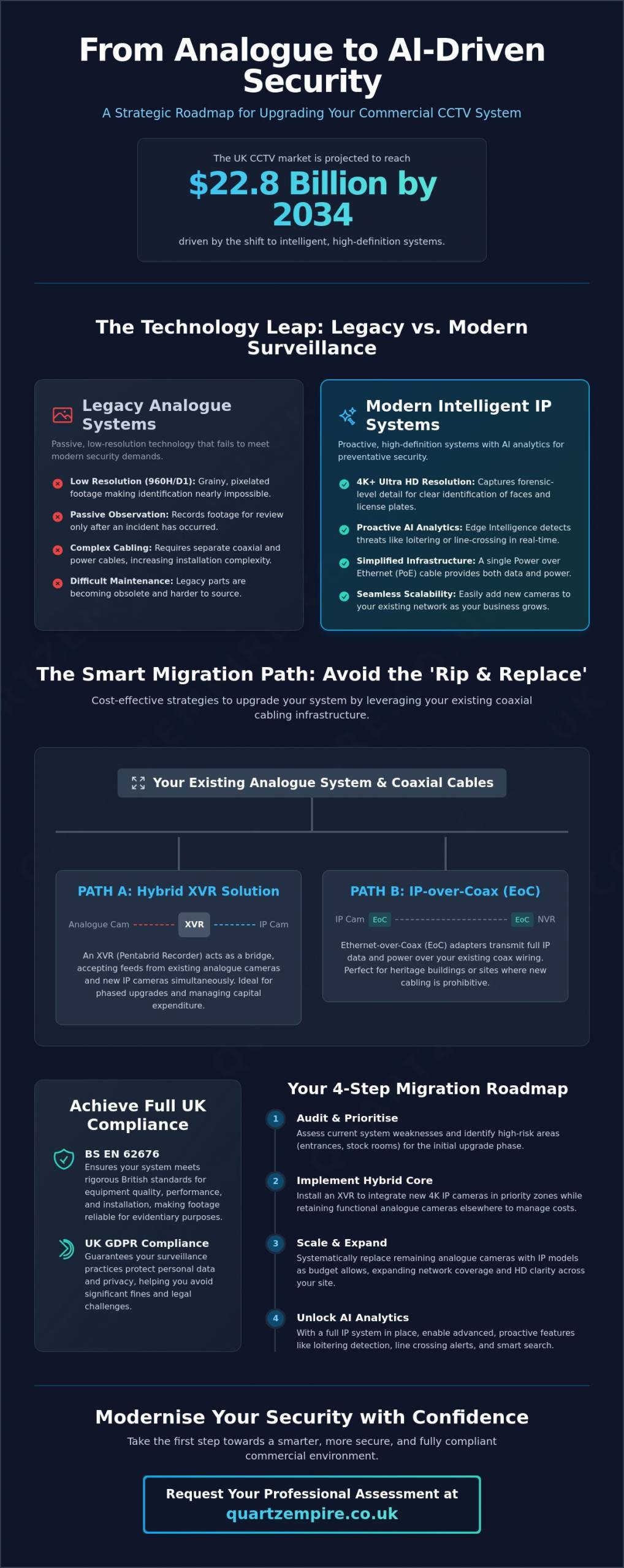
Traditional analogue setups function as passive observers. They capture footage for review after an incident has occurred, but they lack the capability to prevent one or provide intelligent alerts. Transitioning to a modern system through upgrading from analogue to ip cctv changes this dynamic entirely. Instead of a simple lens and a cable, IP camera technology utilises on-board processing known as Edge Intelligence. This allows cameras to analyse a scene in real-time, identifying specific triggers like line crossing, loitering, or suspicious movement without needing constant human monitoring.
The resolution gap is perhaps the most visible difference between these technologies. Older analogue systems typically operate at 960H or D1 resolutions, which often result in pixelated, blurry images when you attempt to zoom in on a face or a number plate. In contrast, IP cameras provide 4K resolution and even higher definitions. This clarity is vital for identification purposes. While an analogue camera might only show a person's silhouette or clothing colour, an IP camera captures facial features and vehicle registrations with forensic precision. Coaxial cables also present physical limitations. They are rigid, only carry video signals, and require separate power lines, whereas modern network cables are far more streamlined and versatile.
Why Analogue Systems Are Failing Modern Business Needs
Maintenance is a growing concern for legacy users. Manufacturers have shifted focus away from older Digital Video Recorders (DVRs), making it harder to find reliable replacement parts. Beyond hardware, the footage itself is often a liability. Grainy SD footage frequently fails to meet the evidentiary standards required in UK courts. Additionally, older systems lack seamless mobile integration. You can't easily check your site from a smartphone, leaving you blind when you're away from the monitor.
The Core Advantages of Moving to an IP Network
Efficiency defines the IP experience. Using Power over Ethernet (PoE), one CAT6 cable handles both data and electricity, simplifying your infrastructure. Digital zoom allows you to enlarge high-detail images without the pixelation common in analogue systems. Scaling is also straightforward since cameras sit on your existing network. This flexibility ensures your commercial CCTV system grows with your business, making upgrading from analogue to ip cctv a strategic investment.
Practical Migration Paths: Upgrading Without the Rip-and-Replace Headache
Many business owners assume a security upgrade requires stripping every existing cable from the walls. This misconception often leads to delayed decisions and increased vulnerability. In reality, upgrading from analogue to ip cctv doesn't have to be a disruptive "rip-and-replace" project. Strategic migration allows you to leverage your current infrastructure while introducing high-definition clarity and intelligent analytics. Reusing coaxial cabling is commercially sensible when the cables are in good health and the cost of installing new CAT6 containment is prohibitive, particularly in heritage buildings or complex industrial sites. Maintaining UK commercial compliance standards ensures that regardless of the migration path chosen, your system remains legally robust and fit for purpose.
The Hybrid Solution: Using XVRs and Encoders
A hybrid approach is often the most logical first step for businesses with large, functional analogue estates. This method relies on XVR technology, also known as Pentabrid recorders. These units feature BNC inputs for your existing analogue cameras and RJ45 ports for new IP additions. If you have specific high-value analogue cameras you wish to keep, video encoders can convert those signals into a digital stream for your Network Video Recorder (NVR). An XVR serves as a technical bridge that translates legacy analogue signals into a digital format while simultaneously hosting native IP cameras. If you are unsure which path suits your building layout, a professional assessment of your commercial CCTV system can identify the most viable route.
IP-over-Coax: High Speed over Old Wires
Ethernet over Coax (EoC) adapters offer a powerful alternative when you want full IP performance without the labour-intensive task of rewiring. These small devices sit at both ends of your existing coaxial run, allowing digital data to travel across the old copper wire. This path provides significant cost savings by avoiding expensive civil works or new cable trays. You should be aware of bandwidth limitations, however. While a single coax run handles one high-definition stream easily, trying to daisy-chain multiple 4K cameras on one old wire can lead to latency. For a successful project, upgrading from analogue to ip cctv via EoC requires a thorough cable health check to ensure the existing copper can handle the increased data load.
Navigating Costs and Commercial Compliance Standards
A common objection among facility managers is the belief that a system is "good enough" as long as the cameras produce an image. However, functional hardware is not the same as a compliant or effective security solution. Legacy systems often fail to meet the rigorous BS EN 62676 requirements, which define the standards for image quality and system performance in the UK. If your footage is too grainy to identify a suspect or cannot be produced in a court-admissible format, the initial savings of keeping an old system are quickly wiped out by the costs of unresolved crime or legal liability.
Modern IP systems provide a more robust framework for meeting the Data Protection Act 2018 and UK GDPR. Digital systems allow for precise privacy masking and secure, encrypted data handling that analogue setups simply cannot match. This level of control is essential for protecting the "Right to Privacy" for staff and visitors. Insurers frequently prefer high-definition IP systems for high-value premises because they significantly reduce the risk of unidentifiable incidents. In many cases, upgrading from analogue to ip cctv can lead to more favourable insurance terms and a stronger position during claim negotiations.
Calculating the Real ROI of an IP Upgrade
While the upfront cost of IP hardware is higher, the total cost of ownership is often lower over a five-year period. Digital systems lack the mechanical wear and tear associated with traditional DVRs, leading to reduced long-term maintenance expenses. You also gain access to "Business Intelligence" features that provide value beyond security. Features such as footfall counting and heat mapping allow you to analyse customer behaviour or staff movements, turning your surveillance into an operational tool. Integrating these features with wider security systems ensures a unified approach to site safety and risk management.
Compliance and Regulatory Adherence in the UK
Professional legitimacy is a cornerstone of a reliable security strategy. When upgrading from analogue to ip cctv, you should ensure your installer holds NSI or SSAIB accreditation. These bodies verify that the installation meets the highest industry standards and that the data handling processes are secure. Modern IP cameras also simplify compliance through built-in software that automates data retention periods, ensuring footage is deleted according to your ICO registration. This meticulous approach to regulation protects your business from the heavy fines associated with data breaches while providing a sense of stability for stakeholders.
A Phased Roadmap for Your Security System Migration
Transitioning your entire facility to a fully digital environment doesn't need to happen overnight. A structured, phased approach allows you to manage budgets effectively while addressing your most immediate security vulnerabilities first. This strategy is particularly vital for businesses operating in London's heritage buildings or the complex industrial sites of Kent and the South East. Structural constraints in these locations often make rapid, site-wide rewiring difficult and costly. By following a clear roadmap, upgrading from analogue to ip cctv becomes a manageable operational task rather than an overwhelming capital expense.
A logical migration typically follows these five critical stages:
- Step 1: Conduct a comprehensive site audit and cable health check.
- Step 2: Prioritise high-risk zones, such as main entrances and cash points, for immediate IP replacement.
- Step 3: Implement a hybrid recording platform to bridge the gap between old and new hardware.
- Step 4: Gradually migrate peripheral cameras as maintenance cycles or budgets allow.
- Step 5: Finalise the move to a fully unified, high-definition IP network.
Phase 1: The Infrastructure Audit
A professional audit is the foundation of any successful migration. We test existing coaxial cables for signal degradation to determine if they can reliably support Ethernet-over-Coax adapters. It's also vital to assess your current network capacity. New IP traffic requires robust switches to prevent lag or system crashes, especially since approximately 43% of UK businesses reported a cybersecurity breach in the last 12 months according to 2026 UK Government data. During this phase, we also identify 'dead zones' that may benefit from integrated access control to ensure every entry point is fully secured and monitored.
Phase 2: Targeted Upgrades for High-Risk Areas
Your initial investment should focus on the perimeter and primary points of entry where the highest level of detail is required. Installing 4K cameras at these locations provides the resolution needed for facial recognition and Automatic Number Plate Recognition (ANPR). These high-risk zones require the proactive intelligence needed to deter intruders before they successfully enter the building. For comprehensive protection, we recommend considering how these cameras integrate with your fire alarm installation. A unified safety system ensures that if a fire alarm is triggered, cameras can automatically pivot to the affected area to provide real-time visual verification for emergency responders.
If you're ready to begin upgrading from analogue to ip cctv, start with a professional assessment to identify your site's specific requirements. Contact our team today to schedule your comprehensive site audit.
Professional CCTV Upgrades in London, Kent, and the South East
Quartz Empire manages the specific logistical hurdles that define the South East's commercial landscape. While a London office might require a discreet installation within a complex heritage layout, a Kent-based industrial unit often presents challenges related to vast perimeters and environmental exposure. We understand these nuances. When upgrading from analogue to ip cctv, our team ensures that the technical solution respects the architectural integrity of your premises while providing maximum coverage. We prioritise official industry recognition to underscore our authority, ensuring every installation aligns with the meticulous standards expected by our commercial clients.
A security overhaul is the ideal time to review your broader safety obligations. We strongly recommend conducting a professional fire risk assessment during the migration process. This holistic approach identifies how new surveillance hardware can assist in fire detection and evacuation monitoring. By evaluating your fire safety and security systems simultaneously, you create a more stable environment for your staff and stakeholders. This integrated strategy ensures that your facility remains compliant with all relevant UK regulations.
Why Local Expertise Matters for South East Businesses
Our presence in London, Kent, and the South East allows for rapid response times that national providers often struggle to match. We don't believe in overcomplicating our services with unnecessary jargon. Our operational philosophy is straightforward, honest, and practical. Whether you're managing a retail space in the City or a warehouse in Dartford, we provide a reliable collaborative relationship focused on long-term safety. We maintain your system through regular servicing, ensuring your investment remains effective and compliant for years to come.
Comprehensive Security and Fire Safety Integration
We provide a unified approach by integrating commercial CCTV systems with intruder alarms and access control. This synergy creates a single point of contact for all your commercial safety needs, reducing administrative burden and ensuring system interoperability. Managing multiple vendors can lead to gaps in protection; we eliminate that risk by overseeing the entire security and fire safety ecosystem. Our meticulous attention to detail ensures that upgrading from analogue to ip cctv serves as the cornerstone of a broader, more intelligent safety strategy.
We invite you to engage with our team for a detailed evaluation of your current infrastructure. Book a site survey today to receive a tailored migration quote that reflects your specific operational requirements and budget.
Secure Your Commercial Future with Modern IP Surveillance
Transitioning to digital surveillance is a strategic necessity for long-term security and regulatory adherence. A phased roadmap allows you to manage the process of upgrading from analogue to ip cctv without the immediate burden of a full infrastructure replacement. High-definition clarity and proactive intelligence provide the forensic detail required to meet modern UK standards and insurance expectations. These systems do more than record events; they provide the actionable data needed to protect your assets and personnel effectively.
Quartz Empire is an accredited fire and security provider specialising in complex commercial system integration. Our expert installers serve businesses across London and Kent, providing the technical knowledge needed to bridge the gap between legacy hardware and modern networks. We maintain a straightforward and practical approach to ensure your facility remains safe, stable, and fully compliant with BS EN 62676. You can rely on our meticulous attention to detail to guide your migration from start to finish.
Request a Professional CCTV Migration Survey to begin your site-specific audit. We're ready to help you establish a more secure and stable foundation for your business operations.
Frequently Asked Questions
Can I use my existing analogue cameras with a new IP recorder?
Yes, you can integrate your current cameras by using a hybrid XVR, also known as a Pentabrid recorder. These devices feature BNC ports for legacy cameras and RJ45 ports for modern digital units. This equipment is essential when upgrading from analogue to ip cctv in a phased manner, allowing you to maintain security while managing your budget.
How much more expensive is IP CCTV compared to analogue?
Initial hardware costs for IP systems are typically higher than basic analogue alternatives. However, digital systems offer a better return on investment through reduced maintenance needs and the ability to use existing network infrastructure. The total cost of ownership often balances out over time because IP systems are more scalable and provide superior evidentiary detail.
Do I need to replace all my cables to upgrade to IP CCTV?
You don't necessarily need to replace your entire cabling infrastructure. Ethernet over Coax (EoC) adapters allow high-definition digital signals to travel across your existing copper wires. This approach is a cost-effective way of upgrading from analogue to ip cctv in buildings where installing new CAT6 containment is physically difficult or commercially prohibitive.
What is the main difference between a DVR and an NVR?
A DVR processes video data at the recorder itself after receiving an analogue signal. In contrast, an NVR receives a digital stream that has already been encoded at the camera level. This shift allows NVRs to handle much higher resolutions and more complex AI analytics, such as facial recognition and automatic number plate detection.
Is an IP CCTV system more likely to be hacked than an analogue one?
IP systems aren't inherently less secure, provided they're installed by an accredited professional. Modern cameras use encrypted protocols and secure authentication to prevent unauthorised access. While analogue systems don't sit on a network, they're often more vulnerable to physical interception of the unencrypted video signal.
How long does it take to migrate a medium-sized office from analogue to IP?
A typical migration for a medium-sized office usually takes between three to five business days. The exact duration depends on the complexity of the building layout and whether you're reusing existing cables or installing new network lines. A phased roadmap ensures that your site remains protected throughout the transition period.
Will upgrading to IP CCTV lower my commercial insurance premiums?
High-definition IP systems are often viewed favourably by insurers because they provide clearer evidence for investigations. While premium reductions depend on your specific provider, a system that meets BS EN 62676 standards demonstrates a commitment to risk management. This professional legitimacy can lead to more competitive terms during your next policy renewal.
Can IP cameras work over long distances like my old analogue ones?
IP cameras can cover significantly longer distances than analogue systems when configured correctly. Standard network cables have a 100-metre limit, but you can extend this to several kilometres using PoE extenders or fibre optic links. Unlike analogue signals, digital streams don't suffer from image degradation as the cable length increases.