
Understanding BS 5839-1: A Guide to Fire Alarm Compliance for Businesses

For any UK business owner, ensuring fire safety is a critical responsibility, yet the regulations can feel like a minefield of technical jargon and legal obligations. If terms like 'categories', 'grades', and 'zones' leave you feeling confused, or you're worried about the severe consequences of non-compliance, you are not alone. This is where a clear understanding of bs 5839 1 becomes essential-it is the UK's definitive code of practice for the design, installation, commissioning, and maintenance of fire alarm systems in commercial properties.
But you don't need to be an expert to grasp what's required. In this no-nonsense guide, we cut through the complexity to give you clarity and confidence. We will explain your specific legal duties, what the different system categories mean for your premises, and how to ensure your maintenance schedule is fully compliant. By the end, you will understand your role in routine testing and be equipped to choose a reliable, accredited partner for your fire safety needs, securing complete peace of mind.
Key Takeaways
- Understand why compliance with bs 5839 1 is not just best practice, but a legal necessity for protecting your people, property, and business.
- Learn the crucial distinction between L-Systems (Life Protection) and P-Systems (Property Protection) to ensure you select the right category for your premises.
- Identify your specific responsibilities as the designated 'Responsible Person', including the vital routine fire alarm checks you are required to oversee.
- Discover what 'competence' means under the standard and how to choose a certified, reliable partner for the design, installation, and maintenance of your system.
What is BS 5839-1 and Why Does It Matter for Your Business?
In the UK, ensuring the safety of your premises from fire is not just a moral duty; it's a legal requirement. At the heart of this responsibility lies BS 5839-1, the definitive code of practice for the design, installation, commissioning, and maintenance of fire detection and fire alarm systems in non-domestic buildings. Its core purpose is threefold: to protect life, safeguard property, and ensure business continuity in the event of a fire.
While BS 5839-1 is a British Standard and not a piece of legislation itself, it serves as the benchmark for compliance with the law. Adhering to its guidelines is the most effective way to demonstrate due diligence and meet your obligations under the Regulatory Reform (Fire Safety) Order 2005. For any business owner or Responsible Person, understanding and implementing the recommendations of bs 5839 1 is critical for validating insurance policies and providing a robust legal defence should an incident occur.
The Scope of the Standard: Who Needs to Comply?
The standard applies to a vast range of non-domestic and commercial properties, whether it involves a brand-new installation or modifications to an existing system. According to the foundational guidelines of BS 5839 Part 1, if you are responsible for any of the following types of premises, you need to be compliant:
- Offices and retail shops
- Factories and warehouses
- Schools, colleges, and hospitals
- Hotels and entertainment venues
It is important not to confuse this standard with BS 5839-6, which specifically covers fire alarm systems within domestic dwellings.
The Real-World Consequences of Non-Compliance
Failing to adhere to the standard can have severe and far-reaching consequences. For the designated Responsible Person, this can lead to significant fines, legal action, and in the most serious cases, imprisonment. Beyond the legal penalties, non-compliance poses a major financial risk. In the aftermath of a fire, insurers will scrutinise your system's compliance; a failure to meet the standard can be grounds for invalidating your claim, leaving you to cover the devastating costs. Most importantly, there is the immeasurable cost of reputational damage and the moral failure of not adequately protecting your staff, visitors, and customers.
The Four Pillars of BS 5839-1: Design, Installation, Commissioning & Maintenance
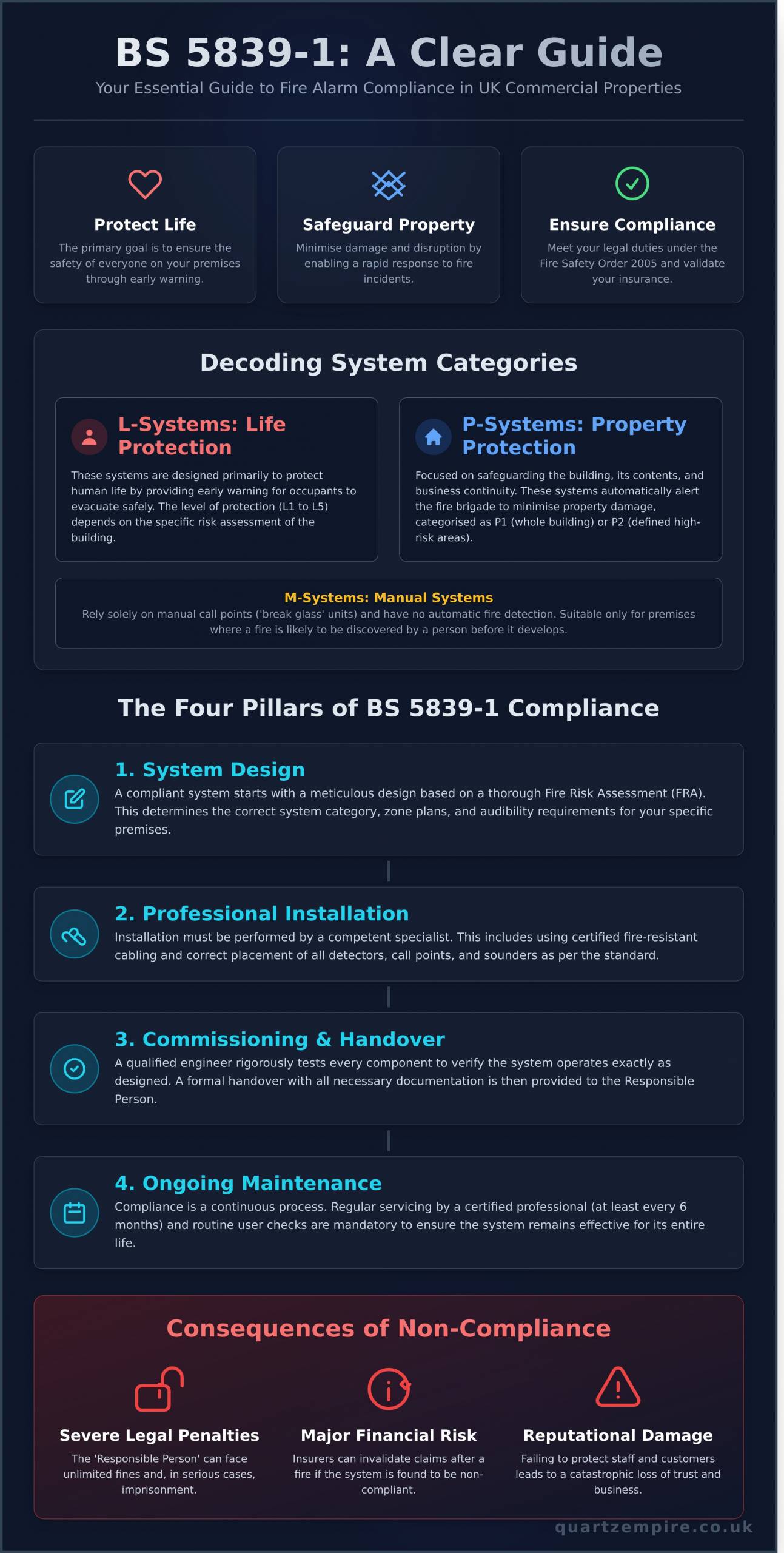
Achieving compliance with bs 5839 1 is not a single event but a continuous process built on four essential pillars. This standard outlines a complete lifecycle for a fire alarm system, ensuring it is not only fit for purpose on day one but remains reliable and effective for its entire operational life. Each stage demands the expertise of a competent, certified professional to guarantee the system's integrity.
This structured framework provides a clear, auditable path to protecting your people and property, transforming a complex requirement into a manageable process. By adhering to these four pillars, you create a robust safety system that meets legal obligations and provides genuine peace of mind.
Pillar 1: System Design
A compliant fire alarm system begins with a meticulous design, which must be based on a thorough and current Fire Risk Assessment (FRA). The design process determines the appropriate system category needed for the premises-whether it's a Category L system for life protection, a Category P system for property protection, or a Category M manual system. Further considerations, such as the creation of clear zone plans and ensuring audibility levels meet required standards, are critical at this foundational stage.
Pillar 2: Professional Installation
The standard mandates that installation must be carried out by a competent person with specialist knowledge of fire alarm systems. This involves more than just connecting wires; it requires adherence to strict guidelines for cabling, such as using certified fire-resistant cables to ensure the system can function during a fire. The correct placement of detectors, manual call points, and alarm sounders is vital for early detection and effective warning, all of which are detailed within the official BS 5839-1 standard.
Pillar 3: Commissioning and Handover
Commissioning is the final verification stage where a qualified engineer rigorously tests every component of the new system to confirm it operates exactly as designed. Upon successful commissioning, a formal handover takes place. It is essential that the building's responsible person receives all necessary documentation to manage the system effectively. This includes:
- A BS 5839-1 commissioning certificate
- A system logbook for recording all tests and maintenance
- An accurate "as-fitted" zone plan
- Operating and maintenance manuals
Pillar 4: Ongoing Maintenance
A fire alarm system is a life-saving device that requires regular attention. The bs 5839 1 standard mandates a schedule of periodic inspection and servicing to ensure the system remains fully operational. This typically involves entering into a formal maintenance contract with a qualified fire safety provider. Regular professional servicing identifies potential faults before they become critical, ensuring your system is always ready to respond. Our accredited engineers ensure your system remains compliant year-round.
Decoding System Categories: L-Systems, P-Systems, and M-Systems
Once you understand the Grade of a fire alarm system, the next critical element defined by bs 5839 1 is its Category. The Category dictates the system's primary objective and the level of coverage required within the building. Your legal obligation is to install a system that is appropriate for the risks present, and this is determined by a thorough fire risk assessment.
The distinction is crucial: is the system there primarily to protect people or to protect the building and its contents? A simple way to remember the difference is:
- L is for Life: The main goal is to give occupants an early warning to evacuate safely.
- P is for Property: The main goal is to alert the fire and rescue service quickly to minimise damage.
Life Protection Systems (Category L)
Category L systems are the most common in commercial and public buildings, as the protection of human life is paramount. Their sole purpose is to provide a warning early enough for everyone to escape. The categories are graded from L1 (maximum protection) to L5 (localised protection).
- L1 (Maximum Life Protection): Automatic fire detectors are installed in all areas of the building. Example: A residential care home where early detection in any room is critical.
- L2: Detectors are placed in all escape routes and rooms defined as high risk. Example: A hotel, with coverage in corridors and high-risk areas like kitchens.
- L3: Coverage includes escape routes and any rooms that open directly onto them. Example: A standard office building, ensuring main exit paths are protected.
- L4: Detectors are installed only within escape routes and circulation areas. Example: A low-risk building where a fire in a room would not impede escape.
- L5 (Localised Life Protection): A bespoke solution where detection is only required in a specific high-risk area to protect life. Example: Protecting the escape route from a hazardous boiler room.
Property Protection Systems (Category P)
Category P systems are designed to protect the property itself by ensuring the earliest possible detection of a fire. This facilitates a rapid response from the fire brigade, helping to limit damage to the building, its contents, and business operations. The official BS 5839-1:2025 standard outlines two levels for property protection.
- P1: Automatic fire detectors are installed in all areas of the building to ensure the earliest possible warning. Example: A critical data centre or a warehouse storing high-value, irreplaceable goods.
- P2: Detectors are installed only in defined parts of the building identified as high risk. Example: Protecting specific server rooms or manufacturing areas within a larger, lower-risk facility.
Manual Systems (Category M)
Category M systems are the most basic and rely entirely on human intervention. They consist solely of manual call points (the red 'break glass' units) and have no automatic fire detectors. These systems are only suitable for premises where a fire is likely to be discovered by an occupant before it can become a threat, and where people are always present. In most commercial settings, a Category M system will supplement a more comprehensive L or P system rather than stand alone.
Your Responsibilities as the 'Responsible Person'
Under the UK's Regulatory Reform (Fire Safety) Order 2005, every non-domestic premises must have a designated 'Responsible Person'. This is typically the business owner, employer, or anyone with control over the building or its activities. A key part of this role is the day-to-day management of the fire alarm system. While professional servicing is essential, the routine checks you perform are a mandatory part of maintaining compliance and ensuring the system is ready to activate in an emergency. These responsibilities ensure the system remains fully operational between expert visits.
Routine User Checks: Weekly & Monthly Tasks
The guidance in bs 5839 1 outlines several simple but critical tasks for the user. Every week, during normal working hours, you should operate at least one manual call point to test the system. It is important to test a different call point each week to cycle through all of them. You should also perform a weekly visual check of the main control panel to ensure there are no fault lights showing. If your system has vented batteries, a monthly check by a trained user may also be required.
The Fire Alarm Log Book: Your Proof of Compliance
Maintaining a detailed fire alarm logbook is a legal requirement and your primary evidence of due diligence. This document must be kept on-site, typically near the main control panel, and be available for inspection by the fire and rescue service at any time. Your logbook must accurately record all system events, including:
- The date and time of all weekly tests.
- Any faults that occur and the action taken to resolve them.
- Details of all professional service visits and maintenance work.
- Any false alarms and their suspected causes.
Arranging Professional Servicing
In addition to your own checks, your fire alarm system must be professionally serviced by a competent and certified company at least every six months. During these visits, engineers will perform in-depth checks that go beyond user tests, including inspecting detectors, testing batteries, verifying control panel functionality, and ensuring the entire system meets required standards. This expert maintenance is crucial for the long-term reliability of your fire protection. To ensure your system remains compliant and effective, you must partner with a trusted provider. Schedule your bi-annual fire alarm service with our certified team to guarantee peace of mind.
How to Choose a Competent Fire Alarm Company
The British Standard bs 5839 1 repeatedly stresses that all work on a fire detection and alarm system-from initial design to ongoing maintenance-must be carried out by a 'competent' person or company. Competence is not a vague term; it is a measurable combination of specialist training, verifiable experience, and access to the correct tools and testing equipment required for the job.
While many general electricians are highly skilled, they may lack the specific, in-depth knowledge of fire alarm system design, installation, and commissioning protocols. The complexities of system grading, zoning, and certification demand a specialist. Entrusting this critical life safety system to a non-specialist can lead to non-compliance, system faults, and ultimately, a failure to protect your people and property.
The Importance of Third-Party Accreditation
The most straightforward way to verify a company's competence is through third-party accreditation. In the UK, key bodies like BAFE (British Approvals for Fire Equipment), NSI (National Security Inspectorate), and SSAIB (Security Systems and Alarms Inspection Board) provide this assurance. These organisations independently audit fire safety providers against the stringent requirements of BS 5839-1, ensuring they have the processes, skills, and quality management systems in place. Choosing an accredited firm is a clear demonstration of your due diligence.
Key Questions to Ask a Potential Provider
Before engaging any fire alarm company, you should ask several key questions to confirm their suitability. A professional and competent provider will be able to answer these confidently and provide evidence.
- Are you BAFE SP203-1 certified for all four modules? This scheme covers the entire lifecycle of a fire alarm system: Design, Installation, Commissioning/Handover, and Maintenance. Certification across all four modules shows comprehensive expertise.
- Can you provide evidence of adequate insurance? Your chosen provider must hold relevant insurance, including Public Liability and, crucially, Professional Indemnity insurance, which covers errors in design or advice.
- Will I receive all the required BS 5839-1 certificates upon completion? A compliant installation must be supported by official documentation, including separate certificates for design, installation, and commissioning. You must receive these for your records.
Making the right choice of provider is fundamental to achieving a compliant and reliable fire alarm system. As a fully accredited and certified company, Quartz Empire provides expert services across Kent, London, and the South East. To ensure your system is managed by a competent and trusted partner, contact our team today.
Secure Your Compliance: Your Final Steps with BS 5839-1
Navigating fire safety regulations can seem complex, but the key takeaways are clear. Adherence to this code of practice is not merely a suggestion-it is the definitive framework for protecting your people, property, and meeting your legal obligations. As the designated 'Responsible Person', understanding your duties across the entire lifecycle, from system design to ongoing maintenance, is paramount. Ultimately, ensuring your system is fully compliant with bs 5839 1 requires a partnership with a competent and certified expert who can manage every detail with precision.
At Quartz Empire, we provide that essential expertise. As BAFE SP203-1 accredited fire alarm specialists, we are the trusted partner for businesses across Kent, London, and the South East, delivering the peace of mind that comes from a fully compliant and reliable system. Our no-nonsense approach means we handle the complexities of fire alarm design, installation, and maintenance, allowing you to focus on your core operations with complete confidence in your safety measures.
Ensure your business is compliant. Contact our experts for a free assessment.
Take the decisive step towards safeguarding your business today.
Frequently Asked Questions About BS 5839-1
Is BS 5839-1 a legal requirement in the UK?
While BS 5839-1 itself is a code of practice and not legislation, it is the recognised British Standard for commercial fire alarm systems. Adhering to it is the primary way to demonstrate compliance with the legal duties outlined in the Regulatory Reform (Fire Safety) Order 2005. A fire risk assessment will determine if a system is required, and if so, following this standard is essential to protect your premises and avoid potential legal consequences.
What is the difference between BS 5839-1 and BS 5839-6?
The key distinction lies in the type of property each standard covers. BS 5839-1 provides detailed recommendations for the design, installation, and maintenance of fire detection and alarm systems in non-domestic, commercial premises such as offices, schools, and factories. Conversely, BS 5839-6 is the code of practice for fire alarm systems in domestic buildings, including individual dwellings, HMOs, and blocks of flats, with different grading systems tailored for residential environments.
How often does a commercial fire alarm system need to be serviced according to BS 5839-1?
BS 5839-1 recommends that a competent and accredited professional services your commercial fire alarm system at least every six months. For larger or higher-risk environments, your fire risk assessment may specify more frequent quarterly inspections. These regular checks are crucial to ensure all components are functioning correctly, providing reliable protection for your people and property. This proactive maintenance is vital for ensuring system integrity and full compliance with fire safety regulations.
What is a fire alarm zone plan and why is it important?
A fire alarm zone plan is a clear diagrammatic representation of your building, located next to the main fire alarm panel. It illustrates the different detection zones, allowing emergency services to quickly identify the exact location of a fire upon activation. This is a critical requirement of the bs 5839 1 standard because it saves invaluable time in an emergency, enabling a faster response to protect lives and minimise potential damage to your property.
Does BS 5839-1 apply to my small office or shop?
Yes, the standard applies to almost all non-domestic premises, irrespective of their size. Whether you operate a small retail shop, a local office, or a workshop, your fire alarm system should be designed and maintained in accordance with BS 5839-1. The specific category of system required will be determined by your Fire Risk Assessment, which evaluates the level of risk and dictates the necessary protection to ensure your business remains safe and legally compliant.
What are the main changes in the latest version of BS 5839-1?
The latest version, BS 5839-1:2017, introduced several important updates to improve safety and reduce unwanted activations. Key changes include revised guidance on the use of multi-sensor detectors to minimise false alarms and specific recommendations for installing manual call points on stairways. It also clarified requirements for staff training and record-keeping. Working with an expert provider ensures your system is fully compliant with all current standards, giving you complete peace of mind.