
Reducing Fire Alarm False Call Outs: A Guide for UK Businesses

Did you know that the London Fire Brigade currently charges £348 plus VAT for every false alarm they attend at certain properties after the tenth call out within a rolling twelve month period? For many UK businesses, reducing fire alarm false call outs is no longer just a matter of convenience; it's a financial and operational necessity. You understand that every unnecessary evacuation disrupts productivity. More dangerously, it breeds a culture of complacency where staff begin to ignore the signals meant to protect them.
We believe your fire safety system should provide total peace of mind, not a list of avoidable expenses and logistical headaches. This guide will show you how to eliminate unwanted fire signals and ensure your business remains fully compliant with BS 5839-1 standards through accredited maintenance strategies. We will outline the specific technical adjustments and management protocols required to transform your system into a reliable asset that only triggers when a genuine threat exists.
Key Takeaways
- Understand the financial burden of Unwanted Fire Signals (UwFS) and how they impact your business productivity and operational downtime.
- Identify the most common technical and environmental triggers to begin reducing fire alarm false call outs across your premises.
- Learn the benefits of transitioning from reactive repairs to a preventative maintenance schedule to ensure full compliance with BS 5839-1.
- Establish "no-nonsense" staff protocols and management training to handle system resets effectively and prevent avoidable human error.
- Recognise why BAFE accreditation is a non-negotiable requirement when choosing a trusted partner for fire safety in London and Kent.
The Impact of Unwanted Fire Signals (UwFS) on Your Business
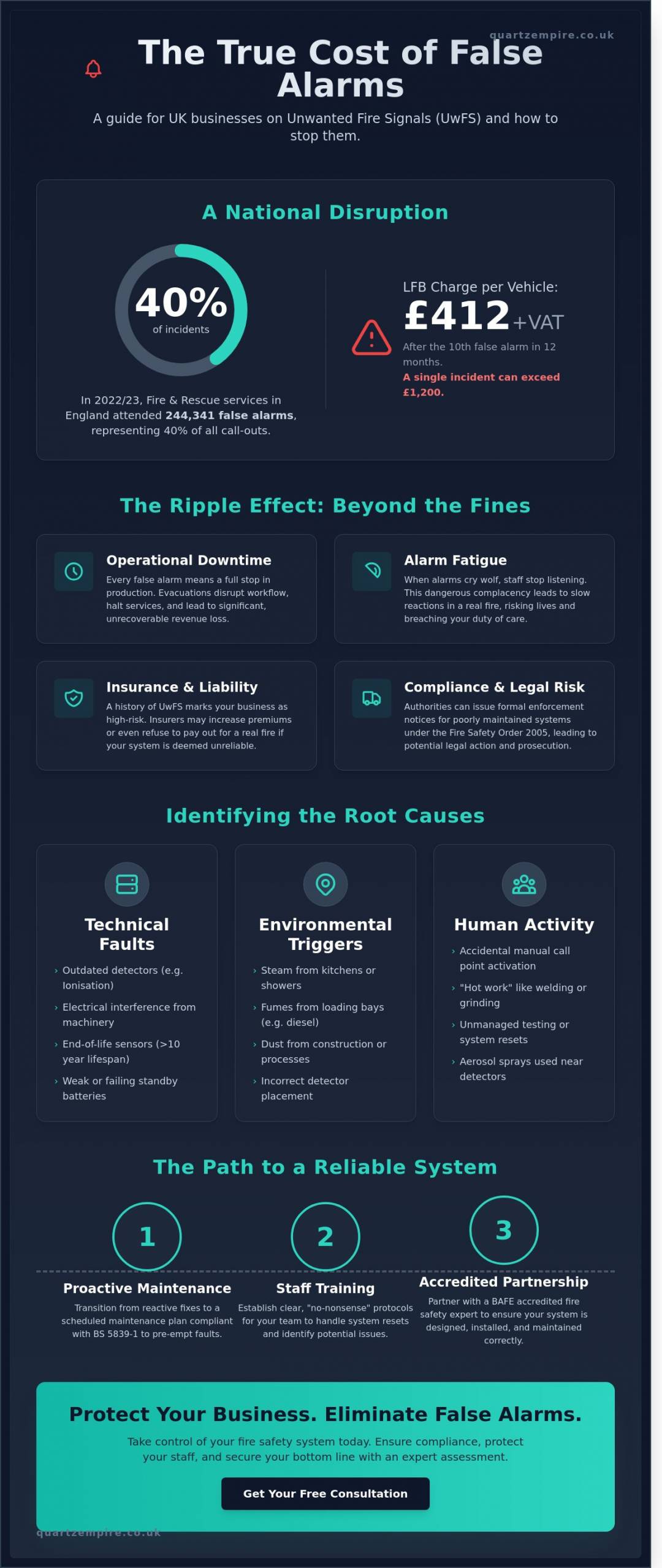
An Unwanted Fire Signal (UwFS) is any fire alarm activation that isn't caused by a real fire. While a genuine alert protects your assets, a UwFS does the opposite. In the 2022/23 financial year, fire and rescue services in England attended 244,341 false alarms. This represents about 40% of all incidents they responded to. For a business, this isn't just a loud noise. It's a stop in production, a break in service, and a loss of revenue. Identifying the common causes of false alarms helps you take control of your site's safety. Quartz Empire focuses on reducing fire alarm false call outs to ensure your operations remain profitable and your staff stay safe.
The London Fire Brigade (LFB) and Kent Fire and Rescue Service (KFRS) have changed how they respond to automatic fire alarms to manage their resources better. In many cases, they won't attend certain commercial premises unless a fire is confirmed by a person on-site. This puts the burden of verification on your team. If your system is prone to errors, you risk missing a real emergency while your staff assumes it's just another technical glitch.
Fines and Penalties for Frequent Call Outs
Fire services are taking a stricter stance on persistent offenders. The London Fire Brigade currently charges for attendance at false alarms in certain non-domestic buildings after the tenth call-out within a 12-month period. As of 2024, this charge stands at £412 plus VAT per vehicle. If three engines are dispatched, the bill exceeds £1,200 for a single mistake. Beyond these direct costs, the Fire Safety Order 2005 allows authorities to issue formal enforcement notices for poorly maintained systems. A poor fire safety record also impacts your commercial insurance. Insurers may increase premiums or even refuse to pay out if a real fire occurs and your system is deemed unreliable due to a history of UwFS.
The Psychology of Alarm Fatigue
Alarm fatigue is a dangerous psychological state where employees become desensitised to the sound of the siren. When false alarms happen regularly, staff often wait for confirmation before evacuating. This delay is fatal in a real emergency. Building managers have a legal duty to ensure safe evacuation under the Regulatory Reform (Fire Safety) Order 2005. Ignoring the risk of complacency can lead to criminal prosecution. Rebuilding trust requires a "no nonsense" approach to maintenance. By investing in certified upgrades and reducing fire alarm false call outs, you prove to your team that their safety is your priority. Reliable systems ensure that when the alarm sounds, your people move immediately.
Identifying the Primary Causes of False Fire Alarms
Understanding the root causes of system triggers is essential for reducing fire alarm false call outs. According to the Home Office, false alarms accounted for 38% of all incidents attended by Fire and Rescue Services in England for the year ending March 2023. These events aren't just disruptive; they lead to "alarm fatigue" where staff begin to ignore genuine warnings. Most issues stem from a handful of predictable areas including technical failure, environmental interference, and human error.
Common Technical Faults in Commercial Systems
Reliability starts with the hardware. Outdated ionisation detectors are a frequent culprit. These sensors use a small radioactive source to detect invisible combustion particles, but they're notoriously prone to triggering from non-fire sources like heavy steam. Modern systems often favour optical or multi-sensor technology for better discrimination.
- Electrical Interference: Poorly shielded wiring can pick up "noise" from heavy machinery or LED lighting circuits, causing the control panel to report phantom faults.
- End-of-Life Detectors: Most smoke detectors have a lifespan of 10 years. After this point, the internal sensing chamber becomes contaminated, leading to increased sensitivity.
- Battery Maintenance: Weak standby batteries can cause voltage drops that confuse the control panel, often resulting in a full alarm state during a minor power fluctuation.
Environmental and Activity-Based Triggers
The physical environment plays a massive role in system stability. If a sensor is placed directly outside a shower room or above a toaster, it's doing its job too well. Identifying "problem zones" like loading bays, where diesel fumes can trigger optical sensors, is a vital part of effective system design. You might find that working with an accredited fire safety partner helps identify these risks during a professional site survey.
Activity on-site also demands strict management. "Hot work" during building renovations, such as welding or grinding, creates fine dust and heat that mimics a fire. Without proper isolation of the specific zone, the system will inevitably trigger. Insects also cause issues; small spiders often crawl into the sensing chambers of optical detectors during the autumn months, blocking the light beam and activating the alarm.
Staff habits remain a factor too. Poor ventilation in staff rooms during lunch hours or accidental damage to call points in high-traffic corridors contribute significantly to the 242,471 false alarms recorded annually in England. By addressing these environmental and human factors, businesses can significantly cut down on the reducing fire alarm false call outs and maintain a more productive workplace.
Implementing a Proactive Maintenance Strategy
UK businesses often fall into the trap of reactive maintenance, only addressing issues once a fault light appears or a false alarm occurs. This approach is inherently flawed. It leads to higher long-term costs and compromises the safety of your occupants. Shifting to a preventative schedule is the most effective method for reducing fire alarm false call outs across your commercial property portfolio.
Compliance with BS 5839-1 Standards
Compliance with BS 5839-1 is the foundation of fire safety. A professional six-monthly service must involve testing detectors, call points, and sounders to ensure the entire system functions as designed. The "Responsible Person" within your organisation must also conduct weekly tests to confirm the panel communicates correctly with the devices. These routines aren't just bureaucratic exercises; they prevent the accumulation of minor system faults that eventually cause catastrophic failures. Accredited maintenance provides the peace of mind that your system meets the highest safety standards and remains reliable year-round.
The Shift to Multi-Sensor Technology
Legacy hardware remains a primary cause of false alarms. Old ionisation or optical detectors cannot always distinguish between real smoke and steam or dust. Modern multi-sensor technology uses complex algorithms to analyse heat and smoke patterns simultaneously. This technology reduces the risk of alarms triggered by non-fire events by a significant margin. While the initial cost of upgrading to analogue addressable systems is higher, the ROI is clear. You'll avoid the £350 to £600 fines often levied by fire authorities for persistent false call outs. Pinpointing the exact location of a fault on an addressable panel saves hours of engineer diagnostic time, further protecting your bottom line and maintaining a no-nonsense approach to safety.
Staff Training and Management Protocols
Technology alone cannot solve the issue of unwanted alarms. The London Fire Brigade (LFB) reports that over 90% of automatic fire alarms are false; a statistic that highlights the urgent need for better human intervention. Reducing fire alarm false call outs requires a disciplined, no-nonsense approach to safety management. This starts with moving away from a culture where alarms are ignored or viewed as a nuisance. Every employee must understand that a false activation isn't just an inconvenience. It wastes emergency resources and risks a fine under the Localism Act 2011, which allows fire authorities to charge for repeated false call outs.
Accountability is the most effective deterrent for accidental activations. If a staff member triggers a manual call point through negligence, it should be investigated with the same rigour as a health and safety breach. Establishing clear protocols for resetting the system is equally vital. Only authorised personnel, such as a trained Fire Marshal, should reset the panel after a confirmed false alarm. This prevents the "reset and forget" habit that often hides underlying system faults.
Effective Fire Marshal Training
Fire Marshals act as the first line of defence against unnecessary brigade attendance. Professional training must focus on the crucial investigation period. Most modern panels, compliant with BS 5839-1, allow for a pre-alarm or investigation delay of up to several minutes. During this window, Marshals must quickly identify the difference between a system fault, indicated by a yellow LED, and a genuine fire signal, indicated by a red LED. If the cause is clearly non-emergency, such as steam or burnt food, the Marshal must communicate immediately with your Alarm Receiving Centre (ARC) to abort the call before the Fire Service is dispatched.
Managing On-Site Contractors
Ensure your team is fully equipped to manage your system by partnering with an accredited provider. Contact Quartz Empire Fire & Security Ltd to discuss professional staff training and system maintenance.
Partnering with Accredited Experts in London and Kent
BAFE SP203-1 accreditation is the industry gold standard that every UK business owner should look for. It isn't just a badge; it's a guarantee of technical competence across design, installation, commissioning, and maintenance. Choosing a non-accredited contractor is a significant risk that often leads to substandard work and recurring system faults. Third-party certification ensures that the engineers working on your life safety systems are regularly audited and remain fully compliant with BS 5839-1 standards. This level of expertise is vital for reducing fire alarm false call outs, as it ensures every sensor and control panel is fit for purpose and correctly configured for your specific environment.
Quartz Empire Fire & Security Ltd operates as a trusted partner for commercial clients who demand reliability. We don't just fix symptoms; we solve the root causes of system instability. Our no-nonsense approach to fire safety means you get clear, actionable advice without the jargon. By focusing on high-quality components and precise engineering, we provide the peace of mind that your premises are protected 24/7 without the disruption of unnecessary alarms.
The Value of Regional Expertise
Operating across the South East requires a deep understanding of local fire authority policies. For example, the London Fire Brigade (LFB) updated its policy in October 2024. They now no longer attend automatic fire alarms in most commercial buildings unless a fire is confirmed by a person on-site. This shift makes a reliable, well-maintained system more critical than ever before. If your system triggers a false alarm, the burden of verification and safety falls entirely on your shoulders.
Our local presence in Kent and London ensures we can offer rapid emergency response times that national providers simply cannot match. We understand the specific requirements of both the LFB and Kent Fire and Rescue Service. This regional knowledge helps us maintain your system's uptime and ensures you stay on the right side of local enforcement. We pride ourselves on the personal touch; you aren't just a contract number to us, but a local business we're committed to protecting.
Developing Your False Alarm Reduction Plan
We begin every partnership by auditing your current hardware to find hidden technical weaknesses. Many systems suffer from "zombie" detectors or sensors that are poorly placed near kitchens, bathrooms, or industrial machinery. Our engineers identify these environmental triggers and recommend smarter solutions, such as multi-sensor detectors that can distinguish between burnt toast and a real fire. This technical precision is the most effective strategy for reducing fire alarm false call outs in complex commercial settings.
Our customised maintenance contracts are designed to scale with your business. Whether you manage a single retail unit in Maidstone or a large office complex in Central London, we tailor our frequency of visits to your risk profile. The first step toward a more reliable system is booking a comprehensive fire risk assessment. This review identifies physical and procedural gaps in your safety strategy, ensuring you meet your legal obligations under the Regulatory Reform (Fire Safety) Order 2005.
Don't let false alarms compromise your site's safety or lead to costly fire brigade charges. Contact our expert team today for a system review and take control of your fire protection strategy.
Secure Your Business with Proactive Fire Safety
Unwanted Fire Signals (UwFS) aren't just a minor inconvenience. They cost the UK economy an estimated £1 billion annually according to data from the Fire Industry Association. You'll prevent these costly interruptions by implementing rigorous staff training and identifying environmental triggers before they cause a problem. Maintaining full BS 5839-1 compliance is the most reliable method for reducing fire alarm false call outs and protecting your business operations. Quartz Empire brings a no-nonsense approach to safety across London, Kent, and the South East. Our accredited experts ensure your systems are dependable and legally compliant. We're here to help you move from reactive fixes to a professional strategy that guarantees peace of mind. It's time to take control of your fire safety protocols with a partner you can trust.
Book a No-Nonsense Fire Alarm Maintenance Review
Frequently Asked Questions
What is the most common cause of false fire alarms in offices?
The most common cause of false fire alarms in UK offices is poor maintenance combined with environmental factors like dust or steam. Data from the Home Office indicates that 48% of all incidents attended by Fire and Rescue Services in the year ending September 2023 were false alarms. These often occur when sensors aren't cleaned regularly, causing them to mistake small particles for smoke.
Can the Fire and Rescue Service charge my business for a false alarm?
Yes, the Fire and Rescue Service can charge your business for persistent false alarms. For example, the London Fire Brigade currently charges £350 plus VAT for every false call out after the ninth occurrence at the same premises within a 12-month window. These costs are designed to recover expenses and encourage businesses to prioritise reducing fire alarm false call outs through better system management.
How often should my fire alarm system be serviced to prevent faults?
You must have your fire alarm system serviced at least every six months to comply with BS 5839-1 standards. Our certified engineers recommend this frequency to identify component wear and prevent faults before they trigger an alarm. Regular maintenance ensures your system remains compliant and reduces the risk of expensive, disruptive false activations that affect your daily operations.
What is an "investigation period" on a fire alarm panel?
An investigation period is a pre-set delay on your fire alarm panel that allows staff to verify a fire before the full alarm sounds or the fire brigade is called. This delay typically lasts between 2 and 5 minutes. It's a highly effective strategy for reducing fire alarm false call outs because it provides a window to identify non-fire events like burnt toast or steam.
Do I need to replace my whole system to stop false alarms?
You rarely need to replace an entire system to stop false alarms. Often, the issue is resolved by replacing outdated ionisation detectors with modern multi-sensor alarms that distinguish between steam and smoke. Our expert team can assess your current setup and suggest targeted upgrades to specific components, ensuring your property is protected without the cost of a full installation.
What should I do if my fire alarm keeps beeping but there is no smoke?
A beeping alarm usually indicates a system fault or a low battery rather than a fire emergency. You should check your fire alarm control panel immediately to identify the specific error message, such as a "power failure" or "detector fault." If the beeping persists, contact an accredited technician to clear the fault and ensure your system remains fully operational and compliant.
How can I prevent steam from the office kitchen triggering the alarm?
You can prevent steam from triggering alarms by replacing smoke detectors in kitchen areas with dedicated heat detectors. Heat detectors ignore vapour and only activate when they sense a specific temperature rise, typically 58°C. Ensuring your kitchen has adequate extraction fans and keeping doors closed during cooking also reduces the chance of steam reaching sensors in adjacent corridors.
Is it legal to cover a smoke detector during building work?
It's legal to cover a smoke detector during building work, provided you follow a strict "Hot Work" permit system and notify your insurance provider. You must use dedicated dust covers and remove them at the end of every shift to restore protection. Failure to remove covers could leave your building unprotected, potentially voiding your insurance and breaching the Regulatory Reform (Fire Safety) Order 2005.