
Landlord Fire Alarm Regulations for Commercial Property UK: 2026 Compliance Guide

A single fire safety breach can cost a commercial landlord over £400,000 in fines, a figure that has become a reality for several UK property owners following 2024 enforcement updates. It's frustrating when the lines between residential and commercial laws blur, leaving you uncertain about your specific liabilities. Staying ahead of landlord fire alarm regulations commercial property uk isn't just about avoiding penalties; it's about your reputation as a responsible provider.
We'll help you master these complex requirements so your property remains fully compliant with the upcoming 2026 standards. You'll find a clear checklist of your legal duties and an expert breakdown of which BS 5839 category fits your building. We'll also resolve the common debate over whether the landlord or tenant pays for system upgrades. As your trusted partner in London and Kent, Quartz Empire is here to provide the peace of mind that comes from certified, no-nonsense fire safety management.
Key Takeaways
- Understand the legal framework of the Regulatory Reform (Fire Safety) Order 2005 and how it distinguishes commercial requirements from residential laws.
- Learn to navigate the technical complexities of BS 5839-1 to determine whether your building requires Life Safety (L) or Property Protection (P) systems.
- Clarify the legal role of the "Responsible Person" to ensure fire safety duties are correctly allocated between the landlord and the business tenant.
- Ensure full compliance with landlord fire alarm regulations commercial property uk by conducting mandatory fire risk assessments and scheduling professional servicing every six months.
- Discover how to streamline safety management across multi-site portfolios with a reliable, no-nonsense approach to commercial fire security in London and Kent.
What Are the Fire Alarm Regulations for Commercial Landlords in the UK?
Understanding landlord fire alarm regulations commercial property uk is vital for maintaining safety and legal compliance. The central piece of legislation is the Regulatory Reform (Fire Safety) Order 2005. This law applies to almost all non-domestic premises. It requires landlords to provide "appropriate means of detection and warning" to ensure all occupants can escape safely. Quartz Empire Fire & Security Ltd helps you meet these standards through certified installations that provide total peace of mind.
The scope of these regulations is broad. They cover several property types:
- Offices and professional suites
- Retail units and shopping centres
- Industrial warehouses and factories
- Common parts of Houses in Multiple Occupation (HMOs)
The Regulatory Reform (Fire Safety) Order 2005
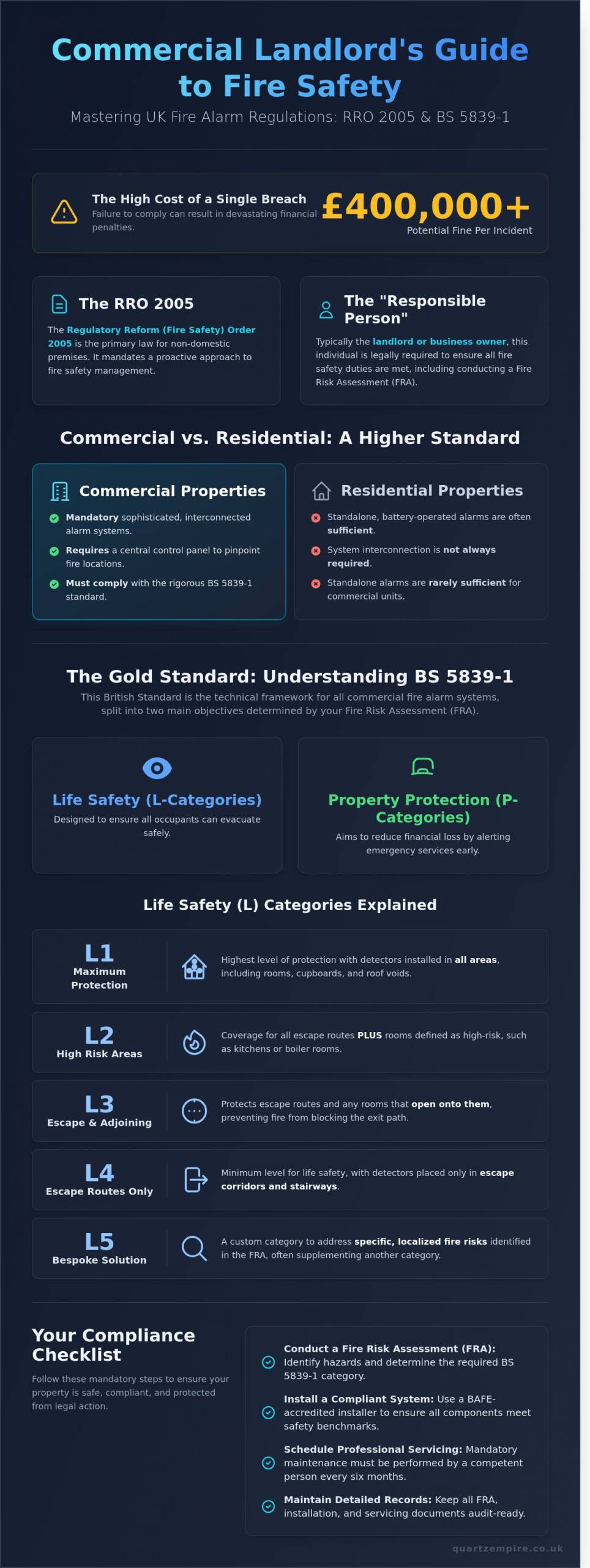
The Regulatory Reform (Fire Safety) Order 2005 (RRO) is the statutory instrument governing fire safety in 2026. It's the primary legislation for all non-domestic premises in England and Wales. This legislation shifted responsibility from the fire service to the "Responsible Person," typically the landlord or business owner. Before October 2006, businesses relied on fire certificates issued by local authorities. Now, you must conduct a regular Fire Risk Assessment (FRA) to determine the specific needs of your building. This proactive approach ensures that safety measures are tailored to the actual risks present in your specific environment.
Key Differences Between Commercial and Residential Rules
Commercial requirements are far more stringent than residential smoke alarm laws. While a standard home might only need a few battery-operated alarms, commercial units require sophisticated, interconnected systems. These systems must include a central control panel that identifies exactly where a fire has been detected. Battery-operated standalone alarms are rarely sufficient for commercial units because they don't provide the site-wide warning required for larger populations. You need a system that alerts everyone simultaneously, regardless of where the fire starts.
The Fire Safety (England) Regulations 2022 and the Building Safety Act 2022 have further tightened these rules. Failing to comply carries severe consequences. Courts can issue unlimited fines and prison sentences of up to two years for serious breaches. In 2023, several UK landlords faced six-figure fines for failing to maintain adequate detection systems in mixed-use properties. Staying compliant isn't just about avoiding penalties; it's about being a trusted partner in your tenants' safety. If you're unsure about your current setup, our expert team provides the no-nonsense approach you need to stay protected.
Understanding BS 5839-1: The Gold Standard for Commercial Systems
Compliance with landlord fire alarm regulations commercial property uk begins with BS 5839-1:2017. This British Standard provides the technical framework for fire detection in non-domestic premises. It isn't just a recommendation; it's the primary document used by fire authorities and insurers to judge if a building meets the Regulatory Reform (Fire Safety) Order 2005. Failing to adhere to these standards can lead to prosecution or voided insurance policies in the event of a fire.
The system categories are split into two main objectives: Life Safety (L) and Property Protection (P). While Property Protection systems aim to reduce financial loss by alerting emergency services early, Life Safety systems are designed to ensure occupants can evacuate safely. Your specific requirement is determined by a Fire Risk Assessment (FRA). This assessment evaluates building size, occupancy levels, and internal hazards to dictate the necessary coverage level.
Using BAFE-accredited installers is vital for total compliance. An accredited provider ensures that every component, from the control panel to the cabling, meets rigorous safety benchmarks. If you're unsure about your current setup, you can speak with a certified expert to review your building's specific needs and ensure your documentation is audit-ready.
Life Safety Categories (L1 to L5) Explained
Life Safety systems range from comprehensive coverage to localized protection. L1 systems offer the highest level of protection, with detectors installed in every room, cupboard, and roof void. L2 and L3 systems focus on protecting escape routes, with L2 adding coverage for high-risk areas like boiler rooms or kitchens. L4 systems cover only escape routes like corridors and stairways. L5 is a bespoke category designed to address specific fire risks identified in the FRA, such as high-voltage equipment areas.
Manual vs. Automatic Fire Detection
A basic Category M system relies entirely on manual call points, often called break-glass units. These are only sufficient if the building is small and fire is likely to be detected by people immediately. However, most modern commercial sites require automatic detection to provide 24/7 monitoring. Automatic smoke and heat detectors remove the risk of human error, especially in unoccupied areas. Integrating these components correctly is a core part of any commercial fire alarm installation project. Meticulous planning ensures that detectors are placed where they'll be most effective without causing false alarms.
Who is the "Responsible Person" in a Commercial Lease?
The Regulatory Reform (Fire Safety) Order 2005 defines the "Responsible Person" as the employer, the owner, or any person who has control over a premises. In a commercial lease, this role is rarely held by just one individual; it's often shared between the landlord and the tenant. Understanding this distinction is vital for meeting landlord fire alarm regulations commercial property uk standards by the 2026 compliance deadline. If you own a building in Kent or London, you must ensure your lease clearly outlines these boundaries to avoid legal gaps.
Full Repairing and Insuring (FRI) leases often shift the financial burden of maintenance to the tenant. However, statutory fire safety duties remain non-delegable in many respects. While a tenant might pay for the service, the landlord remains legally accountable for the structural integrity of fire compartments and the functionality of shared life-safety systems. You can't simply contract out of these legal obligations.
Landlord vs. Tenant: Dividing the Duties
The division of labor usually follows the physical boundaries of the lease. Landlords typically manage the main fire alarm control panel, communal smoke detectors, and any interface with central monitoring stations. Tenants are responsible for detectors added during internal fit-outs, conducting weekly bell tests, and organizing staff fire drills. A written Fire Safety Agreement is a practical tool we recommend for every commercial tenancy. It prevents confusion during a Fire and Rescue Service inspection and ensures 100% accountability across the site.
Multi-Occupancy Buildings and HMOs
Business centers and serviced offices in the South East present a higher level of complexity. When multiple businesses occupy one building, each employer acts as a Responsible Person. Article 22 of the Fire Safety Order requires these parties to cooperate and coordinate their safety measures. Managing agents often act as the central point of contact here. They ensure that the landlord fire alarm regulations commercial property uk are applied consistently across every unit. Quartz Empire works as a trusted partner with facilities managers across London to synchronize these systems, ensuring that a fault in one unit doesn't compromise the safety of the entire building.
Mandatory Maintenance and the Fire Risk Assessment
Compliance with landlord fire alarm regulations commercial property uk starts with a clear strategy. You can't ensure safety without first identifying the specific threats within your building. This process centers on the Regulatory Reform (Fire Safety) Order 2005, which mandates that every commercial premises has a valid assessment in place to protect occupants and assets.
Conducting a Commercial Fire Risk Assessment
A fire risk assessment serves as your compliance foundation. It follows a rigorous five-step process: identifying fire hazards, identifying people at risk, evaluating and reducing risks, recording findings, and creating an action plan. You must review this document at least every 12 months or whenever significant changes occur, such as a new tenant moving in or a structural layout modification. While some landlords attempt a DIY "tick-box" approach, data suggests that 70% of fire safety prosecutions involve inadequate assessments. Professional assessors provide the technical expertise needed to identify hidden risks that untrained eyes often miss.
Service and Maintenance Requirements
Statutory requirements under BS 5839-1 dictate that a competent, accredited person must service your fire alarm system at least every six months. These bi-annual inspections ensure that every smoke detector, call point, and sounder functions according to its design specifications. As a landlord, you're responsible for ensuring any "remedial works" identified during these checks are completed promptly. Staying ahead of landlord fire alarm regulations commercial property uk means keeping a meticulous paper trail. It's a critical financial risk too; failing to produce a valid service certificate can void building insurance and leave you liable for significant damages.
Daily and weekly checks keep the system operational between professional visits. You should perform a weekly bell test to confirm the control panel communicates with the sounders. Record every test, fault, and maintenance visit in your Fire Safety Logbook. This document is your primary evidence of due diligence during a Fire and Rescue Service inspection. Consistent record-keeping includes:
- The date and time of every weekly test.
- Details of any system faults and the specific date they were rectified.
- Certificates for bi-annual professional servicing.
- Records of staff or tenant fire drill training.
If you need to verify your current system's compliance, you can book a professional fire safety audit with our expert team today.
Securing Your Property with Quartz Empire Fire & Security
Meeting the latest landlord fire alarm regulations commercial property uk requires a partner who understands the high stakes of 2026 compliance. We provide a no-nonsense approach to commercial fire safety across London and Kent, stripping away the jargon to deliver clear results. Our team handles the technical complexities of the Regulatory Reform (Fire Safety) Order 2005 so you can focus on your business operations. We currently manage safety systems for over 450 commercial units, ensuring every site meets the rigorous BS 5839-1 standards required for modern insurance and legal validity.
Landlords managing multi-site portfolios face unique challenges in tracking different testing dates and system ages. We simplify this by acting as your single point of contact for compliance. Our digital reporting system provides instant access to maintenance logs and certification, which is vital if a local fire authority requests an audit. Protecting your investment means more than just installing hardware; it's about building a reliable safety net for your tenants and your capital.
- Direct Communication: You speak to experts, not call centres.
- Portfolio Oversight: Centralised management for properties across the South East.
- Certified Reliability: All work adheres to the latest UK fire safety benchmarks.
Expert Installation and Maintenance in the South East
Our coverage spans the entirety of Kent, London, and the surrounding South East regions. Being an accredited partner provides landlords with peace of mind because every installation is verified by industry-leading bodies. We don't believe in one-size-fits-all solutions. Instead, we design maintenance contracts tailored to your property type, whether it's a high-street retail unit or a sprawling industrial estate. These packages include the mandatory six-monthly service visits that are essential for staying on the right side of landlord fire alarm regulations commercial property uk.
Get a Compliance Review Today
If your current fire system hasn't been professionally audited since the 2023 Fire Safety (England) Regulations updates, it's likely your property is at risk. We help you transition from non-compliance to a fully certified fire safety system through a detailed professional survey. Our experts identify specific gaps in your current coverage and provide a clear, cost-effective roadmap for 2026 readiness. Book a professional survey for your commercial premises today to secure your building. Contact our team for a straightforward, expert consultation and let us become your trusted partner in fire security.
Secure Your 2026 Compliance Strategy Today
Meeting the latest safety standards requires more than just basic hardware installation. It demands strict adherence to BS 5839-1 standards and a clear understanding of the legal duties assigned to the Responsible Person. As 2026 approaches, staying ahead of landlord fire alarm regulations commercial property uk is the only way to prevent costly legal penalties and protect your professional reputation. Regular maintenance and updated Fire Risk Assessments aren't just recommendations; they're mandatory legal requirements that ensure your system functions when it matters most.
Quartz Empire Fire & Security Ltd acts as your trusted partner throughout London and Kent. We've spent over 15 years delivering a no nonsense approach to safety and compliance for commercial landlords. Our BAFE accredited installers provide comprehensive fire and security maintenance contracts that guarantee your property remains fully certified and reliable. You'll gain total peace of mind knowing your assets are protected by seasoned experts who understand the local landscape. Don't leave your compliance to chance when expert help is a click away.
Book a Professional Fire Safety Compliance Review and let's ensure your building meets every regulatory benchmark for the years ahead. We're ready to help you build a safer environment today.
Frequently Asked Questions
Do I legally need a fire alarm in a small commercial unit?
You legally require a fire alarm or a reliable electronic detection system in every small commercial unit under the Regulatory Reform (Fire Safety) Order 2005. While simple "shout out" methods worked for tiny single-room offices historically, 2026 standards require electronic detection if a fire could go unnoticed. We ensure your small premises stay compliant by installing systems that meet BS 5839-1 standards. This protects your 100% legal liability as a landlord.
How often must a commercial fire alarm be tested by a professional?
A qualified professional must service your commercial fire alarm at least every 6 months to comply with BS 5839-1. These bi-annual inspections verify that 100% of your detectors, call points, and sounders function correctly. Our accredited engineers provide the necessary certification to prove your compliance during fire service inspections. Regular maintenance prevents the 45% of false alarms caused by equipment neglect and ensures your system remains reliable.
Can a tenant be held responsible for the fire alarm system?
A tenant can be responsible for daily testing and maintenance if your commercial lease agreement explicitly states these terms. However, the landlord usually remains the "Responsible Person" under the Fire Safety Order 2005 for the building's core infrastructure. You should clearly define these duties in your 2026 lease renewals. We work with both parties across London and the South East to ensure landlord fire alarm regulations commercial property uk are met without confusion.
What is the penalty for not having a fire risk assessment in 2026?
Failure to provide a written fire risk assessment carries a penalty of unlimited fines or up to 2 years in prison under the Fire Safety (England) Regulations 2022. Since October 2023, all businesses, regardless of size, must record their full assessment. Local authorities issued over £10 million in fire-related fines last year alone. Our certified team helps you avoid these 2026 legal risks by conducting thorough, compliant assessments for your property.
Does a commercial fire alarm need to be monitored?
Monitoring isn't a universal legal requirement, but 90% of commercial insurers demand it for buildings that remain unoccupied overnight. A monitored system connects to an Alarm Receiving Centre (ARC) that notifies the fire brigade within 60 seconds of a signal. This setup provides 24/7 protection and peace of mind when your staff aren't on-site. We install reliable monitoring solutions that meet all current UK insurance and safety standards.
What happens if my commercial fire alarm system is outdated?
An outdated system often fails to meet the landlord fire alarm regulations commercial property uk, which can void your building insurance policy immediately. If a fire occurs and your system is over 15 years old or non-compliant, you face personal prosecution and 100% liability for damages. We recommend upgrading legacy systems to modern BS 5839-1 compliant panels. This ensures your safety equipment is reliable and your legal documentation is fully up to date.
Are wireless fire alarms legal for commercial properties in the UK?
Wireless fire alarms are 100% legal for UK commercial properties provided they meet BS 5839-1 and EN54-25 standards. These systems are ideal for heritage buildings in Kent where cabling is difficult or restricted. They offer the same level of reliability as wired versions and can be installed 70% faster than traditional systems. Our expert team ensures every wireless component is certified and correctly mapped for signal strength.
What is the difference between a Grade A and Grade D system?
A Grade A system uses a central control panel, detectors, and sounders with backup power, typically required for larger commercial buildings. Grade D systems consist of one or more mains-powered smoke alarms with internal battery backups, often used in smaller HMOs or simple shop units. Most commercial premises require the Grade A standard to ensure 100% coverage and control. We help you choose the right grade to ensure your property remains safe and compliant.