
How to Choose the Right Fire Alarm Company: A Checklist for UK Businesses

Choosing a fire alarm provider for your business is more than a procurement decision; it's a critical investment in the safety of your people and the protection of your property. The risk of partnering with a non-compliant company isn't just a matter of poor service-it can lead to catastrophic system failure in an emergency and severe legal penalties. With a market filled with various fire alarm companies, each making bold claims, how can you confidently distinguish a truly expert and accredited partner from the rest? The technical jargon and concerns over long-term support can make the process feel overwhelming.
This guide provides a straightforward checklist to help you make an informed decision. We will walk you through the essential criteria for vetting potential partners, from verifying crucial accreditations to understanding the key questions you must ask about installation, compliance with UK regulations like BS 5839-1, and ongoing maintenance. Our goal is to equip you with the knowledge to secure a reliable system and achieve complete peace of mind, knowing your business is properly protected by a trusted partner.
Key Takeaways
- Always verify third-party accreditations as the single most important, non-negotiable proof of a company's competence and compliance with UK standards.
- Look beyond installation; a truly expert provider offers a full scope of services, including design, commissioning, and ongoing maintenance for long-term reliability.
- Distinguish professional fire alarm companies from unreliable providers by assessing their track record and learning to identify the key warning signs of poor service.
- Prepare a checklist of specific questions to ask every potential provider, allowing you to accurately compare proposals and clarify their technical expertise.
Non-Negotiable #1: Third-Party Accreditations and Certifications
When selecting a partner to protect your property and people in London or Kent, nothing is more critical than verifiable, independent proof of competence. Third-party accreditations are not merely logos for a website; they are hard-earned credentials that signify a company has undergone rigorous, impartial audits of its processes, skills, and quality management. Choosing an accredited provider ensures your fire alarm system is designed and maintained to the highest British Standards, providing you with genuine peace of mind and demonstrating your commitment to safety.
Understanding BAFE Certification
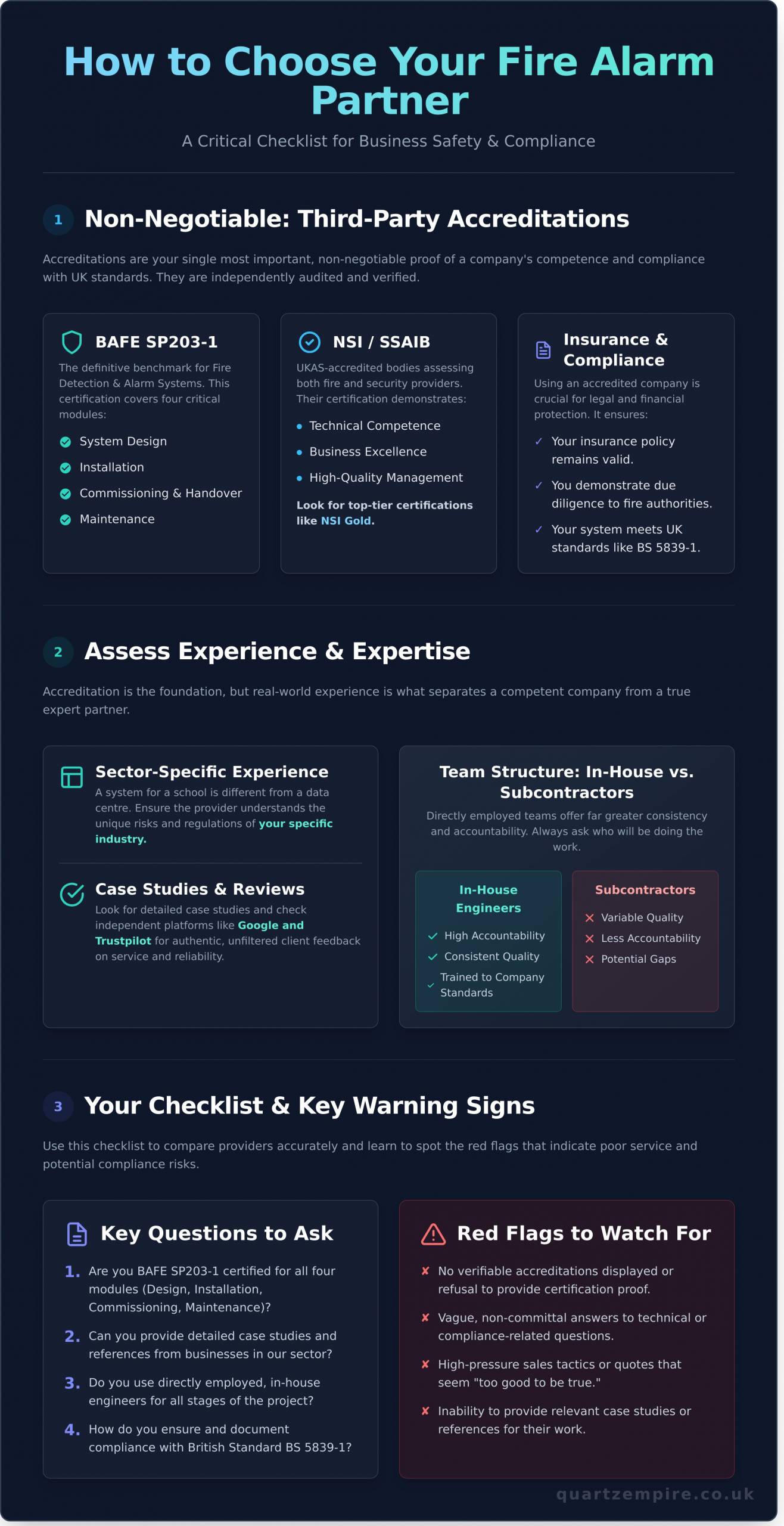
BAFE (British Approvals for Fire Equipment) is widely recognised as the definitive benchmark for quality within the UK fire safety industry. Specifically, the BAFE SP203-1 scheme is dedicated to Fire Detection and Alarm Systems. A company holding this certification has proven its expert capability across all four key modules:
- System Design
- Installation
- Commissioning & Handover
- Maintenance
Engaging a BAFE-certified company is a direct assurance that you are working with a competent, reliable, and audited provider whose work is consistently verified.
Other Key Industry Bodies (NSI/SSAIB)
Beyond BAFE, look for accreditations from UKAS-accredited bodies like the NSI (National Security Inspectorate) or SSAIB (Security Systems and Alarms Inspection Board). These organisations assess both fire and security providers. The most reputable fire alarm companies often hold NSI Gold or SSAIB certification, which signifies not only technical competence but also a commitment to the highest levels of business excellence and quality management. It demonstrates a deep-seated dedication to professional standards.
Why This Matters for Insurance and Compliance
Holding these certifications is fundamental for your legal and financial protection. Insurance providers frequently stipulate that fire alarm systems must be installed and maintained by an accredited company for your policy to be valid. Using an uncertified firm could risk a claim being rejected when you need it most. Furthermore, it is the most straightforward way to demonstrate due diligence to fire authorities. A certificate of compliance from an accredited installer proves your system meets the necessary UK fire alarm system standards, such as BS 5839, helping you fulfil your obligations under the Regulatory Reform (Fire Safety) Order 2005.
Assessing a Company's Experience and Expertise
While accreditations are a vital starting point, they are not the whole story. Proven, real-world experience is what separates competent fire alarm companies from true experts. A long-established provider has a track record of reliability and has navigated countless complex installations and maintenance challenges. Their expertise must align directly with the specific needs of your business premises, ensuring they understand the unique risks you face and can design a system that offers genuine peace of mind.
Experience in Your Commercial Sector
Does the company have a portfolio of work in your specific sector? A fire safety system for a school in Kent has vastly different requirements from one in a London-based data centre or a warehouse. A specialist provider will be intimately familiar with the sector-specific regulations and operational challenges that apply to your business. This expert knowledge is crucial for fulfilling your legal fire safety responsibilities and ensures you receive a compliant, effective solution, not a generic system that fails to address your unique environment.
Reviewing Case Studies and Testimonials
Look beyond brief quotes on a website. A reputable company will showcase detailed case studies that outline the client's problem, the solution they engineered, and the successful outcome. This demonstrates their problem-solving capabilities. Furthermore, check for authentic client feedback on independent platforms like Google and Trustpilot. These unfiltered reviews provide a powerful and honest indicator of a company's service quality, response times, and overall reliability.
In-House Engineers vs. Subcontractors
It is essential to ask whether a company uses its own in-house engineers or relies on subcontractors. Directly employed teams offer far greater consistency and accountability. In-house engineers are trained to the company's exacting standards, are familiar with their procedures, and are part of a cohesive team structure. This direct line of control ensures a higher quality of workmanship, more reliable service, and a professional approach from start to finish.
Evaluating the Scope of Services Offered
Selecting a fire alarm company in London or Kent is about establishing a long-term safety partnership, not just a one-time transaction. The right provider offers comprehensive support that covers the entire lifecycle of your system, from initial design to ongoing maintenance and eventual upgrades. This end-to-end service model ensures you have a single, accountable point of contact for your building's fire safety, providing consistency, reliability, and complete peace of mind.
A truly professional firm moves beyond simple installation. Look for a company that demonstrates a deep commitment to your ongoing safety with a full suite of services designed to keep your system compliant and fully operational at all times.
Comprehensive Design and Installation to BS 5839-1
A compliant and effective fire alarm system begins with a meticulous design. This phase is just as critical as the installation itself, as it ensures the system is perfectly tailored to your property's unique layout, risks, and usage. Your chosen provider must design and install systems in strict accordance with the latest BS 5839-1 standards. Leading industry bodies, such as the Fire Industry Association (FIA), advocate for these high standards to ensure maximum safety. This process should always include a full fire risk assessment, detailed system plans, and recommendations for the most suitable technology, whether it's a conventional system for a small office or a complex addressable system for a large commercial building.
Ongoing Maintenance and Servicing Contracts
For any commercial property, regular fire alarm maintenance is a legal requirement under the Regulatory Reform (Fire Safety) Order 2005. Competent fire alarm companies provide clear, comprehensive service level agreements (SLAs) that detail the scope of their maintenance plans. Before committing, you should always ask what is included in a contract, such as the frequency of routine checks, cover for parts and labour, and procedures for non-emergency call-outs. This transparency is crucial for managing budgets and ensuring your system remains compliant year after year. See our compliant fire alarm maintenance services.
24/7 Emergency Call-Out and Monitoring
A fault in your fire alarm system can occur at any time, potentially leaving your property and its occupants vulnerable. A key indicator of a reliable partner is the availability of a 24/7 emergency call-out service with guaranteed response times. Furthermore, consider companies that offer professional Alarm Receiving Centre (ARC) monitoring. This service provides a constant link to a dedicated monitoring station, ensuring that in the event of a real fire, the emergency services are dispatched immediately, even if the building is empty. This rapid response can be critical in minimising damage and protecting assets.
Key Questions to Ask Before You Commit
Once you have shortlisted potential providers, the next step is a detailed consultation. When comparing quotes from different fire alarm companies, a prepared list of questions is your most effective tool for clarifying the specifics of their proposal. The quality and transparency of their answers will reveal a great deal about their professionalism and commitment to a 'no nonsense' approach. Use this checklist to ensure you have all the necessary information to make a confident, compliant decision.
Questions About the Quoting Process
A quotation should be clear and comprehensive. Ambiguity at this stage can lead to unexpected costs later. Ask these direct questions to understand the full financial commitment:
- Is this quote fully inclusive, or are there potential extra costs for things like access equipment or out-of-hours work?
- Does the price include full commissioning of the system and a BAFE certificate upon completion?
- What are the payment terms for the project? Is a deposit required?
- How long is this quotation valid for?
Questions About Their Engineers and Process
The quality of the installation depends entirely on the expertise of the team carrying it out. Understanding their process helps you prepare for the work and ensures minimal disruption to your business operations.
- Are all your engineers qualified and experienced to work on commercial fire alarm systems in line with British Standards?
- What level of disruption can we expect during the installation, and how will you manage it?
- What training will you provide to our staff or the Responsible Person on how to use the new system?
- Who will be our main point of contact throughout the project for any queries or updates?
Questions About the Maintenance Agreement
A fire alarm system is a long-term investment in safety, and the maintenance contract is crucial for its ongoing reliability and compliance. Clarifying the terms of the agreement from the outset prevents future misunderstandings.
- What is the minimum contract length for a maintenance plan?
- What are your guaranteed response times for different types of faults (e.g., critical vs. non-critical)?
- Are there any additional charges for parts or labour for call-outs that fall outside of the scheduled services?
- What is the process for logging a service call, and is support available 24/7?
A dependable partner will welcome these questions and provide clear, straightforward answers. At Quartz Empire, we believe in complete transparency. If you have any questions about our process, please get in touch with our expert team.
Warning Signs: Red Flags to Watch Out For
When selecting a partner for your fire safety, knowing what to avoid is as crucial as knowing what to look for. Some fire alarm companies in London and Kent may use tactics that seem appealing on the surface but can lead to non-compliant systems, unexpected costs, and significant long-term risk. Your safety is not an area for compromise. Being aware of these red flags will help you make a secure and informed decision. Always trust your instincts; if an offer or a provider feels wrong, it probably is.
Vague or Incomplete Quotations
A professional quotation is a detailed document, not a single figure on a page. Be cautious of any company that provides a quote without a comprehensive breakdown of all costs. A lack of transparency can be a deliberate tactic to hide future charges for "extras" that should have been included from the start. Your quote should clearly itemise every component, including:
- The specific model of control panels and detectors
- All sounders, beacons, and call points
- Costs for cabling and containment
- Labour for installation and commissioning
Crucially, ensure the proposal explicitly references compliance with British Standard BS 5839-1. A failure to do so is a major warning sign.
High-Pressure Sales Tactics
Your decision to install or upgrade a fire alarm system should be based on competence and trust, not fear or urgency. Avoid any provider that pressures you into signing a contract immediately. Tactics like 'today only' special offers or using scare-mongering about your current non-compliance are hallmarks of an unprofessional outfit. A reputable company will provide a detailed proposal and give you the necessary time and space to review it, answer your questions, and allow you to perform your due diligence.
Reluctance to Provide Proof
Transparency is a key indicator of a trustworthy fire safety partner. A certified and experienced company will be proud of its credentials and happy to provide evidence. If a provider is hesitant to share proof of their qualifications, you should walk away. Always ask for their BAFE or NSI registration number and take a moment to verify it on the official online register. Similarly, they should readily provide proof of insurance and be able to connect you with client references. A refusal to do so suggests they have something to hide.
For a transparent, no-nonsense approach from an accredited team, get in touch with Quartz Empire for a fully compliant proposal.
Your Next Step: Partner with a Certified Fire Safety Expert
Selecting the right fire alarm provider is one of the most important safety decisions you will make for your business. As this guide has shown, the process requires careful diligence. Always prioritise companies with verifiable, third-party accreditations, as this is your primary guarantee of competence and quality. Furthermore, look beyond the initial installation to assess their experience and the full scope of their maintenance services. These non-negotiable checks ensure you are not just buying a system, but investing in a long-term safety partnership.
When comparing UK fire alarm companies, choose a partner you can trust. At Quartz Empire, our BAFE SP203-1 Certification and NSI Gold Approval demonstrate our commitment to the highest industry standards. For businesses across Kent, London, and the South East, we provide a comprehensive, no-nonsense approach to fire safety, from design to 24/7 support. Secure your peace of mind today. Request a free, no-obligation quote from our accredited experts and let us protect what matters most to you.
Frequently Asked Questions
What's the difference between a fire alarm company and a general electrician?
While a qualified electrician handles a building's general wiring, a specialist fire alarm company possesses in-depth knowledge of fire safety legislation, including the critical BS 5839-1 standard. Their engineers are specifically trained in the design, installation, and maintenance of complex life-safety systems. They understand the nuances of different detector types, panel programming, and cause-and-effect strategies. Choosing an accredited fire safety specialist ensures your system is not just installed, but is fully compliant and reliable.
How often does a commercial fire alarm system need to be serviced in the UK?
According to the British Standard BS 5839-1, commercial fire alarm systems in the UK should be serviced by a competent person at least every six months. This bi-annual service is a legal requirement for the designated 'Responsible Person' of the premises. A thorough service involves checking control panels, testing detectors and call points, verifying sounder levels, and updating the system logbook. Regular, professional maintenance ensures your system functions correctly when you need it most, providing complete peace of mind.
Can I switch my fire alarm maintenance contract to a new company?
Yes, you are free to switch your fire alarm maintenance provider at any time. A professional new company will manage a seamless transition. The process typically begins with a comprehensive survey of your existing system to assess its condition and compliance. This allows them to understand the equipment and identify any potential issues before taking over the contract. They will then establish a new servicing schedule, ensuring there are no gaps in your legally required maintenance and protection.
What does 'BS 5839-1 compliant' mean and why is it important?
BS 5839-1 is the UK's code of practice for the design, installation, commissioning, and maintenance of fire alarm systems in non-domestic buildings. Being 'compliant' means your system meets this nationally recognised standard for quality and reliability. This is critically important as it demonstrates due diligence under the Regulatory Reform (Fire Safety) Order 2005. A compliant system ensures you are meeting your legal obligations, satisfying insurance requirements, and providing a safe environment for occupants.
Do fire alarm companies provide fire risk assessments as well?
Many specialist fire alarm companies, including our certified team, offer fire risk assessments as a core part of their service. However, it is not a given, as some firms focus purely on system installation. A fire risk assessment is a comprehensive evaluation of your premises to identify fire hazards and recommend safety measures. Choosing a company that provides both services ensures a cohesive, end-to-end fire safety strategy, where system design is directly informed by the identified risks.
How much does a new commercial fire alarm system typically cost?
The cost of a new commercial fire alarm system in the UK varies significantly based on several key factors. A small, conventional system for a simple layout might start from around £1,500. For larger or more complex buildings, an addressable system is often required, with costs potentially running from £5,000 to well over £50,000. Key variables include the building's size, the type of system (conventional, addressable, or wireless), the number of devices needed, and whether third-party monitoring is required.