
Fire Safety in the Workplace Regulations 2026: The Essential UK Compliance Guide

Could your business withstand a rigorous inspection from the Building Safety Regulator after the next major legislative shift? With the formal introduction of Martyn’s Law and the full transition to the Building Safety Regulator (BSR) oversight, the fire safety in the workplace regulations 2026 represent the most significant update to UK safety standards in a generation. You likely feel the pressure of keeping up with these evolving requirements while managing daily operations. It's a common concern for facilities managers who want to avoid heavy penalties and ensure total protection for their staff.
The 2026 framework places a significant emphasis on high-risk residential buildings, where the integration of active fire suppression is a critical safety component. For those overseeing housing developments or multi-occupancy blocks, you can discover more about Residential Fire Sprinkler Systems to see how modern engineering supports these rigorous safety standards and protects occupants in complex living environments.
We've created this guide to help you understand these critical changes and maintain your status as a compliant, responsible employer. You'll find specific details on how the new BSR framework affects your premises and what the move away from BS 476-22 fire testing standards means for your hardware. We provide a clear roadmap for the 2026 compliance deadline, covering everything from the Terrorism (Protection of Premises) Bill tiers to updated fire risk assessment protocols. This ensures your property remains secure and your people stay protected, giving you the peace of mind you need to focus on your business.
Key Takeaways
- Understand the critical shift as the Building Safety Regulator (BSR) becomes a standalone body in January 2026 and what this means for future enforcement.
- Prepare for the upcoming Martyn’s Law requirements by identifying how new capacity-based tiers will impact your terrorism protection and fire safety obligations.
- Master the technical transition from BS 476-22 to the EN 1634-1 standard to ensure your fire doors remain compliant with the fire safety in the workplace regulations 2026.
- Utilise our 2026 operational checklist to review your premises and verify the legal competency of your designated "Responsible Person."
- Discover how to secure your business with accredited fire safety management and maintenance services across London, Kent, and the South East.
Understanding the 2026 Fire Safety Regulatory Landscape in the UK
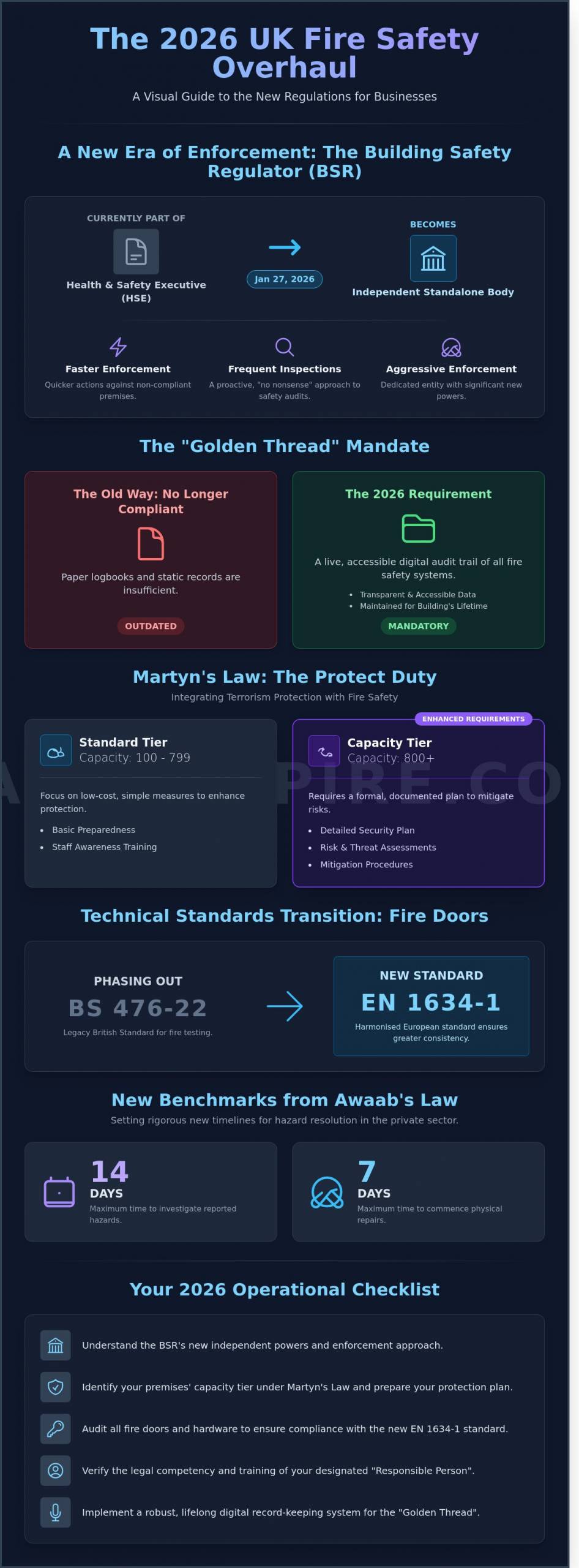
The landscape of fire safety in the workplace regulations 2026 represents a monumental shift in how commercial properties are managed and policed. On 27 January 2026, the Building Safety Regulator (BSR) will transition away from the Health and Safety Executive (HSE) to become a fully independent standalone body. This move is the final milestone in the implementation of the Building Safety Act 2022. It signals a move towards more aggressive enforcement and a "no nonsense" approach to safety failures across the country.
To grasp the scale of these changes, one must consider the history of UK fire safety legislation, which shows a clear trajectory from reactive fire fighting to proactive, data-led risk management. A central requirement for 2026 is the "Golden Thread" of digital record-keeping. This mandate requires every commercial building to maintain a live, digital audit trail of its fire safety systems. It's no longer enough to have a paper logbook; you must prove your systems are compliant through accessible, transparent data that remains available for the entire life of the building.
The BSR's new status ensures that building safety is handled by a dedicated entity rather than being one of many priorities under the HSE umbrella. This independence allows for faster enforcement actions and more frequent inspections. For business owners in Kent and London, this means that compliance is no longer a "check-box" exercise. It's a continuous obligation that requires expert oversight and reliable, accredited systems.
The Role of the Independent Building Safety Regulator
The BSR will possess significant new powers to oversee high-rise and complex commercial buildings. In regions like London and Kent, the regulator will work closely with local Fire and Rescue Services to ensure technical standards are met during every stage of a building's life cycle. The BSR will act as the primary authority for building standards and safety across the United Kingdom from 2026. This allows for a more coordinated approach to safety, ensuring that every fire safety in the workplace regulations 2026 requirement is met with precision.
The Impact on Multi-Occupancy and Social Housing
Key Legislative Updates: Martyn’s Law and the Protect Duty
The introduction of the Terrorism (Protection of Premises) Bill, commonly known as Martyn's Law, represents a significant shift in how UK businesses handle public safety. While fire safety has long been the primary focus of building management, the 2026 landscape demands a more integrated approach. You're now required to "assess and mitigate" risks from public threats alongside traditional fire hazards. This means your fire safety in the workplace regulations 2026 strategy must evolve to include security-based responses that don't compromise fire exit integrity.
Guidance expected in 2026 clarifies that fire safety and terrorism protection aren't separate silos. A fire alarm might be triggered during a security incident, or a security lockdown might occur during a fire. If your plans don't account for both, you risk creating confusion during a crisis. By 2026, the Home Office expects businesses to have clear, documented procedures that address these overlapping risks. It's a "no nonsense" requirement designed to ensure that every person on your premises is protected from multiple threat vectors simultaneously.
Preparing for the Protect Duty Guidance
The law splits premises into two categories. Standard Tier locations (100–799 people) must focus on basic preparedness and staff awareness. Capacity Tier sites (800+ people) require a more detailed security plan. You must integrate these requirements into your fire risk assessment to ensure a cohesive safety policy. Training in 2026 goes beyond the standard fire drill; it involves recognising suspicious behaviour and responding to external threats effectively.
Evacuation vs. Invacuation: A Unified Strategy
Traditional fire safety relies on rapid egress. Security threats, however, often require "invacuation" or lockdown. Your access control systems must balance these needs, allowing for secure lockdowns without trapping occupants during a fire. Fire marshals now need broader training to manage these dual risks. They must be capable of directing an evacuation or a lockdown depending on the specific threat, ensuring total site safety and compliance.
For many business owners, these changes feel daunting. However, the core of the legislation is about common sense and preparedness. You don't need to overcomplicate your systems, but you do need to ensure they're fit for purpose. This includes checking that your fire doors are compatible with electronic locks and that your staff feel confident in their expanded roles. If you're concerned about how these updates impact your current setup, you can speak with our expert team for a professional compliance review.
The fire safety in the workplace regulations 2026 framework won't just be about fire extinguishers and smoke detectors anymore. It's a holistic safety mandate. Businesses that act early to align their security and fire protocols will find themselves in a much stronger position when the Protect Duty guidance becomes mandatory. This proactive approach doesn't just satisfy the law; it provides genuine peace of mind for your employees and visitors alike.
Technical Standards: The Removal of BS 476-22 and PAS 2000
The year 2026 marks a decisive shift in how the UK validates the performance of fire protection equipment. For decades, the industry operated under a dual-standard system, allowing products to be tested under either the British Standard (BS 476 series) or the European Standard (EN 1634 series). The government's decision to withdraw the BS 476-22 standard for fire door testing removes this ambiguity. This transition is a core component of the fire safety in the workplace regulations 2026, ensuring that all life-safety hardware meets the most rigorous contemporary testing protocols.
Relying on "grandfather rights" for older fire doors is no longer a viable strategy for compliance. In the past, doors installed under older versions of the British Standard were often left in place if they appeared to be in good condition. Under the 2026 scrutiny, fire risk assessors will require robust evidence of performance. If a door set lacks a valid test certificate that aligns with current safety expectations, it will likely require replacement with a certified EN-compliant alternative.
Fire Door Compliance and the EN Standard Shift
The phase-out of BS 476-22 happens because the European EN 1634-1 standard provides a more accurate representation of fire behaviour. EN testing includes more intensive pressure conditions and heat sensors that better reflect the reality of a modern building fire. To identify if your current fire doors meet the 2026 requirements, you must check the original manufacturer's data sheets. If the documentation only references BS 476, you must consult a certified professional to determine if the installation remains compliant. Quartz Empire recommends using third-party certified installers to ensure that the entire door set, including frames and seals, functions as a single, proven unit.
PAS 2000 and Product Traceability
Traceability is the cornerstone of the 2026 regulatory framework. The introduction of PAS 2000, which supports the Code for Construction Product Information (CCPI), ensures that every safety product comes with clear, accurate, and accessible technical data. This level of transparency is vital when planning a new fire alarm installation or upgrading existing hardware. Every component, from smoke detectors to control panels, must be traceable to its original test evidence. PAS 2000 establishes a framework that prevents the foreseeable misuse of safety products by ensuring technical data is clear and unambiguous.
- Withdrawal of BS 476-22: Eliminates outdated testing methods that don't reflect modern fire risks.
- EN 1634-1 Adoption: Moves the UK towards a unified, high-pressure testing standard for all fire doors.
- CCPI Compliance: Requires manufacturers to provide honest and verifiable product performance claims.
- End of Grandfather Rights: Older installations must be reassessed against 2026 standards to ensure continued safety.
Ensuring your workplace meets the fire safety in the workplace regulations 2026 requires a meticulous review of your technical assets. This "no nonsense" approach to compliance protects your staff and ensures your business remains legally sound in a tightening regulatory environment.
Operational Compliance: Your 2026 Fire Safety Audit Checklist
Achieving full compliance with the fire safety in the workplace regulations 2026 requires moving beyond basic tick-box exercises. The legislative landscape now demands a "Golden Thread" of digital information that proves your building's safety history. You must ensure your designated "Responsible Person" possesses the specific competency required by Section 156 of the Building Safety Act. This isn't just about having a name on a document; it's about that individual having the training to identify complex risks and manage digital maintenance logs effectively.
Your audit should start with a thorough review of hardware. It's vital to conduct professional reviews of all fire extinguisher types to ensure they're appropriate for the specific risks in your rooms, such as lithium-ion battery charging stations or server hubs. Standard water extinguishers won't suffice for modern office hazards, and 2026 standards require documented proof that each unit is serviced to BS 5306-3:2017 standards.
Step 1: The 2026 Fire Risk Assessment Review
An FRA older than 12 months is now considered a significant compliance risk. Under the 2026 BSR standards, assessments must reflect the current usage of the building. If you've modified your office layout or increased staff capacity, your old FRA is likely void. You also need to account for Martyn’s Law, which requires premises to have clear plans for "lock-down" scenarios that don't conflict with fire evacuation routes. Always ensure your FRA is conducted by an accredited professional to guarantee it stands up to Fire and Rescue Service inspections.
Step 2: Maintenance and Testing Schedules
Compliance hinges on the reliability of your active systems. You must record weekly fire alarm tests and monthly emergency lighting flick-tests in a digital format. For high-occupancy buildings, integrating commercial CCTV installation provides a vital layer of fire verification. This allows your team to visually confirm a fire before total evacuation, reducing costly downtime from false alarms. Remote monitoring is also becoming a standard expectation for 2026, ensuring a rapid response from emergency services even when the building is empty.
Don't leave your business's safety to chance. Contact Quartz Empire for a professional fire safety audit to ensure your premises meet every 2026 requirement.
Professional Fire Safety Management with Quartz Empire
Ensuring your business meets the fire safety in the workplace regulations 2026 is a significant responsibility that requires technical precision and reliable oversight. Quartz Empire Fire & Security Ltd acts as a trusted partner for organisations across London, Kent, and the South East. We provide a direct, no-nonsense approach to safety that prioritises your legal obligations and the protection of your staff. By consolidating your fire alarms, security systems, and risk assessments under a single provider, you eliminate the gaps in communication that often lead to compliance failures.
Managing multiple contractors often creates fragmented records. Our integrated service model ensures that every piece of equipment, from smoke detectors to access control panels, is documented in a unified compliance file. This streamlined process is essential for the 2026 regulatory environment, where the ability to produce a clear audit trail quickly can prevent costly legal complications. We focus on delivering practical solutions that work for your specific premises, whether you manage a single office or a large industrial site.
Accredited Maintenance and Servicing
Third-party accreditation is the most reliable way to prove competence to the authorities. Quartz Empire holds BAFE and NSI certifications, which are vital components of your 2026 evidence trail. These accreditations mean our installation and maintenance work is audited to the highest industry standards. We provide custom maintenance contracts that guarantee your systems remain compliant with BS 5839-1 for fire alarms and BS 5266-1 for emergency lighting. Our regional presence allows our engineers to provide rapid support across the South East, ensuring that any system faults are rectified within hours, not days.
- BAFE SP203-1: Verification of our competence in fire alarm design and maintenance.
- NSI Gold: The highest standard for security and fire system providers.
- Regional Expertise: Local engineers who understand the specific needs of South East businesses.
Compliance Support and Fire Marshal Training
Alongside training, our professional fire risk assessment services identify potential hazards and provide a clear, prioritised path to remediation. We don't just find problems; we provide the engineering expertise to fix them. Request a compliance audit from our expert team today to ensure your property is fully prepared for the upcoming legislative changes. Our goal is to provide total peace of mind through meticulous attention to detail and a commitment to life safety.
Future-Proof Your Compliance Strategy
Adapting to the fire safety in the workplace regulations 2026 requires a proactive approach to significant legislative shifts. Businesses must prepare for the specific requirements of Martyn’s Law and the transition away from legacy technical standards like BS 476-22. These updates demand a meticulous review of your current systems to ensure they meet the latest safety benchmarks. Failing to align with these 2026 standards could leave your organisation vulnerable to both legal risks and safety failures.
Quartz Empire acts as your trusted partner throughout this transition. As a specialist firm accredited by BAFE and NSI, we provide expert fire safety and electronic security integration for businesses across London and Kent. We use a no-nonsense approach to ensure your property remains fully compliant and your people stay protected. Our team understands the complexities of the new Protect Duty and the technical nuances of modern fire door and alarm certifications.
Ensure your business is 2026 compliant with a professional Fire Risk Assessment
Taking these steps today secures your operational future and provides the certainty your team deserves. We're here to help you navigate every regulatory hurdle with confidence.
Frequently Asked Questions
Is Martyn’s Law now legally binding for all UK workplaces in 2026?
Martyn’s Law is legally binding for UK workplaces that function as public venues with a capacity of 200 people or more. The Terrorism (Protection of Premises) Bill categorises these into a standard tier for 200 to 799 occupants and an enhanced tier for locations holding 800 or more. You must implement a prepared plan and provide staff training to meet these specific security requirements by the 2026 deadline.
What happens if my business fails to meet the new BSR standards in 2026?
Failure to comply with Building Safety Regulator (BSR) standards results in severe legal consequences, including unlimited fines or a prison sentence of up to two years. The BSR has the authority to issue formal compliance notices under the Building Safety Act 2022. If you don't rectify the identified safety breaches within the specified timeframe, the regulator will initiate criminal prosecution against the responsible person.
Do I need to replace my fire doors if they were tested under BS 476-22?
You don't need to replace existing fire doors tested under BS 476-22 as long as they remain in good condition and pass regular professional inspections. While the UK government's 2024 guidance prefers the newer EN 1634-1 standard for all new installations, older doors are still considered compliant if they're properly maintained. Our certified team recommends a six-monthly check to ensure your doors provide the necessary 30 or 60 minutes of protection.
How often should a commercial fire risk assessment be updated under 2026 regulations?
You must update your fire risk assessment at least once every 12 months to stay compliant with the fire safety in the workplace regulations 2026. Section 156 of the Building Safety Act 2022 now requires all businesses to record their full assessment in writing, regardless of the number of employees. You're also legally required to conduct a fresh assessment immediately if you make structural changes or change the purpose of a room.
What is the "Golden Thread" in fire safety, and does it apply to my office?
The Golden Thread is a digital record of all fire safety information that must be maintained throughout a building’s entire lifecycle. While it's a mandatory requirement for high-rise residential buildings over 18 metres, it's now the expected standard for professional office management. Keeping this digital trail ensures you have an accessible, reliable history of all fire alarm maintenance, accredited inspections, and safety certifications for your property.
Can I still use a standard fire alarm system, or must it be digitally monitored in 2026?
Standard fire alarm systems remain legal, but most businesses are now switching to digital monitoring to ensure 24/7 protection and faster emergency responses. British Standard BS 5839-1 suggests that systems in high-risk or high-value premises should connect to an Alarm Receiving Centre. These smart systems alert the Fire and Rescue Service automatically, which is essential for protecting your property when the building is unoccupied at night.
Who is legally responsible for fire safety in a multi-tenant London office building?
Legal responsibility is shared between the landlord and the individual tenants under the Regulatory Reform (Fire Safety) Order 2005. The landlord acts as the responsible person for common areas like hallways and stairwells, while you're responsible for the fire safety within your specific leased office. You must collaborate with other tenants to ensure a coordinated evacuation strategy and share your fire risk assessment findings with the building manager.