
Fire Safety Compliance for Business UK: The 2026 Statutory Guide

Your legal status as a 'Responsible Person' under the Regulatory Reform (Fire Safety) Order 2005 isn't just a corporate title; it's a personal liability that carries the risk of unlimited fines or a two-year prison sentence. Achieving total fire safety compliance for business uk shouldn't feel like a guessing game. You likely recognise the pressure of keeping staff safe while trying to interpret complex legislation that seems to change every year. It's stressful to manage these risks when the stakes include both your professional reputation and your personal freedom.
This definitive guide provides a clear, no-nonsense roadmap to your statutory duties for 2026. You'll gain a thorough understanding of your legal responsibilities and the specific British Standards that apply to your building's equipment. We'll show you how to move from confusion to complete confidence, ensuring your premises are protected by an accredited maintenance partner and your legal obligations are fully met.
Key Takeaways
- Understand your non-delegable legal duties as a 'Responsible Person' under the Regulatory Reform (Fire Safety) Order 2005 to ensure your premises are fully protected.
- Learn why a Fire Risk Assessment must be treated as a 'living document' and how to implement the five essential steps required for a professional assessment.
- Identify the specific British Standards and hardware requirements needed to achieve fire safety compliance for business uk, including BS 5839-1 for commercial detection systems.
- Establish a robust maintenance regime and use a Fire Safety Logbook to provide vital evidence of your testing schedules during a Fire Officer inspection.
- Navigate the unique challenges of London’s complex building stock by adopting a no-nonsense approach to regional compliance and safety standards.
Understanding the Legal Framework: The Regulatory Reform (Fire Safety) Order
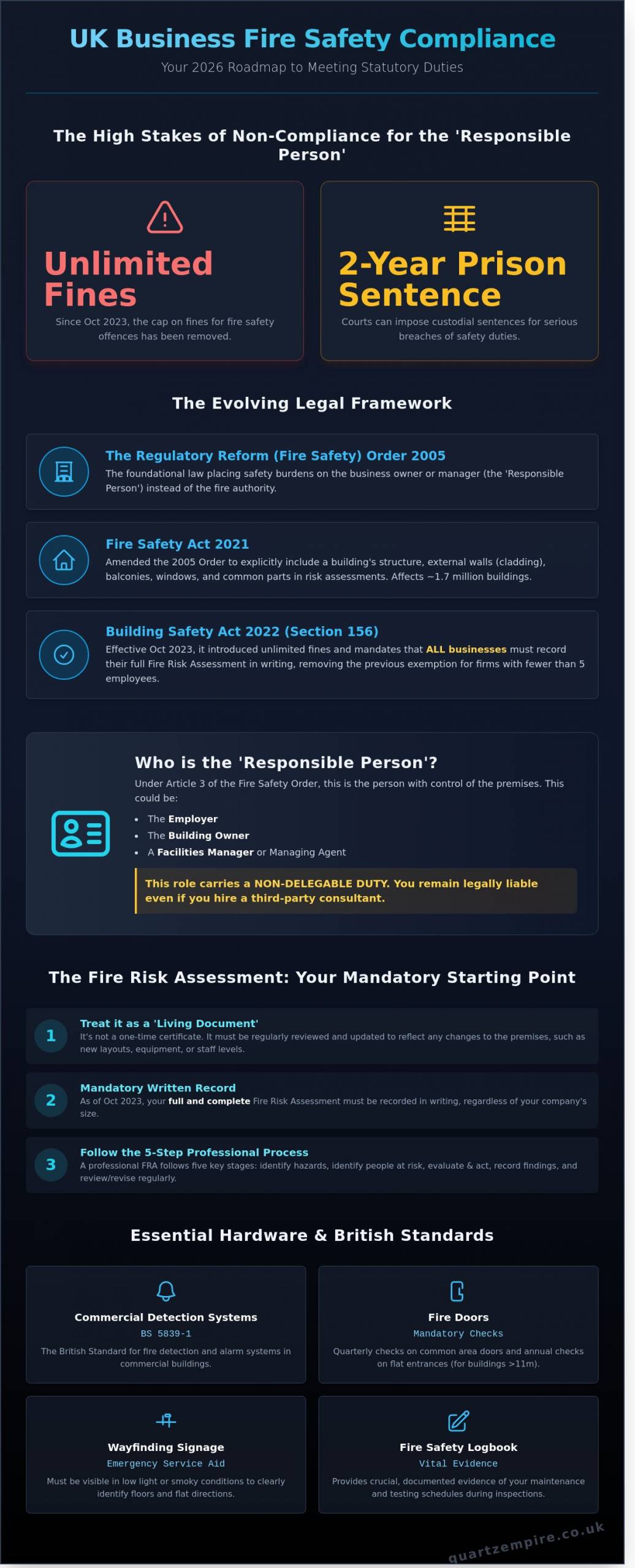
Every business in England and Wales must adhere to a strict legal framework to protect lives and property. The primary legislation is the Regulatory Reform (Fire Safety) Order 2005, which places the burden of safety directly on the business owner or manager rather than the local fire authority. This law demands a proactive approach to risk management. Achieving consistent fire safety compliance for business uk requires an expert understanding of how these laws have evolved to meet modern safety standards.
The Fire Safety Act 2021 amended the 2005 Order to clarify its scope following national safety reviews. It now explicitly includes the building’s structure, external walls, and any common parts. This change affects approximately 1.7 million residential and multi-use buildings across the UK. It ensures that cladding, balconies, and windows are all subject to rigorous fire risk assessments. Our no-nonsense approach helps you identify if your premises fall under these expanded definitions, keeping your staff and assets secure.
Ignoring these regulations leads to severe penalties. Since the implementation of Section 156 of the Building Safety Act on 1 October 2023, the maximum fine for several offences has moved from a fixed cap to an unlimited amount. Courts now have the power to hand down custodial sentences of up to 24 months for serious breaches. We've seen local Fire and Rescue Services increase their inspection frequency to ensure businesses meet these rigorous standards. As a trusted partner, we focus on providing the peace of mind that comes with full legal adherence.
Are You the 'Responsible Person'?
In many commercial settings, identifying the 'Responsible Person' (RP) is the first step toward safety. In shared office blocks in London or Kent, the RP might be the employer, the building owner, or a facilities manager with control over the premises. This role carries a non-delegable duty, meaning you remain legally liable even if you hire a consultant to perform the risk assessment. Coordination between multiple RPs in one building is a legal requirement to ensure no gaps in the safety plan exist.
Under Article 3 of the Fire Safety Order, the 'Responsible Person' is defined as the employer, if the workplace is to any extent under their control, or the person who has control of the premises in connection with the carrying on by them of a trade, business or other undertaking.
The Fire Safety (England) Regulations 2022/23 Updates
New requirements for multi-occupied buildings came into force on 23 January 2023. These updates demand that high-rise residential buildings over 18 metres or seven storeys provide electronic floor plans and information about external wall materials to their local Fire and Rescue Service. For buildings over 11 metres, there's now a mandatory requirement to perform quarterly checks on all fire doors in common parts and annual checks on individual flat entrance doors.
These regulations also mandate the installation of wayfinding signage that's visible in low light or smoky conditions. Such signage must clearly identify floor numbers and flat directions to assist emergency services during an incident. Ensuring fire safety compliance for business uk means staying ahead of these technical requirements. Our accredited team helps you install and maintain the necessary hardware, from fire doors to signage, ensuring your building remains a safe and certified environment.
The Fire Risk Assessment (FRA): Your Mandatory Starting Point
The Fire Risk Assessment (FRA) serves as the foundation of your safety strategy. It is far more than a simple tick-box exercise or a certificate to be filed away in a drawer. Under the Regulatory Reform (Fire Safety) Order 2005, it functions as a living document that must accurately reflect the current state of your premises. This document evolves alongside your business; it requires updates whenever you introduce new equipment, change your floor layout, or hire more staff.
Since 1 October 2023, legislation has tightened significantly. Section 156 of the Building Safety Act 2022 now requires all businesses, regardless of size or employee count, to record their full fire risk assessment in writing. Previously, firms with fewer than five staff members were exempt from the recording requirement. This change ensures a clear audit trail for fire authorities and provides business owners with a definitive record of their safety measures. Maintaining a detailed FRA is a central pillar of fire safety compliance for business uk.
A professional assessment follows five distinct stages to ensure nothing is overlooked:
- Identify fire hazards: Locate potential ignition sources and combustible materials.
- Identify people at risk: Determine who might be vulnerable, including staff, visitors, and contractors.
- Evaluate, remove, or reduce risks: Take active steps to prevent a fire from starting or spreading.
- Record findings and prepare an emergency plan: Document your actions and provide clear instructions for occupants.
- Review and update: Keep the assessment current through regular scheduled checks.
During this process, you must identify "relevant persons" who could be affected by a fire on your site. This definition extends beyond your immediate employees. It includes customers, delivery drivers, and even people in the immediate vicinity of your building who might be at risk if a fire spreads. Following the official government guidance on fire safety helps ensure you account for every individual who steps foot on your property.
Identifying Hazards and Reducing Risk
Hazards in commercial settings often stem from preventable issues. Faulty electrical equipment or overloaded extension leads cause approximately 12% of workplace fires in the UK. Poorly managed waste areas also provide fuel for arson or accidental ignition. We apply a strict hierarchy of prevention: remove the hazard entirely, reduce it if removal is impossible, or protect people through physical measures. This includes checking that fire doors provide at least 30 minutes of compartmentation and ensuring escape routes remain completely unobstructed at all times. If you are unsure about your current risks, our team provides expert Fire Risk Assessments to identify and mitigate these dangers.
Reviewing Your FRA: When and Why?
Your assessment requires a formal review if there is reason to suspect it is no longer valid. This typically happens after structural alterations, a change in building use, or a "near-miss" incident. For high-occupancy London offices or busy warehouses, we recommend an annual review cycle to maintain fire safety compliance for business uk. These regular checks ensure that your safety protocols keep pace with your operational growth. A proactive approach to your FRA review provides peace of mind and protects your most valuable assets: your people and your property.
Essential Fire Safety Hardware and British Standards
Achieving fire safety compliance for business UK operations relies on hardware that meets specific British Standards. You can't simply install any off-the-shelf alarm or extinguisher and assume you're protected. Every piece of equipment must be fit for purpose, correctly positioned, and maintained by a certified professional. Hardware selection begins with your risk assessment. To ensure you've identified every hazard, follow the 5-step fire safety risk assessment checklist provided by the UK government. This document helps determine which categories of detection and suppression are necessary for your specific premises.
Fire Alarm Grades and Categories
Commercial fire detection is governed by BS 5839-1. This standard separates systems into categories based on their objective. If your business insurance requires an L1 system, you must have detectors in all areas of the building, including roof voids and large cupboards, to ensure the highest level of life safety. In contrast, a P1 system is designed for property protection, focusing on early detection to reduce financial loss from fire damage. Manual systems, where a person must trigger a call point, are rarely sufficient for modern commercial units with complex layouts or high-risk activities. BS 5839-1 compliance isn't just a safety recommendation; it's a fundamental requirement for commercial insurance validity that ensures your policy remains active when you need it most.
Extinguisher Placement and Maintenance
Fire extinguishers aren't a one-size-fits-all solution. You must match the extinguisher class to the specific risks present in your workplace. Class A handles combustible solids like paper and wood, while Class F is mandatory for commercial kitchens dealing with cooking oils. Placement is governed by the 30-metre rule. This means an individual shouldn't have to travel more than 30 metres from any point in the building to reach a fire extinguisher. For specialised risks, like electrical server rooms, this distance is often reduced to 20 metres or less. Maintenance is a legal obligation under BS 5306-3, requiring a basic service every 12 months. If your equipment is older than 10 years, it usually requires an overhaul or replacement. For expert help with your setup, see our Fire Extinguisher Services for professional installation and maintenance guidance.
- Class A: Organic solids (paper, wood, textiles).
- Class B: Flammable liquids (petrol, oils, paints).
- Class C: Flammable gases (methane, propane).
- Class D: Flammable metals (magnesium, lithium).
- Class F: Cooking fats and oils.
Emergency lighting and signage are the final components of maintaining fire safety compliance for business UK premises. Under BS 5266-1, emergency lighting must activate automatically during a power failure and provide illumination for at least 3 hours. This allows occupants to navigate escape routes safely. Signage must be photo-luminescent, meaning it glows in the dark without a power source. These 'Fire Exit' signs must be placed at every change of direction and above every exit door. Don't rely on standard printed stickers; they won't be visible if smoke fills a corridor or the lights fail. Meticulous attention to these hardware standards protects your staff and keeps your business on the right side of the law.
Maintenance, Training, and the Fire Safety Logbook
Your Fire Safety Logbook is the most critical document in your building. It serves as the primary evidence of your diligence during a Fire Officer inspection. If an incident occurs, this logbook proves you've met your legal obligations under the Regulatory Reform (Fire Safety) Order 2005. A blank or incomplete logbook suggests a lack of control, which can lead to enforcement notices or even prosecution. It's the definitive record of every test, fault, and training session conducted on your premises.
Achieving consistent fire safety compliance for business uk premises requires a methodical approach to record-keeping. You must document the date of every test, the name of the person performing it, and any remedial actions taken. This "no-nonsense" approach to documentation ensures that nothing is missed. When a Fire Officer visits, they'll expect to see a clear audit trail that aligns with British Standards like BS 5839-1 for fire alarms and BS 5266-1 for emergency lighting.
The Statutory Testing Schedule
Reliable fire protection depends on a rigorous testing regime. You must test fire alarm call points weekly during normal working hours. Use a different call point each week to ensure the entire system is functional over a set cycle. Record the specific device number and the time of the test in your logbook. This simple habit identifies faults before they become life-threatening failures.
Monthly "flick tests" are mandatory for emergency lighting. You should briefly isolate the mains supply to ensure every internal battery-powered lamp illuminates correctly. If a single bulb fails, it must be replaced immediately. Every six months, a professional, accredited technician must carry out a full system service. Quartz Empire experts ensure these inspections meet the highest industry standards. Professional servicing is non-negotiable because it involves deep-system diagnostics that internal staff can't perform. We check battery discharge rates and signal integrity to ensure your system remains fully compliant.
Staff Training and Fire Marshal Duties
Technology only works if your people know how to respond. Every new starter requires induction training on their first day. This isn't a task for the second week; it's a day-one priority. They need to know the location of fire exits, the sound of the alarm, and the exact position of the assembly point. Clear communication saves lives during the high-stress environment of a real evacuation.
Designated Fire Marshals carry a heavier burden of responsibility. They're the backbone of your evacuation strategy, tasked with sweeping the building and ensuring everyone has safely exited. This role requires specific, certified instruction to be effective. You can find comprehensive details on our Fire Marshal Training courses, which provide the practical skills needed to lead during an emergency. In a typical UK office, you should aim for at least one trained Marshal for every 20 employees to maintain adequate coverage.
Effective fire drills should happen at least twice a year. Don't just treat them as a box-ticking exercise. Time the evacuation and record the results. Most commercial buildings should aim for a total evacuation time of under three minutes. If your staff take longer, you need to investigate the bottlenecks and adjust your plan. Documenting these drills in your logbook proves that you're actively managing fire safety compliance for business uk requirements. It shows you aren't just installing equipment, you're building a culture of safety.
Ensure your business stays fully protected and compliant with our expert support. Contact Quartz Empire Fire & Security Ltd today for professional maintenance and certified training solutions.
Achieving Total Compliance in London and the South East
Managing fire safety compliance for business uk requires a firm grasp of a dense regulatory environment. Quartz Empire provides the clarity you need. Our regional expertise across London and the South East isn't just about knowing the postcodes; it's about understanding the diverse architecture of the region. London high-rise offices, many exceeding 11 or 18 metres, face strict requirements under the Fire Safety (England) Regulations 2022. Meanwhile, industrial hubs in Kent require bespoke strategies for large-scale storage and manufacturing units.
Our no-nonsense approach means we don't hide behind jargon or overcomplicate our findings. We provide direct, honest assessments that focus on your specific risks. Since the Fire Safety Act 2021, the legal responsibility on "Responsible Persons" has increased. We act as your trusted partner to ensure these duties are met without the stress. We don't just point out problems; we deliver the technical solutions to fix them, ensuring your property remains safe and your business stays within the law.
Choosing an accredited partner is the most critical decision you'll make for your safety strategy. Quartz Empire holds BAFE and SSAIB certifications, which are vital for your insurance validity and legal standing. BAFE (British Approvals for Fire Equipment) ensures our fire detection and alarm systems meet the highest industry standards. SSAIB accreditation confirms our expertise in security systems. By choosing a dual-accredited provider, you ensure that your fire and security systems work in harmony, rather than as fragmented, conflicting components. Statistics show that businesses using accredited installers reduce their risk of system failure by 40% compared to those using uncertified contractors.
Specialist Support for Kent and London Businesses
We tailor our services to the specific needs of the South East. London offices often require advanced smoke control and complex evacuation systems. Conversely, industrial parks in Kent need robust perimeter security integrated with fire detection. By using a single provider for CCTV, Access Control, and fire systems, you simplify your maintenance schedule. Quartz Empire offers professional maintenance contracts that ensure 100% uptime for your safety equipment, keeping you compliant every day of the year.
Final Compliance Checklist for 2026
Legislation continues to evolve, and staying ahead is always more cost-effective than catching up. Follow these five essential steps to secure your premises for 2026:
- Review your Fire Risk Assessment (FRA): Ensure it covers the latest 2022 regulations regarding external walls and fire doors.
- Verify Accreditations: Check that your current service provider holds valid BAFE certification for the 2025/26 period.
- Integrate Systems: Link your fire alarms with access control to ensure fail-safe exits during an emergency.
- Document Everything: Maintain a digital logbook of all weekly tests and bi-annual professional services to satisfy inspectors.
- Book a Professional Audit: Expert oversight is the only way to guarantee nothing has been missed in your safety plan.
Don't leave your legal obligations to chance. A single oversight can lead to heavy fines or, worse, compromised safety. Contact Quartz Empire for a no-obligation fire safety compliance audit to ensure your business is fully protected and compliant with all current UK regulations.
Future-Proof Your Premises for 2026 and Beyond
Navigating the 2026 statutory requirements doesn't have to be a burden for your management team. You've seen that a valid Fire Risk Assessment is the mandatory starting point for every commercial premises under the Regulatory Reform (Fire Safety) Order. Keeping your fire safety logbooks updated and your hardware maintained to British Standards ensures you avoid the severe penalties and legal risks associated with non-compliance. Achieving total fire safety compliance for business uk requires a meticulous approach to both professional installation and rigorous annual testing schedules.
Quartz Empire is a BAFE and SSAIB accredited provider, acting as a trusted partner for businesses across London, Kent, and the South East. We deliver a comprehensive, no-nonsense approach to maintenance and installation that keeps your people safe and your property fully protected. Our team handles everything from complex system design to routine servicing, so you don't have to worry about the fine print. Secure your business with Quartz Empire’s expert fire safety services and gain the peace of mind that comes from working with certified professionals. We're here to ensure your site remains safe, compliant, and ready for any inspection.
Frequently Asked Questions
What is the maximum penalty for fire safety non-compliance in the UK?
The maximum penalty for serious fire safety breaches in the UK includes unlimited fines and up to two years in prison. These penalties apply to the Responsible Person if they fail to meet the standards required for fire safety compliance for business uk. Since the 2023 update to the Building Safety Act, the courts have increased the severity of fines for certain offences. This ensures stricter adherence to life safety regulations across all commercial sectors.
How often does a business need a professional fire risk assessment?
You should review your fire risk assessment every 12 months or immediately if your building's layout or purpose changes. While the law doesn't specify a fixed expiry date, industry best practice for most commercial premises in Kent and London suggests a new professional assessment every 3 years. High-risk businesses, such as those storing chemicals or providing sleeping accommodation, require more frequent professional reviews to remain certified and safe for all occupants.
Can I carry out my own fire alarm maintenance as a business owner?
You can perform weekly functional tests yourself, but a competent person must carry out professional maintenance every 6 months. British Standard BS 5839-1 requires these biannual inspections to ensure the system's electronics and sensors function correctly. Our accredited engineers provide the technical expertise needed to issue a certificate of maintenance. This documentation proves your system is reliable and meets the rigorous standards expected by insurers and local fire authorities across the South East.
Is a fire logbook a legal requirement for small businesses with under 5 staff?
Yes, a fire logbook is now a legal requirement for all businesses regardless of their employee count. Following the Section 156 amendments to the Fire Safety Order on 1 October 2023, even small firms with fewer than 5 staff must record their full fire risk assessment and safety arrangements. Keeping a meticulous logbook ensures you can demonstrate fire safety compliance for business uk during an inspection by the Fire and Rescue Service or other regulatory bodies.
How many Fire Marshals does my business legally need?
UK law doesn't state a specific number of Fire Marshals, but your fire risk assessment must determine a sufficient quantity for your specific premises. For low-risk environments like small offices, one marshal per 50 employees is often adequate. In high-risk settings or complex buildings, you might need one for every 15 occupants. You must also account for shift patterns and holidays to ensure constant coverage during all operating hours to maintain a safe environment.
What happens if a fire occurs and I don't have a valid fire risk assessment?
If a fire occurs and you lack a valid assessment, you face immediate criminal prosecution and your business insurance will likely be voided. Statistics show that 80% of businesses that suffer a major fire without adequate protection fail within 18 months. Without a documented assessment, you cannot prove you took reasonable steps to protect occupants. This negligence leads to personal liability for directors and significant financial loss that most companies simply cannot recover from.
Do I need to test my fire extinguishers every month?
You must perform a basic visual inspection of your extinguishers every 30 days to check for damage or pressure loss. However, a certified technician must conduct a full service annually in accordance with BS 5306-3 standards. During this yearly visit, the expert checks internal components and replaces seals. Every 5 years, most extinguishers also require an extended service or discharge test to ensure they remain a reliable tool for life safety during an emergency.
What is the difference between the Fire Safety Order 2005 and the Fire Safety Act 2021?
The Regulatory Reform (Fire Safety) Order 2005 provides the core legal framework, while the Fire Safety Act 2021 clarifies its application to specific building elements. The 2021 Act explicitly includes a building's structure, external walls, and individual flat entrance doors within the scope of the original Order. This change ensures that the Responsible Person accounts for cladding and balcony safety. It's a vital update that empowers fire services to take enforcement action against non-compliant buildings.