
Fire Risk Assessment Review Frequency: A 2026 Compliance Guide for UK Businesses

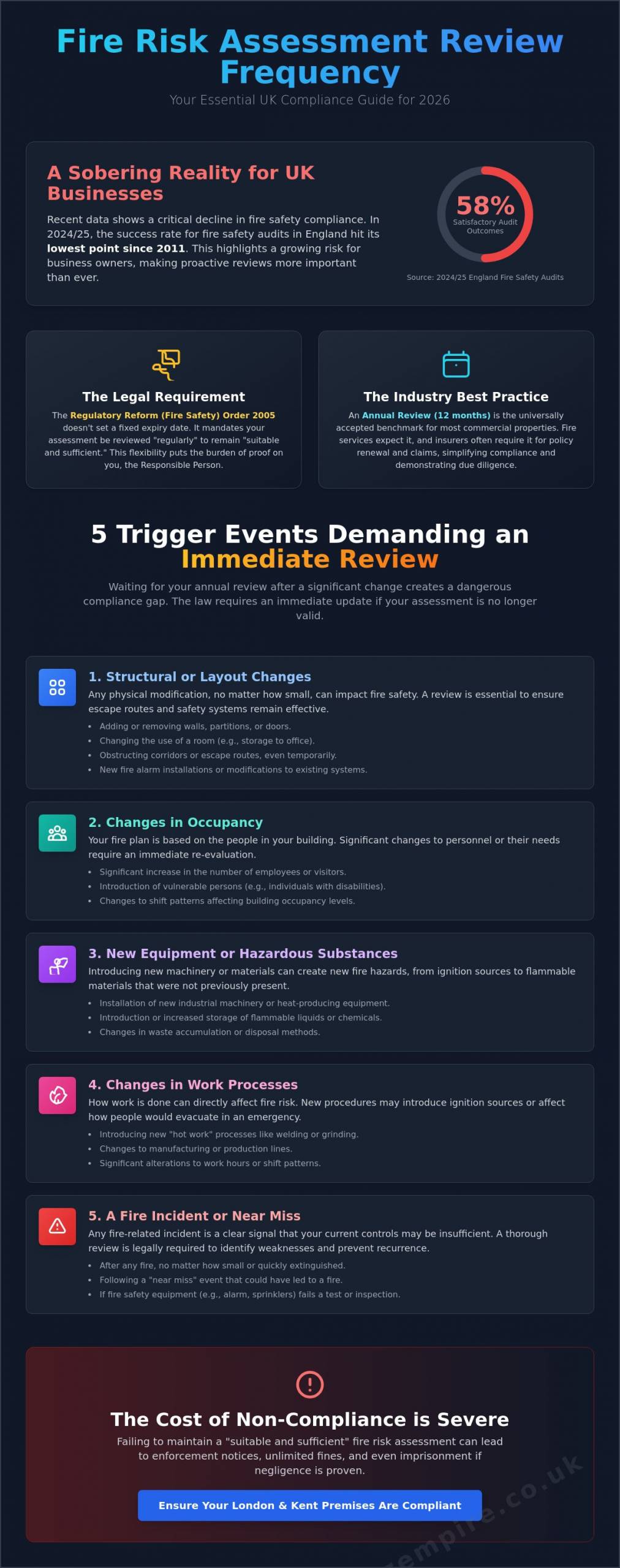
Did you know that only 58% of fire safety audits in England yielded a satisfactory outcome in 2024/25? This represents the lowest success rate since 2011. It's a sobering statistic that highlights why many business owners feel anxious about their upcoming inspections. You likely understand that safety is a priority, but the legal ambiguity between a regular review and a fixed expiry date creates unnecessary stress. Determining the correct fire risk assessment review frequency shouldn't be a guessing game that puts your business at risk of unlimited fines or legal action.
We've created this 2026 compliance guide to give you peace of mind and a clear path forward. You'll learn the exact legal requirements and industry standards needed to maintain a suitable and sufficient assessment. We'll outline the specific trigger events that demand an immediate review and explain how the new BS 5839-1:2026 standards impact your current safety strategy. By following this structured approach, you can ensure your premises remain safe and fully compliant with the latest UK legislation.
Key Takeaways
- Understand why the law requires a "regular" review rather than a fixed expiry date to keep your premises suitable and sufficient.
- Identify the five specific trigger events, including structural changes and personnel shifts, that mandate an immediate update to your documentation.
- Learn how to determine the correct fire risk assessment review frequency based on your building's risk profile and recent operational changes.
- Clarify the legal definition of a "Competent Person" to ensure your safety audits meet the strict standards required by UK fire authorities.
- Discover how to navigate complex compliance challenges in London and Kent with the support of an accredited fire safety partner.
Fire Risk Assessment Review Frequency: Legal Requirements vs. Best Practice
The Regulatory Reform (Fire Safety) Order 2005 serves as the foundation for modern fire safety in England and Wales. This legislation doesn't provide a specific calendar date for when your documentation expires. Instead, it requires that your assessment remains "suitable and sufficient." To achieve this, the law dictates that the document must be reviewed "regularly." While this phrasing allows for flexibility, it also places the burden of proof on you. You must demonstrate that your fire risk assessment review frequency is appropriate for the specific hazards present in your building.
UK fire safety regulations establish that a fire safety plan is essential for any non-domestic premises. In the UK, this plan is the fire risk assessment. Under current 2026 UK legislation, the Responsible Person is the individual or legal entity in control of the premises, such as the employer or building owner, who bears the legal duty to ensure all fire safety measures are implemented and maintained. Failure to meet these duties can lead to unlimited fines or even imprisonment if negligence is proven.
The "Annual Review" Standard
Across Kent and London, the 12-month mark is the universally accepted benchmark for commercial properties. Fire and Rescue Services expect to see an annual review as a minimum standard of care. Sticking to this schedule simplifies your insurance compliance. Most providers require proof of an up-to-date fire risk assessment before they'll renew a policy or settle a claim. It's a straightforward way to maintain your status as a responsible business owner.
Risk levels naturally dictate your timeline. A low-risk office with 10 employees might only need that standard annual check. However, a high-risk industrial site in the South East, perhaps dealing with flammable chemicals or complex machinery, often requires more frequent oversight to stay compliant. In these environments, waiting a full year to reassess hazards could leave your staff and property vulnerable.
When "Regular" Isn’t Enough
The law uses flexible language because fire risks aren't static. Your document is a living record. It actually dictates its own review schedule based on the findings of the initial assessor. If your last report identified significant risks or required major remedial works, you can't wait a full year to check your progress. You must verify that the new controls are working effectively.
The Fire and Rescue Authority holds the power to determine if your fire risk assessment review frequency is adequate during an audit. If they find that your business operations have changed but your assessment hasn't, you face the risk of enforcement notices. They look for evidence that you're proactive, not just reactive. Peace of mind comes from knowing your documentation accurately reflects the reality of your workspace today, not how it looked months ago.
5 Trigger Events: When an Immediate Review is Essential
The annual review is a reliable baseline, but it isn't a safety net for significant business changes. Under the Regulatory Reform (Fire Safety) Order 2005, you must update your assessment if you suspect it's no longer valid. Waiting for your scheduled anniversary after a major shift creates a dangerous compliance gap. Your fire risk assessment review frequency must adapt to the speed of your operations to remain legally "suitable and sufficient." Five specific triggers demand an immediate update: structural modifications, occupancy shifts, new equipment hazards, changes in work processes, and any "near miss" fire incidents.
1. Structural Changes and Building Layout
Physical modifications are the most common triggers for a new evaluation. Adding a single partition wall can block a smoke detector's field or obstruct a designated escape route. Even "temporary" changes, like storing stock in a corridor during a busy season, create immediate hazards that your current document doesn't account for. If you've undergone a new fire alarm installation or changed the building's use, such as converting a storage bay into a staff canteen, an immediate review is essential. This ensures your life safety systems still provide adequate coverage for the new layout.
2. Changes in Occupancy or Vulnerable Persons
Your assessment is based on the number and type of people using the building. If your staff count increases by 20% or you introduce night shifts, your evacuation plans may no longer be viable. The 2026 regulations place a heavy emphasis on protecting vulnerable residents and employees. Hiring a team member with a mobility or sensory impairment requires the creation of Personal Emergency Evacuation Plans (PEEPs). These shifts in personnel profile render your previous assessment obsolete because the risk to life has fundamentally changed. If you aren't sure if your current headcount exceeds your original assessment capacity, it's time to consult a fire safety expert.
3. Introduction of New Hazards or Equipment
Modern businesses constantly evolve their technology, which introduces new fire loads. Installing an IT server room or high-voltage equipment significantly changes the risk profile of a commercial unit. These additions often require an integration with your wider security systems to ensure early detection. As of 2026, the rise of EV charging points in commercial car parks has become a specific point of concern for fire authorities. If you've added hazardous chemical storage or new machinery, your fire risk assessment review frequency must be immediate to account for these specific ignition sources and fuel loads.
Review vs. Re-Assessment: Which One Do You Need?
Understanding the distinction between a review and a full re-assessment is vital for maintaining compliance without over-extending your resources. A review is essentially a high-level audit of your existing document. It confirms that the risks identified previously haven't changed and that the controls you put in place are still working. Conversely, a new assessment is a comprehensive, from-scratch evaluation of the entire premises. While your fire risk assessment review frequency might suggest an annual check, you need to know when that check must evolve into a complete overhaul.
Documenting every review is a legal necessity. Even if your walk-through reveals that absolutely nothing has changed in your office or warehouse, you must record that the review took place. An unsigned or undated assessment is viewed by inspectors as an expired one. This simple administrative step provides the paper trail needed to prove you're meeting your obligations under the Fire Safety Order. It gives you the evidence required during a Fire and Rescue Service audit to show you've remained proactive.
The Internal Review Checklist
A standard review often involves walking the floor to verify the physical state of your safety measures. You should inspect fire doors for damage, ensure escape routes are clear, and confirm you have the correct fire extinguisher types for the specific hazards present. For example, a CO2 extinguisher must be available near electrical clusters. You should also check maintenance logs to ensure your fire alarms and emergency lighting have been tested according to the 2026 standards. Finally, verify that your designated fire marshals are still employed and that their training remains current.
When to Commission a Full Professional Assessment
There are times when a simple internal review isn't sufficient to protect your business. If your building has undergone the major trigger events discussed earlier, such as structural extensions or a change in use, a professional must start over. Industry best practice suggests that even with annual internal reviews, a full professional assessment should be commissioned every 3 to 5 years. This ensures that blind spots don't develop over time as staff become accustomed to minor, incremental changes in the workspace.
A full re-assessment is also mandatory following any fire-related incident or a "near miss." If a small electrical fire occurred in a breakroom, your previous assessment clearly failed to account for a specific risk. In 2024/25, only 58% of fire safety audits had a satisfactory outcome. This low figure suggests that many businesses rely on superficial reviews when a deeper, professional evaluation was required to identify hidden vulnerabilities. Investing in a full assessment provides a fresh perspective from a competent person, ensuring your safety strategy remains robust and reliable.
Who is Qualified to Review a Fire Risk Assessment?
A "competent person" is defined under UK law as someone who has sufficient training, experience, and knowledge to carry out the task at hand. While the legislation doesn't mandate a specific certificate for every scenario, the complexity of your building dictates the level of expertise required. For a small, single-room shop, the owner might manage a basic review. However, for multi-storey offices in London or industrial units in Kent, a DIY approach carries significant legal and safety risks. Professional assessments are a no-nonsense investment in business continuity that ensures your safety strategy withstands the scrutiny of a fire inspector.
When you determine your fire risk assessment review frequency, you must also decide who will lead that review. A professional assessor brings an objective eye to your premises, identifying hazards that staff might overlook due to "site blindness." You should look for individuals or companies with BAFE accreditation and robust professional indemnity insurance. These credentials prove the assessor has been third-party verified and that your business is protected should any recommendations be challenged after an incident. Relying on an unaccredited source can leave you vulnerable to the 79% increase in prosecutions recently seen across England.
The Role of the Responsible Person
Legal accountability is a burden that stays with the Responsible Person. You can delegate the task of conducting a review to a trusted partner, but you cannot delegate the legal liability if things go wrong. Your primary duty is to act on any recommendations found during the review process. If an assessor identifies that your fire doors require new seals, ignoring that advice is a direct breach of the Fire Safety Order. To satisfy fire inspectors during an unannounced audit, you must maintain a clear written record of every review, detailing the date, the person who conducted it, and any remedial actions taken.
Why Professional Accreditation Matters
Accreditation from bodies like the Institution of Fire Engineers (IFE) provides a gold standard of reliability. These certifications are often a prerequisite for insurance providers. Many insurers in the South East now offer more competitive premiums to businesses that can demonstrate their fire safety strategy is managed by certified experts. This third-party validation acts as a seal of quality, proving your commitment to total compliance. At Quartz Empire, we provide accredited and meticulous evaluations that integrate your assessment with your wider safety systems. If you need to ensure your documentation is legally "suitable and sufficient," you can book a professional fire risk assessment with our expert team today.
Maintaining a consistent fire risk assessment review frequency with an accredited provider ensures your business remains a safe environment for employees and visitors alike. This proactive approach prevents minor issues from escalating into major compliance failures. By choosing a certified professional, you gain the peace of mind that your life safety systems are designed, maintained, and reviewed to the highest possible standards.
Ensuring Total Fire Safety Compliance in London and Kent
The commercial landscape of London and the South East presents unique challenges that generic safety guides often overlook. High-density urban environments and historic structures in areas like the City or Maidstone require a specialized approach to risk management. Your fire risk assessment review frequency must account for these complexities, especially in multi-tenanted buildings where a neighbor's change in operations can directly impact your safety profile. If a nearby unit begins storing hazardous materials or alters its internal layout, your current assessment may no longer be "suitable and sufficient" under the law.
A truly compliant strategy goes beyond a single document. It requires the seamless integration of your physical life safety systems. For example, your assessment should dictate the specific settings for your access control systems to ensure all electronic locks release instantly during an alarm. This prevents life-threatening bottlenecks during an evacuation. With fire and rescue services attending 628,764 incidents in the year ending June 2025, the importance of a fully functional, integrated safety network has never been clearer.
Local Expertise: From Maidstone to the City
Fire authorities in Kent and London have become increasingly rigorous in their enforcement. Recent data shows a 79% increase in prosecutions in England in the 12 months leading to March 2024. This trend highlights why a "no-nonsense" approach to compliance is essential for business continuity. As your trusted partner, we understand the specific expectations of local inspectors. We help you avoid the pitfalls that led to only 58% of the 51,020 fire safety audits in 2024/25 receiving a satisfactory outcome. Whether you operate a modern office in Canary Wharf or an industrial unit in Ashford, we provide the accredited expertise needed to keep your people and property secure.
Don't wait for a formal inspection or a "near miss" to discover that your documentation is out of date. Breaches of the Fire Safety Order now carry the risk of unlimited fines and, in serious cases, up to two years in prison. We provide a reliable, professional service that covers everything from the initial evaluation to the maintenance of your alarms and extinguishers. Contact our team today to schedule a comprehensive review that meets the 2026 standards.
Next Steps for Your Business
To ensure your business remains on the right side of the law, we recommend taking the following immediate actions:
- Check your records: Locate your last Fire Risk Assessment and verify the date of its last professional review.
- Audit for changes: Walk your premises to identify any "Trigger Events," such as new machinery, structural partitions, or significant changes in staff numbers.
- Verify maintenance: Ensure your fire alarm and emergency lighting logs are up to date and compliant with BS 5839-1:2026.
- Consult the experts: Reach out to an accredited professional to determine if your current fire risk assessment review frequency is adequate for your specific risk level.
Taking these steps today provides the peace of mind that your business is protected, compliant, and ready for any audit. Our expert team is ready to support your safety goals across Kent, London, and the South East.
Secure Your Business Compliance Today
Maintaining a safe workspace requires more than just a document on a shelf. It demands a proactive strategy that keeps pace with your business growth. You've seen that the law requires your assessment to remain suitable and sufficient; therefore, your fire risk assessment review frequency must be dictated by your building's specific risks and any operational changes. Whether you're managing a complex office in London or an industrial site in Kent, the 2026 standards leave no room for ambiguity.
Relying on an accredited expert ensures your documentation stands up to the scrutiny of the Fire and Rescue Service. Don't risk the penalties associated with the recent 79% increase in fire safety prosecutions across England. Instead, partner with a certified team that provides a no-nonsense approach to total compliance. We help you navigate these regulations with precision and provide the peace of mind that your people and property are fully protected.
Book Your Professional Fire Risk Assessment Review with Quartz Empire to ensure your business remains secure and compliant. Our team of accredited fire safety experts is ready to support your operations across London, Kent, and the South East. We are here to help you stay safe.
Frequently Asked Questions
Is it a legal requirement to have a fire risk assessment every year?
The law doesn't mandate a specific annual deadline, but it's the recognized industry standard for compliance. The Regulatory Reform (Fire Safety) Order 2005 requires that your assessment stays "suitable and sufficient" through regular reviews. Most Fire and Rescue Services in London and Kent expect a yearly check to ensure your safety measures haven't lapsed or become outdated due to minor site changes.
Can I review my own fire risk assessment if I am the business owner?
You can legally conduct your own review if you're considered a "competent person" with the necessary training and experience. However, this is often risky for complex or multi-tenanted commercial properties. If you miss a technical hazard that leads to an incident, you remain legally liable. Many owners in the South East choose an accredited partner to ensure their documentation meets the rigorous 2026 standards.
What happens if my fire risk assessment is out of date?
An expired assessment leaves you vulnerable to unlimited fines and potential prosecution. Fire authorities can issue enforcement notices that force you to close your doors until the building is safe. Beyond the legal risks, your commercial insurance policy may be voided if you can't prove you've maintained a valid assessment. This puts your entire business continuity at significant risk if a fire occurs.
How long does a fire risk assessment review take to complete?
A standard review for a mid-sized office typically takes between two and four hours to complete on-site. This duration depends entirely on the size of your premises and the complexity of your safety systems. Your chosen fire risk assessment review frequency will influence this, as regular updates make the process much faster than starting a full re-assessment from scratch after years of neglect.
Does a change in office furniture require a new fire risk assessment?
You must review your assessment if the furniture change alters the fire load or obstructs escape routes. Adding 15 new workstations or high-density storage units is a "trigger event" because it changes the occupancy and fuel levels in the room. You don't always need a full new document, but you must record that you've reviewed the layout and verified that your evacuation plan remains viable.
What is the difference between a fire safety audit and a risk assessment review?
A fire safety audit is an official inspection conducted by the Fire and Rescue Service to check your compliance. A risk assessment review is the internal process you manage to keep your safety documentation current. Think of the review as your proactive preparation and the audit as the external test. Keeping your reviews up to date ensures you're always ready for an unannounced visit from an inspector.
How much does a professional fire risk assessment review cost in the UK?
Professional reviews vary based on building size, with costs typically starting around £150 for small, low-level shops. According to 2026 industry data, a mid-level two-storey office averages approximately £425 for a thorough evaluation. For complex high-rise buildings or industrial sites, the cost can reach £925 or more. These figures reflect the expertise required to ensure your business remains fully compliant with the latest British Standards.
Do I need a written record of my review if I have fewer than five employees?
Yes, all businesses must now maintain a written record regardless of their staff count. This change was introduced on October 1, 2023, under Section 156 of the Building Safety Act. You must document your findings and your fire risk assessment review frequency to prove you're meeting your legal duties. Previous exemptions for small teams no longer exist, so every "Responsible Person" must hold a physical or digital copy of their assessment.