
Fire Risk Assessment: A Complete Guide for UK Businesses

For any UK business owner, the responsibility of fire safety can be a significant source of concern. Navigating complex legal duties, the fear of severe fines, and the potential for business disruption can feel overwhelming. At the core of your compliance strategy is one critical document: the fire risk assessment. It is your legal and moral duty to ensure one is completed and regularly reviewed to protect your people and property.
But what does the process actually involve? Are you qualified to do it yourself, or do you need a certified expert? This complete guide provides the clear, no-nonsense answers you need. We will explain your legal obligations under UK law, walk you through the essential 5-step process, and provide an actionable plan to make your commercial property fully compliant and safe. Read on to gain the peace of mind that comes from being in complete control of your fire safety.
Key Takeaways
- Clarify your legal responsibilities as a UK business owner to ensure your premises are fully compliant with fire safety law.
- Learn the official 5-step process for conducting a thorough fire risk assessment, from identifying hazards to documenting your findings.
- Discover the most common fire hazards in commercial properties and the effective control measures you can implement to reduce risk.
- Determine if you can perform the assessment yourself by understanding the legal definition of a 'Competent Person'.
What is a Fire Risk Assessment & Why is it a Legal Duty in the UK?
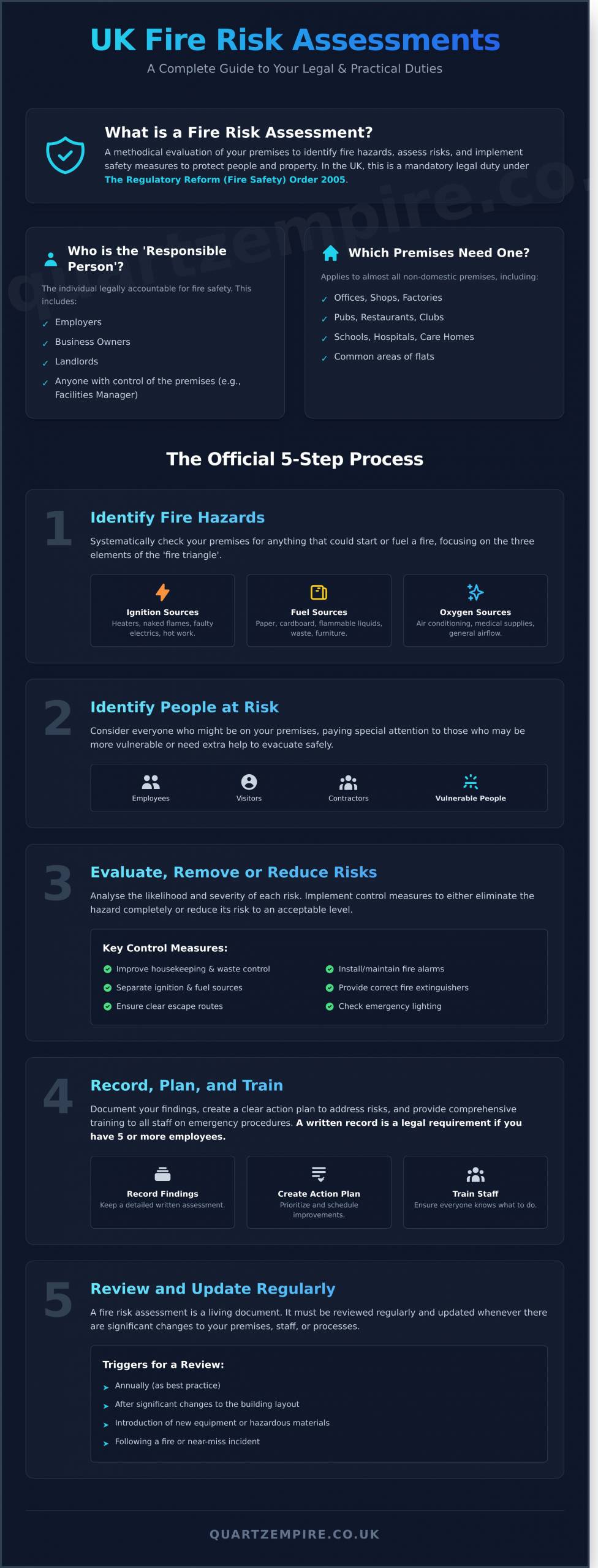
A fire risk assessment is a methodical and practical evaluation of your business premises to identify potential fire hazards and the people who may be at risk. It is a specific application of the broader principles of risk assessment, focused entirely on fire safety. The core purpose is not just to tick a box; it is a critical process designed to protect lives, prevent injuries, and safeguard your property and business continuity. By understanding the risks, you can implement effective and compliant fire safety measures.
In the UK, this is not optional advice-it is a mandatory legal duty. The foundational legislation is The Regulatory Reform (Fire Safety) Order 2005. This law places the responsibility for fire safety squarely on the shoulders of business owners and managers. Failure to conduct and maintain a suitable and sufficient assessment can lead to severe penalties, including unlimited fines and, in the most serious cases, imprisonment. Ensuring compliance provides peace of mind and protects your organisation from significant legal and financial repercussions.
The 'Responsible Person': Who is Legally Accountable?
The Fire Safety Order 2005 identifies a ‘Responsible Person’ who holds the legal duty for fire safety. This is typically the employer, the owner of the premises, a landlord, or anyone else with control over the building, such as a facilities manager. Their primary duties include carrying out a thorough fire risk assessment, implementing and maintaining appropriate fire safety measures, and keeping a formal record. Crucially, while you can hire an expert to conduct the assessment, the legal responsibility cannot be delegated.
Which Premises Require a Fire Risk Assessment?
The requirement applies to almost all non-domestic premises in the UK. If anyone other than the occupants of a single private dwelling has access to a property, an assessment is needed. This includes a vast range of commercial and public properties, such as:
- Offices and shops
- Warehouses and factories
- Pubs, clubs, and restaurants
- Schools, hospitals, and care homes
- The common areas of multi-occupied residential buildings (e.g., blocks of flats)
If your business has five or more employees, you are legally required to maintain a formal, written record of your assessment and its findings. The only significant exception is a private domestic dwelling occupied by a single family.
The 5 Steps of a Fire Risk Assessment: A Practical Walkthrough
Conducting a compliant and effective fire risk assessment follows a structured, five-step methodology endorsed by UK authorities. This logical framework ensures a thorough evaluation, with each step building upon the last to create a comprehensive safety strategy for your premises. Documenting this process is not just good practice; for most businesses, it is a legal requirement that provides a clear record of your commitment to safety and compliance.
Step 1: Identify All Potential Fire Hazards
The first step is a meticulous survey of your premises to identify anything that could start or fuel a fire. This requires looking at the three components of the 'fire triangle'. Consider all potential sources, including:
- Sources of Ignition: Electrical equipment (especially if faulty or portable), heaters, naked flames, smoking areas, and hot work processes like welding.
- Sources of Fuel: Combustible materials such as paper and cardboard, flammable liquids, furniture, textiles, and accumulated waste.
- Sources of Oxygen: Beyond the natural air supply, consider air conditioning systems or medical oxygen supplies which can intensify a fire.
Step 2: Identify People at Risk
With hazards identified, you must then determine who could be harmed in the event of a fire. This extends beyond your employees to include anyone who might be on your premises, such as visitors, contractors, or members of the public. Pay special attention to vulnerable individuals-including those with disabilities, lone workers, or young people-who may need specific assistance to evacuate safely. It is also crucial to consider different times of day, such as night shifts when staffing levels may be lower.
Step 3: Evaluate, Remove, or Reduce Risks
This step involves analysing the risks you have found and taking decisive action to protect people and property. For each hazard, evaluate the likelihood of a fire starting and the potential severity of the outcome. The goal is to remove these risks entirely or, if that is not possible, reduce them to an acceptable level. Practical control measures include improving housekeeping to reduce fuel loads, separating ignition sources from combustible materials, and ensuring your fire safety provisions-such as fire alarms, extinguishers, and emergency lighting-are professionally installed and maintained.
Step 4 & 5: Record, Plan, Instruct, Train, and Review
The final, crucial stages involve formalising and maintaining your safety procedures. You must record any significant findings from the assessment and the actions you have taken to mitigate them. From this, create a clear emergency plan detailing evacuation procedures and roles. This information must be communicated through robust instruction and training for all staff. Finally, your fire risk assessment is a dynamic document; it must be reviewed regularly (typically annually) or whenever significant changes occur in your business to ensure it remains relevant and effective.
Common Fire Hazards in Commercial Properties (and How to Mitigate Them)
Moving beyond regulatory theory, a professional fire risk assessment identifies tangible dangers present in your day-to-day operations. Recognising these common hazards is the first step towards creating a genuinely safe environment for your staff and visitors, a core legal responsibility outlined in the official government guidance. Below, we detail the most frequent issues our accredited assessors find in UK commercial properties.
Electrical Faults and Misuse
Electrical systems are a leading cause of workplace fires. Common culprits include overloaded plug sockets, daisy-chained extension leads, and deteriorating or faulty wiring. Portable appliances that have not undergone regular Portable Appliance Testing (PAT) also present a significant risk, capable of igniting nearby combustible materials without warning.
- Mitigation: Schedule routine inspections and maintenance of your electrical infrastructure by a certified, qualified electrician. Implement a PAT testing schedule for all portable equipment and educate staff on the dangers of overloading sockets. All electrical work must be carried out by a competent professional to ensure compliance and safety.
Similarly, poorly maintained gas appliances and central heating systems are a significant fire and explosion hazard. If you suspect an issue with your boiler, it is crucial to seek professional help immediately; for emergency service information, you can click here.
Poor Housekeeping and Storage
A cluttered workplace is a high-risk workplace. Accumulated combustible waste like cardboard and paper, blocked fire exits or corridors, and the incorrect storage of flammable materials can allow a fire to start and spread rapidly, while also impeding escape. This is one of the easiest hazards to control, yet one of the most commonly overlooked.
- Mitigation: Implement and enforce a clear housekeeping policy, including daily waste removal. Use clear floor markings to keep escape routes and corridors unobstructed. Flammable substances must be stored in designated, well-ventilated areas away from ignition sources. Crucially, ensure fire doors are never wedged or propped open, as they are essential for containing fire and smoke.
Negligence and Human Error
Unfortunately, human behaviour remains a significant factor in many workplace fires. This includes smoking in non-designated areas, the misuse of portable heaters placed too close to furniture, or simple arson. A lack of staff awareness and training often exacerbates these risks, turning a minor incident into a major emergency.
- Mitigation: Establish a strict smoking policy with clearly signed, designated outdoor areas. The most effective control is comprehensive staff fire safety training, a key outcome of a thorough fire risk assessment. This ensures your team knows how to prevent fires and how to react correctly to protect themselves and others if one occurs.
After the Assessment: The Report, Action Plan, and Regular Reviews
Completing the physical inspection of your premises is a critical first step, but it is only the beginning. The true value of a professional assessment lies in the documented findings and the subsequent actions you take to mitigate risks. A thorough report provides a clear, compliant roadmap to enhancing safety, giving you peace of mind and creating a legally defensible record of your due diligence as a 'Responsible Person'.
What Should a Fire Risk Assessment Report Contain?
A comprehensive fire risk assessment report is more than just a checklist. It is a detailed document that provides a complete picture of your fire safety status. At a minimum, it should include:
- An overview of the premises, its use, and details of the 'Responsible Person'.
- A detailed list of all significant findings and identified fire hazards (e.g., combustible materials stored near ignition sources).
- An evaluation of your existing fire safety measures, including fire alarms, emergency lighting, and extinguisher suitability.
- A clear, prioritised list of recommended actions to rectify any deficiencies and ensure compliance.
Creating and Implementing an Action Plan
Your report's recommendations form the basis of your action plan. To manage this effectively, you must prioritise tasks based on risk level-addressing high-risk issues like a blocked fire escape immediately. Assign responsibility for each action to a specific person, set realistic deadlines for completion, and crucially, document when each task is finished. This creates a clear audit trail demonstrating proactive safety management.
How Often Should You Review Your Fire Risk Assessment?
Fire safety is not a one-time task; your assessment is a living document that must adapt to your business. We recommend a formal review at least annually as best practice. However, an immediate review is essential following certain triggers:
- Significant changes to the building: Such as an extension, a change in layout, or new internal partitions.
- New processes or materials: Introducing highly flammable substances or new, high-risk machinery.
- A change in occupants: A significant increase in staff numbers or the presence of more vulnerable people.
- After a fire or near-miss: To learn lessons and prevent a recurrence.
Staying on top of these reviews ensures your fire safety measures remain effective and fully compliant. For expert guidance on implementing your action plan or scheduling a review, get in touch with our accredited team.
DIY vs. Professional Assessors: Who is a 'Competent Person'?
One of the most common questions business owners ask is, "Can I do my own fire risk assessment?" The answer is technically yes, but only if you meet the legal definition of a 'Competent Person'. Under UK law, this is someone with sufficient training, experience, and knowledge to identify fire hazards and implement the necessary precautions. The responsibility for a compliant assessment rests entirely on you, the Responsible Person.
This principle of competency through accredited training is crucial across all high-risk sectors. For instance, in the construction industry, providers like YTA Training offer intensive courses to ensure tradespeople meet stringent safety and skill standards.
An inadequate assessment can lead to oversights that jeopardise lives, as well as significant fines or even imprisonment. Therefore, it is crucial to make an honest evaluation of your capabilities before proceeding.
When a DIY Assessment Might Be Suitable
A self-assessment may be appropriate for very small, simple, and low-risk premises. This could include a single-floor office with a small number of staff or a small retail shop with no significant fire hazards. If you have the time, a thorough understanding of fire safety principles, and are confident you can produce a detailed, legally compliant document, a DIY approach could be an option. However, you must be prepared to defend its adequacy if challenged.
When You MUST Hire a Professional Assessor
For the vast majority of businesses, engaging a professional is the only reliable and safe choice. We strongly advise hiring an expert assessor in the following circumstances:
- Complex Premises: Multi-story buildings, large factories, warehouses, or sites with multiple buildings.
- High-Risk Environments: Premises where flammable materials are stored or used, or where there is sleeping accommodation (e.g., hotels, care homes, HMOs).
- Lack of Expertise or Time: If you are not completely confident in your knowledge of current fire safety legislation or simply lack the time to conduct a thorough evaluation.
- Need for Assurance: To gain the peace of mind that comes from an independent, accredited, and insured assessment that guarantees compliance.
Benefits of Using an Accredited Assessor
Partnering with a certified professional offers more than just a report; it provides a framework for robust safety and legal protection. An accredited assessor ensures your fire risk assessment is fully compliant with The Regulatory Reform (Fire Safety) Order 2005, delivering an unbiased and comprehensive action plan. This expert guidance helps you avoid costly mistakes, protects your business from potential legal action, and most importantly, keeps your people and property safe.
For a reliable, no-nonsense evaluation from a trusted partner, ensure compliance with our expert Fire Risk Assessment Services.
Secure Your Business with a Compliant Fire Risk Assessment
As we have explored, a fire risk assessment is not merely a procedural task; it is your fundamental legal duty and the cornerstone of a robust safety strategy in the UK. Understanding the five core steps, from identifying hazards to implementing a clear action plan, empowers you to proactively protect your people, premises, and assets. Regular reviews ensure this protection remains effective, maintaining a safe and compliant environment for everyone.
For complete peace of mind and guaranteed compliance, partnering with a competent professional is the most reliable path forward. At Quartz Empire, our accredited and certified assessors deliver a 'no nonsense' approach to fire safety for businesses throughout Kent, London, and the South East. We provide the expert support you need to meet your legal obligations with confidence.
Book Your Accredited Fire Risk Assessment in Kent, London or the South East.
Take the definitive step towards securing your business and ensuring everyone's safety today.
Frequently Asked Questions About Fire Risk Assessments
How much does a professional fire risk assessment cost in the UK?
The cost of a professional fire risk assessment in the UK depends on the size and complexity of your premises. For a small, simple business like a local shop or office, you can expect to pay between £200 and £500. For larger, more complex sites such as manufacturing facilities or multi-occupancy buildings, the cost can be £1,000 or more. The price reflects the time and expertise required to conduct a thorough, compliant assessment that protects your business.
How long is a fire risk assessment valid for?
While there is no legal expiry date, a fire risk assessment is a live document that must be reviewed regularly to remain valid. Best practice dictates a formal review by a competent person at least annually. A review is also legally required immediately following any significant changes to your premises, processes, or personnel, as this could impact fire safety risks. This ensures your assessment remains an effective and compliant safety tool for your business.
What happens if I don't have a fire risk assessment for my business?
Failing to have a suitable and sufficient fire risk assessment is a breach of the Regulatory Reform (Fire Safety) Order 2005. The consequences can be severe, including unlimited fines and, in serious cases, imprisonment for the Responsible Person. Furthermore, your business insurance could be invalidated in the event of a fire, leaving you personally and financially liable for all damages. It is a non-negotiable legal requirement designed to protect lives and property.
Is a fire risk assessment the same as a fire certificate?
No, they are not the same. Fire certificates were issued by local fire brigades under previous legislation but were abolished in England and Wales in 2006. The current legal requirement is for the business's 'Responsible Person' to conduct and maintain a fire risk assessment. This important change shifted the responsibility from a certification body directly to the business owner or manager, requiring them to proactively manage their own fire safety compliance.
What are the most common failings found during a fire risk assessment?
The most common failings often relate to basic maintenance and human error. These include blocked or obstructed fire exits and escape routes, inadequate or non-compliant fire safety signage, and fire doors being wedged open. Other frequent issues are a lack of regular fire alarm testing, poorly maintained fire extinguishers, and insufficient or undocumented staff fire safety training. These oversights can pose a significant risk and lead to non-compliance.
Do I need a fire risk assessment if I work from home?
If you are a sole trader working alone from your domestic property, a formal assessment is not typically required. However, the legal duty arises if you employ anyone else to work from your home, even on a part-time basis. You would also need one if clients or members of the public visit your home for business purposes, as you become responsible for their safety on your premises. In these cases, a proper assessment is essential.
What other fire safety services do I need besides an assessment?
An assessment is the foundation of your fire safety strategy; it identifies the specific measures you need. Based on its findings, you will likely require ongoing services such as the professional installation and regular maintenance of a compliant fire alarm system and emergency lighting. Other essential services include the supply and annual servicing of fire extinguishers and providing comprehensive fire warden and awareness training for your staff to ensure a prepared response.