
Fire Protection and Safety: A Complete Guide for UK Businesses (2026)

Navigating the complexities of UK fire safety regulations can be a daunting responsibility for any business owner. The fear of non-compliance, steep penalties, and the welfare of your team can feel overwhelming. Understanding your legal obligations for fire protection and safety is not just about ticking boxes; it’s about creating a genuinely secure environment for your people and property, providing essential peace of mind.
This comprehensive 2026 guide is designed to cut through the confusion. We will demystify the technical jargon, from active and passive systems to mandatory risk assessments, providing you with a clear, actionable checklist of essential requirements. You will gain a solid understanding of your duties under UK law and learn what a compliant, reliable fire safety strategy looks like for your specific business.
By the end of this article, you will have the clarity and confidence needed to protect your premises, ensure full compliance, and make informed decisions when choosing a trusted, accredited fire safety partner.
Key Takeaways
- Understand your legal duties under The Regulatory Reform (Fire Safety) Order 2005, which is the foundation of all commercial fire safety in the UK.
- A compliant fire protection and safety strategy integrates three essential pillars: Active systems to detect fire, Passive measures to contain it, and Procedural protocols for human response.
- Recognise that advanced equipment is only effective when supported by robust Procedural Fire Safety, including comprehensive staff training and clear evacuation plans.
- Learn why a one-size-fits-all approach is non-compliant and how to develop a bespoke fire strategy tailored to the unique risks of your business premises.
What is Fire Protection and Your Legal Duty in the UK?
Effective fire safety is not about a single piece of equipment; it is a comprehensive, legally mandated strategy. To understand what is fire protection in its entirety, it must be viewed as a combination of measures designed to prevent fire from starting, detect it quickly if it does, and contain its spread to protect lives and property. For any UK business, implementing robust fire protection and safety measures is not just best practice—it is a fundamental legal obligation.
At the heart of this duty is the 'Responsible Person'. This is typically the employer, business owner, or person in control of the premises. You are legally accountable for taking reasonable steps to reduce the risk from fire and ensure people can safely escape if a fire does occur. This responsibility is serious and non-delegable, making expert guidance essential for full compliance.
Understanding the Fire Safety Order 2005
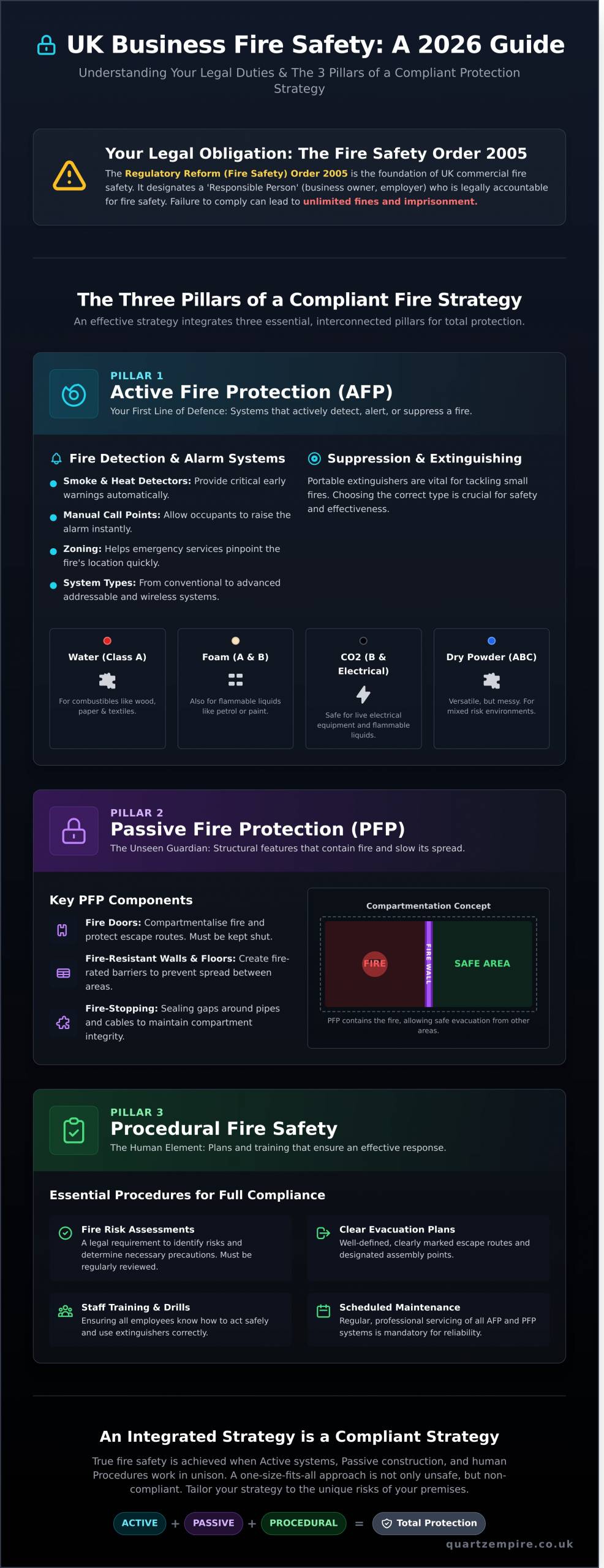
The key legislation governing fire safety in England and Wales is The Regulatory Reform (Fire Safety) Order 2005. It applies to virtually all non-domestic premises, including offices, shops, and factories. The Order requires the Responsible Person to conduct a thorough fire risk assessment, implement and maintain appropriate fire safety measures, and provide staff with adequate training. Failure to comply can result in severe penalties, including unlimited fines and, in the most serious cases, imprisonment.
The Three Pillars of a Robust Fire Safety Strategy
A compliant and effective fire safety plan is built on three interconnected pillars. Integrating all three ensures your premises are protected from every angle, creating a reliable safety net for your people and assets.
- Active Fire Protection (AFP): These are systems that require a trigger to activate and actively fight a fire. This includes fire alarm systems, smoke detectors, emergency lighting, fire extinguishers, and sprinkler systems.
- Passive Fire Protection (PFP): These are features built into the structure of your building to contain a fire and slow its spread. Examples include fire-resistant doors, walls, and floors, as well as fire-stopping materials that seal gaps in building compartments.
- Procedural Fire Protection: This pillar covers the human element of fire protection and safety. It involves creating and maintaining robust plans and procedures, such as regular fire risk assessments, clear evacuation plans, staff fire safety training, and scheduled maintenance of all safety equipment.
Pillar 1: Active Fire Protection (AFP) – Your First Line of Defence
Active Fire Protection (AFP) systems are your first line of defence in a fire emergency. These are the systems designed to react once a fire has started, either by detecting it and alerting occupants or by actively suppressing it. The primary goal of AFP is to enable a swift, safe evacuation and minimise the initial damage to your property. For any AFP system to be effective and compliant, regular, professional maintenance is not just recommended—it is a mandatory requirement for reliable fire protection and safety.
Fire Detection & Alarm Systems
A professionally installed fire alarm system is the cornerstone of your AFP strategy. Designed and maintained in accordance with British Standards like BS 5839, these systems provide critical early warnings. Key components include:
- System Types: From conventional systems for smaller premises to sophisticated addressable and wireless systems for larger, more complex buildings, the right choice depends on your specific needs.
- Detection Devices: Smoke and heat detectors automatically sense the first signs of a fire, while manual call points allow occupants to raise the alarm immediately.
- Zoning: Correct zoning is essential as it helps emergency services quickly identify the fire's location, saving valuable time.
Fire Suppression & Extinguishing Systems
Once a fire is detected, suppression systems work to control or extinguish it. While automatic sprinklers provide robust, 24/7 protection for larger commercial buildings, portable fire extinguishers are vital for tackling small, incipient-stage fires. Selecting the correct extinguisher is crucial and depends on the specific fire risks in your workplace:
- Water (Class A): For combustible materials like wood and paper.
- Foam (Class A & B): For combustible materials and flammable liquids.
- CO2 (Class B & Electrical): For flammable liquids and live electrical equipment.
- Dry Powder (Class A, B, C): A versatile but messy option for multiple fire types.
- Wet Chemical (Class F): Specifically for deep-fat cooking fires in commercial kitchens.
Emergency & Exit Lighting
In the event of a power failure during a fire, your building must remain safely navigable. Emergency lighting is a legal requirement that illuminates escape routes, allowing for an orderly evacuation. As part of your legal duty, you must ensure these systems are correctly installed and maintained. There are two primary types:
- Maintained: The luminaires are lit continuously and remain lit during a power outage, often used in public venues like cinemas.
- Non-Maintained: These only illuminate when the main power supply fails, which is common in most workplaces.
Clear, unambiguous fire exit signage is an equally critical component, guiding people to safety without causing confusion.
Pillar 2: Passive Fire Protection (PFP) – The Unseen Guardian
While active systems like alarms alert you to danger, Passive Fire Protection (PFP) is the silent, structural guardian working 24/7 to keep your premises safe. Built into the very fabric of your building, PFP comprises components designed to contain a fire and its smoke to their area of origin. This containment is critical; it protects escape routes, slows the spread of flames, and provides the vital time needed for occupants to evacuate safely. Unlike systems that require activation, PFP is always on, but its effectiveness depends entirely on its integrity being maintained.
A single breach, such as a propped-open fire door or an unsealed gap in a wall, can render an entire PFP strategy useless. Ensuring your passive fire protection and safety measures are correctly installed and maintained is a non-negotiable part of your legal responsibility.
Fire Doors: More Than Just a Door
A certified fire door is a highly-engineered safety device, not merely an access point. Ratings like FD30 or FD60 indicate that the complete door set is certified to resist fire for a minimum of 30 or 60 minutes. Its performance relies on a complete system of components working together, including intumescent seals that expand with heat to seal the door, smoke seals to stop toxic fumes, and a reliable closing mechanism. Propping a fire door open or using incorrect, uncertified hardware creates a dangerous breach in your building's defences. Maintaining these doors is a fundamental part of Your Legal Duty in the UK and is essential for protecting lives.
Fire Compartmentation Explained
Fire compartmentation is the principle of dividing a building into smaller, fire-resistant sections using specialist walls, floors, and ceilings. In effect, it creates a series of secure boxes within the property. Should a fire start in one compartment, these robust barriers are designed to contain it for a specified period, preventing its rapid spread. A crucial element of this system is fire-stopping. Any gaps created by pipes, cables, or ductwork passing through a fire-rated barrier must be sealed with certified fire-stopping materials to ensure there are no weak points for fire or smoke to exploit.
Pillar 3: Procedural Fire Safety – The Essential Human Element
Advanced fire detection systems and modern extinguishers are critical assets, but they are rendered ineffective without the essential human element. Procedural fire safety is the brain of your entire strategy, coordinating your people and equipment into a cohesive and effective response. For UK businesses, these procedures are not just best practice; they are legal duties placed squarely upon the designated ‘Responsible Person’ to ensure comprehensive fire protection and safety.
This pillar is built on knowledge, training, and documentation. It ensures that in the critical moments of an emergency, your team acts decisively and correctly, turning a potential disaster into a managed incident. Neglecting this human element is a direct failure of your legal and moral duty of care.
The Fire Risk Assessment: Your Mandatory Starting Point
Under The Regulatory Reform (Fire Safety) Order 2005, a suitable and sufficient Fire Risk Assessment (FRA) is the non-negotiable, legal starting point for all fire safety planning. This document is the cornerstone of your strategy, informing every decision you make, from equipment installation to staff training. The process involves five key steps:
- 1. Identify Hazards: Pinpoint potential sources of ignition, fuel, and oxygen.
- 2. Identify People at Risk: Consider employees, visitors, and vulnerable individuals.
- 3. Evaluate and Act: Remove or reduce risks and implement control measures.
- 4. Record: Document your significant findings, the actions taken, and your emergency plan.
- 5. Review: Regularly review and update the assessment to reflect any changes in the workplace.
Fire Marshal & Staff Training
Your legal obligations extend to ensuring your team is competent and prepared. All staff require basic fire awareness training, including their specific evacuation procedures. Additionally, designated Fire Marshals (or Wardens) must receive enhanced training to confidently manage an emergency, clear designated zones, and assist with a safe, swift evacuation. Regular, documented fire drills are essential to test these procedures and build muscle memory, ensuring your plan works in practice, not just on paper.
System Maintenance & Logbooks
Effective fire protection and system reliability depend on diligent, recorded maintenance. The law requires that all equipment, from alarms to emergency lighting, is kept in efficient working order. A dedicated fire safety logbook is your legal record of compliance, documenting every test, inspection, and service. This includes routine checks like weekly alarm tests and critical tasks such as annual servicing by an accredited engineer. Ensuring your systems are maintained by certified professionals is vital for both safety and legal compliance. Our expert team provides fully documented maintenance services to give you complete peace of mind.
Building Your Integrated Fire Strategy in London & The South East
Achieving compliant fire safety is about creating a seamless, integrated system where the three pillars we've discussed—Active, Passive, and Procedural—work in unison. A one-size-fits-all template simply doesn't exist for effective fire protection and safety. Every building in London, Kent, or the South East has unique characteristics, risks, and operational needs that demand a bespoke strategy. This is where engaging a trusted, professional partner becomes essential to ensure every component is correctly specified, installed, and maintained.
At Quartz Empire, we specialise in developing these tailored strategies for businesses across the region, transforming complex legal duties into a clear and manageable plan.
The Professional Assessment Process
Our assessment is a straightforward, no-nonsense process designed to provide you with complete clarity. It typically involves:
- A thorough on-site survey of your premises to identify its unique layout and risks.
- A detailed review of your existing Fire Risk Assessment (FRA) and documentation.
- A discussion to understand your specific business operations and building usage.
This detailed review culminates in a clear, prioritised action plan. We ensure your investment is directed where it's most needed, eliminating confusion and delivering cost-effective compliance.
Why Choose an Accredited & Certified Partner?
In an industry where competence is non-negotiable, third-party accreditations are your guarantee of quality and expertise. Accreditations from bodies like BAFE and the NSI demonstrate a commitment to excellence and adherence to the highest industry standards. Choosing a certified partner ensures that all work is performed by qualified engineers to the latest British Standards. This provides more than just a certificate; it delivers genuine peace of mind that your people and property are properly protected.
Your Next Step Towards Complete Fire Safety
Taking control of your fire safety strategy is a critical step towards securing your business's future. Gaining a clear understanding of your compliance requirements and potential vulnerabilities is the most effective way to achieve lasting peace of mind. To discuss your specific needs and begin building a robust, reliable plan, we invite you to connect with our team. Schedule a no-obligation consultation with our Kent-based experts.
Your Trusted Partner in Comprehensive Fire Safety
As this guide has established, achieving true fire safety compliance in the UK is not about a single solution, but a holistic, integrated strategy. The synergy between Active Fire Protection systems, robust Passive Fire Protection infrastructure, and clear Procedural Safety is what creates a truly resilient defence. Neglecting any one of these pillars leaves your business, your assets, and most importantly, your people, vulnerable.
Implementing a complete strategy for fire protection and safety management is a critical responsibility. As BAFE & NSI Gold accredited specialists serving businesses across Kent, London, and The South East, Quartz Empire provides the expert guidance and comprehensive fire and security services you need for total peace of mind. Our no-nonsense approach ensures your premises are not just compliant, but genuinely secure.
Don't leave your safety to chance. Book a free site survey to assess your fire protection strategy. Let our certified team provide a comprehensive assessment and expert recommendations. Protecting your business is our priority.
Frequently Asked Questions About Fire Protection
What are the 5 main elements of fire protection?
Comprehensive fire safety is built upon five key pillars. These are: Prevention, which involves minimising ignition sources; Detection, using compliant alarm systems to provide early warnings; Containment, using features like fire doors to limit fire spread; Suppression, using equipment like extinguishers and sprinklers to control the fire; and finally, Evacuation, ensuring clear, safe escape routes. A robust strategy incorporates all five elements to fully protect your people and property.
What is the difference between fire prevention and fire protection?
Fire prevention includes all measures taken to stop a fire from starting, such as regular electrical testing, safe storage of flammable materials, and staff training. In contrast, fire protection refers to the systems and procedures designed to manage a fire once it has begun. An effective safety plan requires both diligent fire protection and prevention measures, as one is proactive and the other is reactive, working together to ensure complete safety and compliance.
Who is legally responsible for fire safety in a UK workplace?
In the UK, the legal responsibility for fire safety rests with the ‘Responsible Person’. As defined by the Regulatory Reform (Fire Safety) Order 2005, this is typically the employer, the owner of the premises, or anyone with control over the building, such as a facilities manager. This individual has a duty to conduct fire risk assessments, implement appropriate safety measures, and ensure all systems are correctly maintained to protect all relevant persons.
How often should a fire risk assessment be reviewed?
Your fire risk assessment must be reviewed regularly to ensure it remains current and effective. While UK law does not specify a fixed interval, best practice dictates a review at least once a year. A review is also legally required immediately following any significant changes to the premises, processes, or workforce, or after a fire incident. This ensures your safety measures remain adequate and fully compliant with current regulations.
What is a BS 5839 compliant fire alarm system?
A BS 5839 compliant fire alarm system is one that has been designed, installed, commissioned, and maintained in accordance with the relevant parts of the British Standard. This standard is the primary code of practice for fire detection and alarm systems in the UK. Compliance ensures your system is reliable, fit for its purpose, and meets the stringent requirements of legislation and insurance providers, offering you complete peace of mind.
Are fire drills a legal requirement for businesses in the UK?
Yes, conducting fire drills is a legal requirement for all businesses in the UK. The Regulatory Reform (Fire Safety) Order 2005 mandates that you must establish and maintain appropriate procedures for evacuation. Regular drills test these procedures and ensure your employees understand how to exit the building safely in an emergency. It is best practice to conduct a drill at least annually and record the results in your fire safety logbook.
What is the main purpose of passive fire protection?
The primary purpose of passive fire protection (PFP) is to contain a fire within a specific compartment of a building, limiting its spread. It involves structural components like fire-resistant walls, floors, and fire doors that are designed to resist fire for a set period. This containment strategy protects escape routes for occupants, provides valuable time for emergency services to respond, and minimises damage to the building and its assets.
Can I carry out my own fire risk assessment for my business?
You can legally conduct your own fire risk assessment if you are deemed a 'competent person'—meaning you have the necessary experience, knowledge, and training to do so effectively. However, for most businesses, particularly those with complex layouts or high-risk activities, we strongly recommend engaging a qualified and accredited professional. This ensures a thorough, compliant assessment that correctly identifies all risks and necessary control measures, safeguarding your business and its people.