
Fire Extinguisher Colours: A Complete UK Guide for Businesses
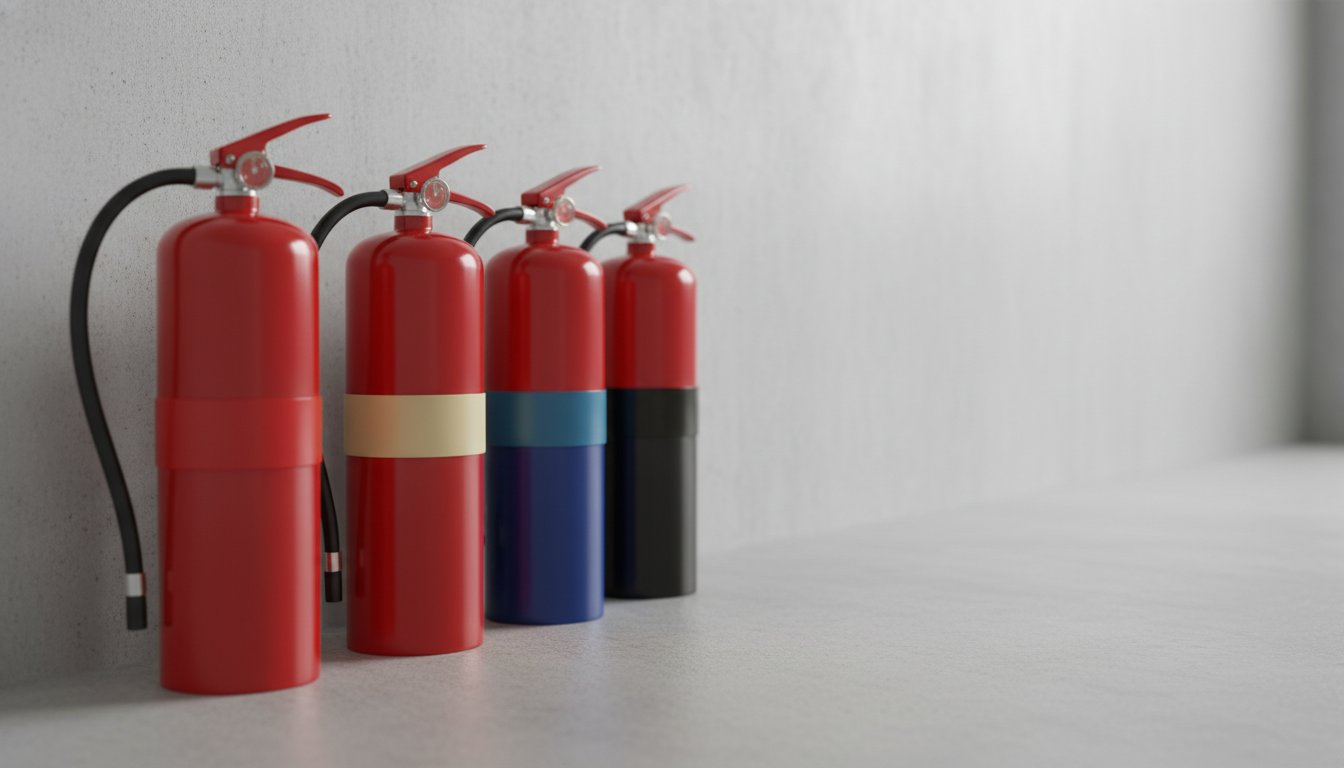
In the critical moments of a fire, hesitation can be costly. Faced with a row of seemingly identical red cylinders, how can you be certain you are reaching for the correct one in an emergency? That moment of uncertainty is precisely why understanding the UK's system of fire extinguisher colours is not just a matter of compliance, but a fundamental part of your business's safety strategy.
Failing a fire safety inspection or using the wrong extinguisher can have severe consequences. This guide provides a clear, no-nonsense breakdown of what each colour band signifies, the specific type of fire it tackles, and how to ensure your premises are fully protected and compliant with current UK fire safety law. By the end of this guide, you and your team will have the expert knowledge needed to act decisively, safeguarding your people and property and securing complete peace of mind.
Key Takeaways
- Learn why all modern UK fire extinguishers are red and how a small coloured band is the key to identifying their contents under the current BS EN3 standard.
- Quickly decode the UK's fire extinguisher colours to understand which type of extinguisher is required for the different classes of fire within your premises.
- Understand how identifying the correct extinguisher types is a critical part of your legal duty under the Regulatory Reform (Fire Safety) Order 2005.
- Recognise that correct identification is only the first step; UK law also requires annual servicing to ensure your extinguishers are compliant and ready for an emergency.
The Current UK Fire Extinguisher Colour Code Explained (BS EN3)
In the event of a fire, immediate and correct action is critical. Understanding the modern system of fire extinguisher colours is a fundamental part of fire safety compliance for any UK business. This system ensures that anyone can quickly identify the type of extinguisher they are using, which is essential for tackling a blaze safely and effectively without making the situation worse.
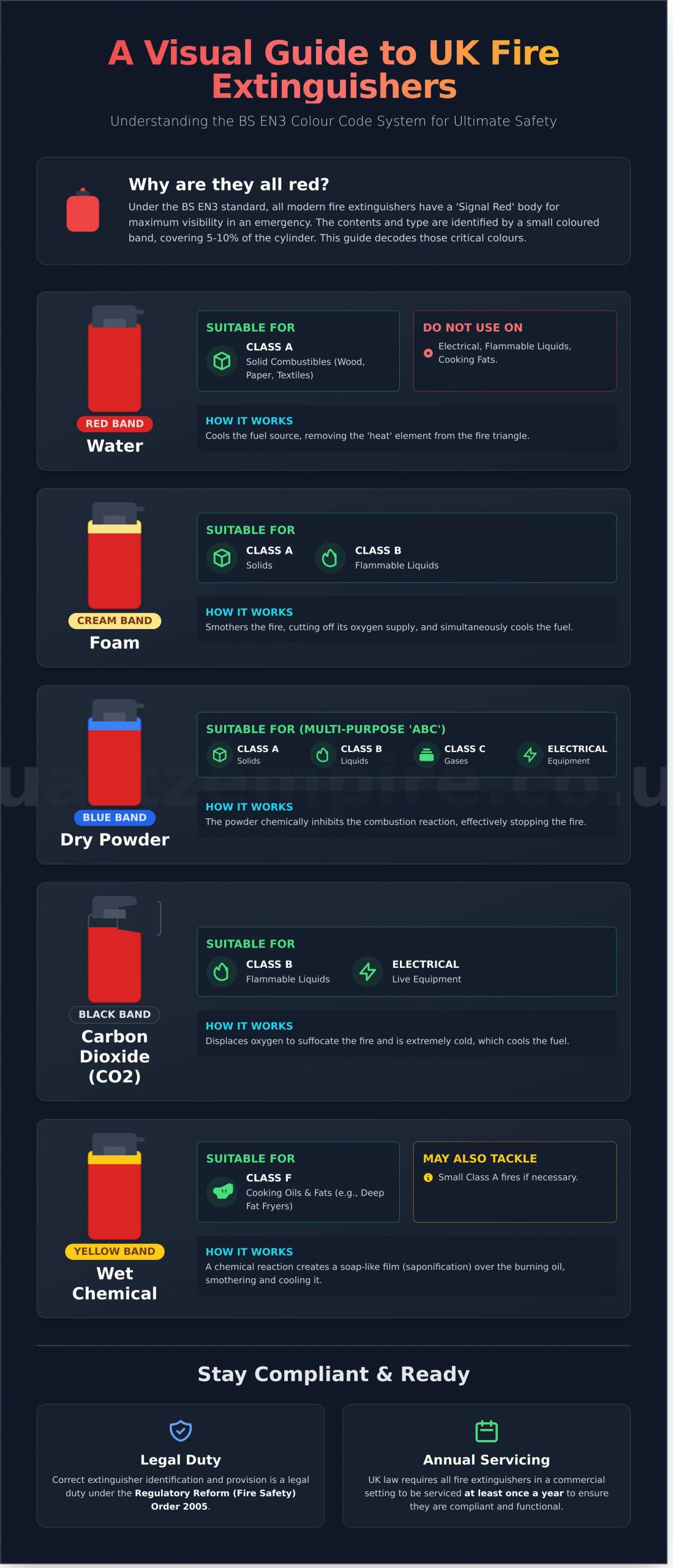
The current standard, BS EN3, was introduced in 1997 to harmonise standards across Europe and eliminate confusion. Under these regulations, all new fire extinguishers must have a body that is entirely 'Signal Red'. The contents and intended use of the extinguisher are now identified by a distinct colour-coded band or label, covering approximately 5-10% of the extinguisher's surface area.
Why is the Body Always Red?
The decision to standardise the main body colour to red was a critical safety measure. Red is universally recognised as a symbol of danger and fire, making the extinguishers highly visible and easy to locate in an emergency, even in a smoke-filled room. This uniformity replaced the previous British Standard where the entire extinguisher body was a solid colour, a system that could cause dangerous delays if someone was unfamiliar with the code.
Quick Reference Chart: Colours, Contents, and Fire Classes
To ensure your team can act decisively, it is vital they are familiar with the different fire extinguisher colours and their corresponding fire classes. This quick reference chart provides a clear, at-a-glance summary of the BS EN3 system used throughout the UK.
| Colour Band | Extinguisher Type | Suitable For Fire Class(es) |
|---|---|---|
| Red | Water | Class A |
| Cream | Foam | Class A & B |
| Blue | Dry Powder | Class A, B, C & Electrical |
| Black | Carbon Dioxide (CO2) | Class B & Electrical |
| Yellow | Wet Chemical | Class F |
A Detailed Breakdown of Each Fire Extinguisher Colour
Understanding the UK's standard fire extinguisher colours is a critical component of workplace safety. While all modern extinguishers are predominantly red, a coloured band across the top indicates the type of extinguishing agent inside and, therefore, its correct application. This system ensures rapid and reliable identification in an emergency. Ensuring you have the right types of extinguishers is a legal requirement, and a thorough understanding of their use forms a key part of your duties, as detailed in the official guidance on Colour Coding and Your Business: Compliance & Fire Risk Assessments.
Red Band: Water Extinguishers
Agent: Water. This is the most traditional type of extinguisher. It works by cooling the fuel source, removing the 'heat' element from the fire triangle until it is below its ignition temperature. They are highly effective but have significant limitations.
- Use: Exclusively for Class A fires involving solid combustible materials like wood, paper, and textiles.
- Warning: Crucially, never use a water extinguisher on electrical fires due to the severe risk of electrocution, or on burning fats and oils, as it can cause a dangerous fire splash.
Cream Band: Foam Extinguishers
Agent: Aqueous Film Forming Foam (AFFF). Foam extinguishers work by both smothering the fire-cutting off its oxygen supply-and cooling the fuel. The foam creates a robust barrier over flammable liquids, preventing re-ignition.
- Use: Effective on both Class A and Class B (flammable liquids) fires. This versatility makes them a common and compliant choice for offices, warehouses, and petrol stations.
Blue Band: Dry Powder Extinguishers
Agent: Powder. Often called 'ABC' extinguishers, these contain a powder that chemically inhibits the combustion reaction. They are extremely versatile but come with a significant drawback for indoor use.
- Use: Suitable for Class A, B, and C (flammable gases) fires and are safe for use on live electrical equipment.
- Caution: When discharged, the powder creates a dense cloud that severely impairs visibility and can cause breathing difficulties. For this reason, they are not recommended for use in small, confined indoor spaces like offices.
Black Band: Carbon Dioxide (CO2) Extinguishers
Agent: Pressurised Carbon Dioxide (CO2) gas. CO2 extinguishers extinguish fires by displacing oxygen in the air and rapidly cooling the burning materials with their freezing discharge.
- Use: Their primary use is on fires involving live electrical equipment, as CO2 is non-conductive and leaves no residue. They are also effective on Class B liquid fires.
- Ideal For: Server rooms, electrical switch rooms, and offices with sensitive electronic equipment.
Yellow Band: Wet Chemical Extinguishers
Agent: A specialist alkaline solution. This agent is designed to tackle the unique challenges of cooking oil and fat fires through a process called saponification.
- Use: Specifically designed for Class F fires. The chemical reacts with burning oil to form a thick, soap-like blanket that smothers the flames and cools the substance, preventing re-ignition.
- Essential For: Any commercial kitchen environment, including restaurants, canteens, and cafes.
The History of Extinguisher Colours: Why Did They Change?
For many years, the system for identifying fire extinguishers in the UK was very different. If you have been responsible for workplace safety for some time, you may recall a system where the entire body of the extinguisher was a solid colour. This approach, however, was phased out for a safer, more intuitive system.
The change was driven by the introduction of the BS EN3 European Standard in 1997, which aimed to harmonise safety equipment across Europe. The primary goal was to eliminate confusion. In a fire emergency, every second is critical, and a standardised system ensures that anyone, anywhere, can quickly identify a fire extinguisher and understand its purpose without hesitation. This standardisation is a core tenet of modern fire safety, as outlined in UK government fire safety guidance, which mandates compliance with BS EN 3.
As a result, any of the old, fully coloured extinguisher units are no longer compliant with UK regulations. If you have these on your premises, they must be replaced by a certified engineer to ensure your business meets its legal safety obligations.
The Old Colour System vs. The New
The old system used a variety of colours to denote the extinguisher's contents. For instance, water was red, foam was cream, powder was blue, and CO2 was black. While this seems logical, a wall with multiple different coloured cylinders could cause a moment of hesitation in a high-stress situation. The new system simplifies this by making all extinguishers a single, recognisable 'Signal Red'. This ensures immediate identification of fire-fighting equipment, while the small colour-coded band we see today provides the crucial secondary information about the contents and fire class.
What About Green (Halon) Extinguishers?
You may also remember fully green fire extinguishers. These contained Halon gas, an effective agent for electrical fires. However, Halon extinguishers are now illegal for general use in the UK and have been for many years. The gas was banned under the Montreal Protocol because of its severe ozone-depleting properties. If you discover a green Halon unit on your property, it is critical that you do not use it. Contact a certified fire safety professional immediately for its safe removal and disposal.
Colour Coding and Your Business: Compliance & Fire Risk Assessments
Understanding fire extinguisher colour codes is more than just a matter of general knowledge; it is a fundamental part of your legal responsibility as a business owner or premises manager. Under the Regulatory Reform (Fire Safety) Order 2005, you are legally required to conduct a thorough fire risk assessment. This assessment is the cornerstone of your fire safety strategy, ensuring your premises are equipped to handle the specific fire hazards present.
A key outcome of this professional assessment is determining the correct types and number of fire extinguishers needed to protect your staff and property. Choosing the right unit, identified by its colour band, is a critical step towards achieving full compliance and providing genuine safety.
Identifying Fire Risks on Your Premises
Every commercial environment presents a unique combination of fire risks. Your fire risk assessment must identify these specific hazards to determine the appropriate fire-fighting provisions. For example:
- An office environment primarily contains Class A risks (paper, wood, textiles) and potential electrical fires. This would typically require Water or Foam extinguishers, alongside CO2 units for electrical equipment.
- A commercial kitchen faces different threats, including Class F fires (cooking fats and oils) and electrical appliance risks. Here, Wet Chemical and CO2 extinguishers are essential.
The assessment ensures the right extinguishers are available for the risks your team is most likely to face.
The Role of Signage and Placement
Simply having the correct extinguishers is not enough. Each unit must be accompanied by a compliant Fire Extinguisher ID sign. This signage is crucial, as it clearly indicates the extinguisher type and the classes of fire it is safe to use on. Correct placement is also mandated by law; extinguishers must be clearly visible, unobstructed, and positioned on escape routes so they can be accessed quickly in an emergency.
Staff Training and Fire Safety
Effective fire safety relies on confident and well-trained staff. In a high-stress situation, your employees must be able to select the correct fire extinguisher without hesitation. A clear understanding of the fire extinguisher colours and their uses is a vital component of this training. This knowledge empowers your team to act decisively and safely, preventing an incident from escalating and ensuring the wrong type of extinguisher is never used on a fire.
Ensuring you meet these legal duties is essential for protecting your people and property. If you need expert guidance from an accredited and trusted partner, we are here to help. Book a Fire Risk Assessment today.
Ensuring Your Extinguishers Are Ready: Servicing & Maintenance
Understanding the different fire extinguisher colours is an essential part of your fire safety strategy. However, a colour-coded extinguisher is only effective if it functions correctly when needed most. In the UK, the law is clear: all fire extinguishers within a commercial or public setting must be professionally serviced at least once a year. This is not a task for an untrained staff member; it must be carried out by a competent, certified professional to ensure your equipment is reliable, compliant, and ready to protect your people and property.
Regular visual checks by a designated person on your team are also recommended, but they do not replace the need for an annual professional service.
What Does a Professional Service Involve?
A certified technician performs a series of meticulous checks to ensure each unit is in optimal condition. This comprehensive service, conducted to BS 5306 standards, is designed to verify that the extinguisher is safe and will perform as expected in an emergency. Key steps include:
- A full visual inspection for corrosion, dents, damage, and signs of tampering on the safety pin.
- Checking that the pressure gauge needle is within the safe, operable green zone.
- Verifying the weight of the unit to ensure no extinguishing agent has been lost over time.
- Updating the service label with the inspection date, the technician's details, and the date of the next required service.
Why Choose a BAFE Accredited Partner?
Choosing a service provider with BAFE (British Approvals for Fire Equipment) accreditation is the most reliable way to guarantee competence and compliance. BAFE is the independent, third-party certification body for the UK fire protection industry. Partnering with a BAFE accredited company provides the assurance that your technicians are fully trained, regularly assessed, and work to the highest industry standards. This ensures your knowledge of fire extinguisher colours is backed by fully functional, legally compliant equipment, giving you complete peace of mind. For accredited extinguisher servicing in London & Kent, contact our expert team.
Ensure Your Business is Compliant and Protected
Understanding the UK standard for fire extinguisher colours is a fundamental responsibility for any business owner. The distinct colour bands-from the black CO2 label to the cream foam indicator-are designed for rapid identification, ensuring the correct extinguisher is used when it matters most. This knowledge is not just a recommendation; it's a critical component of your legal compliance and fire risk assessment.
But knowing the code is only the first step. To guarantee complete protection and peace of mind, you need a trusted partner. Quartz Empire's BAFE accredited and certified engineers provide a no-nonsense approach to fire safety for businesses across Kent, London, and The South East. We ensure your premises are equipped with the right, fully maintained extinguishers to meet all regulatory standards.
Secure your premises and protect your people. Get a quote for compliant fire extinguisher installation and servicing.
Frequently Asked Questions About Fire Extinguisher Colours
Are old fully-coloured fire extinguishers still legal in the UK?
No. Since 1997, UK regulations (BS EN3) have standardised fire extinguisher colours. All new extinguishers must have a red body, making old, fully-coloured models non-compliant and obsolete. If your business premises still has these older units, they must be replaced immediately to meet current safety standards. A compliant extinguisher is signal red with a colour-coded band that indicates its contents, ensuring uniformity and rapid identification during an emergency.
What colour is a CO2 fire extinguisher?
A modern CO2 fire extinguisher has a signal red body with a distinct black colour-coded label. This black identifier clearly shows the extinguisher contains carbon dioxide, which is suitable for fires involving live electrical equipment (Class E) and flammable liquids (Class B). Another key identifying feature is its large, horn-shaped nozzle. Always check the label to confirm the extinguisher type before use, as selecting the wrong one can be extremely dangerous.
Can you use a water fire extinguisher (red label) on an electrical fire?
Absolutely not. Using a water-based fire extinguisher, identified by its solid red label, on a fire involving live electrical equipment is incredibly dangerous. Water is a conductor of electricity, and applying it to an electrical source creates a severe risk of electrocution for the operator. For electrical fires, you must use a CO2 (black label) or a dry powder (blue label) extinguisher, as these are non-conductive and will safely extinguish the flames.
How often do I need to get my business's fire extinguishers serviced?
According to UK standards (BS 5306-3), fire extinguishers in a commercial environment must be serviced at least once a year by a certified technician. This annual service ensures the unit is functional, correctly pressurised, and free from damage. Additionally, most extinguishers require a more detailed extended service every five years (this is ten years for CO2 models). Regular, professional servicing is a legal requirement and vital for ensuring your equipment is reliable and compliant.
What is the most common type of fire extinguisher found in an office?
In a typical office, the most common extinguishers are CO2 (black label) and Water (red label) or Foam (cream label). CO2 extinguishers are essential for protecting against fires in electrical equipment such as computers, servers, and printers. Water or foam extinguishers are deployed to tackle Class A fires involving combustible materials like paper, wood, and textiles, which are also prevalent in offices. A professional fire risk assessment will determine the precise types required for your premises.
Do I need different coloured fire extinguishers for my business?
Yes, it is highly probable that your business will require different types of fire extinguishers to cover the various fire risks present. For example, a commercial kitchen needs a Wet Chemical (yellow label) extinguisher for cooking oil fires, while a server room requires a CO2 (black label). A comprehensive fire risk assessment conducted by a certified expert will identify all specific hazards and determine the correct combination of extinguishers needed to protect your staff and property effectively.