
Fire Door Installation: A Complete Guide to UK Compliance

Confused by terms like FD30 and FD60? Worried about the legal and financial consequences of non-compliance? For many UK business owners and facilities managers, ensuring correct fire door installation feels like a complex and high-stakes responsibility. A correctly fitted fire door is more than just a piece of hardware; it is a critical, life-saving component of your building's passive fire protection system. Getting it right involves a detailed understanding of specific regulations, materials, and the certification process that provides proof of compliance.
This comprehensive guide is designed to deliver that clarity and confidence. We will walk you through everything you need to know, from your legal obligations under UK fire safety law to identifying the right type of fire door for your premises. You will learn how to select a competent, accredited installer and understand the importance of receiving proper documentation for your records. Our goal is to empower you to protect your people and property, ensuring you achieve full compliance and lasting peace of mind.
Key Takeaways
- Understand that a fire door is an engineered safety system, not just a standard door, designed to compartmentalise a building and stop the spread of fire and smoke.
- Learn to identify the essential components, ratings, and certifications that prove a fire door assembly is genuine and compliant with UK standards.
- UK regulations state that fire door installation must be completed by a certified 'Competent Person' to ensure it performs correctly and meets legal requirements.
- Recognise that your legal duty as a property manager extends beyond installation, requiring a schedule of regular maintenance and inspections to keep fire doors effective.
The Critical Role of Fire Doors in Commercial Properties
In any commercial property, a fire door is far more than a simple point of entry or exit. It is a precision-engineered safety device, a critical component of your building's passive fire protection strategy. Its primary function is compartmentation: to contain a fire within a specific area, preventing the rapid spread of flames and deadly smoke. This containment provides building occupants with vital time to evacuate safely and limits the potential damage to your property.
The legal framework governing this is The Regulatory Reform (Fire Safety) Order 2005, which places a clear duty on business owners to ensure their premises are safe. Correctly specified and installed fire doors are fundamental to meeting this obligation. A failure in this system is not a minor oversight; it can have catastrophic consequences.
What is a Fire Door Assembly?
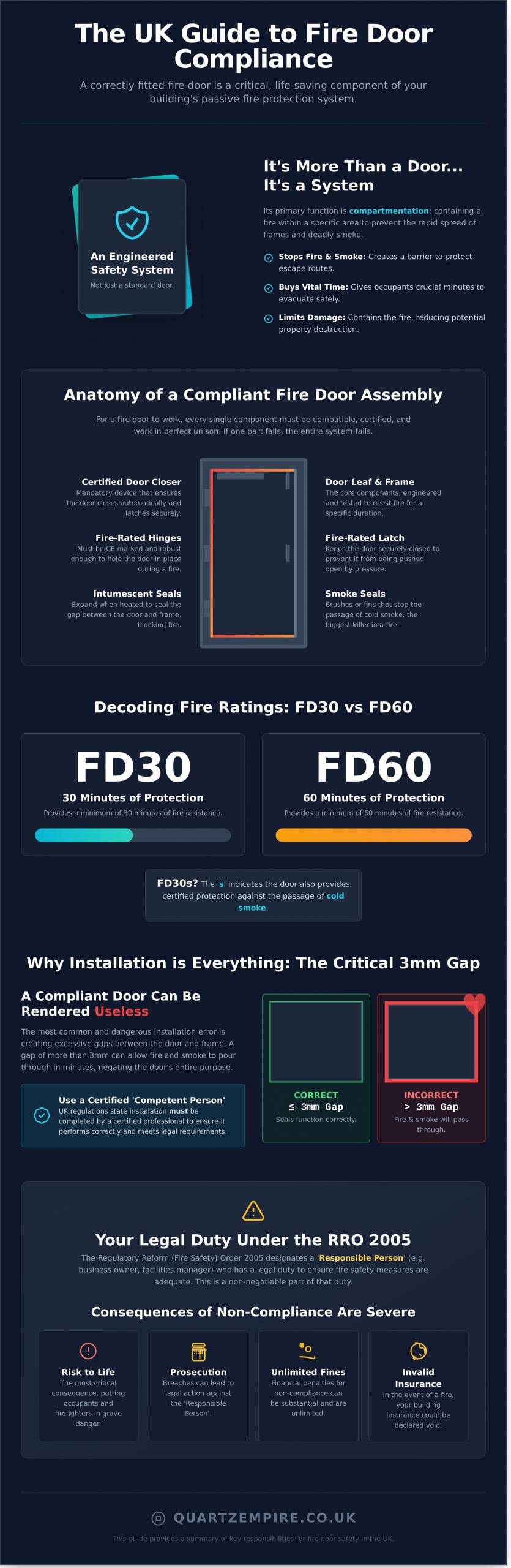
A common misconception is that a fire door is just the door leaf itself. In reality, it is a complete, tested system known as a 'door assembly'. For a fire door to perform as intended, every single component must be compatible, certified, and work in unison. These critical parts include:
- The Door Leaf & Frame: The core components, built to resist fire for a specified duration.
- Intumescent Seals: Strips fitted around the door edge that expand when heated, sealing the gap between the door and frame to block fire.
- Smoke Seals: Brushes or fins that prevent the passage of cold smoke, the biggest killer in a fire.
- Certified Hardware: This includes hinges, latches, closers, and locks, all of which must be fire-rated to ensure the door remains securely closed during a fire.
Each assembly is designed to achieve a specific fire protection rating (e.g., FD30 for 30 minutes of protection). If even one component is incorrect or incompatible, the entire system's integrity is compromised.
Your Legal Duties Under the RRO 2005
The Fire Safety Order 2005 designates a 'Responsible Person' for every commercial property. This is typically the employer, building owner, or facilities manager. This individual holds the legal duty to carry out a fire risk assessment and implement and maintain adequate fire safety measures. Properly functioning fire doors are a non-negotiable part of this duty, essential for protecting escape routes and ensuring the safety of everyone in the building.
The Dangers of Incorrect Installation
A compliant fire door is rendered completely ineffective by an incorrect fire door installation. The risks are severe, ranging from prosecution and unlimited fines to invalidated insurance policies. Most critically, it puts lives at risk. A common but dangerous installation error is creating excessive gaps between the door and the frame. A gap of more than 3mm can allow fire and smoke to pour through in minutes, making the door utterly useless. This is why professional, certified fire door installation is not just a recommendation; it is an absolute necessity for compliance and safety.
Decoding Fire Door Ratings, Components, and Certification
A common and dangerous misconception is that any heavy, solid door can function as a fire door. In reality, a compliant fire door is a precisely engineered safety system. Every single component-from the door leaf itself to the hinges, seals, and closing mechanism-must be third-party certified and compatible to ensure it performs as expected in an emergency. Understanding these elements is the first step towards a compliant fire door installation.
Understanding Fire Ratings: FD30 and FD60 Explained
The most common fire ratings you will encounter are FD30 and FD60. This simple code indicates the minimum number of minutes the complete door assembly can withstand fire. An FD30 door offers 30 minutes of protection, while an FD60 provides a full hour. The specific rating required for a location is determined by your building's fire risk assessment and the official UK Building Regulations for fire safety, with higher ratings typically mandated for high-risk areas like protected stairwells or corridors. If a door is marked with an 's' (e.g., FD30s), it also provides certified protection against the passage of cold smoke.
Essential Hardware: More Than Just Handles and Hinges
A fire door is rendered useless if its hardware is not also fire-rated and correctly fitted. Using standard, non-certified components will cause the door to fail prematurely, negating its protective qualities. Key certified hardware includes:
- Self-Closing Devices: A certified overhead or concealed closer is mandatory. It ensures the door automatically and reliably closes fully into its frame after every use.
- Hinges: A fire door must be fitted with at least three fire-rated hinges to prevent the door from warping under intense heat and dropping from its frame.
- Latches and Locks: The latching mechanism must be fire-rated to hold the door securely closed and prevent it from being pushed open by the pressures created during a fire.
Intumescent Strips and Smoke Seals
Fitted into grooves around the door edge or frame, these seals are critical. Intumescent strips remain dormant until activated by heat, at which point they expand significantly to seal the gap between the door and the frame, blocking flames and hot gases. Cold smoke seals, which often look like brushes or fins, are vital for preventing the spread of toxic smoke before the intumescent strips are triggered.
How to Identify a Certified Fire Door
A genuinely compliant fire door will always have a certification mark. Look for a label or a small colour-coded plastic plug on the top edge of the door. This mark provides crucial information about the manufacturer, the fire rating, and its certification scope. In the UK, trusted third-party certification bodies include BWF-Certifire and BM TRADA Q-Mark. It is essential to check that both the door leaf and the frame carry compatible certification marks, confirming they are designed and tested to work together as a complete, effective doorset.
The Professional Fire Door Installation Process: What to Expect
Understanding the steps involved in a professional fire door installation provides peace of mind and demystifies what is a critical safety procedure. A compliant installation is not simply about hanging a new door; it is a meticulous, evidence-based process carried out by certified experts to ensure your property and its occupants are protected. From the initial assessment to final certification, every stage is designed to meet strict UK regulations.
Here is what you should expect when you engage a trusted partner for this essential service.
Step 1: The Initial Site Survey
The foundation of any compliant installation is a thorough site survey. A certified surveyor will visit your premises to conduct a detailed assessment. This involves more than just measuring an opening; they evaluate the integrity of the surrounding wall, its construction type (e.g., blockwork or stud partition), and the intended use of the door. This critical first step determines the correct fire rating (e.g., FD30 or FD60) and hardware specifications required to guarantee a compliant and effective fire door set.
Step 2: Correct Door and Frame Installation
This stage requires absolute precision. The door frame must be fitted securely into the structural opening without any distortion, ensuring it is plumb and square. The precision required cannot be overstated; as the London Fire Brigade guidance on fire doors makes clear, incorrect gaps can render a door completely ineffective. Certified installers ensure the gaps between the door leaf and the frame are consistently within the tight tolerances specified by the manufacturer (typically 2-4mm). All components, including hinges, closers, and intumescent seals, must be compatible and fitted strictly in line with their data sheets.
Step 3: Final Checks and Certification
Once the installation is complete, the work is not yet finished. The installer will perform a series of commissioning checks to verify that the door operates correctly. This includes ensuring it self-closes and latches securely from any angle. Upon successful completion, you must be provided with a certificate of installation. This document is your formal proof of compliance and a vital record for your fire safety logbook, demonstrating that the work was completed to the required standard by a competent professional.
Ensure your business is protected and fully compliant. Book your compliant fire door survey today.
Why You Must Use a Certified 'Competent Person' for Installation
A common and dangerous misconception is that any competent builder or joiner can fit a fire door. While they may be skilled in their trade, a compliant fire door installation is a specialist task that falls under life safety regulations. The Regulatory Reform (Fire Safety) Order 2005 mandates that the person responsible for the building must ensure fire safety tasks are carried out by a 'competent person'. In this context, a competent person is an individual or company with the specific training, qualifications, experience, and knowledge required to install a fire door assembly correctly, ensuring it will perform as intended in a fire.
The Dangers of Uncertified Work
An incorrectly installed fire door is no better than a standard door. The smallest error can completely negate its fire-resistant properties, creating a critical failure point in your building's fire protection strategy. Common mistakes made by unqualified fitters include:
- Incorrect Gaps: Gaps between the door and the frame that are too large will allow fire and smoke to pass through prematurely.
- Non-Compliant Hardware: Using standard hinges, latches, or closers that are not fire-rated will fail under heat.
- Improperly Fitted Seals: Intumescent seals that are poorly installed or damaged will not expand correctly to seal the gaps.
- Wrong Sealants: Using standard decorators' caulk or expanding foam instead of certified fire-rated mastic around the frame.
These errors compromise the integrity of the entire door set, potentially leading to catastrophic failure during a fire and placing lives, property, and your legal compliance at severe risk.
Third-Party Accreditation Schemes to Look For
To guarantee competence, you must choose an installer certified by a UKAS-accredited third-party scheme. These schemes provide independent verification that a company and its operatives are suitably trained and regularly audited. This gives you undeniable proof of due diligence and peace of mind. Always ask for evidence of certification from reputable schemes such as:
- FDIS (Fire Door Inspection Scheme)
- BM TRADA Q-Mark Fire Door Installation Scheme
- LPCB (Loss Prevention Certification Board)
Verifying Your Installer's Credentials
A professional, certified installer will be transparent about their qualifications. Do not simply take their word for it; perform your own checks. First, ask to see a copy of their company's certificate from the accreditation body. Then, visit the scheme's official website and use their online register to look up the company. This simple step confirms their certification is current and valid. A trustworthy company will readily provide this proof, as it is a hallmark of their professionalism and commitment to safety.
As a fully accredited provider, Quartz Empire ensures every fire door installation is completed to the highest standards, giving you complete confidence in your building's compliance and safety.
Beyond Installation: Fire Door Maintenance and Inspections
A compliant fire door installation is the critical first step in protecting your premises, but it is not the last. To remain effective and legally compliant, your fire doors require a structured programme of regular maintenance and inspection. The responsibility for this ongoing diligence rests with the designated ‘Responsible Person’ for the building.
Daily use, wear and tear, and environmental changes can all compromise a fire door's integrity. Without routine checks, components can fail, rendering the door ineffective in a fire and placing lives, property, and your business at risk.
Your Legal Duty for Ongoing Maintenance
The Regulatory Reform (Fire Safety) Order 2005 (RRO 2005) explicitly states that all fire safety equipment, including fire doors, must be "maintained in an efficient state, in efficient working order and in good repair." To meet this legal requirement, we recommend that all fire doors are professionally inspected at least every six months. For doors in high-traffic areas, such as main corridors or busy stairwells, more frequent checks may be necessary to ensure they remain fully operational.
A 5-Point Checklist for Routine Inspections
While professional servicing is essential, facilities managers can perform interim visual checks to spot obvious faults. This simple checklist helps identify common issues that require immediate attention from a certified expert:
- Gaps: Check the gap between the door and the frame. It should be consistently around 3-4mm.
- Seals: Ensure intumescent and smoke seals are intact, without damage or gaps.
- Hinges: Confirm all hinges are firmly fixed with no missing screws. The door should hang correctly in its frame.
- Closer: Open the door and let it go. It must close firmly and fully into its latch from any position without slamming.
- Latch: Ensure the door latches securely into the frame, holding it shut.
If any of these checks reveal a fault, it is crucial to arrange for professional repair without delay.
Professional Servicing with Quartz Empire
Engaging a certified fire safety company for a maintenance contract provides complete peace of mind. Our expert technicians ensure every component is inspected to the correct standard, using their specialist knowledge to identify issues that may not be visually obvious. Unlike a one-off fire door installation, ongoing maintenance is a continuous process that demands meticulous record-keeping for your fire safety logbook.
A professional service contract with Quartz Empire guarantees that your doors are kept compliant, your legal duties are met, and a full audit trail is maintained. This proactive approach not only enhances safety but also protects your business from the severe legal and financial consequences of non-compliance.
Ensure ongoing compliance with our fire door maintenance plans.
Your Definitive Step Towards Compliant Fire Safety
As this guide has detailed, a fire door is only as effective as its installation and maintenance. The use of a certified 'Competent Person' is not just a recommendation but a critical legal and safety requirement to ensure your passive fire protection performs correctly in an emergency. This commitment to safety is a continuous responsibility, extending from the initial fit to regular, documented inspections.
For businesses across Kent, London, and the South East, achieving this standard of compliance provides invaluable peace of mind. As your trusted, comprehensive fire safety partners, Quartz Empire delivers an expert service grounded in a no-nonsense approach. Our third-party accredited installers ensure every fire door installation is completed meticulously and to the highest regulatory standards.
Protect your people, property, and legal obligations. Request a quote for certified fire door installation today and partner with the experts in fire safety.
Frequently Asked Questions About Fire Door Installation
How much does commercial fire door installation cost in the UK?
The cost for a commercial fire door installation in the UK typically ranges from £800 to over £1,500 per doorset. This price is influenced by several factors, including the required fire rating (e.g., FD30 or FD60), the door's size and finish, and the complexity of the necessary hardware. For an accurate and compliant quote tailored to your business premises, it is essential to consult with a certified fire safety professional who can assess your specific requirements.
How often should fire doors in a business be inspected or maintained?
According to UK regulations and best practices, fire doors should be inspected at least every six months by a competent person. For doors in high-traffic areas, such as main corridors or busy staff rooms, more frequent checks (e.g., quarterly or even monthly) are advisable to ensure they remain fully functional and compliant. Regular maintenance is a legal requirement under the Fire Safety Order 2005 and is critical for protecting people and property.
Can an existing door be upgraded to become a fire door?
In almost all cases, it is not possible or compliant to upgrade a standard door to a certified fire door. Fire doors are engineered as a complete doorset, including the frame, leaf, and hardware, which are all tested together to achieve their fire rating. Attempting to modify a non-rated door compromises its structural integrity and will not meet legal safety standards. The only reliable solution is to install a new, fully certified fire doorset from an accredited provider.
What is the difference between a fire door and a fire exit door?
A fire door is designed for compartmentalisation; its primary role is to contain a fire and stop the spread of smoke and flames for a specified period (e.g., 30 or 60 minutes). A fire exit door is part of an escape route and is designed to be opened easily from the inside without a key to allow for rapid evacuation. While a fire exit door may also be a fire door, its main function is fast egress, not fire containment.
Do I need a fire door with glass (vision panel)?
Whether you need a vision panel depends on the door's location and your building's risk assessment. Vision panels are often required in high-traffic corridors to prevent collisions and improve visibility, enhancing daily safety. If a glass panel is needed, it must be specialist fire-rated glazing installed as part of a certified fire doorset. This ensures the door's overall integrity and fire resistance rating are not compromised, providing safety without sacrificing compliance.
What documentation should I receive after a fire door installation?
After a compliant fire door installation, you should receive a certificate of installation from the accredited installer. This crucial document confirms that the work was completed by a competent person and adheres to all relevant British Standards and building regulations. This certification is essential for your fire safety records, providing proof of due diligence for legal compliance, insurance purposes, and complete peace of mind that your assets are properly protected.