
Fire Alarm Systems: A Complete Guide for UK Businesses

As a UK business owner, ensuring your property is fully compliant with fire safety regulations is a significant responsibility. Navigating the legal requirements for commercial alarm systems fire safety is non-negotiable, yet the world of fire alarms can seem complex. If you feel confused by technical terms like 'conventional' and 'addressable' or are concerned about choosing the right system without overspending, you are not alone. This uncertainty can stand in the way of achieving total security for your people and premises.
This guide is designed to provide clarity with a straightforward, no-nonsense approach. We will explain the different types of fire alarm systems available, break down their core components, and outline your legal obligations under UK law. Our goal is to equip you with the expert knowledge needed to select the most suitable and cost-effective solution for your business. By the end, you will have the confidence to make an informed decision and find a reliable, accredited partner, securing complete peace of mind that your property is safe and compliant.
Key Takeaways
- Learn how a complete fire alarm system functions beyond simple smoke detection, acting as the 'brain, nerves, and voice' to protect your people and property.
- Discover the key differences between conventional, addressable, and wireless systems to select the right technology for your specific business needs.
- Understand your legal obligations under UK regulations; installing and maintaining compliant alarm systems fire protection is a non-negotiable duty for every business owner.
- Recognise what defines a reliable fire security partner, ensuring your system is expertly installed and maintained for ultimate peace of mind.
What is a Commercial Fire Alarm System and Why is it Essential?
When considering the safety of a commercial property, a fire alarm system is far more than a simple, battery-operated smoke detector. It is a sophisticated, interconnected network of devices designed to detect the earliest signs of a fire and provide clear, immediate warnings to everyone on the premises. For a comprehensive overview of fire alarm systems, it is crucial to understand their core functions: detection, notification, and response. A professionally installed system uses devices like heat detectors, smoke sensors, and manual call points to identify a threat, which then triggers audible and visual alarms to facilitate a safe evacuation and can automatically alert emergency services.
Unlike a basic domestic alarm, a commercial-grade solution is engineered for the complexities of a business environment. It is robust, centrally monitored, and designed to protect a larger number of people across more complex layouts. This distinction is not just a matter of scale; it is a critical component of your legal and moral responsibility as a business owner.
The Primary Goals: Protecting People, Property, and Operations
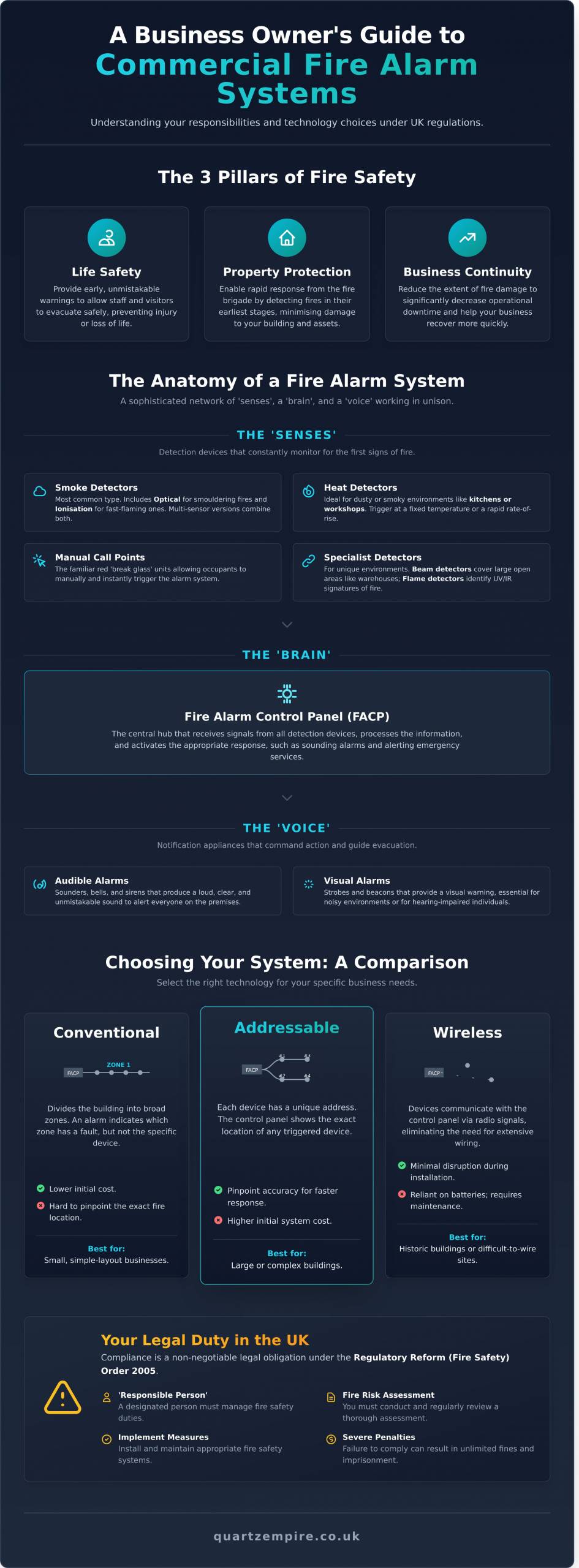
A compliant commercial fire alarm system serves three fundamental purposes, each vital for the resilience of your organisation:
- Life Safety: The absolute priority is to provide an early and unmistakable warning, allowing staff, visitors, and customers sufficient time to evacuate the building safely. This early detection is paramount in preventing injury or loss of life.
- Property Protection: By detecting a fire in its incipient stage, the system enables a rapid response from the fire brigade. This swift action is essential for minimising damage to your building, equipment, and stock.
- Business Continuity: The aftermath of a fire can be devastating. An effective alarm system reduces the extent of the damage, thereby significantly decreasing operational downtime and helping your business recover more quickly.
The Legal Imperative: Compliance in the United Kingdom
In the UK, installing and maintaining adequate alarm systems fire safety is not optional-it is a legal obligation. The Regulatory Reform (Fire Safety) Order 2005 mandates that the designated ‘Responsible Person’ for any commercial premises must conduct a thorough fire risk assessment and implement appropriate fire safety measures. This includes ensuring a suitable fire detection and alarm system is in place. Failure to comply with this legislation can result in severe penalties, including unlimited fines and, in the most serious cases, imprisonment. Ensuring your system is compliant provides peace of mind and protects your business from legal and financial repercussions.
The Core Components of a Modern Fire Alarm System
A commercial fire alarm is a sophisticated, integrated network designed for one critical purpose: to protect people and property. To understand how it achieves this, it is helpful to think of it as a central nervous system. It has 'senses' to detect danger (detectors), a 'brain' to process information (the control panel), and a 'voice' to command action (notification appliances). Understanding these components is a fundamental part of meeting UK fire safety regulations, which require a suitable system based on a thorough risk assessment of your premises.
Detection Devices: The 'Senses' of the System
These devices are the system's vigilant front line, constantly monitoring the environment for the earliest signs of a fire. Choosing the correct type of detector for each area is essential for reliable and rapid detection while minimising false alarms. Key types include:
- Smoke Detectors: The most common type, including optical (photoelectric) detectors that are best for slow, smouldering fires, and ionisation detectors for fast-flaming fires. Multi-sensor devices combine both technologies for a more comprehensive response.
- Heat Detectors: Ideal for environments where smoke detectors are unsuitable, such as kitchens or dusty workshops. They trigger at a fixed temperature or when they detect a rapid rate-of-rise in temperature.
- Manual Call Points: The familiar red 'break glass' units that allow occupants to manually trigger the alarm.
- Specialist Detectors: For unique environments, devices like beam detectors can cover large open areas like warehouses, while flame detectors identify the specific infrared or ultraviolet light signatures of a fire.
The Control Panel (FACP): The 'Brain' of Operations
The Fire Alarm Control Panel (FACP) is the central hub that coordinates the entire system. It receives and analyses signals from all detection devices, making the critical decision to activate an alarm. A modern panel does more than just sound the alarm; it provides precise information, indicating the exact zone or device that has been triggered. This intelligence is invaluable for guiding building occupants to safety and for directing emergency services upon their arrival. For all compliant alarm systems fire management relies on the FACP's processing power and reliability.
Notification Appliances: The 'Voice' of the System
Once the control panel confirms a fire, it must immediately and unambiguously alert everyone in the building. Notification appliances are the 'voice' of the system, designed to cut through distractions and command an immediate evacuation. These include:
- Audible Alarms: Traditional bells or, more commonly, high-decibel electronic sounders that produce a distinct evacuation tone.
- Visual Alarms: High-intensity strobes or beacons that provide a clear visual warning. They are a regulatory requirement in noisy environments or areas accessible to the hearing impaired.
- Voice Alarm Systems: Advanced systems that broadcast clear, pre-recorded or live voice messages with specific evacuation instructions, helping to reduce panic and ensure an orderly exit.
Types of Fire Alarm Systems: Which is Right for Your Business?
Selecting the right fire alarm system is a critical decision for any business owner, directly impacting the safety of your people and the protection of your property. The market offers several types of alarm systems fire detection, each with distinct technology, applications, and costs. Understanding these differences is the first step towards making an informed investment. It ensures you choose a system that is not only compliant but perfectly suited to the unique layout and risks of your premises. All systems must be designed and installed to meet rigorous safety protocols, such as the Fire Industry Association standards, to guarantee reliable performance when it matters most.
Conventional Systems: Simple and Cost-Effective
Conventional fire alarm systems divide your building into broad zones. When a detector is triggered, the main control panel identifies the activated zone but not the specific device. This straightforward, zone-based approach makes them a reliable and budget-friendly choice for smaller, less complex properties.
- Best Suited For: Small offices, retail shops, and small warehouses where a fire can be located quickly.
- Pros: Lower initial installation cost and simple-to-understand operation.
- Cons: Slower to pinpoint the exact location of a fire, which can delay response times in larger buildings.
Addressable Systems: Intelligent and Precise
Also known as 'intelligent' systems, addressable fire alarms assign a unique digital address to every device on the network, from smoke detectors to call points. If a device is activated, the control panel displays its exact location, enabling a rapid and precise response. This level of detail also simplifies maintenance by identifying specific device faults.
- Best Suited For: Large or complex sites such as hospitals, schools, multi-storey office blocks, and large warehouses.
- Pros: Pinpoint accuracy for faster incident response, greater flexibility for expansion, and lower long-term maintenance costs.
Wireless Systems: Flexible and Minimally Invasive
Wireless fire alarm systems use secure radio signals to connect sensors and devices to the control panel, eliminating the need for extensive and disruptive cabling. This technology offers unparalleled flexibility, making it an ideal solution for buildings where traditional wiring is impractical or undesirable, such as heritage sites with strict preservation rules.
- Best Suited For: Listed or historic buildings, temporary sites, or premises where business disruption must be kept to an absolute minimum.
- Pros: Extremely fast installation, minimal structural impact, and easily adaptable or expandable.
- Cons: Higher initial equipment cost and a reliance on batteries that require routine monitoring and replacement.
UK Fire Alarm Regulations: Understanding Your Legal Obligations
In the United Kingdom, fire safety in commercial premises is not a matter of choice-it is a legal requirement governed by a stringent framework. Failure to comply can lead to severe penalties, including unlimited fines and imprisonment. Understanding your duties is the first and most critical step in protecting your staff, visitors, and property, while ensuring your business remains fully compliant.
The 'Responsible Person' and the Fire Safety Order 2005
The Regulatory Reform (Fire Safety) Order 2005 places the legal responsibility for fire safety on a designated ‘Responsible Person’. This is typically the employer, business owner, landlord, or facilities manager. The duties of this person are clear and non-negotiable, and include:
- Conducting and regularly reviewing a comprehensive Fire Risk Assessment (FRA).
- Implementing and maintaining appropriate fire safety measures.
- Planning for emergencies and providing staff with fire safety training.
- Ensuring all fire safety equipment, including the fire alarm system, is correctly installed and maintained.
BS 5839-1: The Code of Practice for Fire Alarms
BS 5839-1 is the primary British Standard outlining the code of practice for the design, installation, commissioning, and maintenance of fire detection and alarm systems in non-domestic buildings. While not legislation itself, following this standard is universally recognised as the best way to satisfy your legal obligations under the Fire Safety Order. It details system categories-such as 'L' for life protection and 'P' for property protection-which dictate the level of coverage required. For a full breakdown, read our Guide to BS 5839-1.
The Importance of a Fire Risk Assessment
Your Fire Risk Assessment (FRA) is the foundation of your entire fire safety strategy. A professional assessment, conducted by a competent person, will identify potential hazards and evaluate the risks within your premises. Crucially, the FRA determines the specific type and category of fire alarm system required to provide adequate protection. An outdated or inadequate FRA leaves your business exposed, both to fire and to legal action. Ensuring your assessment is current is essential for compliance and safety.
Navigating the complexities of alarm systems fire regulations can be challenging. Partnering with an accredited and certified expert ensures that your system is not only effective but also fully compliant with all legal standards, providing you with complete peace of mind. To discuss your fire safety obligations, get in touch with our team of trusted professionals today.
Choosing a Partner: Professional Installation and Maintenance
Selecting the right fire alarm system is only the first step. The long-term reliability and compliance of your system depend entirely on the quality of its installation and the diligence of its upkeep. A state-of-the-art system incorrectly installed or poorly maintained offers a false sense of security and fails to meet legal obligations. Choosing a trusted partner for installation and servicing is therefore a critical business decision.
What to Look for in a Fire and Security Company
When entrusting a company with the safety of your premises, staff, and assets, look for clear indicators of competence and reliability. Your choice should be based on evidence of their expertise.
- Third-Party Accreditation: In the UK, accreditation from bodies like BAFE (for fire) or SSAIB (for security) is non-negotiable. This certification is your assurance that the provider works to the highest industry standards.
- Experience and Expertise: Seek a provider with a proven track record in commercial properties similar to yours. They will understand the unique challenges and regulatory demands your business faces.
- Comprehensive Service: A partner who can design, install, and maintain your system provides a seamless, accountable service, simplifying management and ensuring consistency.
- Local Presence: Choosing a provider based in your area, such as Kent or London, ensures a faster response for call-outs and a better understanding of local requirements.
The Installation Process: What to Expect
A professional installation follows a meticulous, structured process to guarantee compliance and performance. At Quartz Empire Fire & Security Ltd, we follow a clear, three-step approach:
- Site Survey and System Design: Our experts conduct a thorough survey of your premises, referencing your Fire Risk Assessment (FRA) to design a bespoke system that provides optimal protection.
- Professional Installation: Our certified engineers install all components efficiently and with minimal disruption to your operations, adhering strictly to British Standards.
- Commissioning and Certification: We rigorously test every element of the system before commissioning it. You will be provided with full documentation and certification for your records.
Why Regular Maintenance is Non-Negotiable
For commercial alarm systems fire protection is not a one-time setup; it is an ongoing legal responsibility. Under the BS 5839-1 standard, routine maintenance by a competent person is a mandatory requirement. Regular servicing prevents disruptive and costly false alarms, extends the life of your equipment, and, most importantly, ensures the system will function correctly in an emergency. During a typical visit, engineers will test control panels, check detectors and call points, verify battery health, and log all results.
Ensuring your system is professionally maintained provides peace of mind and keeps your business compliant. Request a quote for accredited fire alarm services.
Your Next Step Towards Complete Fire Safety Compliance
As this guide has demonstrated, selecting the right commercial fire alarm system is a critical responsibility for any UK business. Understanding your legal obligations, the various system types, and the necessity of professional maintenance are fundamental to protecting your people and property. Navigating the complexities of modern alarm systems fire technology requires a trusted partner to ensure your solution is both effective and fully compliant with current standards.
At Quartz Empire, we provide this expertise with our signature no-nonsense approach to fire safety. As the trusted fire and security partner for businesses across Kent, London, and the South East, our BAFE and SSAIB accredited engineers are committed to delivering reliable, high-quality solutions. We take the guesswork out of compliance, providing you with the peace of mind you deserve.
Ready to ensure your premises are fully protected? Get a no-obligation quote for your compliant fire alarm system. Take the decisive step towards securing your business today.
Frequently Asked Questions About Commercial Fire Alarms
What is the difference between a fire alarm system and smoke detectors?
A single smoke detector is a standalone device that sounds an alarm when it senses smoke. In contrast, a commercial fire alarm system is a fully integrated network. It connects multiple components, including smoke and heat detectors, manual call points, and sounders, to a central control panel. This provides comprehensive, centralised monitoring and a coordinated response, offering a far superior level of protection that is essential for ensuring your business premises are fully compliant with UK safety regulations.
How often should a commercial fire alarm system be tested and serviced?
According to UK regulations (BS 5839-1), commercial fire alarms require weekly testing by the user, typically by activating a different manual call point each week. A comprehensive service and inspection by a competent, certified engineer must be conducted at least every six months. This professional maintenance ensures all components function correctly and your system remains fully compliant. Regular servicing is critical for the reliability of all commercial alarm systems fire and security installations, providing you with complete peace of mind.
How much does a commercial fire alarm system cost to install?
The installation cost for a commercial fire alarm system varies widely based on the size of your premises, building complexity, and the type of system required (e.g., conventional or addressable). A small business installation might start from around £1,500, whereas a large, multi-storey property could cost significantly more. We provide a detailed, no-nonsense quotation following a thorough site survey to ensure you receive a compliant and cost-effective solution tailored to your exact needs.
Can an existing fire alarm system be upgraded or extended?
Yes, in most situations, an existing fire alarm system can be successfully upgraded or extended to accommodate changes to your building or to meet updated regulations. This is a common requirement for businesses that are expanding or altering their premises. Our expert engineers can assess your current installation and design a compliant modification, whether that involves adding new detectors and sounders or integrating more advanced technology to enhance protection for your people and property.
What are the most common causes of false fire alarms?
The most frequent causes of unwanted false alarms include airborne contaminants like dust, steam, or aerosols activating a detector, as well as the accidental operation of a manual call point. A lack of professional maintenance is another major contributing factor. A correctly designed and regularly serviced system significantly reduces these occurrences. Our accredited engineers can identify environmental risks and specify the appropriate detection technology to ensure your system performs reliably without causing unnecessary disruption.
Do I need a fire alarm system if my business is very small?
Under UK law, all businesses must have a fire risk assessment, regardless of their size. The outcome of this assessment dictates the level of fire protection required. While a very small, simple premises may not legally require a complex electrical system, a commercial-grade alarm is often necessary to provide adequate warning, protect life, and satisfy insurance obligations. We can provide expert advice on the most suitable and compliant solution to ensure your business and staff are properly protected.
Are wireless fire alarm systems as reliable as wired ones?
Modern wireless alarm systems fire and security technology is exceptionally reliable and is engineered to meet the same stringent British Standards (BS 5839-1) as traditional wired systems. They utilise secure, encrypted radio signals and feature long-life batteries with constant system monitoring to report any faults. Wireless systems are an excellent, compliant solution for listed buildings or properties where running new cables would be disruptive or aesthetically undesirable, offering robust and dependable protection.