
Fire Alarm Servicing: A Complete Guide to Your Legal Responsibilities

Navigating the legal requirements for fire safety can feel overwhelming. As a business owner or designated 'Responsible Person' in the UK, the weight of ensuring your premises are fully compliant-and your people protected-is significant. The fear of steep fines, voided insurance, or a system failing when it's needed most is a genuine concern for many. That is why understanding your duties for professional fire alarm servicing is not just a box-ticking exercise; it is a fundamental part of responsible business management.
This comprehensive guide is designed to provide clarity and peace of mind. We will clearly outline your legal obligations under UK law, detail exactly what a compliant service should include, and provide a practical checklist for maintenance frequencies. By the end, you will have a clear understanding of your responsibilities, giving you the confidence that your business is safe, compliant, and fully protected from risk.
Key Takeaways
- Understand your specific legal duties as the designated 'Responsible Person' for fire safety in your building.
- Learn the precise schedule for weekly, monthly, and bi-annual checks, clarifying which tasks can be handled in-house versus those requiring a certified engineer.
- Discover what a compliant professional fire alarm servicing entails according to BS 5839-1, so you can verify your provider is thorough.
- Protect your business from severe legal and financial penalties by understanding the true cost of neglect and how to select a competent, accredited partner.
Why Regular Fire Alarm Servicing Isn't Just an Option-It's the Law
In the United Kingdom, maintaining a fully operational fire alarm system is not a matter of choice; it is a fundamental legal obligation. For any non-domestic premises, from offices and warehouses in Kent to retail stores in London, the responsibility for fire safety falls on a designated 'Responsible Person'. This individual is legally accountable for ensuring all fire safety measures are fit for purpose. This includes arranging regular, professional fire alarm servicing to guarantee system reliability. While legislation dictates the legal duty, established British Standards provide the practical framework for compliance, creating a clear path to protecting your people and property.
The Regulatory Reform (Fire Safety) Order 2005 Explained
This crucial piece of legislation, often called the Fire Safety Order, is the cornerstone of fire safety law in England and Wales. It mandates that the Responsible Person must carry out a suitable and sufficient fire risk assessment and act on its findings. Article 17 of the Order explicitly states that fire detection and alarm systems must be "subject to a suitable system of maintenance and are maintained in an efficient state, in efficient working order and in good repair." Non-compliance is not taken lightly; penalties can include unlimited fines and, in the most severe cases, imprisonment.
The Role of British Standard BS 5839-1
While the Fire Safety Order tells you what you must do, British Standard BS 5839-1 provides the expert, technical guidance on how to do it. This standard is the UK's definitive code of practice for the design, installation, commissioning, and maintenance of fire alarm systems. Adhering to its recommendations is the universally accepted method to demonstrate that you are meeting your legal duties. The standard advises on critical frequencies for professional servicing, recommending inspections by a competent, certified engineer at least every six months. It also details routine user checks, such as weekly tests of the system's Fire Alarm Control Panel (FACP), to ensure constant readiness and integrity.
Your Servicing Schedule: A Checklist for Weekly, Monthly & Bi-Annual Checks
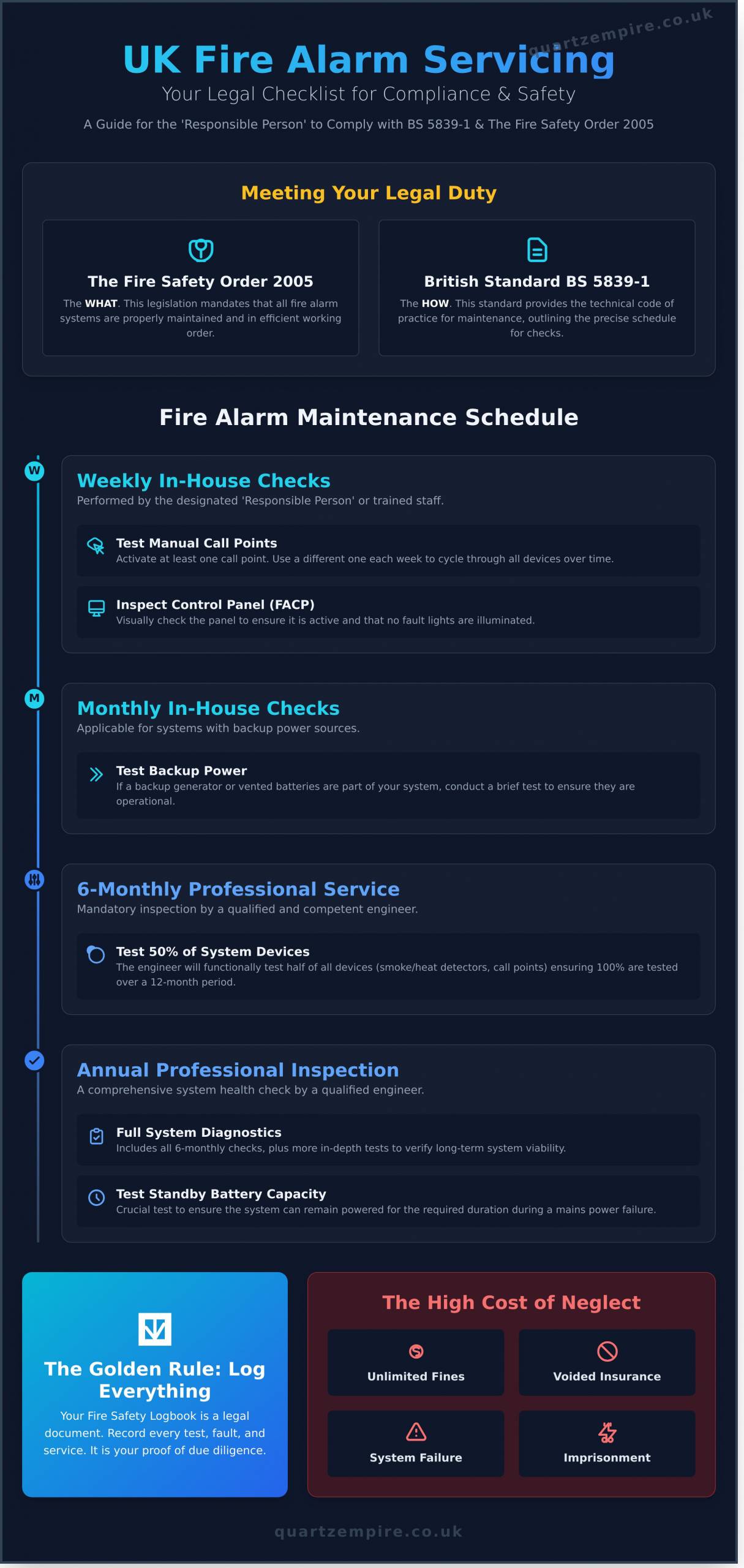
A reliable fire alarm system is not a "fit and forget" installation. Its dependability is maintained through a structured schedule of checks and professional servicing. This combination of routine in-house inspections and expert engineering assessments ensures every component functions correctly, from the control panel to the most distant smoke detector. This structured approach is not just best practice; it is a legal requirement under the Regulatory Reform (Fire Safety) Order 2005 and aligns with the detailed guidance provided by British Standard BS 5839-1 on fire alarm servicing to ensure systems are always operational. The cornerstone of this entire process is a meticulously kept fire safety logbook, which serves as a legal record of all tests, faults, and maintenance activities.
In-House Weekly & Monthly User Checks
As the building's responsible person, you or your designated staff should perform regular checks to catch potential issues early. These tests are straightforward but vital for day-to-day safety and compliance.
- Weekly: Test at least one manual call point during working hours, ensuring you test a different one each week to cycle through all of them.
- Weekly: Visually inspect the control panel. Check that the display is clear and there are no fault indicators illuminated.
- Monthly: If your system has a backup generator or vented batteries, conduct a test to ensure they are in good working order and ready to take over in a power failure.
Action: It is critical to record the date, time, and result of every test in your fire safety logbook. This provides an auditable trail of your due diligence.
The Six-Monthly Professional Service by a Competent Engineer
Under BS 5839-1 guidelines, your fire alarm system must be inspected by a qualified and competent third-party engineer, such as those at Quartz Empire Fire & Security Ltd, at least every six months. This professional fire alarm servicing goes far beyond the scope of user checks. The engineer will typically test a percentage of all devices (e.g., 50% of smoke detectors, heat detectors, and call points) on each visit. This methodical approach ensures that 100% of the system's devices are functionally tested over a 12-month period. The engineer will also update your logbook with their findings, certifying the inspection.
The Annual Inspection and Certification
The annual inspection is a comprehensive health check of your entire system. This visit includes all the checks from the six-monthly service, plus more in-depth diagnostics to verify the system's long-term viability. Key annual tasks include testing the standby battery capacity to ensure it can power the system for the required duration during a mains failure and verifying that all sounders and visual alarms operate at the correct levels. Upon successful completion, the engineer will issue a certificate of inspection and servicing, a crucial document for your compliance and insurance records.
What a Professional Fire Alarm Service Involves (BS 5839-1 Checklist)
A compliant fire alarm service is a meticulous process, not a simple formality. It is guided by the UK's code of practice for fire detection and alarm systems in non-domestic buildings. To ensure your system is reliable and legally compliant, our accredited engineers perform a series of detailed checks. Understanding this process helps you recognise a high-quality service that genuinely protects your people and property.
Visual Inspection of All Components
The first step is a thorough physical inspection of every accessible part of the system. This identifies any visible signs of damage, interference, or environmental changes that could compromise performance. Our engineers will methodically check:
- Detectors and Call Points: Ensuring they are free from damage, obstructions like dust or paint, and are correctly positioned.
- Control and Indicating Equipment: Verifying the main panel and any remote indicators are in good working order and accessible.
- Wiring and Connections: A visual check to confirm that all cabling appears secure, protected, and undamaged.
- Zone Plans: Confirming that the on-site zone plan accurately reflects the current building layout and any system modifications.
Functional Testing of Devices and Sounders
Beyond visual checks, our engineers conduct functional tests to prove the system works as intended. This is a critical phase where we simulate real-world conditions to verify the response of every component. Each test is carried out in line with the comprehensive BS 5839-1 checklist to guarantee full compliance. This includes:
- Device Activation: At least one detector or call point in each zone is manually activated to confirm the control panel receives the signal correctly.
- Audibility and Visual Alarms: We measure sound pressure levels to ensure alarms are audible throughout the premises and check that all visual alarm devices (beacons) function correctly.
- System Links: Testing ancillary functions, such as the automatic release of fire doors or the grounding of lifts upon activation.
Control Panel, Battery, and Documentation Checks
The final stage of our professional fire alarm servicing focuses on the system's core, its backup power, and the all-important documentation that proves compliance. This provides peace of mind that your system will function even during a power outage.
- Standby Batteries: We test the standby power supply and batteries to ensure they can sustain the system for the required duration in a mains failure.
- Event Log Review: The panel's internal log is checked for any recent faults or alarm activations that may require further investigation.
- Logbook and Reporting: Your on-site fire logbook is meticulously updated with the service details. We then provide a detailed service certificate outlining all findings and noting any remedial works required to maintain compliance.
The High Cost of Neglect: Risks of Skipping Fire Alarm Maintenance
Viewing fire alarm maintenance as a simple compliance task is a dangerous oversight. The reality is that neglecting your system is a high-stakes gamble with consequences that extend far beyond a failed inspection. The potential costs-financial, legal, and human-are staggering. Professional fire alarm servicing is not an expense; it is a critical investment in the safety and continuity of your business.
Legal Penalties and Corporate Manslaughter Charges
Under UK law, the designated 'Responsible Person' can face severe penalties for failing to maintain fire safety systems. Breaches can lead to unlimited fines issued by the fire service or HSE and, in serious cases, custodial sentences. In the event of a tragedy, a company could face corporate manslaughter charges, a devastating outcome for any organisation. UK courts have a history of prosecuting businesses with significant fines for such fire safety failings.
Invalidated Business Insurance and Civil Liability
Your business insurance policy is a contract that requires you to meet your legal fire safety obligations. In the event of a fire, insurers will demand evidence of compliant system maintenance. Without a complete service history, your claim can be rejected, leaving you personally liable for all damages, stock loss, and rebuilding costs. This can lead to complete financial ruin, a catastrophic and entirely avoidable outcome.
The Unacceptable Risk to Life, Property, and Business Continuity
Beyond any financial or legal penalty is the primary purpose of your fire alarm: to provide an early warning and save lives. A system failure due to a lack of maintenance can have devastating results:
- Loss of Life: A delayed or non-existent warning can be the difference between a safe evacuation and a tragedy.
- Catastrophic Property Damage: An unchecked fire can destroy your premises, equipment, and vital records in minutes.
- Business Failure: Many businesses never recover from a major fire, losing customers, reputation, and the ability to operate.
Regular, professional fire alarm servicing ensures your system performs when it matters most. Don't risk it. Ensure your business is protected.
How to Choose a Competent Fire Alarm Servicing Partner
Selecting the right company for your fire alarm servicing is a critical decision that directly impacts the safety of your premises and the people within it. A competent partner not only ensures your system functions correctly but also provides the peace of mind that comes with full legal and insurance compliance. Making an informed choice requires looking beyond a simple price quote and evaluating a provider's credentials, expertise, and reliability.
Why Third-Party Accreditation is Non-Negotiable
In the UK fire safety industry, third-party accreditation is the definitive mark of quality. Certifications from bodies like BAFE (British Approvals for Fire Equipment) or NSI (National Security Inspectorate) are not just logos on a van; they are proof of competence. A company holding BAFE SP203-1 accreditation, for example, has been independently audited to ensure its engineers are trained, its processes are robust, and its work meets the highest industry standards. Many insurance providers now mandate using an accredited company, making this a non-negotiable criterion.
Key Questions to Ask a Potential Servicing Company
To ensure you are partnering with a professional and reliable provider, we recommend asking the following questions before signing any agreement:
- Are you BAFE accredited for fire alarm design, installation, commissioning, and maintenance?
- What are your guaranteed call-out response times for system faults?
- Can you provide references from other businesses like ours in the local area?
- What level of public and professional liability insurance do you hold?
A reputable company will be able to answer these questions confidently and provide documented proof of their qualifications and insurance.
The Quartz Empire Promise: Accredited Servicing in Kent & London
At Quartz Empire, we believe in a no-nonsense approach to fire safety. We are proud to be a BAFE SP203-1 accredited company, offering you independently verified assurance of our expertise. Our in-house engineering team is highly experienced, providing a consistent and reliable service across Kent, London, and the South East.
We provide clear, jargon-free reports and honest advice, ensuring you understand the status of your system and your legal obligations. When you choose Quartz Empire, you are not just hiring a contractor; you are gaining a local, trusted partner dedicated to protecting your people and property. Get in touch with our team today to discuss your fire alarm servicing needs.
Ensure Your Compliance with an Expert Fire Alarm Servicing Partner
As this guide has shown, your legal responsibilities for fire safety are clear and non-negotiable. Regular, documented fire alarm maintenance is not merely a recommendation but a fundamental requirement to protect your people, property, and business continuity. From routine user checks to comprehensive six-monthly inspections by a competent professional, each step is crucial for ensuring your system performs flawlessly when it matters most. Ignoring these duties exposes your organisation to significant risks, including hefty fines and invalidated insurance.
Choosing the right partner is therefore essential for your peace of mind and legal compliance. At Quartz Empire, our experienced, certified engineers provide fully compliant fire alarm servicing in line with BS 5839-1 standards. As a BAFE SP203-1 accredited company serving Kent, London, and the South East, we act as your trusted partner, delivering a reliable, no-nonsense approach to fire safety.
Take the definitive step towards securing your premises. Request a Quote for Compliant Fire Alarm Servicing and ensure your business is protected by certified experts.
Frequently Asked Questions About Fire Alarm Servicing
How often must a commercial fire alarm be serviced in the UK?
According to British Standard BS 5839-1, your commercial fire alarm system must be professionally serviced at least every six months. For businesses with higher-risk environments or specific insurance requirements, more frequent quarterly inspections may be necessary. This bi-annual servicing is a legal requirement to ensure your system remains fully compliant, reliable, and effective at protecting your people and property, providing essential peace of mind.
What is the difference between a weekly fire alarm test and a bi-annual service?
A weekly fire alarm test is a simple check, usually performed in-house by the Responsible Person. It involves activating a single call point to ensure the control panel receives the signal and the sounders operate. In contrast, a bi-annual service is a comprehensive inspection conducted by a certified engineer. This includes testing detectors, checking battery health, and verifying that the entire system functions correctly according to British Standards.
Is a fire alarm logbook a legal requirement for businesses?
Yes, maintaining an accurate and up-to-date fire alarm logbook is a legal requirement under the Regulatory Reform (Fire Safety) Order 2005. This logbook must be used to record all system activity, including weekly tests, professional servicing visits, false alarms, and any faults or repairs. It serves as crucial evidence that you are meeting your legal fire safety obligations and maintaining your system correctly.
How much does commercial fire alarm servicing cost?
The cost of commercial fire alarm servicing depends on the size and complexity of your system. For a small business in Kent or London, a service visit may start from approximately £150 to £250. Larger premises with more devices or networked systems will require a bespoke quotation. We provide a no-nonsense, transparent quote that details all work required to ensure your system remains fully compliant and reliable.
Can I carry out the fire alarm servicing myself to save money?
While you are required to carry out weekly fire alarm tests, the bi-annual service must be completed by a 'competent person'-meaning a qualified and experienced fire alarm engineer. Attempting to perform this complex work yourself is not compliant with BS 5839-1, can invalidate your insurance, and compromises the safety of your premises. Using an accredited professional is the only way to guarantee compliance and system integrity.
What happens if a fault is found during a professional service?
If one of our certified engineers discovers a fault during a service, they will immediately notify you and document the issue in a detailed report. We will provide a clear explanation of the problem and a transparent quotation for any necessary repairs to restore your system to full operational status. Our priority is to ensure your building is protected and you remain fully compliant with all fire safety regulations.
Who is considered the 'Responsible Person' for fire safety in a business?
The 'Responsible Person' is the individual legally accountable for fire safety within a commercial property. This is typically the employer, business owner, landlord, or facilities manager-essentially, anyone with control over the premises. Their duties include conducting a fire risk assessment and ensuring that all fire protection systems, including the fire alarm, are properly maintained and serviced by an accredited expert to protect occupants.
While fire safety is critical, the 'Responsible Person' must also manage other aspects of property health and safety. This often includes regular electrical testing, gas safety checks, and asbestos management. For a comprehensive understanding of a building's overall condition, value, and potential defects, obtaining a professional building survey from a RICS-regulated firm like South Surveyors is a fundamental step in due diligence for property owners and managers.