
Fire Alarm Log Book Requirements UK: A 2026 Compliance Guide

Would your business survive the £400,000 maximum fine often handed out for serious fire safety breaches, simply because you missed a few entries in a paper folder? You likely understand that keeping records is necessary, but the technical language used in British Standard 5839-1 can feel like it was written for lawyers rather than facilities managers. It's frustrating to manage your daily operations while worrying if your testing schedule meets the specific fire alarm log book requirements uk. We believe safety shouldn't be a source of stress.
As your trusted partner in Kent and London, we've designed this guide to help you master the legal requirements for your fire alarm log book so your business remains both compliant and safe. You'll gain the confidence to face any fire officer inspection with a perfectly organized record of your safety measures. We're going to break down the legal testing frequencies, provide a concrete checklist for every entry, and show you how to maintain your status as a responsible, accredited business. This no-nonsense approach ensures you spend less time worrying about paperwork and more time focusing on your core operations.
Key Takeaways
- Understand your legal obligations under the Regulatory Reform (Fire Safety) Order 2005 to ensure your premises remain fully compliant.
- Learn exactly what to document, from weekly testing results to false alarm causes, to satisfy the latest fire alarm log book requirements uk.
- Discover how to align your maintenance records with BS 5839-1 standards and the role formal service certificates play in your safety audit.
- Evaluate the advantages of modern digital compliance software compared to traditional paper logs for protecting your vital fire safety records.
- Gain peace of mind by adopting a no-nonsense approach to record-keeping with support from accredited fire safety experts.
Understanding Fire Alarm Log Book Requirements in the UK
A fire alarm log book serves as the definitive legal record for your building's life safety systems. It's a chronological diary that documents every weekly test, false alarm, fault, and professional service visit. Since the introduction of stricter safety standards for 2026, maintaining these records accurately is no longer optional; it's a vital component of your building's safety infrastructure. Meeting fire alarm log book requirements uk ensures that your system remains reliable and that you stay on the right side of the law.
The Legal Framework: RRO 2005 and Your Business
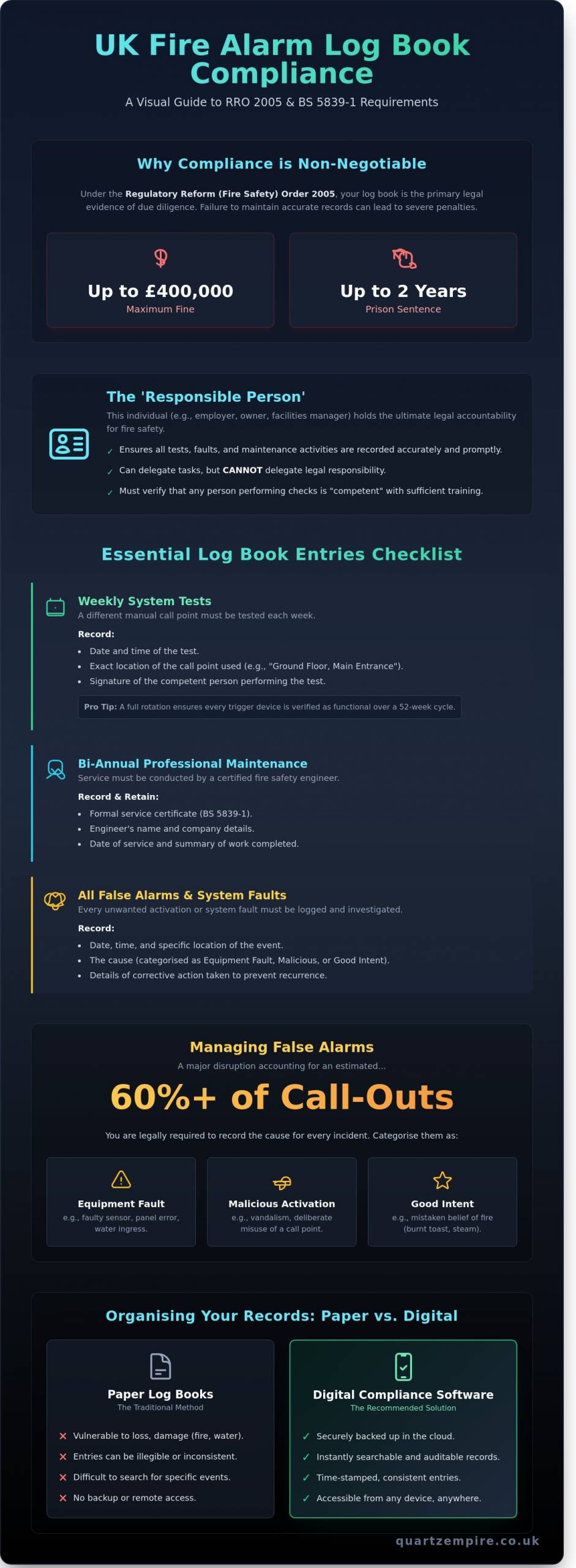
The primary legislation governing these records is the Regulatory Reform (Fire Safety) Order 2005. This law applies to almost every non-domestic premises in the UK, including shops, offices, and factories. Your log book acts as your "due diligence" shield. If a fire occurs, investigators use this document to determine if you took reasonable steps to protect occupants. If a Fire Officer conducts an unannounced inspection, they'll demand to see these records immediately. They must be kept "readily available" at all times. Failure to produce a compliant log can result in formal enforcement notices, unlimited fines, or even prison sentences of up to 2 years for serious breaches.
Who is the Responsible Person?
The law identifies a specific individual, known as the Responsible Person, who holds accountability for fire safety. This is usually the employer, building owner, or facilities manager. Their duties regarding fire alarm log book requirements uk involve ensuring every event is logged correctly and promptly. While you can delegate the physical task of testing to a staff member or an accredited contractor, the legal responsibility cannot be transferred. You must ensure the person performing the checks is "competent." Under UK law, this means they possess the necessary training to recognize when a system is failing and know exactly how to record those findings to maintain a compliant audit trail.
- Weekly Tests: These must be recorded with the date, time, and the specific call point used for the test.
- False Alarms: Every incident requires a recorded cause and a note of any corrective action taken.
- Professional Maintenance: Bi-annual services must be signed off by a certified engineer to remain valid.
Keeping these records updated isn't just about paperwork; it's about providing peace of mind. A well-maintained log book demonstrates a proactive approach to safety, proving that you prioritize the protection of your people and property above all else.
What to Record in a Fire Log Book: Essential Entry Requirements
Maintaining a compliant log book is a legal obligation under the Regulatory Reform (Fire Safety) Order 2005. It serves as your primary evidence that fire alarm log book requirements uk are being met consistently. Every entry must be legible, chronological, and signed by the competent person responsible for the task. This document is the first thing an inspector will request during a fire safety audit, so precision is vital. You must record all maintenance visits by accredited fire security engineers, ensuring their name and company details are clearly noted alongside the work completed.
Weekly Testing and False Alarm Management
Weekly testing is a core part of official government guidance for UK businesses. You must test a different manual call point every seven days. This rotation ensures that over a 52-week cycle, every trigger device in the building is verified as functional. Record the exact location of the tested call point, such as "Reception Main Entrance" or "First Floor Kitchen," to provide a clear audit trail. If the test fails, log the specific fault and the time you contacted a technician.
False alarms are a major disruption, with some estimates suggesting they account for over 60% of fire service call-outs. You're required to categorise every incident in your log. Use three specific categories: equipment fault, malicious activation, or good intent. Recording the remedial action, such as "optical sensor replaced by engineer on 14/05/2026," proves you're proactive in reducing system downtime. If you're unsure if your current records meet these standards, our team can provide a professional compliance review to ensure your property remains protected.
Staff Training and Evacuation Drills
Fire drills must occur at least once every 12 months, though high-risk environments like care homes often require them every 90 days. Log the date, the exact time the alarm sounded, and the total evacuation duration. If a fire door jammed or a staff member failed to follow the correct route, record these difficulties immediately. This data allows for targeted improvements during your next safety briefing.
Staff training records are equally critical. You must log induction training for 100% of new employees before they start their first shift. Annual refresher sessions should also be documented, including the names of attendees and the specific topics covered. Don't forget to include testing for related systems. Emergency lighting flick tests and fire door release mechanisms should be checked monthly and recorded to ensure a fully integrated safety strategy.
Compliance with BS 5839-1: Standards for Maintenance Records
BS 5839-1 serves as the definitive code of practice for fire detection and alarm systems in UK non-domestic premises. To satisfy fire alarm log book requirements uk, your documentation must align with this standard's rigorous framework. It isn't enough to simply record a date; your log book acts as a legal history of the system's reliability. Professional maintenance ensures that every component, from smoke detectors to manual call points, functions according to its original design specifications.
A compliant log book must be supported by a formal Certificate of Inspection and Servicing. This document, issued by an accredited engineer, provides the technical proof that your system meets the 2017 amendments of the British Standard. Engineers record specific data points that go beyond basic functionality, such as battery manufacturing dates and standby power calculations. Keeping these records organized provides peace of mind during local fire authority audits or insurance reviews.
The Difference Between User Checks and Professional Servicing
Weekly user tests are essential but they don't replace the 6-monthly professional service required by law. While a staff member confirms the sounders work, a certified engineer performs a deep-dive technical assessment. They check battery impedance and signal strengths that a standard "walk test" misses. Following each visit, the engineer must sign your log book and provide a Certificate of Inspection and Servicing. This certificate is the primary evidence that your fire alarm log book requirements uk are fully met.
- Weekly Check: Performed by the "responsible person" to test one call point.
- 6-Monthly Service: Conducted by an expert to inspect 100% of the devices over a 12-month period.
- Battery Logs: Engineers must record installation dates, as most lead-acid batteries require replacement every 4 years.
Remedial Works and Fault Documentation
If your system develops a fault, the log book must reflect a "closed-loop" reporting process. This means every identified issue needs a corresponding entry showing when and how it was fixed. Remedial works are the corrective actions required to return a system to full BS 5839-1 compliance. You should never leave a fault entry "open" for more than 24 hours without documenting the interim safety measures you've put in place. This meticulous approach protects your building and demonstrates a clear commitment to life safety standards.
Organising Your Records: Physical vs Digital Log Book Requirements
The shift from traditional paper logs to digital compliance software is accelerating across the UK. While the 2017 update to BS 5839-1 permits electronic record keeping, the choice between formats depends on your specific operational needs. Physical log books offer immediate, offline access without requiring technical training. However, they're vulnerable to fire damage, water leaks, or being misplaced. If a book is destroyed in a fire, you lose the primary evidence of your compliance history.
Digital systems provide a robust audit trail. They use cloud-based storage to ensure data remains secure even if the physical premises suffer a disaster. Under the Electronic Communications Act 2000, digital signatures carry the same legal weight as ink. This allows for instant verification of fire alarm log book requirements uk from any location. To remain compliant during a power cut, ensure your digital provider offers an offline mode or that staff have local copies saved on battery-powered devices.
Choosing the Right Format for Your Premises
Small businesses often find a physical A4 log book is the simplest way to manage a single fire panel. It's a no-nonsense approach that works well for local shops or small offices in Kent. Conversely, multi-site managers across London and the South East increasingly rely on digital platforms. Recent industry data shows that 68% of facilities managers in the capital now use cloud-based reporting to monitor testing schedules across multiple locations simultaneously. Whatever format you choose, it must be instantly accessible for inspection by Fire and Rescue Authorities.
Common Mistakes in Log Book Management
Avoid "pencil-whipping," which is the practice of falsifying test entries without actually performing the check. This is a serious legal risk that can lead to prosecution under the Regulatory Reform (Fire Safety) Order 2005. An incomplete entry is another frequent failure. A missing signature or a vague "all okay" without a specific device ID can invalidate a test record during a post-incident investigation. Always store physical logs in a dedicated red fire document box near the main control panel to ensure they meet fire alarm log book requirements uk during an unannounced inspection.
Ensuring Compliance with Quartz Empire Fire & Security
Quartz Empire Fire & Security Ltd delivers a straightforward, no-nonsense approach to fire safety. Our accredited engineers understand that meeting fire alarm log book requirements uk is a critical part of your legal obligations under the Regulatory Reform (Fire Safety) Order 2005. We don't just test your hardware; we ensure your documentation stands up to scrutiny from the Fire and Rescue Service. During every scheduled six-monthly service visit, our team completes all necessary entries in your log book, providing a clear and permanent audit trail. This meticulous attention to detail removes the administrative burden from your shoulders and ensures your records are always up to date.
Our engineers are fully certified and bring years of field experience to every site visit. We've found that 85% of businesses we first visit have gaps in their weekly testing records. We bridge these gaps by providing training for your staff and setting up robust systems that make compliance automatic. Whether you're managing a single retail unit in Kent or a multi-site corporate office in Central London, our reliable maintenance contracts provide the consistency required for 100% compliance. We focus on being your trusted partner, offering professional support that protects both your people and your property.
Partnering with a Trusted Fire Safety Expert
Relying on professional maintenance contracts gives you total peace of mind. We've helped over 450 businesses across Kent, London, and the South East organise their records to pass rigorous safety audits since January 2024. Our engineers provide a personal touch, sitting down with your designated Responsible Person to explain exactly what needs recording between our professional visits. This proactive support ensures your fire alarm log book requirements uk are met every day of the year, not just when an engineer is on site. We pride ourselves on being dependable and meticulous, ensuring no detail is overlooked in your fire security management plan.
Request a Quote for Fire Alarm Maintenance
Commercial fire alarm systems require expert oversight to remain effective and legal. We specialise in high-end systems, ensuring your infrastructure is both modern and fully compliant with the latest 2026 standards. If your current log book is incomplete or your maintenance schedule has slipped, we can help you get back on track quickly. Our team is ready to provide a detailed quote tailored to your specific building layout and occupancy type. Don't leave your safety to chance; professional maintenance is the only way to guarantee system reliability.
Book Your Fire Safety Assessment today to secure your property and ensure your business meets every legal requirement.
Securing Your Business for 2026 and Beyond
Maintaining a safe premises starts with a meticulous approach to record-keeping. By 2026, meeting the fire alarm log book requirements uk demands strict adherence to BS 5839-1:2017 standards. You must ensure every weekly test and mandatory six-monthly service is documented accurately to remain compliant with the Regulatory Reform (Fire Safety) Order 2005. Whether you opt for a traditional paper log or a digital system, your records must be organized and ready for inspection at any moment.
Quartz Empire Fire & Security is your trusted partner for professional safety solutions. We're an accredited and certified provider that brings a no-nonsense approach to customer service across Kent, London, and the South East. Our experts handle the technical details so you can focus on running your business with total peace of mind. We've built our reputation on reliability and expert knowledge of the latest safety legislation.
Ensure Your Business is Compliant; Book a Fire Alarm Maintenance Review
Protecting your property is a continuous commitment, and we're here to help you every step of the way.
Frequently Asked Questions
Is a fire alarm log book a legal requirement for UK businesses?
Yes, maintaining a fire alarm log book is a legal requirement for all UK businesses under the Regulatory Reform (Fire Safety) Order 2005. Article 17 of this legislation mandates that all fire safety equipment must be subject to a suitable system of maintenance. Keeping detailed records is the only way to demonstrate compliance during a Fire and Rescue Service inspection. Failure to provide these records can lead to formal enforcement notices or prosecution.
How long should I keep fire alarm log book records?
You should keep your fire alarm log book records for a minimum of 5 years. While older guidelines sometimes suggested 3 years, the 2026 standards recommend a longer retention period to provide a clear historical audit trail for insurance and legal purposes. This ensures that every weekly test and six-monthly service by an accredited engineer is documented. Keeping these records helps your business prove a consistent commitment to safety over a long period.
Can I use a digital fire log book instead of a paper one?
Yes, you can use a digital fire log book if it meets the fire alarm log book requirements UK businesses must follow. The British Standard BS 5839-1:2017 permits electronic record keeping as long as the data is secure and instantly accessible to fire inspectors. Digital systems often provide better reliability than paper because they include automated date stamps. We recommend ensuring your digital provider offers cloud backups to prevent data loss.
What happens if I lose my fire safety log book?
If you lose your log book, you must start a new one immediately and document the date the previous records were lost. You should contact your fire safety provider to obtain copies of service certificates from the last 12 months to reconstruct your history. Fire inspectors may issue a formal deficiency notice if they find gaps in your documentation. Having your accredited engineer verify the system's current status is a vital first step in regaining compliance.
Who is allowed to sign the fire alarm log book?
A designated "Responsible Person" within your business signs for weekly tests. This is usually a staff member trained to operate the panel and check a different manual call point each week. However, the six-monthly service must be signed by a "Competent Person," typically a certified fire alarm engineer. This dual approach ensures that daily operational checks and complex technical maintenance are both recorded accurately to meet safety standards.
How often should fire alarm tests be recorded?
You must record fire alarm tests at least once every week. This weekly check ensures the system is functional and that the alarm is audible throughout the premises. In addition to these 52 annual internal checks, you must record professional maintenance visits which occur every 6 months. These intervals are strictly defined by BS 5839-1 to ensure your system remains reliable and fully compliant with current UK fire safety regulations.
What should I do if a fire alarm test fails?
If a test fails, you must record the specific fault in your log book and call a certified engineer immediately. You shouldn't leave a system in a fault state overnight. Most professional maintenance contracts guarantee a response within 4 hours for critical issues. Once the repair is complete, ensure the engineer signs the log book to confirm the system is fully operational again. This creates a clear trail of your proactive response to safety risks.
Does a small office with only two employees still need a log book?
Yes, even a small office with 2 employees must maintain a fire alarm log book. While the requirement to have a written fire risk assessment specifically applies to businesses with 5 or more staff, the duty to maintain safety equipment applies to everyone. Small businesses are not exempt from the fire alarm log book requirements UK authorities enforce during spot checks. Keeping a simple log ensures you're protected if a fire occurs or if an inspector visits your site.