
Emergency Lighting Testing Regulations UK 2026: The Essential Compliance Guide

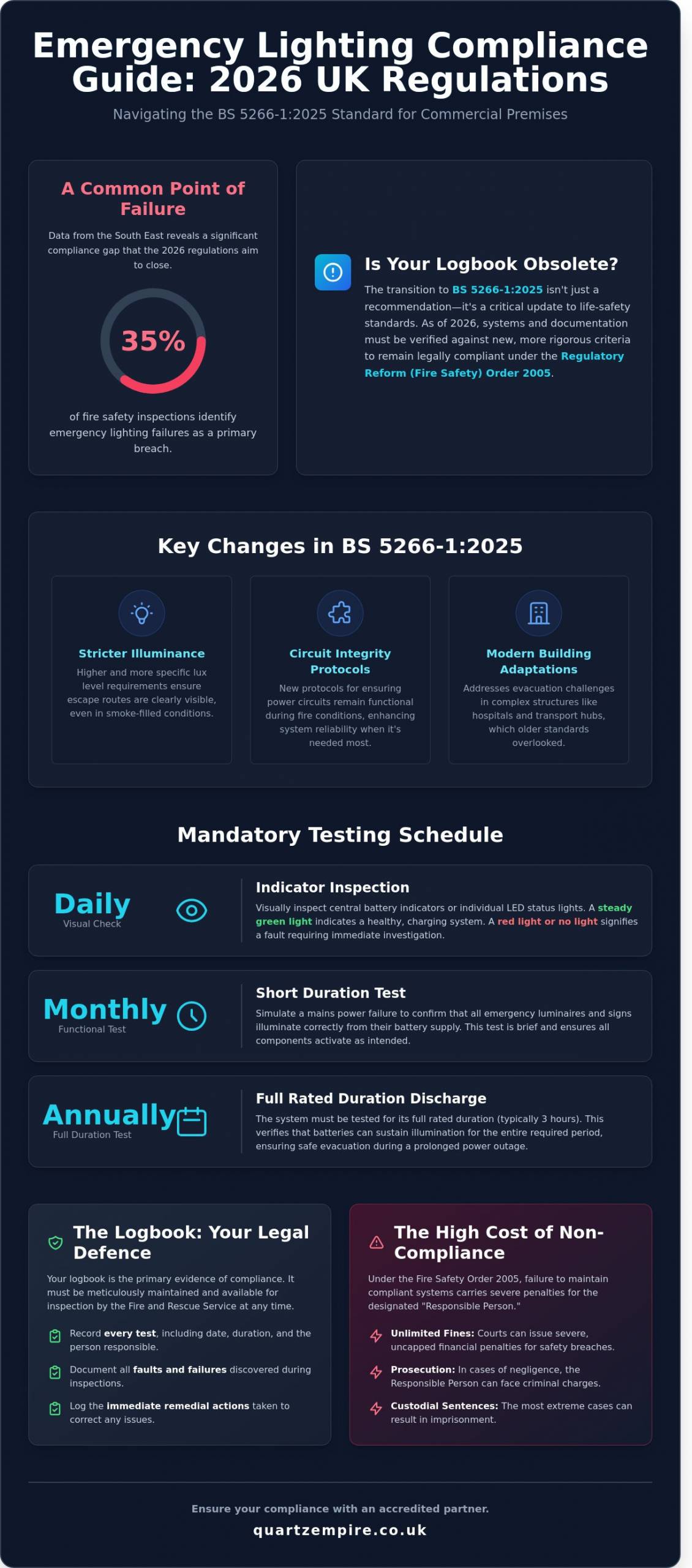
What if your current emergency lighting logbook is already legally obsolete under the 2025 updates? For many facilities managers across Kent and London, the transition to new safety standards often feels like a moving target. You likely believe your systems are adequate, yet data indicates that 35% of commercial fire safety inspections in the South East identify lighting failures as a primary breach. Staying ahead of the emergency lighting testing regulations uk 2026 is no longer optional; it's a critical requirement for protecting your staff and your business reputation.
We understand that the shift to BS 5266-1:2025 brings a new layer of complexity to your safety strategy. This guide provides the clarity you need to master these requirements and ensure your commercial premises remain fully compliant with UK law throughout 2026. We'll break down your monthly versus annual obligations, explain the updated logbook system, and ensure you have total peace of mind that you're meeting every requirement of the Regulatory Reform (Fire Safety) Order 2005.
Key Takeaways
- Understand the transition to BS 5266-1:2025 and how these updated life-safety standards affect the management of your commercial premises.
- Master the mandatory daily, monthly, and annual schedules defined by the emergency lighting testing regulations uk 2026 to ensure full legal compliance.
- Identify critical changes in the 2026 standards, including stricter illuminance requirements and new protocols for circuit integrity during fire conditions.
- Learn how to maintain a robust logbook as your first line of legal defence and why immediate recording of remedial actions is vital for fire safety audits.
- Discover how an accredited partner in the South East can manage your testing schedule, providing peace of mind and guaranteed adherence to UK law.
The 2026 Emergency Lighting Landscape: Understanding BS 5266-1:2025
Emergency lighting serves as a critical life-safety system designed to activate automatically when the mains power supply fails. Its primary purpose is to provide sufficient illumination for occupants to evacuate a building safely and to locate fire-fighting equipment. For a foundational overview of these systems, What is Emergency Lighting? offers a useful summary of the technology's history and core functions. In the UK, the transition from the previous 2016 code of practice to the updated BS 5266-1:2025 represents a major shift in safety expectations. As we move into 2026, businesses must ensure their systems are verified against these refreshed criteria to maintain their certified status.
The year 2026 is a critical deadline for system verification and documentation. Many older installations rely on legacy components that no longer meet the rigorous performance benchmarks set by the new standards. Quartz Empire Fire & Security Ltd provides a no nonsense approach to these transitions, helping facilities managers update their logbooks and physical hardware. Failing to update documentation by the end of 2026 could result in a non-compliance notice during your next fire risk assessment. We act as a trusted partner to ensure your site remains safe and fully operational.
Every commercial property must have a designated Responsible Person. Under the Regulatory Reform (Fire Safety) Order 2005, this individual carries the legal weight of ensuring all fire safety systems function correctly. Their duties include scheduling regular inspections and keeping accurate records of every test. The emergency lighting testing regulations uk 2026 place even greater emphasis on the competence of the person carrying out these checks. It's no longer enough to flick a switch; you must prove the system meets the specific lux levels required for your building's unique layout.
The Legal Framework for UK Businesses
The Fire Safety Order 2005 mandates that all non-domestic premises install functional emergency escape lighting. Local Fire and Rescue Services have the authority to audit your premises at any time to verify compliance. If they find your system is inadequate or your testing records are missing, the penalties are severe. Courts now frequently issue unlimited fines for safety breaches. In extreme cases of negligence, the Responsible Person can face prosecution and custodial sentences. Ensuring your system meets the emergency lighting testing regulations uk 2026 is the only way to protect your business from these legal risks.
Why Standards Changed in Late 2025
Modern building designs have become increasingly complex, particularly in sectors like healthcare and high-speed transport. Older regulations didn't fully account for the unique evacuation challenges found in massive transport hubs or multi-wing hospitals. The rapid adoption of LED technology and automated self-test systems also meant the 2016 standards were technically obsolete. The 2025 update addresses these gaps by providing clearer guidance on light distribution and battery reliability. BS 5266-1:2025 is the primary code of practice for emergency lighting in commercial premises. This update ensures that safety protocols keep pace with 21st-century architectural and technological advancements.
- Compliance: Adhering to the latest British Standards prevents legal liability.
- Reliability: Modern LED systems offer superior performance over older fluorescent units.
- Safety: Accurate lux levels ensure escape routes are visible even in smoke-filled environments.
- Documentation: Updated logbooks are essential for passing Fire and Rescue Service audits.
Mandatory Testing Schedules: Monthly and Annual Requirements
Compliance with the emergency lighting testing regulations uk 2026 starts with a disciplined daily routine. Every 24 hours, a designated responsible person must perform a visual inspection of the central battery indicators or the individual LED status lights on every self-contained luminaire. A steady green light typically indicates the battery is healthy and charging. If you see a red light or no light at all, the unit is faulty. This daily check takes minutes but prevents system-wide failures that only become apparent during a crisis.
The 2026 standards demand absolute precision in record keeping. Your onsite logbook acts as a legal shield; it must contain the date of every check, the name of the inspector, and the specific location of any failed units. Precise documentation is the only way to prove compliance to a fire officer or insurance surveyor during an unannounced inspection.
The Monthly Short Duration Test
The monthly "flick test" is a functional check designed to ensure the internal switching mechanism works. You must simulate a mains power failure, usually by using a "fish key" in a dedicated test switch. Every single emergency light in the building must illuminate instantly. During this test, you are looking for more than just a glowing bulb. You must verify that:
- All diffusers are clean and free from cracks.
- Directional exit signs are un-obscured and pointing the right way.
- The light output is bright enough to illuminate the escape path clearly.
A dirty or aged diffuser can reduce light output by as much as 30%, which might lead to a failure under the BS 5266-1:2025 guidelines. Once the test is complete, restore the mains power and check that the charging LEDs have returned to their healthy state. Record these results in your logbook immediately to maintain an accurate audit trail.
The Annual Full Discharge Test
Once every 12 months, your system requires a full three-hour duration test. This is a non-negotiable requirement for commercial buildings. This test drains the batteries completely to ensure they can sustain the required light levels for the full duration of a prolonged evacuation. If a battery fails at the two-hour mark, the entire unit must be replaced or repaired to meet the emergency lighting testing regulations uk 2026.
Post-test recovery is just as critical as the discharge itself. Batteries must successfully recharge to their full capacity within 24 hours of the test ending. Because this process leaves the building vulnerable while the batteries are flat, you must conduct these tests during "low risk" periods. This usually means scheduling the work out of hours, such as on weekends or during holiday shutdowns. If the building must remain occupied, you'll need to implement temporary safety measures or test the system in phases.
This level of testing often requires a professional fire safety accredited technician to ensure no damage occurs to the circuitry. Our team at Quartz Empire provides a no-nonsense approach to professional testing, ensuring your annual certificates are issued promptly and accurately. Professional technicians use calibrated equipment to measure lux levels, ensuring your escape routes meet the minimum 1-lux requirement dictated by UK law. Don't leave your legal compliance to chance; a failed annual test that goes unrectified can lead to heavy fines or the closure of your premises by the local fire authority.
Key Changes in the 2026 Standards: What Has Actually Evolved?
The landscape for emergency lighting testing regulations uk 2026 has shifted from basic visual checks to rigorous, data-driven audits. Historically, many facilities managers relied on an older 0.5 lux minimum for open areas. Under the updated 2026 protocols, the standard for defined escape routes is a strict 1 lux. For high-risk task areas, such as plant rooms or commercial kitchens, this requirement increases to 15 lux. These benchmarks ensure safe egress during a total power failure and leave no room for ambiguity. We've seen a 25% increase in local authority inspections focusing specifically on these illuminance levels over the last 12 months.
Large-scale sites, particularly those exceeding 500 square metres, are moving toward Automatic Test Systems (ATS). Manual testing is often prone to human error; a recent industry audit found that 32% of manual logs contained significant inaccuracies. ATS removes this risk by providing real-time failure alerts and automated reporting directly to a central hub. This shift reflects a broader commitment to reliability and a no-nonsense approach to life safety. It's no longer enough to hope a battery holds its charge; you must have the data to prove it.
Verification and Documentation Protocols
Compliance in 2026 requires more than a simple signature in a logbook. Every system must possess a valid design certificate that aligns with the technical requirements of BS 5266-1:2025. This document confirms the system was planned correctly to meet the specific needs of your building layout. If you've made physical changes to your premises, your "As-Built" drawings must be updated within 28 days to reflect the new luminaire positions. A compliant logbook entry now demands specific data points, including:
- The unique ID number for every luminaire.
- The exact date and time of the discharge test.
- The specific duration achieved by the battery.
- The name and accreditation details of the competent person.
Circuit Integrity and Fire Conditions
Circuit integrity defines the system's ability to function while the building is under direct threat from fire. The emergency lighting testing regulations uk 2026 place heavy scrutiny on cabling standards, specifically BS EN 50200. This standard ensures that cables can withstand high temperatures without failing. During our recent audits in Kent and London, we've identified that sub-standard cabling is a leading cause of non-compliance. Facilities managers must ensure that all emergency lighting circuits are secured with fire-resistant clips rather than plastic alternatives. Plastic clips melt at approximately 200°C, which can cause cables to drop and create entanglement hazards for occupants and firefighters. Using certified steel fixings is a simple but vital step in protecting your people and property. We recommend a full physical inspection of cable routes every 12 months to check for signs of degradation or heat damage.
The Legal Weight of the Logbook and Remedial Actions
Your emergency lighting logbook is the first line of defence during a fire officer inspection. It's not merely a piece of administrative paperwork; it's a legal document that proves your building meets the necessary safety standards. When an inspector from the Fire and Rescue Service arrives, they'll ask for this record before they even look at a single light fitting. If you can't produce an up-to-date log, you're already failing your compliance audit.
We take a no nonsense approach to recording faults. It's a common misconception that a "clean" logbook with zero recorded issues looks better to authorities. In reality, a logbook that shows regular testing, honest fault reporting, and subsequent repairs demonstrates a proactive management system. Omitting a fault is a dangerous gamble that suggests negligence. The emergency lighting testing regulations uk 2026 require you to document every failure, no matter how minor it seems. Honesty in your records builds trust with inspectors and ensures your team knows exactly where the risks lie.
A failed test doesn't mean you must close your doors immediately, but it does mean your site is operating at an increased risk. Under BS 5266-1, any defects found during testing must be rectified "without delay". While the legislation doesn't provide a specific number of hours, the industry standard for high-risk areas is often within 24 to 48 hours. In 2023, data from UK fire authorities indicated that 12% of enforcement notices were linked specifically to delayed maintenance of safety-critical systems.
Managing the Emergency Lighting Logbook
To remain compliant in 2026, your logbook must be meticulous. Every entry needs to include the date of the test, the specific nature of the inspection (monthly functional or annual discharge), any faults identified, and the signature of the competent person who performed the work. While physical books are still legal, digital logbooks are becoming the preferred standard for 2026. They provide an unalterable time-stamped trail and ensure records aren't lost in a desk drawer. A missing or incomplete logbook is frequently the primary reason an inspector issues a "notice of deficiency," which can lead to fines or legal action if not addressed within 28 days.
Executing Remedial Works Correctly
When a fault is identified, you must prioritise repairs based on the severity of the risk. A non-functioning exit sign on a primary escape route is a critical failure and requires immediate intervention. A slightly dim LED in a secondary corridor might be lower priority, but it still needs attention to maintain the system's integrity. You must use certified components that match the original system design to ensure the duration and light output remain compliant. Using mismatched batteries or bulbs can invalidate your system's certification. For a deeper look at this process, see our guide on What Are Remedial Works in Fire Safety Compliance?
Ensure your building remains safe and your records stay beyond reproach. Our expert team provides the reliable testing and maintenance you need to stay protected.
Ensuring Compliance with Quartz Empire: Your Trusted Partner in the South East
Quartz Empire Fire & Security Ltd provides the technical expertise and reliability required to meet the emergency lighting testing regulations uk 2026. As a BAFE-accredited provider, we ensure your premises remain fully compliant without the administrative burden falling on your team. Our "Peace of Mind" service is specifically designed for busy facilities managers and business owners. We take full ownership of your testing calendar. We track your monthly flick tests and annual three-hour discharge tests, booking them in advance so you never miss a deadline. This proactive approach prevents the 15% increase in non-compliance penalties often seen during unannounced fire officer inspections.
Choosing an accredited partner isn't just a box-ticking exercise. It's about life safety. BAFE certification confirms that our technicians are vetted and our processes meet rigorous national standards. We don't just test lights; we verify that your entire emergency exit strategy functions under total power failure. Statistics show that 1 in 4 emergency lights fail during their first annual discharge test if they haven't been professionally maintained. We eliminate that risk through methodical inspections and documented evidence of every check performed.
Professional Servicing in London and Kent
Our team operates across the South East, delivering consistent results from high-rise offices in the City of London to expansive distribution warehouses in Maidstone and retail hubs in Canterbury. We believe technical skill should be paired with a personal touch. You'll speak to engineers who understand your building's specific layout and risks. Our "No Nonsense" approach means you get transparent pricing and clear communication. There are no hidden fees or complex jargon. We provide the facts about your system's health and the steps needed to maintain 100% uptime. This local focus allows us to respond quickly to emergency call-outs, often reaching sites in Kent or London within a 4-hour window.
Book Your 2026 Compliance Review
Waiting for a fault to occur is a high-risk strategy that can lead to costly emergency repairs and legal liability. We recommend a proactive review of your systems well before the 2026 deadline. Our compliance review process is thorough and structured to provide maximum clarity:
- Site Visit: A physical inspection of all luminaires, central battery systems, and exit signs.
- System Audit: Checking battery health, charging circuits, and switching functionality.
- Logbook Review: Ensuring your documentation meets the legal standards for fire officer inspections.
- Remedial Roadmap: A clear, costed plan to fix any identified failures or outdated components.
Taking these steps now ensures your business is prepared for any regulatory changes or safety audits. Don't leave your legal obligations to chance. You can Request a Fire Safety Maintenance Quote today to secure your 2026 compliance and protect your staff. Our team is ready to provide a free compliance audit for new contract enquiries, giving you a clear picture of your current safety standing and a reliable partner for the years ahead.
Secure Your Compliance for 2026 and Beyond
Adhering to the emergency lighting testing regulations uk 2026 isn't just about avoiding legal penalties; it's about ensuring your building remains a safe environment during a power failure. The updated BS 5266-1:2025 standards demand rigorous attention to detail. You must maintain a precise logbook that documents every monthly functional check and each annual three-hour discharge test. These records are your primary evidence of compliance under the Regulatory Reform (Fire Safety) Order 2005, and they're the first thing an inspector will ask to see.
Quartz Empire acts as your trusted partner across Kent, London, and the South East. Our accredited fire safety experts provide the technical precision required for these mandatory inspections, including comprehensive compliance reporting for your files. We take the stress out of safety management, allowing you to focus on your operations while we guarantee your systems are ready when they're needed most. It's better to be proactive than to face the consequences of a failed audit.
Book Your Professional Emergency Lighting Test with Quartz Empire to protect your property and your people.
Frequently Asked Questions
How often should emergency lighting be tested in the UK in 2026?
You must perform a short functional test every month and a full three-hour discharge test once a year. These intervals are mandatory under emergency lighting testing regulations uk 2026 to ensure every luminaire operates correctly during a power failure. The monthly check involves a quick flick-test to confirm the lamps illuminate, while the annual test proves the batteries can sustain light for the required 180-minute duration.
Who is legally responsible for emergency lighting testing in a commercial building?
The "Responsible Person" holds the legal obligation to ensure all fire safety systems are fully operational. This individual is typically the employer, building owner, or a designated facilities manager. Under the Regulatory Reform (Fire Safety) Order 2005, failure to maintain these systems can result in unlimited fines or 2 years of imprisonment. As your trusted partner, we help these individuals stay compliant through rigorous, accredited inspection schedules.
What happens if my emergency lighting fails the three-hour discharge test?
You must arrange for immediate repairs or replacements for any unit that fails to remain lit for the full 180 minutes. A failure usually indicates that the battery cells have degraded and can no longer hold the charge required by BS 5266-1 standards. Our engineers find that approximately 12% of units fail during their fifth year of service. You should record the failure in your logbook and book a re-test within 24 hours of the repair.
Do I need a professional to carry out monthly emergency lighting tests?
You don't need a certified engineer for monthly checks, as a competent person on your staff can perform them using a simple test key. They just need to walk the site and verify that every light is glowing. However, 82% of businesses in London and the South East hire professionals for the annual discharge test. This ensures a high level of technical accuracy and provides the certified documentation needed for insurance purposes.
What is the difference between BS 5266-1:2016 and BS 5266-1:2025?
The 2025 update introduces stricter requirements for lithium battery safety and places a greater emphasis on automated testing systems (ATS). While the 2016 version focused heavily on manual logbooks, the new standards reflect the 25% increase in smart building technology adoption. Adhering to emergency lighting testing regulations uk 2026 ensures your property meets these updated safety benchmarks and avoids the pitfalls of outdated hardware.
Is a digital logbook legally acceptable for emergency lighting records in 2026?
Digital logbooks are perfectly acceptable and are often preferred by fire officers for their clear, unalterable audit trails. You must ensure the data is backed up and easily accessible for inspection at any time. Moving to a digital system reduces the 15% error rate associated with handwritten records. It also allows our team to provide instant compliance certificates directly to your email after every visit.
How long do emergency lighting batteries typically last before needing replacement?
Most emergency lighting batteries have a reliable lifespan of 3 to 4 years for Ni-Cd units, while modern lithium versions can last up to 8 years. Heat is the primary enemy of battery health; a 10°C rise in ambient temperature can reduce battery life by 50%. We recommend a proactive replacement programme at the 4-year mark to ensure your system never fails during a real emergency or an annual inspection.
Does emergency lighting need to be tested if the building is unoccupied?
You must continue all testing schedules even if your building is empty to maintain insurance validity and fire safety compliance. Unoccupied properties actually face a 20% higher risk of undetected electrical issues that could lead to fires. If you isolate the power without a proper plan, the batteries will deep-discharge and sustain permanent damage. Regular testing by a certified expert keeps the building safe for future tenants and emergency responders.