
Commercial Fire Risk Assessment Kent: The Complete 2026 Compliance Guide

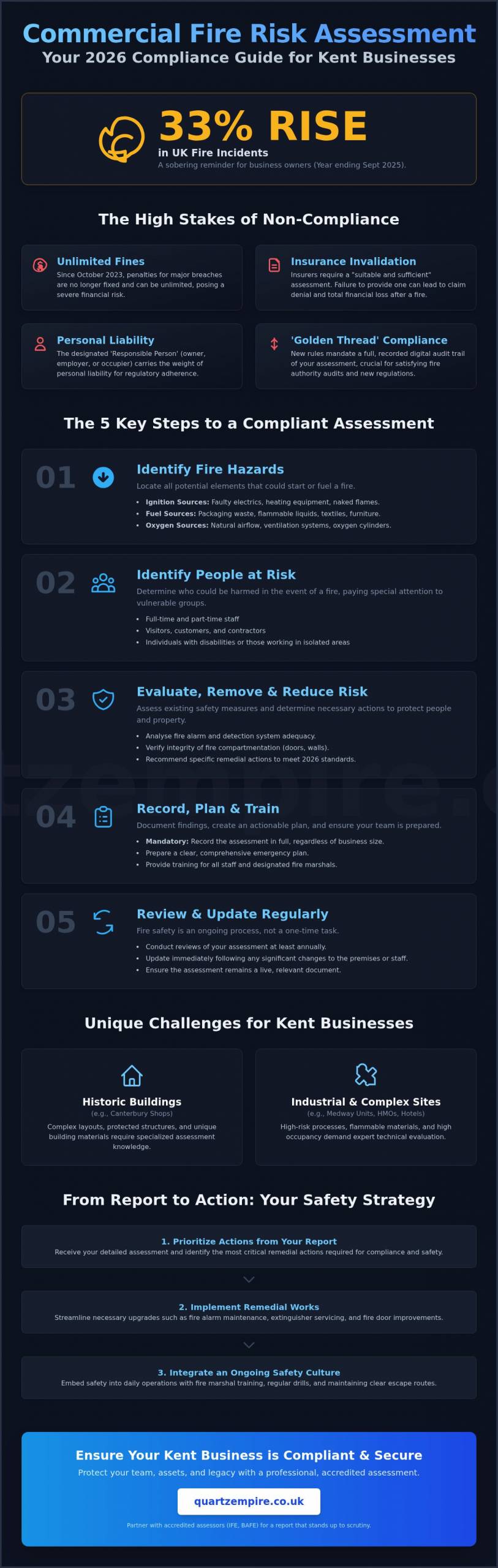
Did you know that UK fire incidents rose by 33% in the year ending September 2025? For business owners across the county, this statistic is a sobering reminder that a commercial fire risk assessment kent is far more than a bureaucratic hurdle; it's a fundamental pillar of your operational safety. You're likely feeling the weight of the 'Responsible Person' role, especially with the introduction of unlimited fines and the complex requirements of the 'Golden Thread' digital audit trail.
We understand that managing safety in a historic Canterbury shop or a Medway industrial site feels daunting when new regulations like Martyn's Law are now in the mix. This guide provides a clear roadmap to 2026 compliance, ensuring your premises meet every legal standard while protecting your team and your assets. We'll examine the mandatory recording of assessments, the necessity of annual reviews, and the practical steps you can take to maintain a secure, compliant environment that satisfies both insurers and the Fire and Rescue Service.
Key Takeaways
- Identify your specific legal duties as the 'Responsible Person' to ensure your premises remain fully compliant with the latest safety regulations.
- Master the five critical steps of a professional assessment to effectively identify ignition sources and protect everyone on your site.
- Navigate the distinct safety requirements of the region by securing a specialized commercial fire risk assessment kent for your historic or industrial property.
- Learn how to prioritize remedial actions from your report to streamline necessary upgrades, such as fire alarm maintenance or extinguisher servicing.
- Implement a comprehensive safety strategy that integrates risk assessment with practical solutions like fire marshal training and access control.
What is a Commercial Fire Risk Assessment and Why is it Mandatory in Kent?
A commercial fire risk assessment is a structured, methodical evaluation of your business premises. It identifies potential fire hazards, determines the people at risk, and outlines the necessary measures to reduce those risks to an acceptable level. Under UK fire safety regulations, this isn't a suggestion; it's a strict legal requirement. For businesses across the county, securing a professional commercial fire risk assessment kent ensures that your operations remain compliant with the Regulatory Reform (Fire Safety) Order 2005.
Failure to maintain a valid assessment carries severe penalties. Since October 2023, the legal landscape has shifted significantly. Enforcement authorities no longer issue small, fixed penalties for major breaches. Instead, fines for non-compliance are now unlimited. Beyond the financial risk, insurance providers often mandate a "suitable and sufficient" assessment as a condition of your policy. If a fire occurs and you can't produce a valid, up-to-date report, your insurer may refuse to pay out for damages, leaving your business facing total financial loss.
The Legal Framework: Regulatory Reform (Fire Safety) Order 2005
The Fire Safety Order applies to almost all non-domestic premises. Recent amendments through Section 156 of the Building Safety Act 2022 have strengthened these rules. As of 2024 and looking toward 2026, every fire risk assessment must be recorded in full, regardless of the size of the business or the number of employees. This change eliminates previous exemptions for small teams. The Responsible Person is the individual or entity legally accountable for ensuring fire safety within a building, typically the employer, owner, or occupier who carries the weight of personal liability for regulatory adherence.
Who Needs a Professional Fire Risk Assessment in Kent?
While some very simple premises might attempt a self-assessment, most Kent businesses require professional expertise to meet the "suitable and sufficient" standard. This is particularly true for high-occupancy or complex buildings. For example, Kent-based HMOs, hotels, and retail units face specific challenges regarding escape routes and fire detection. 2026 standards place a heavy emphasis on fire compartmentation, especially in high-rise commercial units where the spread of smoke must be strictly contained.
If your building has complex fire alarm systems or shared escape routes, a basic checklist won't suffice. Professional assessors accredited by bodies such as the Institution of Fire Engineers (IFE) or BAFE provide the technical depth required for these environments. They ensure your commercial fire risk assessment kent accounts for the "Golden Thread" of digital records, providing a live audit trail that demonstrates your commitment to safety and protects you during local fire authority audits. Using an accredited professional ensures your report stands up to scrutiny and, most importantly, keeps your staff safe.
The 5 Key Steps of a Professional Fire Risk Assessment
A professional assessment follows a rigorous five-step process to ensure total site safety. It begins with identifying fire hazards. We look for ignition sources, such as faulty electrics or heating equipment, and fuel sources like packaging waste or flammable liquids. Oxygen, the final part of the fire triangle, is often overlooked but critical in environments with specialized ventilation. Following Kent Fire and Rescue Service guidance, we then identify people at risk. This includes everyone from full-time staff to visitors and contractors. We pay special attention to those who may be more vulnerable, such as individuals with disabilities or those working in isolated areas of the building.
Step three involves evaluating, removing, or reducing these risks. This is where technical expertise becomes vital. We assess the technical adequacy of your fire alarm systems and the integrity of your building's compartmentation. For a commercial fire risk assessment kent, this means verifying that fire doors and walls actually prevent smoke spread as intended. If your current precautions aren't sufficient, we recommend specific remedial actions to bring the building up to 2026 standards. This evaluation ensures that your existing fire-fighting equipment and detection systems are positioned correctly and functioning at peak performance.
Identifying Hazards and People at Risk
Common hazards in Kent business parks often stem from faulty electrics, overloaded power strips, or poorly managed stock storage. In multi-tenanted buildings, the risk profile changes because one tenant's actions affect everyone else. We identify all "relevant persons," which includes night staff and lone workers who might be more vulnerable during an incident. Every assessor must consider how fire would move through shared spaces and affect occupants in adjacent units. This holistic view is essential for ensuring that an incident in one office doesn't trap workers in another.
Recording Findings and Emergency Planning
Recording your findings is a legal mandate if you have five or more employees. However, 2024 updates suggest recording everything regardless of headcount for better liability protection. A robust Fire Emergency Evacuation Plan (FEEP) is essential for guiding staff through the safest routes. You should also integrate Fire Marshal Training into your strategy to ensure designated staff know how to respond during a crisis.
Finally, establish a review schedule. Your assessment isn't a static document. It requires an update at least every 12 months or whenever significant changes occur to the building layout. If you're unsure about your current compliance status, you can request a comprehensive site survey to identify any hidden vulnerabilities and ensure your documentation is up to date.
Kent-Specific Challenges: From Historic Canterbury to Industrial Medway
Kent features a diverse architectural landscape that demands a localized approach to safety. A generic checklist won't suffice for a county that blends medieval timber frames with state-of-the-art logistics hubs. When conducting a commercial fire risk assessment kent, we must account for these regional variations to ensure your business remains both compliant and safe. Whether you operate a boutique in a listed building or a massive distribution center, the risks you face are fundamentally different based on your location and building stock.
Coastal businesses in areas like Dover and Folkestone face unique environmental challenges. Salt-air corrosion is a genuine concern for fire safety hardware. Sensors, alarm components, and fire extinguishers in these areas often require more rigorous maintenance schedules to prevent mechanical failure. Proactive management ensures that your equipment remains reliable despite the harsh maritime climate. This attention to detail is what local fire authorities look for during routine safety audits.
Historic and Listed Building Compliance
Canterbury and Rochester are home to some of the UK's most significant historic commercial properties. These buildings often contain hidden voids, original timber frames, and combustible materials that facilitate the rapid spread of fire. Achieving compliance here requires balancing modern safety requirements with strict heritage preservation laws. Passive fire protection is a major hurdle, as you can't always install standard fire doors or visible wiring without violating conservation orders. We recommend early consultation with local conservation officers. This collaboration allows for the integration of discreet solutions, such as wireless fire alarm systems, which protect the structure without damaging its historical integrity.
Industrial and High-Volume Storage Risks
In contrast to the historic centers, the industrial corridors of Medway, Dartford, and Ashford present high-volume storage risks. These sites often feature large, open-plan warehouses where fire compartmentation is difficult to maintain. Smoke ventilation is a critical priority in these environments to ensure escape routes remain clear. If your facility handles hazardous materials or specialized manufacturing, your assessment must include detailed plans for specialized fire suppression. The scale of modern logistics in Kent means that a small incident can quickly escalate, making robust detection and clear evacuation protocols essential for business continuity.
Working closely with the Kent Fire and Rescue Service (KFRS) is a cornerstone of our approach. During an audit, KFRS officers expect to see that the Responsible Person has considered these site-specific nuances. A thorough assessment acts as your primary evidence of due diligence, proving that you've identified every regional factor that could impact the safety of your staff and visitors.
Beyond the Report: Remedial Works and Fire Safety Maintenance
Receiving your report is just the beginning of your compliance journey. A professional commercial fire risk assessment kent categorizes findings into three distinct priority levels to help you manage safety effectively. 'Immediate' actions highlight life-threatening issues that require instant resolution before operations continue. 'Urgent' tasks are typically mandated for completion within a short window, often 28 days, to rectify significant safety breaches. 'Recommended' actions focus on long-term safety improvements and industry best practices. This structured approach allows the Responsible Person to manage budgets while addressing the most critical risks first. It's a logical way to move from a document to a safer workplace.
Maintaining clear exit routes is another critical factor. Emergency lighting and photoluminescent signage must be functional and visible to guide occupants during a power failure or in smoke-filled conditions. Regular testing of these systems ensures that staff can evacuate without confusion. Your assessment will verify that these components are positioned correctly according to the specific layout of your Kent premises. Neglecting these smaller details often leads to failed audits, even if your larger systems are in good working order.
Implementing Passive Fire Protection
Fire compartmentation is a vital concept in modern fire safety. It involves dividing a building into 'cells' using fire-resistant walls and floors to contain a fire at its source. Your assessment will scrutinize these boundaries for any breaches. Fire doors represent the most frequent failure point during Kent business audits. They often suffer from damaged intumescent seals, missing closers, or being propped open for convenience. Maintaining these doors is a legal necessity. Additionally, fire stopping ensures that any penetrations for office renovations, like data cabling or plumbing, don't compromise the integrity of your fire-rated partitions.
Active Fire Protection Maintenance
Your report may indicate that your current detection methods are outdated. This often leads to a recommendation for a professional fire alarm system installation. These systems must adhere to BS 5839-1 standards and undergo regular testing to ensure long-term reliability. Portable equipment is equally important. You must schedule annual servicing for different fire extinguisher types to ensure they're ready for use. Whether it's CO2 for electrical risks or foam for flammable liquids, having the correct, maintained equipment is essential for protecting your property.
Integrated security systems shouldn't impede your emergency exit routes. Access control measures, such as magnetic locks, must fail-safe to the open position upon alarm activation. This prevents occupants from being trapped during a crisis. If you've identified gaps in your current safety infrastructure, contact us today for expert remedial support.
Why Choose Quartz Empire for Your Kent Fire Risk Assessment?
Selecting the right provider for your commercial fire risk assessment kent is a decision that directly impacts your legal standing and the safety of your personnel. We offer more than a simple compliance check. Our team provides a foundation of reliability by combining technical expertise with a deep understanding of the local regulatory environment. We deliver clear, jargon-free reports designed to satisfy the requirements of the Kent Fire and Rescue Service and your insurance providers. This transparent approach ensures you understand your obligations without getting lost in technical jargon.
Our "Fire to Security" methodology bridges the gap between identifying a risk and resolving it. Many assessors provide a list of faults and leave the business owner to find a contractor. We operate differently. We maintain a collaborative relationship with our clients, emphasizing long-term reliability through a full suite of services. This includes everything from fire alarm maintenance to the provision of fire extinguishers. By choosing a single, professional partner, you ensure that your safety systems are integrated, documented, and consistently maintained to the highest standards.
Our Local Expertise and Accreditation
Our presence across Kent, London, and the South East allows us to respond effectively to the specific needs of local businesses. We've built a reputation for professional legitimacy through a persistent commitment to official industry recognition. Whether you manage a retail unit in Maidstone or a manufacturing plant in Dartford, our assessors bring meticulous attention to detail to every site. We've supported commercial clients across various sectors, helping them navigate the complexities of the Fire Safety Order with confidence. Our localized knowledge means we're already familiar with the specific challenges posed by Kent's diverse building stock, from modern offices to heritage properties.
Your Partner for Long-Term Fire Safety
We believe in a holistic approach to building protection. Once your assessment is complete, we help you implement the necessary remedial works to ensure permanent compliance. This often involves the integration of advanced access control systems or the installation of upgraded fire detection hardware. Our goal is to provide a seamless transition from risk identification to a fully secured environment. We don't just provide a one-off service; we offer ongoing support and annual reviews to keep your "Golden Thread" of digital records up to date.
Our interactions with the public and our clients are guided by a straightforward, honest, and practical operational philosophy. We prioritize your staff's well-being and your business's continuity above all else. If you're ready to secure your premises and achieve full regulatory adherence, contact us today for a bespoke compliance consultation for your Kent business. We're here to provide the steadfast expertise you need for long-term safety.
Secure Your Business Future Through Professional Compliance
Maintaining full regulatory adherence is a continuous process that protects your staff and your commercial assets. By following the latest 2026 standards, you ensure that your building meets the strict requirements of the Fire Safety Order and satisfies critical insurance criteria. A professional commercial fire risk assessment kent provides the specific roadmap needed to address regional challenges, from historic timber frames in Canterbury to high-volume industrial units in Medway.
Quartz Empire brings professional accreditation and recognized industry standards to every project. We serve businesses across Kent, London, and the South East, offering specialized expertise in both modern developments and protected historic structures. Our team is ready to help you navigate the complexities of fire safety with straightforward, practical solutions that ensure long-term stability and protection for your organization.
Book Your Professional Kent Fire Risk Assessment Today and take the first step toward a safer, fully compliant workplace. We look forward to building a reliable partnership for your long-term safety needs.
Frequently Asked Questions
How often should a commercial fire risk assessment be reviewed in Kent?
A commercial fire risk assessment should be reviewed at least every 12 months to remain compliant with 2026 regulations. You must also conduct a review if there are significant changes to your building's layout, occupancy levels, or intended use. This ensures your safety measures reflect the current reality of your operations and protects you from legal liabilities.
Can I carry out a fire risk assessment myself for my Kent business?
You can legally carry out an assessment yourself if you're the Responsible Person, but you must be a competent person with sufficient knowledge and training. For most businesses, especially those in complex buildings, hiring a professional is the safest choice. Using an accredited expert for your commercial fire risk assessment kent ensures the document stands up to scrutiny during a local fire authority audit.
What is the average cost of a professional fire risk assessment in Kent?
The cost of a professional assessment depends entirely on the size, age, and complexity of your commercial premises. A small retail unit requires less time and technical analysis than a large industrial warehouse or a multi-tenanted office block. We recommend requesting a site-specific quote to ensure your report covers all technical requirements and provides a clear list of remedial actions for your specific building.
Will a fire risk assessment help with my business insurance premiums?
A valid fire risk assessment is typically a mandatory requirement for your business insurance policy. While it doesn't always guarantee a lower premium, it validates your coverage and ensures that claims are paid out in the event of an incident. Proving that you've implemented the recommended remedial works shows insurers that you're a lower-risk client, which can lead to more favorable terms over time.
What happens if Kent Fire and Rescue Service finds my assessment is inadequate?
If the Kent Fire and Rescue Service deems your assessment inadequate, they can issue an enforcement notice or a prohibition notice. Since October 2023, fines for non-compliance with fire safety regulations are unlimited. In severe cases, the Responsible Person can face criminal prosecution and imprisonment. Maintaining a high-quality commercial fire risk assessment kent is the most effective way to avoid these severe legal consequences.
What is fire compartmentation and do I need a separate survey for it?
Fire compartmentation involves dividing a building into fire-resistant sections to contain fire and smoke at the source. A comprehensive assessment includes a visual check of these compartments, such as fire walls and doors. However, if your building has hidden voids or complex architecture, a more intrusive survey might be recommended to verify the integrity of the passive fire protection measures within the structure.
Do small Kent offices with only three employees still need an FRA?
Yes, all non-domestic premises in Kent now require a recorded fire risk assessment, regardless of the number of employees. Section 156 of the Building Safety Act 2022 removed the previous exemption for businesses with fewer than five staff members. This means even a small office with three people must maintain a full, written record of their fire safety measures and risks to remain legally compliant.
What qualifications should I look for in a Kent fire risk assessor?
You should look for assessors who hold recognized professional accreditations from bodies like the Institution of Fire Engineers (IFE) or BAFE. These credentials demonstrate that the individual has the necessary training, experience, and knowledge to conduct a suitable and sufficient assessment. Choosing a qualified professional provides peace of mind that your business is meeting the highest safety standards and protecting its most valuable assets.