
Commercial CCTV Installation: The Complete Guide for UK Businesses

Choosing the right security system for your business can feel like a significant challenge. With concerns ranging from complex UK data protection laws and the risk of unaccredited installers to confusing technology and the fear of hidden costs, it’s easy to feel overwhelmed. A professional commercial cctv installation is about far more than simply mounting cameras; it’s about implementing a robust, reliable, and fully compliant security strategy that gives you complete peace of mind.
This comprehensive guide is designed to provide the clarity you need. We will walk you through every critical step, from identifying the right CCTV technology for your specific premises to understanding your legal obligations under GDPR. You’ll learn how to vet and select a trusted, certified installation partner and what to expect from a clear, upfront quote. Our aim is to empower you to make an informed decision that protects your people, property, and assets, ensuring your business is secure for years to come.
Key Takeaways
- Understand how a professionally installed CCTV system provides critical, high-quality evidence to protect your business assets, staff, and customers.
- Navigate your legal responsibilities under GDPR and the Data Protection Act 2018 to ensure your business remains fully compliant and avoids significant penalties.
- Discover why industry accreditations like NSI or SSAIB are non-negotiable when selecting a trusted partner for your commercial cctv installation.
- Identify the key differences between various CCTV camera technologies to ensure you invest in a bespoke system perfectly suited to your premises.
Why Professional CCTV Installation is a Critical Investment
For any business in Kent, London, or the South East, a modern surveillance system is a cornerstone of security. But its value extends far beyond a simple visual deterrent. An expert commercial cctv installation provides a comprehensive tool for protecting assets, ensuring staff safety, and gaining valuable operational insights. While the basic principles are straightforward (for a foundational overview of CCTV technology, this resource is helpful), the difference between a DIY setup and an accredited, professional installation is significant.
A professionally designed system moves beyond simple monitoring to become an active asset for your organisation, addressing critical areas of risk, compliance, and operational management. The risks associated with non-accredited or poorly executed installations-from inadequate coverage to non-compliance with data protection laws-can ultimately cost a business far more than the initial investment in a certified solution.
Deterrence, Evidence, and Peace of Mind
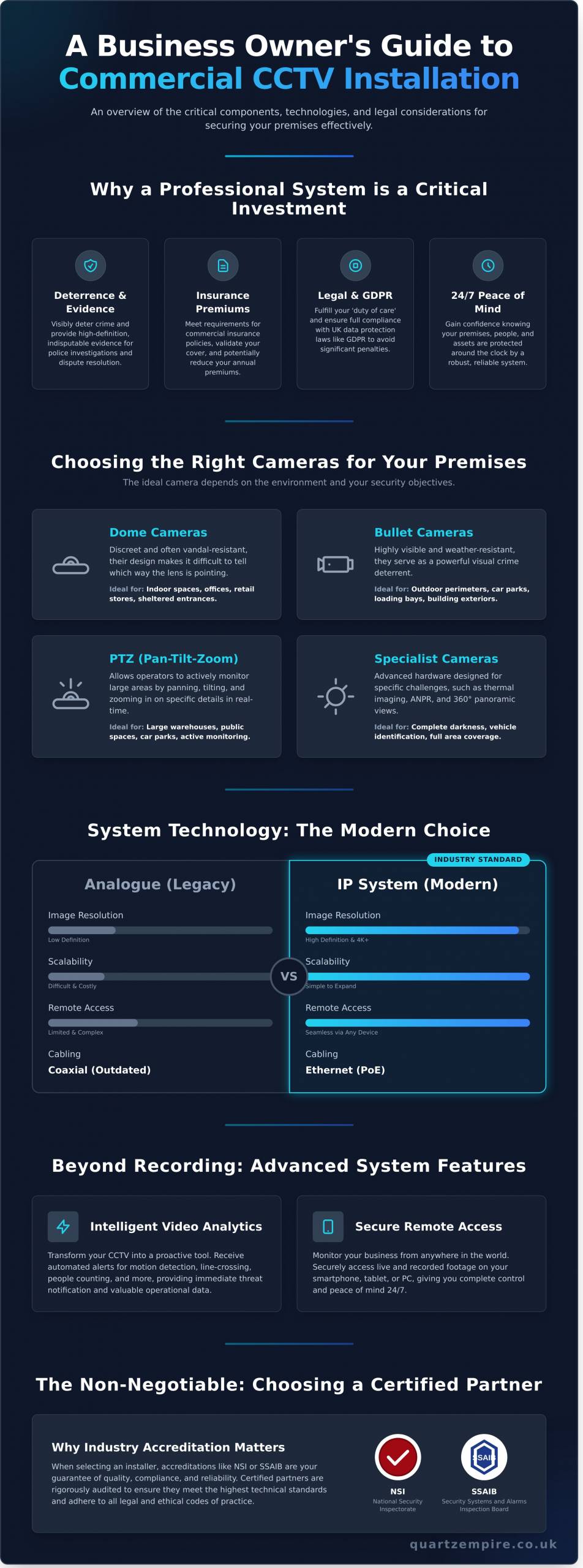
The visible presence of high-quality, strategically placed cameras is a powerful deterrent against opportunistic crime, including theft, vandalism, and anti-social behaviour. However, should an incident occur, high-definition footage becomes indisputable evidence. It is crucial for police investigations, resolving internal disputes, and defending against fraudulent liability claims. Ultimately, a robust and reliable system provides business owners with genuine peace of mind, knowing their premises, people, and property are protected 24/7 by a trusted security partner.
Insurance and Legal Obligations
Many UK commercial insurance policies now stipulate that a compliant, professionally installed and maintained CCTV system must be in place to validate cover. Failing to meet these requirements can void a claim when you need it most. Conversely, an accredited system can often lead to reduced annual premiums. Furthermore, businesses have a legal 'duty of care' to ensure the safety of employees and visitors. A reliable CCTV system is a key component in fulfilling this obligation, monitoring for health and safety compliance and helping to create a secure working environment while avoiding potential legal complications.
Understanding Commercial CCTV Systems: Key Components and Technologies
A professional security system is built on a foundation of reliable hardware and intelligent software. Understanding the core components-cameras, recorders, and storage solutions-is the first step towards a successful commercial CCTV installation. The quality and type of technology you choose directly impact your ability to protect your assets, monitor activity, and provide clear, usable evidence when required.
Choosing the Right Cameras for Your Premises
Selecting the appropriate cameras is critical for effective surveillance coverage. Our accredited engineers assess your specific environment to recommend the ideal mix of hardware for optimal security:
- Dome Cameras: Discreet and often vandal-resistant, these are perfect for indoor spaces like offices and retail stores, as well as sheltered outdoor entranceways.
- Bullet Cameras: Highly visible and weather-resistant, they act as a powerful visual deterrent for protecting perimeters, car parks, and loading bays.
- PTZ (Pan-Tilt-Zoom) Cameras: Ideal for actively monitoring large areas such as warehouses or public spaces, allowing operators to track activity and zoom in on details in real-time.
- Specialist Cameras: For specific challenges, we can install thermal cameras for detection in complete darkness, ANPR for vehicle identification, or fisheye cameras for 360-degree panoramic views.
IP vs. Analogue Systems: Making the Modern Choice
Today, Internet Protocol (IP) based systems are the industry standard, having surpassed older analogue technology in every key area. An IP system offers significant advantages for modern businesses seeking a reliable commercial CCTV installation. The primary benefits include vastly superior image resolution (essential for evidential purposes), simplified scalability to add more cameras as your business grows, and seamless remote access. Footage is managed and stored on a Network Video Recorder (NVR), a dedicated device that provides reliable, high-capacity recording.
Advanced Features: Analytics and Integration
Modern CCTV systems offer far more than simple recording. Intelligent video analytics can transform your security system into a proactive business tool, with features like automated motion detection, line-crossing alerts, and people counting. This allows for immediate notifications of potential threats and provides valuable operational insights.
Furthermore, you can securely access live and recorded footage from anywhere via a smartphone, tablet, or PC. For a truly integrated solution, we can link your CCTV with access control and intruder alarm systems. While these features provide powerful insights, it is vital to use them responsibly and in full compliance with the UK legal requirements for business CCTV, which govern how you collect, store, and manage surveillance data.
The Professional Installation Process: From Survey to Handover
A successful commercial CCTV installation is not a one-day task but a structured, meticulous process. At Quartz Empire, we follow a proven methodology designed to deliver a reliable security system with minimal disruption to your business operations. From the initial consultation to the final handover, our focus is on providing a compliant and effective solution that gives you complete peace of mind.
Step 1: Site Survey and System Design
The process begins with a comprehensive, no-obligation site survey. Our expert engineers visit your premises to conduct a thorough risk assessment. We identify vulnerable areas, such as entry points, cash handling zones, and stockrooms, to determine strategic camera placements. We also assess critical factors like:
- Lighting conditions (both day and night) to select the right camera technology.
- Existing network infrastructure and available power sources.
- Potential obstructions and environmental challenges.
Following this assessment, we design a bespoke CCTV system tailored to your specific security needs and budget. You will receive a detailed, transparent proposal with a clear breakdown of all equipment and installation costs.
For larger commercial properties, a detailed site survey often requires precise measurements of the building's exterior to plan cabling routes and optimal camera placement on high walls or rooftops. In such cases, having access to digital measurements can streamline the design and quoting process. For those looking to get ahead, services that provide 1ESX Roof & Wall Reports can offer the kind of detailed external data that is invaluable for complex security projects.
Step 2: Installation and Cabling
Our accredited engineers carry out the installation with precision and care. For modern IP-based systems, we implement structured cabling to ensure a stable and reliable network connection for your cameras, which is essential for high-quality, uninterrupted footage. All equipment is professionally mounted and configured to be discreet and tamper-resistant. We pride ourselves on completing every commercial cctv installation to the highest safety standards, ensuring all wiring is tidy, concealed where possible, and fully compliant with regulations.
Step 3: Commissioning and Training
Once the hardware is in place, we commission the system. This involves fine-tuning camera angles, focusing lenses, and configuring recording settings such as motion detection and storage retention periods. We ensure your system is optimised for performance and that you understand your obligations, which are detailed in the official UK government CCTV guidance on data protection. The final step is a comprehensive handover, where we provide full training to you and your designated staff on operating the system, from viewing live feeds to exporting evidence. You will also receive all necessary user manuals and contact details for our ongoing support services, establishing us as your trusted security partner.
UK Legal Compliance: A 'No Nonsense' Guide for Businesses
Installing a commercial CCTV system is about more than just hardware; it involves significant legal responsibilities. Protecting your premises must not come at the expense of individual privacy rights. Understanding your obligations under the General Data Protection Regulation (GDPR) and the Data Protection Act 2018 is non-negotiable. This guide provides a direct, no-nonsense overview to ensure your commercial cctv installation is fully compliant from day one, giving you complete peace of mind.
GDPR and the ICO Explained
Under UK law, CCTV footage of identifiable individuals is classified as personal data. As the business owner, you are the 'data controller' and must have a clear, documented, and legitimate purpose for your surveillance, such as preventing crime or ensuring staff safety. This means you must register with the Information Commissioner's Office (ICO) and pay an annual data protection fee, which is typically £40 or £60 for most small to medium-sized enterprises. For any large-scale or high-risk surveillance projects, you may also be required to conduct a Data Protection Impact Assessment (DPIA) to identify and minimise data protection risks before installation begins.
Signage and Data Management
Transparency is a cornerstone of compliant CCTV operation. You must display clear and visible signs at the edge of your surveillance area to inform people that they are being recorded. These signs must include:
- The identity of the data controller (your business name).
- The specific purpose of the surveillance (e.g., "For the prevention of crime").
- Contact details for any enquiries, such as a phone number or website address.
Furthermore, you must manage the data you collect responsibly. This involves creating a formal CCTV policy detailing secure storage methods, access controls, and a defined data retention period-30 days is a common and justifiable standard. If an individual requests a copy of their footage (a Subject Access Request), you have one calendar month to respond. It is your legal duty to protect the privacy of other individuals in the footage, which often requires redacting or blurring their images before release. As your trusted partner, Quartz Empire ensures these legal considerations are built into every system we design and install.
How to Choose the Right CCTV Installation Partner
Selecting the right technology is only half the battle; a successful commercial cctv installation depends entirely on the expertise and reliability of your chosen partner. The right installer provides not just equipment, but long-term peace of mind, ensuring your system remains effective, compliant, and fully supported for years to come. Here’s what to look for in a trusted security provider.
Check for Accreditations and Certifications
The most critical benchmark for quality in the UK security industry is accreditation from a recognised body like the NSI (National Security Inspectorate) or SSAIB (Security Systems and Alarms Inspection Board). This is non-negotiable. These accreditations guarantee that a company:
- Adheres to the highest technical standards for installation and maintenance.
- Employs security-screened, fully trained, and competent engineers.
- Is comprehensively insured for the work it carries out on your premises.
- Operates a fair and transparent business practice.
Choosing an accredited installer ensures your security is handled by vetted professionals, not unqualified amateurs.
Assess Their Experience and Reputation
A reputable installer will have a proven track record. Look for a company that can provide case studies or examples of work in sectors similar to your own, whether it's retail, warehousing, or corporate offices. This demonstrates they understand the unique security challenges your business faces. Furthermore, check for independent online reviews on platforms like Google to gain an unbiased perspective on their customer service and quality of work. A provider with a strong local presence is often a wise choice, offering greater accountability and faster response times.
Enquire About Ongoing Support and Maintenance
Your security system is a long-term investment that requires professional upkeep. Before committing, it is vital to look beyond the initial commercial cctv installation and understand the ongoing support on offer. A comprehensive maintenance contract is essential for maximising system longevity, ensuring optimal performance, and preventing faults. Ask direct questions about their service level agreements (SLAs), including guaranteed response times for emergency call-outs and technical support. A reliable partner will also offer a robust warranty covering both parts and labour, protecting your investment fully.
Ready to partner with a security expert? Get a quote from an accredited installer in Kent, London & the South East.
Your Next Step Towards Comprehensive Business Security
As this guide has shown, investing in a professional security system is one of the most effective measures for protecting your business. A successful installation is about more than just hardware; it demands strategic design, a clear understanding of UK legal compliance, and a reliable partner committed to your long-term security.
A compliant and expertly handled commercial cctv installation provides not only a powerful deterrent but also invaluable peace of mind. As the trusted security partner for businesses across Kent, London, and The South East, Quartz Empire delivers this with our team of SSAIB Accredited & Certified Installers. We ensure your system is effective from day one and remains so with comprehensive maintenance and support contracts.
Take the definitive step to safeguard your assets and secure your future. Request a Free, No-Obligation Site Survey for Your Business today and let our experts design a solution that protects what matters most.
Frequently Asked Questions About Commercial CCTV
How much does a commercial CCTV installation cost?
The cost of a commercial CCTV installation is tailored to the specific needs of your business. A basic system for a small retail unit might start from around £800, while a complex, multi-camera system for a large warehouse could cost several thousand pounds. Key factors influencing the price include the number and type of cameras (e.g., dome, bullet, PTZ), the recording device, and the complexity of the cabling. We provide a detailed quote following a comprehensive site survey to ensure a transparent, no-nonsense price.
How long does a typical business CCTV installation take?
The timeframe for a business CCTV installation depends on the size of your premises and the system's complexity. A standard installation for a small office or shop with a few cameras can typically be completed within one working day. For larger, more intricate projects, such as those in industrial units or multi-storey buildings that require extensive wiring and network configuration, the installation may take between two and five days. Our accredited engineers work efficiently to minimise any disruption to your operations.
Can I view my business CCTV footage remotely on my phone?
Yes, remote viewing is a standard and essential feature of all modern commercial CCTV systems we install. Once your system is connected to your network, you can securely access live and recorded footage from anywhere in the world using a dedicated application on your smartphone, tablet, or computer. This provides business owners and managers with invaluable peace of mind, allowing them to monitor their property, staff, and assets 24/7, no matter where they are.
What is the difference between an NVR and a DVR?
The primary difference lies in how they process and record video. A DVR (Digital Video Recorder) is used with analogue cameras and processes the video data at the recorder itself. An NVR (Network Video Recorder) works with modern IP (Internet Protocol) cameras, where the video is encoded at the camera and then streamed to the NVR for storage. NVR systems generally offer superior image quality, greater flexibility, and more advanced features, making them the standard for new professional security installations.
Do I need to inform my staff about the installation of CCTV?
Yes, it is a legal requirement in the UK to inform your staff about workplace surveillance. Under GDPR and the Data Protection Act 2018, you must have a legitimate reason for installing CCTV and be transparent about its use. This includes notifying employees, explaining the purpose of the cameras, and displaying clear and visible signage in all monitored areas. Failure to do so can lead to legal challenges and fines, so ensuring your system is fully compliant is critical.
How often should a commercial CCTV system be serviced?
To ensure optimal performance and reliability, we recommend that a commercial CCTV system is professionally serviced at least once a year. Regular maintenance helps to identify and resolve potential issues before they become serious problems. A typical service includes cleaning camera lenses, checking all physical connections, testing recording and playback functions, and ensuring the system's software is up to date. This proactive approach guarantees your security system remains effective and protects your investment.
Are wireless commercial CCTV systems reliable?
Modern wireless CCTV systems have become significantly more reliable and are an excellent solution for properties where running cables is impractical or undesirable. They offer flexibility and a cleaner installation process. However, their performance can be affected by signal obstructions or network interference. For mission-critical security in high-risk environments, a hard-wired system is often considered more robust and secure, providing a consistently stable connection that is not susceptible to wireless signal issues.