
Choosing a Security Partner for My Business: A 2026 Guide to Physical Safety & Compliance

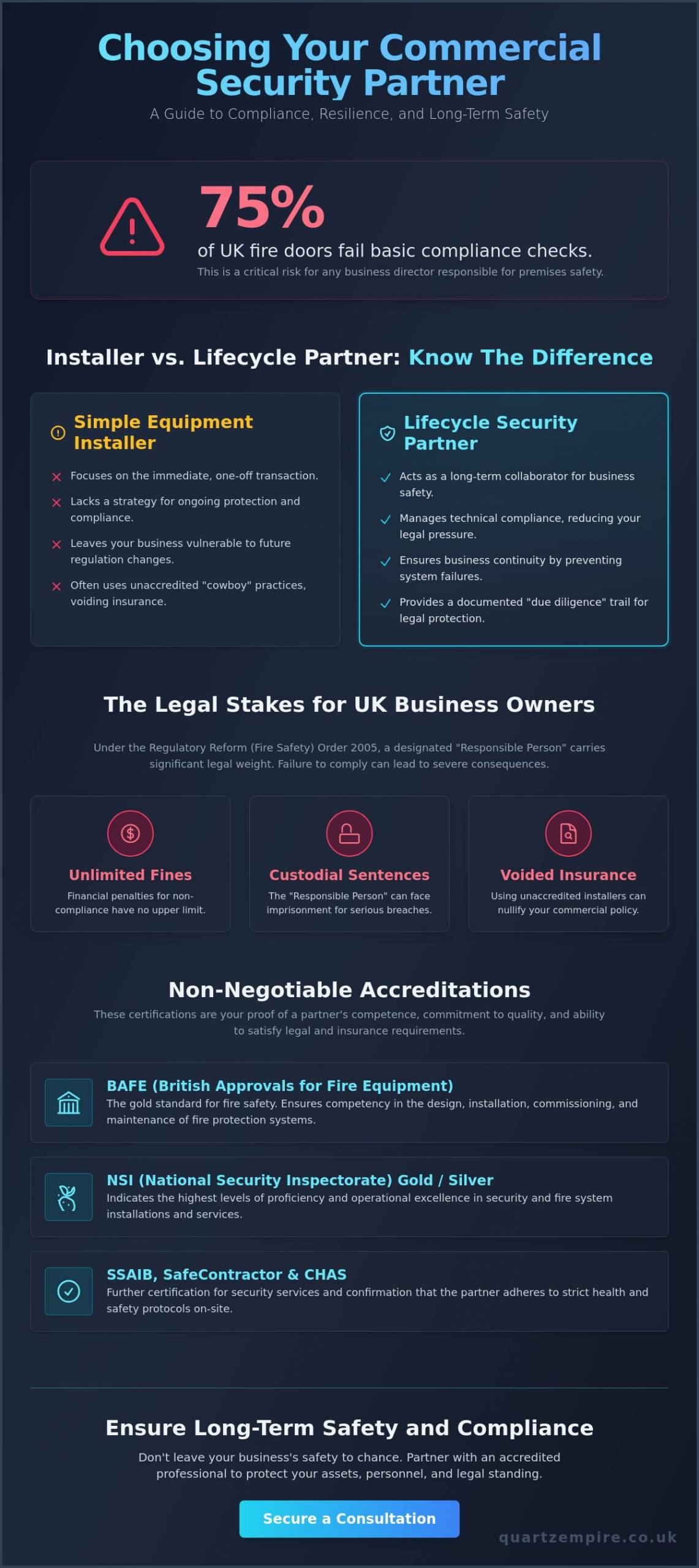
Industry inspections suggest that approximately 75% of fire doors in existing UK stock currently fail basic compliance checks. This is a serious concern for any director who believes their premises are fully protected. You've likely felt the pressure of keeping up with shifting regulations like the 2026 updates to BS 8214 or the implementation phase of Martyn's Law. The process of choosing a security partner for my business should focus on your legal liability as much as your physical safety.
We understand that the fear of system failure during a critical inspection or emergency is a significant burden. This guide shows you how to select an accredited professional who ensures your business remains legally compliant, physically secure, and resilient against modern threats. We will examine how to verify industry credentials, consolidate your fire and security needs into a single point of contact, and achieve the high standards required to reduce insurance premiums. By following this framework, you can move away from low cost providers and establish a foundation of long term safety and reliability.
Key Takeaways
- Differentiate between a simple equipment installer and a lifecycle security partner to maintain continuous operational resilience and safety.
- Identify the critical accreditations, including BAFE and NSI gold standards, required to satisfy insurance providers and legal fire safety obligations.
- Learn the operational benefits of consolidating fire protection and commercial security systems under a single, accredited point of contact.
- Discover why local regional expertise in London and the South East is essential for achieving rapid emergency response targets and reliable maintenance.
- Evaluate the essential criteria for choosing a security partner for my business to ensure your systems provide long-term protection beyond the initial installation.
The Strategic Importance of a Physical Security Partnership
A professional security partner acts as a long term collaborator in your business safety rather than a simple equipment vendor. While a one-off installer focuses on the immediate transaction of mounting hardware, a lifecycle partner prioritizes the ongoing protection of your assets and personnel. The Strategic Importance of a Physical Security Partnership lies in its ability to integrate various layers of protection into a cohesive strategy that evolves with your business. When you're choosing a security partner for my business, you must look for an organization that understands the specific risks associated with your industry and geographic location.
Under the Regulatory Reform (Fire Safety) Order 2005, every UK business must designate a "Responsible Person." This individual carries the legal weight for ensuring the premises are safe from fire hazards. This burden is significant, as it involves continuous monitoring, documentation, and system testing. A dedicated security partner reduces this administrative and legal pressure by managing the technical requirements of compliance. They ensure that your systems don't just function, but also meet the rigorous standards required by insurance providers and local authorities.
Beyond Hardware: Security as Business Continuity
Security and fire protection systems are essential components of business continuity. If a fire alarm system fails or a major security breach occurs, the resulting disruption often leads to immediate business closure. Beyond the physical risks, operational inefficiencies like frequent false alarms can drain resources and damage your reputation with emergency services. We define a security partnership as a comprehensive risk mitigation strategy that prevents these interruptions before they occur. By maintaining your systems in peak condition, a partner ensures your business remains operational and resilient against unforeseen events.
The Legal Stakes for UK Business Owners
The legal consequences for failing to maintain safety standards are severe. Non-compliance with fire safety laws can lead to unlimited fines or even custodial sentences for the Responsible Person. A professional partner provides a robust "due diligence" trail, offering the documented evidence needed to prove you've taken all reasonable steps to protect your premises. Central to this protection is the role of documented fire risk assessments. These assessments are not just a legal requirement; they're the foundation of your safety strategy. A qualified partner helps you navigate these assessments, ensuring that every identified risk is addressed with a certified solution that stands up to official scrutiny.
Essential Accreditations and Compliance Standards to Verify
Professional credentials serve as the primary evidence of a contractor's technical competence and operational integrity. When choosing a security partner for my business, you must look beyond marketing claims and examine official certifications. These badges aren't merely decorative. They represent a commitment to rigorous external auditing and a promise that your installations will satisfy both legal authorities and insurance providers. Using an unaccredited "cowboy" installer often voids commercial insurance policies, leaving your business financially vulnerable after an incident.
To ensure full regulatory adherence, verify that your prospective partner holds the following credentials:
- BAFE (British Approvals for Fire Equipment): The gold standard for fire safety, ensuring the provider is competent to design, install, and maintain fire protection systems.
- NSI (National Security Inspectorate) Gold or Silver: This indicates the highest level of proficiency in security and fire system installations.
- SSAIB (Security Systems and Alarms Inspection Board): A leading certification body for organizations providing security and fire protection services.
- SafeContractor or CHAS: These statuses confirm that the partner adheres to strict health and safety protocols during on-site work.
Why BAFE and NSI Matter
The auditing process for BAFE and NSI is exceptionally demanding. These bodies perform regular, unannounced inspections of both administrative records and physical installations. They verify that staff members possess the appropriate training and that the hardware used meets current safety requirements. Insurers frequently mandate the use of NSI-approved security systems because they provide a lower risk profile. By selecting a partner with these medals, you guarantee a level of expertise that protects your staff and your bottom line.
Understanding British Standards (BS)
Compliance is a moving target. A reliable partner stays updated on evolving regulatory changes, such as the specific requirements of BS 5839-1 for fire detection and alarm systems. This standard dictates everything from the placement of smoke detectors to the decibel levels of sounders. Additionally, all security installations must comply with BS 7671 to ensure electrical safety across the entire network. A professional partner handles these technical details on your behalf, providing the necessary certification to prove your premises are safe and legally sound. If you're unsure about your current status, it's wise to consult with an accredited expert to identify any compliance gaps before your next inspection.
Evaluating Service Depth: Fire Protection and Security Integration
Managing multiple contractors for different safety systems often leads to communication gaps and technical silos. When choosing a security partner for my business, you should prioritize providers who can bridge the gap between fire protection and physical security. A unified approach ensures that your commercial CCTV installation works in tandem with your fire detection protocols. This synergy provides a more resilient safety net for your premises and simplifies your administrative burden. By choosing a comprehensive security partner, you gain a single point of contact for all regulatory requirements, from intruder detection to fire safety maintenance.
Integrated Fire and Security Ecosystems
The technical integration between systems is a critical factor in life safety. Modern access control systems must be professionally configured to ensure they automatically release during a fire alarm to prevent entrapment. Additionally, your security partner can link CCTV feeds to fire sensors. This allows for immediate visual verification of an alert before emergency services are dispatched, reducing the cost and disruption of false alarms. Consolidating these services into a single maintenance contract also improves operational efficiency. A single engineer visit can often cover both your intruder alarm and fire detection systems, saving time and reducing site disruption.
Specialist Fire Safety Services
A capable partner must demonstrate deep expertise in fire-specific regulations. This starts with a professional fire alarm installation that adheres to BS 5839-1 standards. However, hardware alone is insufficient for full compliance. Your provider should also offer Fire Marshal Training to ensure your staff knows how to respond during an evacuation. They must also manage your fire extinguisher inventory, selecting the correct fire extinguisher types based on the specific risks identified in your risk assessment. This holistic view of fire safety ensures that your business is not just equipped with hardware, but is fully prepared for an emergency.
When you evaluate a potential partner, ask about their ability to scale these services. A partner who can manage your intruder alarms, CCTV, access control, and fire extinguishers under one roof provides a level of oversight that fragmented providers cannot match. This integrated strategy is the most effective way to ensure your business remains compliant and operationally resilient in 2026.
Assessing Long-Term Reliability: Maintenance and Emergency Response
The initial installation of your fire and security hardware represents only 20% of the total value you receive from a provider. The remaining 80% is found in the years of ongoing maintenance, technical support, and emergency response that follow. Choosing a security partner for my business requires looking at the next ten years, not just the first ten days. A system that works today but fails during a critical emergency or a regulatory inspection is a liability, not an asset. You must assess a provider's ability to support your operations long after the engineers have left the site.
Choosing a security partner for my business also involves scrutinizing the depth of their technical support and the speed of their response. Reactive repairs are often expensive and occur at the most inconvenient times. In contrast, proactive preventative maintenance identifies potential failures in sensors, batteries, or wiring before they trigger a false alarm or a system blackout. Meticulous technicians who understand the specific nuances of industry-leading hardware manufacturers provide a level of reliability that general contractors cannot match. This steadfast approach to service delivery is what separates a professional partner from a casual installer.
The Maintenance Framework
A standard commercial maintenance contract should provide a clear schedule of preventative visits. These are not merely optional check-ups. They are essential for meeting the legal requirements for periodic fire alarm and emergency light testing. Regular inspections identify component wear and tear before it leads to system failure, ensuring your business remains compliant with BS standards. Modern providers now utilize remote diagnostics to solve software-related issues without the need for an on-site visit. This technology reduces downtime and ensures your security network remains stable and efficient without interrupting your daily operations.
Monitoring and Rapid Response
For 24/7 protection, your partner should offer connection to an Alarm Receiving Centre (ARC). These centres monitor your intruder and fire alarms around the clock, providing a professional buffer between an alert and the emergency services. Reliable partners also manage keyholding services and police response protocols, ensuring that the correct authorities are dispatched only when a genuine threat is verified. Maintenance is the insurance policy for your security system. It guarantees that your investment continues to perform its primary function: protecting your people and your property. You should look for partners who commit to specific service level agreements, such as 4-hour response targets for emergency call-outs.
If you want to ensure your business remains fully protected through a certified maintenance plan, you can contact our technical team for a professional assessment of your current systems.
Why Regional Expertise Matters for London and South East Businesses
The logistical reality of operating in London and Kent presents unique challenges that a generic national provider often struggles to overcome. When you are choosing a security partner for my business, geographical proximity is a critical factor in maintaining the response times discussed in previous sections. Congestion in central London and the spread of commercial estates across the South East require a partner with a localized engineering fleet. Local engineers don't just arrive faster; they possess the specific regional knowledge required to navigate the area's infrastructure and unique security risks.
A partner with a strong regional presence understands the localized crime trends and fire safety requirements specific to the South East. Whether it is the high-density office environments of the City or the sprawling industrial units in Kent, the security approach must be tailored to the environment. Choosing a security partner for my business that is established within your region ensures that your safety strategy is informed by local intelligence and supported by rapid, on-site assistance when a critical failure occurs.
London and Kent: A Unique Security Landscape
High-density London offices face complex fire safety challenges, particularly regarding evacuation routes and multi-tenant occupancy. Navigating local council fire regulations and the specific requirements of the London Fire Brigade requires a partner who understands the local regulatory landscape. Regional expertise allows for a smoother liaison with local authorities and ensures that your systems meet the exact standards expected during an inspection. Localized partners often maintain established links with regional suppliers, ensuring that replacement hardware for your fire alarm or CCTV system is sourced and installed without the delays associated with national supply chains.
The Quartz Empire Fire & Security Ltd Difference
Quartz Empire Fire & Security Ltd is deeply committed to supporting businesses throughout London and the South East with a straightforward, honest, and practical operational philosophy. We don't believe in one-off sales or temporary fixes. Instead, we focus on building long-term collaborative relationships that provide our clients with a sense of safety and stability. Our engineers are familiar with the specific logistical hurdles of the region, allowing us to maintain our commitment to reliability and professional standards. We provide a dependable point of contact for all your fire and security needs, ensuring your business remains compliant and resilient.
We invite you to experience a more meticulous approach to your safety requirements. Our team is ready to help you secure your premises with the expertise that only a local specialist can provide. To begin securing your business, contact our London or Kent teams today for a professional site survey and a comprehensive evaluation of your current safety systems.
Establishing a Foundation of Long Term Safety
Maintaining a compliant and secure business environment requires more than high quality hardware. It demands a steadfast commitment to regulatory standards and proactive maintenance. By prioritizing integrated systems and verifying essential BAFE and NSI credentials, you ensure that your safety infrastructure meets the rigorous expectations of both insurers and legal authorities. Choosing a security partner for my business is a strategic decision that impacts your operational resilience for years to come. Local expertise in London and the South East further guarantees that rapid assistance is always available when critical failures occur.
Quartz Empire provides the technical proficiency and industry recognition necessary to protect your assets and personnel. As a BAFE and NSI accredited provider, we deliver comprehensive maintenance and 24/7 monitoring solutions tailored to the unique landscape of London, Kent, and the South East. Our straightforward, honest, and practical approach ensures that your business remains a safe and stable environment for your stakeholders.
Secure your premises with a professional fire and security partner today and gain the peace of mind that comes with meticulous, expert protection.
Frequently Asked Questions
What is the difference between a security installer and a security partner?
A security installer typically focuses on the physical mounting of hardware during a single transaction. In contrast, choosing a security partner for my business ensures you have a long term collaborator who manages your ongoing compliance and system lifecycle. This partnership includes proactive maintenance, emergency support, and regular updates to your safety strategy. This approach prioritizes your operational resilience rather than just the initial equipment sale.
How often does my business need a fire risk assessment?
You must review your fire risk assessment regularly to ensure it remains valid under the Regulatory Reform (Fire Safety) Order 2005. While the law does not specify a strict timeframe, industry best practice is an annual review or whenever significant changes are made to the building or its occupancy. Maintaining an up to date assessment is a critical component of your due diligence trail for authorities and insurance providers.
Do I need different companies for my fire alarm and my CCTV?
It is not necessary to use different companies; in fact, consolidating your fire alarm and CCTV systems with one provider is often more efficient. A single partner ensures that your access control and surveillance work in tandem with your fire detection protocols. This integration simplifies your administrative burden and often reduces costs by allowing a single engineer visit to cover multiple safety systems.
What accreditations should I look for in a UK security company?
You should prioritize providers who hold BAFE (British Approvals for Fire Equipment) and NSI (National Security Inspectorate) Gold or Silver medals. These accreditations prove that the company undergoes rigorous external auditing and adheres to the highest technical standards. Additionally, look for SafeContractor or CHAS status, which confirm the provider's commitment to strict health and safety protocols during on site work.
How quickly should a security partner respond to an emergency call-out?
A professional security partner should aim to respond to emergency call outs within a four hour window for critical system failures. This target is a standard benchmark for NSI accredited providers and ensures that your premises don't remain vulnerable for extended periods. When choosing a security partner for my business, always verify their specific service level agreements regarding response times for London and the South East.
Can a security partner help reduce my business insurance premiums?
Yes, using an accredited security partner can often lead to reduced commercial insurance premiums. Insurers recognize that systems installed and maintained by NSI or BAFE approved contractors represent a lower risk profile. By providing documented evidence of professional maintenance and 24/7 monitoring, you demonstrate a high level of risk management that justifies more favorable terms from your insurance provider.
What are the legal requirements for commercial fire alarm maintenance?
Commercial fire alarms must be maintained according to the BS 5839-1 standard, which typically requires a professional inspection at least every six months. These periodic tests ensure that all detectors, sounders, and control panels are fully operational. Failing to meet these maintenance requirements can lead to unlimited fines or custodial sentences for the designated Responsible Person if a fire incident occurs.
Is it better to lease or buy security equipment for my business?
The decision to lease or buy security equipment depends on your business's cash flow and tax preferences. Buying hardware offers long term ownership and can be more cost effective over time, while leasing provides access to the latest technology with lower upfront costs. Regardless of the financial model you choose, the legal requirement for regular maintenance and professional certification remains the same to ensure full compliance.