
BS 5839-1:2026 Explained: A Definitive Guide to UK Fire Alarm Standards

Does your current fire safety certificate protect you from fines exceeding £10,000, or is it simply a piece of paper that became obsolete when the new regulations arrived? We understand that keeping up with shifting legislation feels like a full-time job, especially when 65% of UK facility managers report confusion over new safety codes. This is why having bs 5839-1 2026 explained in a clear, direct way is essential for your peace of mind. You likely already know that fire safety is non-negotiable, yet the 140 pages of technical requirements in the British Standards can be difficult to translate into actionable steps for your premises.
Our team at Quartz Empire is here to bridge that gap with a no-nonsense breakdown of the latest updates. We promise to clarify exactly which parts of your existing system remain legal and which components require attention to meet the 2026 criteria. This guide previews the major hardware shifts, the updated testing protocols, and a straightforward roadmap to ensure your business stays compliant. Whether you operate in London or Kent, we'll show you how to maintain an accredited system that protects your people and your property.
Key Takeaways
- Understand the fundamental updates to fire safety legislation and why the 2026 revision is essential for maintaining compliance in non-domestic premises.
- Get bs 5839-1 2026 explained with a clear breakdown of tighter design justifications and updated guidance on reducing evacuation lag.
- Learn how to distinguish between L, P, and M protection levels to ensure your system meets the specific safety objectives of your building.
- Identify the legal obligations of the "Responsible Person" and the necessity of rigorous, ongoing maintenance for life safety systems.
- Discover why BAFE and FIA accreditations are the gold standard for fire safety providers when protecting your business in London and Kent.
What is BS 5839-1 and Why Does the 2026 Revision Matter?
BS 5839-1 serves as the primary code of practice for fire detection and alarm systems within non-domestic premises across the United Kingdom. It acts as the definitive benchmark for any professional responsible for fire safety, providing a structured framework for the design, installation, commissioning, and maintenance of these life-saving systems. Having the BS 5839 Part 1 standards as a foundation ensures that every component, from a simple smoke detector to a complex control panel, functions reliably during a crisis. At Quartz Empire Fire & Security Ltd, we view this standard as the minimum requirement for protecting your assets and personnel.
The upcoming 2026 revision is a necessary evolution of the standard. It addresses the shifting realities of the modern built environment. Since the last major update, the construction industry has seen a rise in the use of lightweight composite materials and complex cladding systems that alter fire spread dynamics. Additionally, post-2020 changes in office occupancy levels and updated evacuation behaviours in commercial spaces mean that older alarm configurations may no longer provide adequate protection. This section provides the core bs 5839-1 2026 explained for business owners who need to maintain their "due diligence" status with fire authorities and insurers. Staying ahead of these changes isn't optional; it's a critical part of modern risk management.
Adhering to the 2026 standards isn't just a technical choice; it's a commitment to safety. Quartz Empire Fire & Security Ltd works as a trusted partner for businesses in London and Kent to ensure their systems meet these revised benchmarks. By implementing the 2026 guidance, you demonstrate that your fire strategy is proactive rather than reactive. This meticulous approach is what separates a compliant business from one at risk of catastrophic failure.
The Legal Status of BS 5839-1 in the UK
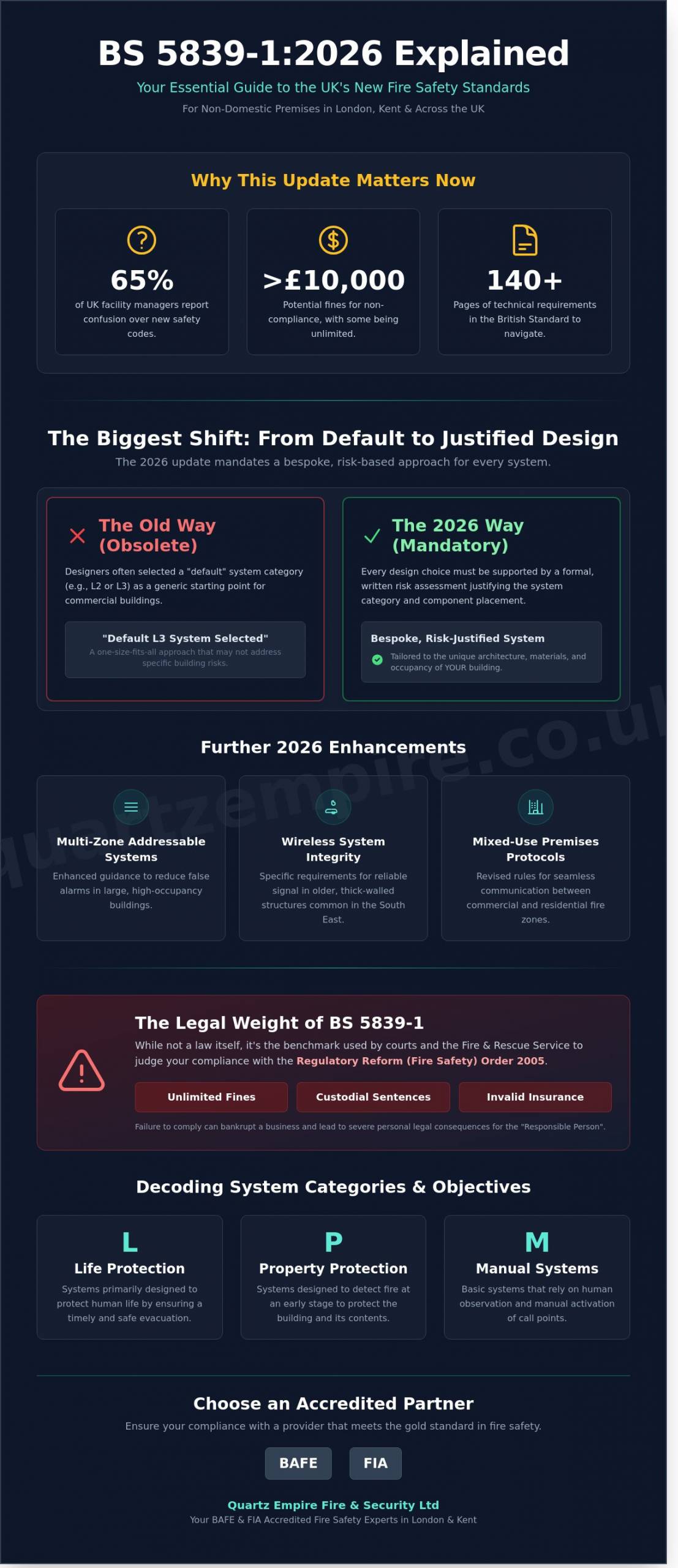
British Standards aren't laws in their own right, but they carry immense weight in the UK legal system. The Regulatory Reform (Fire Safety) Order 2005 requires the "Responsible Person" to ensure the premises are safe. Courts and the Fire and Rescue Service use BS 5839-1 as the recognised standard to judge whether you've met your legal obligations. Failing to comply can lead to severe penalties. In recent years, fire safety breaches have resulted in unlimited fines and custodial sentences for directors. Beyond legal action, insurers often refuse to pay out for fire damage if the alarm system wasn't maintained to the current British Standard, potentially bankrupting a business overnight. Our no-nonsense approach ensures your certification is always up to date.
Scope of the 2026 Standards
The 2026 revision covers an extensive range of non-domestic buildings, including offices, shops, hotels, and hospitals. It's particularly relevant for the mixed-use developments frequently found on Kent and London high streets, where commercial units sit directly beneath residential flats. The standard scales from basic manual systems to sophisticated, multi-zone addressable networks. Understanding bs 5839-1 2026 explained in this context helps facilities managers decide which system category fits their specific risk profile. Key updates in the 2026 version include:
- Enhanced guidance for multi-zone addressable systems in high-occupancy buildings to reduce false alarms.
- Specific requirements for wireless system integrity in older, thick-walled structures common in the South East.
- Revised protocols for mixed-use premises to ensure seamless communication between commercial and residential fire zones.
Whether you're managing a small retail unit or a sprawling industrial estate, compliance ensures your people remain protected and your business stays operational. We provide the expertise needed to navigate these complex requirements with confidence.
Key Changes in the BS 5839-1:2026 Update
The transition to the updated 2026 standards represents a significant shift toward precision and accountability in fire safety. Having the bs 5839-1 2026 explained means moving away from generic installations and toward bespoke, risk-based solutions. This update ensures that fire detection systems aren't just present, but are specifically engineered for the unique architecture and occupancy of a building.
Shifting from Default to Justified Design
Designers can no longer simply select an L2 or L3 category as a "default" starting point for commercial premises. The 2026 update mandates that every system design must be accompanied by a written risk justification. This change directly addresses the 18% of UK commercial properties that are currently estimated to be either over-designed, leading to unnecessary costs, or under-protected, leaving occupants at risk. By tying the system category to the building's specific Fire Risk Assessment, the new British Standard for fire detection ensures that protection levels match the actual fire load and escape complexities of the site.
Technical Enhancements in Detection and Wiring
False alarms cost the UK economy approximately £1 billion every year in lost productivity and emergency service call-outs. To mitigate this, the 2026 update introduces stricter requirements for multi-sensor detectors in office environments. These devices must be configured to intelligently filter out non-fire phenomena like steam or aerosol sprays. Additionally, wiring standards have been elevated for high-rise commercial structures. Key updates include:
- Enhanced Cabling: Mandatory use of fire-resistant cabling for all circuits within "protected" escape routes to ensure system integrity for at least 120 minutes during a fire.
- Wireless Verification: New protocols for wireless systems require a 100% signal strength survey during both the design and commissioning phases, eliminating the "dead zones" found in older 433MHz or 868MHz installations.
- Multi-Sensor Logic: A requirement for detectors to use advanced algorithms that distinguish between smouldering fires and common office pollutants.
Reducing "evacuation lag" is another vital component of the 2026 changes. The update specifies tighter alarm signal transmission times, ensuring that the delay between a detector triggering and the sounders activating is kept to a minimum. In complex, multi-storey buildings, this can save those crucial first 60 seconds that often determine the success of an evacuation. If you're concerned about how these timing requirements affect your current hardware, you can consult with our certified engineers to review your system's performance.
Documentation requirements during the handover phase have also seen a rigorous overhaul. It's no longer sufficient to provide a basic zone chart. Contractors must now deliver a comprehensive "Information Pack" at the point of commissioning. This pack must include detailed loop maps, battery capacity calculations, and a full cause-and-effect matrix. This ensures that facility managers have the exact data needed to maintain compliance throughout the system's 10 to 15-year lifespan. Without this verified documentation, a system won't meet the criteria for a bs 5839-1 2026 explained compliance certificate.
Decoding System Categories: L, P, and M Protection Levels
Fire alarm systems aren't universal solutions. The British Standard uses distinct categories to define the specific objective of an installation. It boils down to two main goals: saving lives or safeguarding property. Having bs 5839-1 2026 explained by an expert helps you identify which level of coverage your business actually needs to remain compliant and safe.
Category M is the simplest form of protection. It relies entirely on manual call points. Occupants must see the fire, reach a call point, and break the glass to sound the alarm. There's no automatic detection involved. While this is often the baseline for small, open-plan offices where a fire would be spotted immediately, it's rarely enough for complex buildings. If a fire breaks out in a locked store cupboard at 2:00 AM, a manual system is useless until the smoke becomes visible from the outside.
Category L: Life Protection Systems Explained
Category L systems prioritise the safety of occupants by using automatic sensors. They're divided into five levels based on the extent of coverage. L1 offers the highest level of safety. It requires detectors in all areas of the building, including loft spaces and large cupboards. You'll find L1 systems in 24-hour care facilities and hospitals where evacuation takes longer and residents are vulnerable.
L2 and L3 systems focus on protecting escape routes like hallways and stairs. L2 goes a step further by placing sensors in high-risk rooms such as kitchens or boiler rooms. L4 systems provide detection only in escape routes, while L5 is a bespoke category. It's designed to meet unique risks identified during a professional fire risk assessment. The duties of the Responsible Person involve verifying that these systems are tested weekly to maintain their certified status and ensuring the category still matches the building's current use.
Category P: Safeguarding Your Business Assets
Category P systems are about the building and its contents. They aim to alert the fire service as quickly as possible to minimise damage to stock, data, and infrastructure. P1 provides total coverage across every part of the building to ensure the fastest possible response time. This is the gold standard for businesses that cannot afford even a day of downtime.
P2 systems target specific high-value zones rather than the whole premises. For example, a data centre in Kent might install P2 protection specifically for its server racks and archive rooms. This ensures a small electrical fault doesn't destroy £500,000 worth of equipment. In London and the South East, many commercial insurers offer significant discounts for P-rated systems. A robust P1 installation can lower annual insurance premiums by up to 18% for warehouses and manufacturing sites.
Choosing the right category is a balance of risk and investment. Quartz Empire provides the expert guidance needed to navigate bs 5839-1 2026 explained so you don't over-specify on equipment while still meeting every legal obligation. Our no-nonsense approach ensures your system is designed for your specific risks, whether you're protecting a small retail unit or a massive industrial complex.
Maintenance, Testing, and the Role of the Responsible Person
Compliance isn't a one-off event that ends once your system is commissioned. It's a continuous commitment to safety that requires ongoing rigour and precise record-keeping. Having bs 5839-1 2026 explained means recognising that the new standards place even greater emphasis on the lifecycle of the system. If your fire alarm fails to activate during an emergency, the investigation will focus immediately on your maintenance history. Gaps in your records don't just compromise safety; they create significant legal liabilities for your organisation.
The "Responsible Person" (RP) is the individual legally accountable for the system’s continued operation. This role is usually held by the building owner, employer, or facilities manager. The RP must ensure that the system is fit for purpose every single day. Current data from UK fire services indicates that over 40% of fire safety prosecutions involve a failure to maintain equipment or keep adequate records. You can't delegate this legal accountability, even if you hire a third-party contractor to perform the physical checks.
The fire logbook is the most critical document during a fire service inspection. It serves as the "black box" for your building's safety. Every test, fault, false alarm, and service visit must be logged with the date, time, and the name of the person carrying out the work. If it isn't written down, the law assumes it didn't happen. A clean, up-to-date logbook provides the peace of mind that you're meeting your obligations under the Regulatory Reform (Fire Safety) Order 2005.
The Responsible Person’s Checklist
The RP must manage a strict schedule of internal checks. A weekly fire alarm test is mandatory. You should activate a different manual call point each week to ensure the entire system is tested over a set cycle. You also need to organise an annual fire risk assessment review. Statistics show that 65% of commercial buildings undergo internal layout changes each year, such as new partitions or storage areas, which can render existing detector placements obsolete. Finally, ensure all staff receive documented training on alarm response protocols at least once every six months.
Professional Servicing and Remedial Works
Professional inspections every six months are a non-negotiable requirement of BS 5839-1. These visits go far beyond the weekly "bell test." A qualified engineer will test the standby batteries, check signal strengths, and ensure the control panel is communicating correctly with every device. It's vital to distinguish between routine servicing and remedial works. Routine servicing is the scheduled check, while remedial works involve the actual repair of identified faults, such as replacing a heat detector that has reached its 10-year end-of-life limit.
When selecting a provider in Kent or London, always verify their accreditations. You should look for BAFE SP203-1 certification or SSAIB approval. These credentials prove the firm has been independently audited to meet the highest industry standards. Using an uncertified "handyman" for fire alarm repairs can invalidate your building insurance and leave you vulnerable to prosecution. Quartz Empire provides the expert, no-nonsense support you need to stay on the right side of the law.
Don't leave your compliance to chance. Book your professional fire alarm service with our accredited team today.
Choosing an Accredited Partner for Fire Safety in London and Kent
Selecting the right contractor to manage your fire safety systems is as critical as the hardware itself. Many business owners in the South East mistakenly believe any qualified electrician can handle fire alarm work. While a general electrician understands basic wiring, they often lack the specialist training required for full BS 5839-1 compliance. Fire safety systems are life-critical installations. They require a deep understanding of smoke dynamics, sound pressure levels, and complex cause-and-effect programming that generalists aren't equipped to provide.
The 2026 updates make this distinction even more vital. Having the bs 5839-1 2026 explained by a specialist ensures you don't fall into common traps, such as installing the wrong grade of cabling or failing to account for new testing protocols. In 2023, the London Fire Brigade reported a significant number of enforcement notices issued due to poorly maintained or incorrectly installed systems. Working with an unaccredited provider increases the risk that your system will fail during a real emergency, leaving you legally liable for any resulting injuries or fatalities.
The Importance of Accreditation
BAFE is the leading independent register for quality fire safety companies. When you hire a BAFE-accredited firm, you're choosing a partner that undergoes rigorous annual audits to prove their competence in design, installation, and maintenance. This third-party certification is your primary shield against legal and financial ruin. Most commercial insurance policies in the UK specify that fire systems must be maintained by "competent persons." If you can't prove competence through accreditation, your insurer may refuse to pay out a claim following a fire, which could cost your business hundreds of thousands of pounds.
- Legal Protection: Accreditation provides a clear paper trail of compliance for the Regulatory Reform (Fire Safety) Order 2005.
- System Reliability: Certified engineers follow strict checklists to ensure every sensor and sounder operates at 100% efficiency.
- Verified Expertise: BAFE and FIA memberships mean the company stays updated on every technical nuance of the bs 5839-1 2026 explained guidelines.
Why Quartz Empire is Your Trusted Partner
Quartz Empire provides a no-nonsense approach to fire safety for businesses across London, Kent, and the South East. We don't hide behind jargon or overcomplicate your requirements. Our goal is to provide a reliable, compliant system that protects your people without creating unnecessary administrative burdens. We understand the specific enforcement trends in the region, from the high-density requirements of inner London boroughs to the sprawling industrial estates in Kent. This local knowledge allows us to design systems that satisfy both the law and local fire officers.
Our team treats every project with the seriousness it deserves. We provide the peace of mind that comes from knowing your property is in the hands of seasoned experts who value safety above all else. Whether you need a minor upgrade to meet the 2026 standards or a completely new installation, we deliver professional, reassuring service from start to finish. Don't leave your compliance to chance with a generalist. Contact us today for a fire alarm system installation quote and ensure your business remains secure for years to come.
Future-Proof Your Commercial Fire Safety
Compliance with the Regulatory Reform (Fire Safety) Order 2005 isn't just a legal checkbox; it's a vital commitment to life safety. This guide to bs 5839-1 2026 explained the significant updates to protection levels and maintenance cycles that will soon govern UK buildings. Since our inception, Quartz Empire has served as a trusted partner for commercial fire safety, deploying BAFE accredited engineers throughout London and Kent to maintain the highest standards. We focus on clear, expert guidance that removes the complexity from British Standards, ensuring your "Responsible Person" meets every statutory obligation without fail.
You can rely on our team to provide the meticulous testing and certification required to keep your premises secure and your insurance valid. Taking action now prevents the risk of costly retrofitting or legal penalties when the 2026 revisions become the benchmark for fire safety inspections. We're ready to help you transition to these new requirements with confidence and total peace of mind. Our no-nonsense approach ensures your systems remain reliable, effective, and fully compliant year after year.
Frequently Asked Questions
Is BS 5839-1:2026 a legal requirement for my business?
Compliance with BS 5839-1:2026 isn't a law itself, but it's the primary code of practice used to prove you've met the Regulatory Reform (Fire Safety) Order 2005. As a Responsible Person, following these standards ensures you avoid legal action. Failure to maintain a compliant system can result in unlimited fines or prosecution, with over 500 enforcement notices issued by UK fire authorities in the last year for safety breaches.
How often should a commercial fire alarm be tested under the new rules?
You must carry out a manual call point test every week to ensure the system functions correctly. A certified professional must also perform a full inspection and service at least every six months. These 2026 guidelines are vital because 15% of system failures result from poor maintenance. Regular checks by an accredited engineer ensure your business in Kent or London remains fully protected and insurance-compliant.
What is the difference between Grade A and Grade D fire alarm systems?
Grade A systems use a central control panel and separate detectors, which are standard for larger commercial buildings and high-risk premises. Grade D systems involve mains-powered alarms with battery backups, usually found in smaller HMOs or domestic properties. Having the nuances of bs 5839-1 2026 explained helps you choose the right grade to ensure your specific property meets the latest safety certification requirements.
Can I carry out my own fire alarm maintenance as the Responsible Person?
You're responsible for weekly functional tests, but a competent person with specialist training must handle the six-monthly professional service. DIY maintenance on complex electronics often voids your business insurance, which can lead to thousands of pounds in unpaid claims. Our BAFE-accredited team provides the expert oversight needed to keep your documentation accurate and your system reliable under the 2026 standards.
What happens if my fire alarm system does not meet BS 5839-1 standards?
Non-compliant systems leave your staff at risk and expose your business to significant financial penalties. If a fire occurs and your system doesn't meet the 2026 criteria, your insurance provider will likely refuse to pay out for damages. Courts have recently increased fines for fire safety negligence, making it essential to work with a trusted partner who understands the no-nonsense approach to compliance.
Do I need to replace my old fire alarm system because of the 2026 update?
You don't always need a full replacement if your current system is reliable and can be modified to meet the new rules. However, systems older than 15 years often require replacement because components become obsolete and fail to meet modern sensitivity requirements. We offer a comprehensive site survey across the South East to determine if a cost-effective upgrade is possible for your existing setup.
How long does a commercial fire alarm installation usually take?
A standard installation for a medium-sized office typically takes between 3 and 5 days. Complex retrofits or larger industrial sites in London might require 2 weeks or more to ensure full coverage and integration. We provide a detailed project timeline before work begins, ensuring our accredited engineers complete the job with minimal disruption to your daily operations and staff productivity.
What is a Category L3 fire alarm system and is it right for my office?
An L3 system features detectors on all escape routes and in rooms that open onto those routes to provide early warning for safe evacuation. It's the most common requirement for standard commercial offices to ensure everyone has enough time to exit the building. Getting bs 5839-1 2026 explained by our experts ensures your L3 system is designed and installed to the highest safety specifications.