
Fire Safety Audit for Business: A Complete Guide to Compliance in 2026

A fire safety audit for business isn't a surprise inspection designed to catch you out; it's a verification of your site’s ongoing safety culture and maintenance discipline. You likely feel a sense of dread when thinking about complex UK fire safety legislation or the potential for heavy fines. It's common for business owners to worry about missing a single record that could lead to formal action or even business closure. We understand that managing maintenance records while running a company is a significant challenge that requires meticulous attention to detail.
You'll learn exactly how to prepare for a fire safety audit for business to meet the latest 2026 standards, including the major BS 8214:2026 fire door revisions and the new residential evacuation plan requirements. This article provides a clear roadmap to help you pass your audit without formal action, ensuring your staff remain safe and your business stays operational. We'll examine the specific documentation you need, the physical system checks involved, and how to establish a clear maintenance schedule for your fire risk assessments and alarm systems. By following this structured approach, you can maintain professional legitimacy and protect your stakeholders with confidence.
Key Takeaways
- Understand the legal framework of the Regulatory Reform (Fire Safety) Order 2005 and how it defines your statutory obligations.
- Learn how Fire and Rescue Services use the Risk Based Inspection Programme to prioritize which premises receive an official visit.
- Identify the mandatory records needed for a fire safety audit for business, including your Fire Risk Assessment and BS 5839-1 maintenance logs.
- Follow a proactive pre-audit checklist to resolve physical hazards, such as wedged fire doors, before an inspector arrives.
- Discover how professional maintenance contracts from Quartz Empire Fire & Security Ltd provide the accredited documentation required to pass inspections.
What is a Fire Safety Audit for Business?
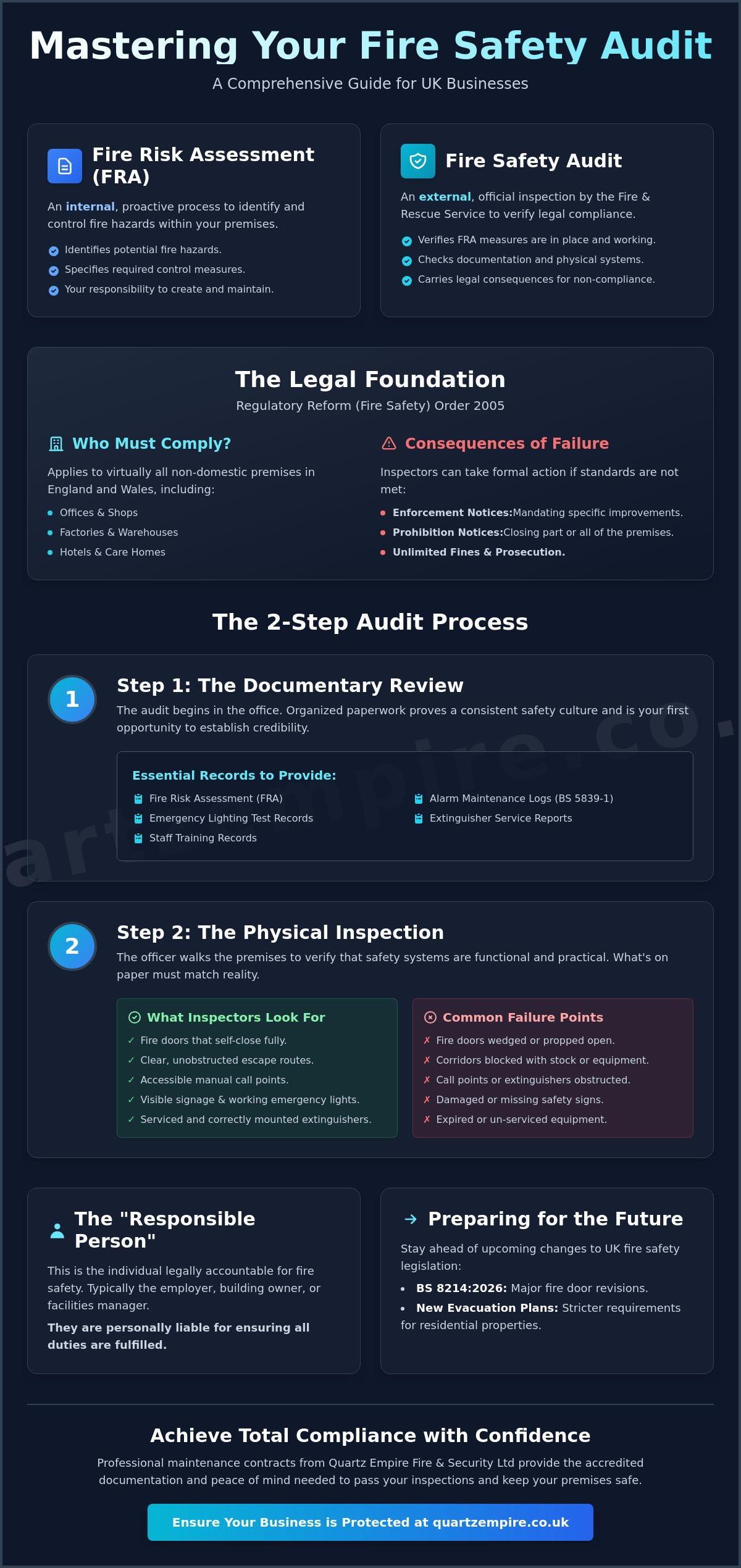
A fire safety audit for business is a formal examination conducted by your local Fire and Rescue Service to verify that your premises comply with statutory regulations. Unlike an internal review, this is a legal inspection to ensure that fire safety principles are being actively applied to protect lives and property. It's important to distinguish this from your Fire Risk Assessment (FRA). An FRA is a proactive, internal document that identifies hazards and specifies control measures. In contrast, the audit is the external process where an officer verifies that those measures are actually in place and functional. Passing an audit requires more than just having a folder on a shelf; it requires proof of ongoing maintenance and staff awareness.
The Legal Framework: The Fire Safety Order 2005
The Regulatory Reform (Fire Safety) Order 2005 (FSO) serves as the primary legislation governing commercial premises in England and Wales. This law applies to almost all non-domestic buildings, including offices, shops, factories, and warehouses. It places the burden of proof on the business to demonstrate compliance. Enforcement agencies, such as the London Fire Brigade, have the authority to enter your premises to conduct these audits. If an inspector finds that you've failed to meet these standards, the consequences are serious. You might receive an enforcement notice requiring specific improvements. In severe cases, they may issue a prohibition notice that prevents you from using the building until the risks are mitigated. Fines for non-compliance can be unlimited, reflecting the critical nature of these safety protocols.
Who is the Responsible Person?
Every business must have a designated "Responsible Person" who oversees fire safety strategy. This individual is typically the employer, the building owner, or a facilities manager with control over the premises. During a fire safety audit for business, the inspector will look to this person to provide documentation and explain safety procedures. The Responsible Person is the individual legally accountable for fire safety measures. They carry the liability for ensuring that fire alarms are maintained, staff are trained, and escape routes are clear. Failing to fulfill these duties can lead to personal prosecution, especially if a lack of oversight results in a safety incident. Identifying this person early ensures that your business has a clear point of contact for all regulatory matters and maintains a professional foundation of trust with enforcement officers.
The Audit Process: What to Expect When an Officer Visits
A fire safety audit for business typically begins with a notification letter, though officers have the power to visit without prior warning. Most scheduled inspections are part of the Risk Based Inspection Programme (RBIP). This system ensures that fire authorities focus their resources on premises where the risk to life is highest, such as hotels, care homes, or large industrial sites. When the officer arrives, they'll present their identification and explain the scope of the visit. This process is structured to be collaborative rather than confrontational, aiming to verify that your safety measures align with professional standards.
Step 1: The Documentary Review
The inspection starts in your office, not on the shop floor. An officer will first examine your record-keeping to see if your safety culture is consistent. They expect to see a chronological log of all maintenance activities, including weekly alarm tests and annual extinguisher servicing. While many businesses still use paper logbooks, modern inspectors often prefer digital records for their legibility and ease of access. Providing organized documentation immediately establishes your credibility during a fire safety audit for business. These requirements often mirror international best practices, such as OSHA fire safety standards, which emphasize the importance of documented emergency plans. If your paperwork is incomplete, the officer may conclude that your physical systems are also neglected.
Step 2: The Physical Inspection
Once the documentation is verified, the officer will conduct a walk-through of the premises. They'll look for practical functionality in every safety component. For instance, they'll check that fire doors close fully into their frames and that escape routes are entirely free of obstructions. They also test the accessibility of manual call points and ensure that fire extinguishers are correctly mounted and visible. These checks are meticulous. An officer will notice if a fire exit is blocked by a delivery or if a smoke detector has been covered during recent decorating.
A critical part of the physical inspection involves speaking with your employees. The officer might ask a staff member what they'd do if the alarm sounded or where the nearest assembly point is located. This tests the effectiveness of your Fire Marshal Training and general safety induction. If staff appear confused, it suggests a failure in your safety management system. Ensuring your team is prepared is just as vital as maintaining the hardware. To ensure your documentation and systems are always ready for scrutiny, consider establishing a professional maintenance schedule with a qualified provider.
Essential Documentation: The Paperwork You Must Provide
Your documentation serves as the primary evidence of your safety management system during a fire safety audit for business. An inspector won't simply take your word for it; they require a clear, chronological paper trail that proves every safety device is functional and every hazard is managed. The cornerstone of this file is your Fire Risk Assessment. This document must be current and reflect any significant changes to your building’s layout, occupancy, or fire load. Without a valid assessment, the rest of your safety measures lack a legal foundation and could lead to immediate formal action.
Maintenance logs must follow specific British Standards to remain compliant. For example, your fire alarm records should align with BS 5839-1, showing that the system is not only installed but also regularly scrutinized. You must also provide certificates for emergency lighting periodic inspections and annual fire extinguisher service reports. These reports should match the service labels found on the equipment itself. Discrepancies between your physical hardware and your paperwork are a common red flag. Inspectors often view inconsistent record-keeping as a sign of broader operational neglect.
Fire Alarm and Detection Records
Officers look for consistency in your detection records. You must document weekly tests where different manual call points are activated in rotation to ensure the entire system functions. These entries should be supported by records of professional six-monthly services conducted by competent engineers. Ensure all fire alarm installation certificates are readily available to prove the system meets the required category for your specific building type. A dedicated logbook is necessary to record every activation, false alarm, or system fault, along with the remedial actions taken to resolve them.
Staff Training and Drill Logs
The human element of fire safety is just as important as the hardware. You must prove that every employee has received a basic fire safety induction when they started their role. Your logs should also detail specialized training for Fire Marshals and those responsible for assisted evacuations. Recording the results of your fire drills is a statutory requirement. Don't just list the date; document the evacuation time and any lessons learned to show you're actively improving your procedures. This level of detail demonstrates a proactive safety culture that reassures inspectors during a fire safety audit for business.
Preparing Your Premises: A Proactive Compliance Checklist
The best way to pass a fire safety audit for business is to conduct a thorough self-inspection before the fire officer arrives. Taking a proactive approach allows you to identify and rectify obvious hazards that could otherwise lead to formal enforcement. You should walk through your premises with a critical eye, focusing on the same elements an inspector will prioritize. This preparation not only reduces the risk of penalties but also reinforces the safety of your employees and visitors. Identifying issues early demonstrates to the visiting officer that you take your legal obligations seriously and maintain a high standard of safety discipline.
Fire doors are one of the most frequent points of failure during an official inspection. You must ensure that every fire door closes fully into its rebate and that no doors are held open with wedges or heavy objects. Similarly, your escape routes must be completely clear of storage, furniture, or combustible debris. Even a temporary obstruction in a corridor can be flagged as a significant risk. You should also verify that all fire safety signage is correct, clearly visible, and illuminated where required. If your signage is faded or missing, it can cause confusion during an evacuation, which is a major concern for inspectors.
Scheduling a professional fire alarm servicing visit before your audit is a strategic move. This ensures that any technical faults or battery issues are resolved, providing you with the up-to-date certification the officer will expect to see. A system that has been recently verified by a competent engineer provides a strong foundation for your compliance folder.
Passive Fire Protection Checks
Inspect the integrity of your building's compartmentation by looking for gaps in walls or ceilings, especially where new cables or pipes have been installed. These openings require professional fire-stopping seals to prevent the spread of smoke and flame. You should also test the fire door seals, known as intumescent strips, for any signs of wear or damage. It is vital to verify that all emergency exits can be opened immediately without the use of a key or specialized knowledge, ensuring a rapid exit during an emergency.
Active System Readiness
Verify that your fire extinguisher types are correctly matched to the specific risks in each area of your building. For example, a kitchen requires different suppression tools than a server room. You should also confirm that emergency lighting batteries hold their charge by conducting a simulated power failure test. Active systems must be tested by accredited professionals to ensure audit validity. If you want to ensure your premises meet every regulatory standard, you can request a comprehensive site survey to identify any remaining compliance gaps.
Achieving Total Compliance with Quartz Empire Fire & Security Ltd
Quartz Empire Fire & Security Ltd provides the technical expertise and administrative support required to transform your fire safety strategy. Managing a fire safety audit for business often feels overwhelming due to the meticulous level of detail required by inspectors. By establishing a professional maintenance contract, you transfer the burden of regulatory tracking to our team of accredited engineers. We ensure your documentation is audit-ready at all times, providing clear evidence of compliance that satisfies even the most rigorous fire authority standards. Our approach focuses on establishing a foundation of trust, allowing you to focus on your core operations while we manage your safety obligations.
Our team possesses deep regional expertise, serving a diverse range of commercial clients across London, Kent, and the South East. We understand the specific expectations of local fire authorities in these areas, from the high-density requirements of central London to the industrial standards of the South East. This localized knowledge allows us to position your business as a responsible collaborator rather than a target for enforcement. Moving from a state of anxiety over potential formal action to a position of long-term safety partnership ensures your operations remain stable and secure. Quartz Empire Fire & Security Ltd acts as a reliable collaborator for your long-term safety needs.
Our Comprehensive Maintenance Solutions
We deliver tailored servicing packages that cover all aspects of your building's security and fire protection infrastructure. This includes meticulous maintenance for fire alarms, commercial CCTV, and access control systems. Routine inspections are scheduled to ensure your business remains compliant with current BS standards, preventing system failures before they occur. Our engineers provide the detailed logs and certificates required to pass a fire safety audit for business without complication. We also provide support for emergency repairs, ensuring that your critical safety systems maintain maximum uptime and reliability throughout the year.
Expert Fire Risk Assessments and Training
A high-quality Fire Risk Assessment (FRA) is your primary defense against audit failure. Our professional FRA services identify and mitigate potential risks long before a Fire Officer sets foot on your premises. We provide clear, actionable reports that allow you to address vulnerabilities systematically. Beyond hardware, we provide certified Fire Marshal training to ensure your staff are confident and competent in their emergency roles. This holistic approach ensures that both your building and your people are prepared for any scrutiny. Contact Quartz Empire Fire & Security Ltd today for a compliance health check to secure your business's future and ensure total peace of mind.
Securing Your Business Future Through Professional Compliance
Preparing for a fire safety audit for business requires a meticulous approach to both physical safety measures and administrative records. You've seen that maintaining a current Fire Risk Assessment and ensuring your fire doors are functional are non-negotiable steps for any responsible person. These actions protect your staff and ensure your company avoids the severe penalties associated with non-compliance. By shifting from a reactive mindset to a proactive maintenance culture, you create a stable environment where safety is a constant rather than a concern.
As accredited Fire & Security specialists serving London and Kent for over a decade, Quartz Empire Fire & Security Ltd provides the expertise needed to navigate complex 2026 regulations. We deliver comprehensive BS 5839-1 compliant maintenance logs that satisfy the most rigorous inspections. Ensure your business is audit-ready with Quartz Empire Fire & Security Ltd’s compliance services and gain the confidence that comes with professional legitimacy. Taking these steps today guarantees a safer, more resilient workplace for everyone.
Frequently Asked Questions
How much notice will I get before a fire safety audit?
Fire and Rescue Services typically provide written notification before a scheduled visit, often giving between 24 and 48 hours of notice. However, they possess the legal power to conduct unannounced inspections if they have specific concerns or if your premises are part of a targeted enforcement campaign. Maintaining a professional standard of readiness ensures you are prepared regardless of the notification period provided.
What happens if my business fails a fire safety audit?
If your business fails an inspection, the officer will issue a formal notice detailing the required improvements. This could be an informal letter for minor issues or a statutory Enforcement Notice for serious breaches. Failing to address these points within the specified timeframe can lead to prosecution, unlimited fines, or a Prohibition Notice that restricts building access and halts operations.
Can a fire officer shut down my business immediately?
Yes, a fire officer can issue a Prohibition Notice that takes effect immediately if they identify a risk to life that is deemed too great to continue. This typically happens when escape routes are completely blocked or fire detection systems are non-functional. Such actions are serious and emphasize why a regular fire safety audit for business is a critical part of your operational safety planning.
Is a fire safety audit the same as a fire risk assessment?
No, these are distinct but related processes. A Fire Risk Assessment is a document you or a specialist produce to identify hazards and specify safety measures. A fire safety audit for business is the official inspection conducted by the Fire and Rescue Service to verify that your assessment is accurate and that your safety measures are functioning correctly according to the law.
How often should a business have a fire safety audit?
There is no fixed interval for audits; instead, frequency is determined by the Risk Based Inspection Programme (RBIP). High-risk premises, such as hotels, care homes, or large industrial sites, receive more frequent visits than low-risk offices. Changes in building use, recent safety incidents, or a history of false alarms can also trigger a more frequent inspection schedule from your local authority.
What are the three main things a fire officer looks for?
Officers primarily focus on your documentation, physical safety measures, and the awareness level of your staff. They will examine your Fire Risk Assessment and maintenance logs, test the functionality of fire doors and escape routes, and interview employees to gauge their understanding of evacuation procedures. These three pillars provide the inspector with a comprehensive view of your ongoing safety culture and discipline.
Do small businesses need a fire safety audit?
Yes, the Regulatory Reform (Fire Safety) Order 2005 applies to all commercial premises regardless of size. If you have five or more employees, you are legally required to have a written Fire Risk Assessment and keep records of your safety measures. Small businesses are still subject to inspections, especially if they provide sleeping accommodations or serve members of the public, such as retail units.
Can I perform my own fire safety audit?
You cannot perform the official audit yourself, as this is a statutory duty of the Fire and Rescue Service. However, you can and should perform a pre-audit self-inspection using a compliance checklist. Engaging accredited specialists to conduct a professional Fire Risk Assessment or system maintenance ensures that your premises meet the required British Standards before the official fire officer arrives at your door.