
CCTV Workplace Privacy Laws UK 2026: The Business Compliance Guide

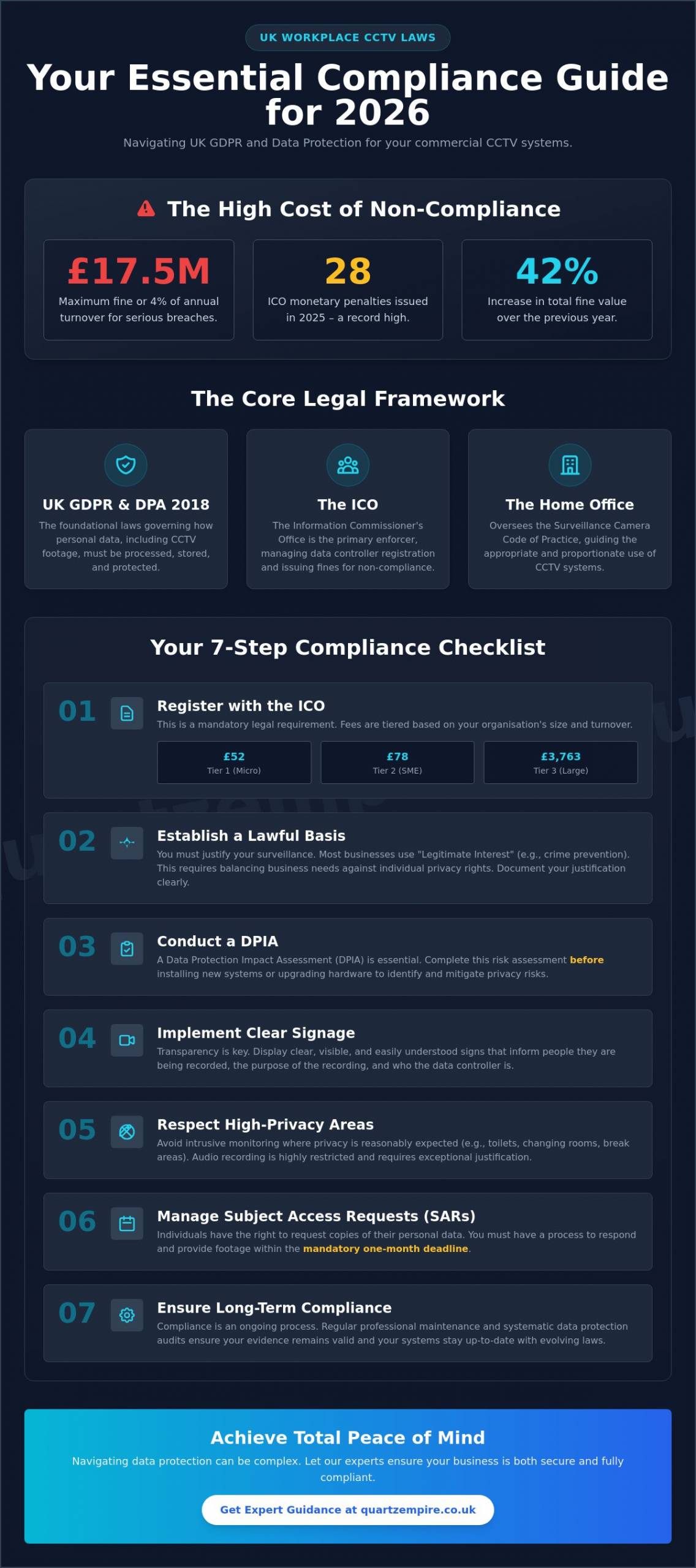
The Information Commissioner's Office issued 28 monetary penalty notices in 2025, marking the highest annual total since UK GDPR came into force. With the total value of these fines increasing by 42 percent over the previous year, staying informed about cctv workplace privacy laws uk 2026 is vital for any responsible business owner. You've likely invested in commercial CCTV systems to protect your assets and staff, but the fear of a 17.5 million pound fine for a compliance oversight is a heavy burden to carry.
We understand that navigating data protection legislation can feel overwhelming, especially when balancing security needs with employee privacy rights. This guide simplifies the process, offering a clear path to mastering the latest regulations so your business remains both secure and respectful of personal data. You'll learn how to implement robust policy documentation, manage subject access requests within the mandatory one month deadline, and ensure your signage meets the strict transparency standards required in 2026. We provide the technical expertise and regulatory knowledge you need to achieve total peace of mind during your next data protection audit.
Key Takeaways
- Understand the evolving requirements of cctv workplace privacy laws uk 2026 to safeguard your organisation against substantial ICO fines.
- Identify the mandatory steps for ICO registration and learn how to establish a lawful basis for monitoring through documented Legitimate Interest.
- Master the strict regulations regarding audio recording and high-privacy areas to maintain a respectful, legally sound workplace environment.
- Implement a robust compliance strategy by completing essential Data Protection Impact Assessments (DPIAs) before upgrading your security hardware.
- Ensure the long-term validity of your surveillance evidence through regular professional maintenance and systematic data protection audits.
Navigating CCTV Workplace Privacy Laws in the UK for 2026
Compliance with cctv workplace privacy laws uk 2026 requires a transition from viewing cameras as simple security tools to managing them as powerful data processing assets. The Information Commissioner’s Office (ICO) and the Home Office govern this space, ensuring that every frame captured adheres to strict legal standards. For businesses operating in London and Kent, the density of surveillance and the high volume of footfall make adherence a critical priority rather than an optional safeguard. You must view your commercial CCTV system through the lens of data responsibility, ensuring that every recorded second serves a documented, lawful purpose.
Regulators now focus on the balance between operational safety and the rights of the individual. This dual oversight ensures that while you protect your property, you do not infringe upon the civil liberties of those within it. The legal landscape in 2026 demands a proactive approach to documentation and system transparency.
- The ICO: Acts as the primary enforcer of UK GDPR, managing the registration of data controllers and issuing monetary penalties for breaches.
- The Home Office: Oversees the Surveillance Camera Code of Practice, which provides the framework for the appropriate and proportionate use of surveillance systems.
Why 2026 is a Turning Point for Surveillance
2026 represents a significant shift in how regulators approach workplace monitoring. The evolution of the UK General Data Protection Regulation (UK GDPR) and the Data Protection Act 2018 has moved beyond initial implementation into a phase of rigorous enforcement. In 2025, the ICO issued 28 monetary penalty notices, which was the highest annual total since the current regulations began. This increased scrutiny means that South East businesses can no longer rely on outdated policies. A failure to update your compliance framework can lead to fines of up to 17.5 million pounds or 4 percent of your annual turnover. Staying ahead of cctv workplace privacy laws uk 2026 is the only way to ensure your security infrastructure remains an asset rather than a liability.
The Definition of Personal Data in CCTV
Every individual captured on your cameras has employee privacy rights that your business must actively protect. Personal data in this context includes any image where a person can be identified, whether through their physical appearance, clothing, or even their location at a specific time. If your system utilises biometric features, such as facial recognition, you enter a higher tier of legal requirements due to the sensitive nature of the data. Under 2026 standards, identifiable imagery is defined as any visual data that allows for the recognition or isolation of an individual within a recorded environment. You must ensure your system is configured to capture only what is necessary for your stated purpose, avoiding intrusive monitoring in areas where privacy is reasonably expected.
The Core Legal Framework: GDPR, the ICO, and Data Protection
Every business operating commercial CCTV systems must register as a data controller with the Information Commissioner's Office (ICO). This registration is a mandatory legal requirement under the Data Protection Act 2018. The annual data protection fee is tiered based on your organisation's size and turnover. As of February 2025, Tier 1 micro-organisations pay £52, while Tier 2 small and medium organisations pay £78. Large organisations falling into Tier 3 are required to pay £3,763. Failure to register or pay the correct fee is a direct compliance failure that invites regulatory intervention.
Establishing a lawful basis for processing visual data is the next critical step. Most organisations rely on "Legitimate Interest" to justify surveillance. This principle requires you to prove that monitoring is necessary for a specific purpose, such as crime prevention or protecting staff. You must document this justification clearly. If your surveillance activities are challenged, you must demonstrate that your business interests do not override the fundamental rights and freedoms of the individuals being recorded. For larger firms or those engaged in large-scale monitoring, appointing a Data Protection Officer (DPO) is essential to oversee these responsibilities and ensure cctv workplace privacy laws uk 2026 are upheld across the organisation.
Conducting a Data Protection Impact Assessment (DPIA)
A Data Protection Impact Assessment (DPIA) is a formal requirement for any high-risk processing, including large-scale workplace surveillance. This document serves as your evidence that the system is proportionate to the risks identified. You must record specific security threats, such as a history of unauthorised access or the protection of high-value assets. A vital part of the DPIA involves exploring less intrusive alternatives. You should assess whether improved lighting or upgraded access control could achieve your security goals without the need for constant video recording. Documenting this thought process is vital for maintaining compliance.
Transparency and Signage Requirements
Transparency ensures that individuals are aware they are being recorded, which is a cornerstone of cctv workplace privacy laws uk 2026. Your signage must be clear, visible, and placed at all entry points to the monitored area. Each sign must contain the identity of the data controller, the purpose of the surveillance, and contact details for those wishing to exercise their data rights. For businesses utilising remote monitoring, digital transparency is also required. This typically involves providing a link to a comprehensive privacy policy that explains data retention periods and third-party access protocols. Proper placement in commercial units ensures that both employees and visitors are informed before they enter a recorded zone.
Balancing Business Security with Employee Privacy Rights
Business owners often ask if constant monitoring is truly legal under the latest regulations. The answer is yes, provided the surveillance is necessary, proportionate, and transparent. Compliance with cctv workplace privacy laws uk 2026 isn't about "spying" on staff; it's about protecting the work environment. You must distinguish between monitoring for security and intrusive surveillance for performance management. Using cameras to track how long an employee spends at their desk is generally seen as a breach of privacy unless you have a very specific, documented justification that outweighs the individual's rights.
Audio recording carries a much higher legal threshold than video capture. In most commercial settings, recording conversations is considered highly intrusive and is rarely lawful. The ICO views continuous audio recording as a significant privacy risk that's hard to justify for standard security purposes. You should only consider audio features in exceptional circumstances, such as at a high-risk reception desk where staff safety is frequently threatened. Even then, you must provide clear notice and ensure the recording is only triggered during specific incidents.
Managing the "Reasonable Expectation of Privacy" is a core duty for any data controller. Employees expect a higher level of privacy in certain office zones compared to public facing areas. You must also be prepared to handle Subject Access Requests (SARs) efficiently. Individuals have the right to request a copy of any footage where they are identifiable. Under current standards, you must respond to these requests within one month. This requires a structured process for locating, reviewing, and redacting footage to protect the identities of other people captured in the same frame.
Restricted Zones: Where Cameras Cannot Go
Certain areas are strictly off limits for surveillance due to the high expectation of privacy. You should never install cameras in toilets, changing rooms, or private offices where confidential discussions occur. Staff breakrooms also require a high threshold for monitoring. If you must place cameras in a rest area, you must demonstrate that less intrusive measures have failed to address a specific security risk. You should also avoid intrusive camera angles that peer over partitions or zoom into personal workspaces, as these can be challenged as disproportionate under cctv workplace privacy laws uk 2026.
Covert Monitoring: The Exceptional Circumstances
Hidden cameras are only lawful in very narrow, exceptional circumstances. You can only use covert monitoring as part of a specific, targeted criminal investigation where informing the individuals would prejudice the inquiry. This is never a permanent solution. Your covert operations must be time-limited, confined to a specific area, and supported by a rigorous Data Protection Impact Assessment. Once the investigation concludes, the cameras must be removed. Documenting the start and end dates of such monitoring is vital to prove your business acted within the law during a regulatory audit.
Implementing a Compliant CCTV Strategy: A Step-by-Step Checklist
Establishing a compliant surveillance infrastructure requires a methodical approach to both documentation and technical configuration. You must start by registering as a data controller with the ICO if you haven't already. This is a foundational step for adhering to cctv workplace privacy laws uk 2026. Before you install any new hardware or upgrade existing cameras, you must complete a formal Data Protection Impact Assessment (DPIA). This document proves you've considered the risks and benefits of the system. Use this checklist to ensure your strategy is sound:
- Register with the ICO: Ensure your data protection fee is paid and your details are current.
- Complete a DPIA: Document the specific security risks you are mitigating and why CCTV is the best solution.
- Draft a CCTV Policy: Create a document that explains how data is captured, stored, and protected.
- Audit Camera Angles: Verify that cameras are focused only on your property and do not peer into public spaces.
- Set a Deletion Schedule: Automate the purging of footage to ensure you don't hold data longer than necessary.
Distributing your Workplace CCTV Policy to all employees is a vital transparency requirement. This policy should outline the location of the equipment and the identity of the person responsible for data protection. Capturing data outside your business boundary without a strong justification is a common cause for ICO complaints. If you need assistance with a compliant setup, our team provides expert installation of commercial CCTV systems designed for regulatory adherence.
Data Retention and Footage Security
Storing visual data requires a balance between security needs and privacy rights. A 30-day retention period is the widely accepted standard for most commercial settings. Keeping footage longer than necessary without a specific reason, such as an ongoing police investigation, can lead to compliance failures. You must ensure all stored data is encrypted to protect against unauthorised access. Only a limited number of authorised staff members should have access to the monitoring equipment and storage servers. This restricted access should be documented and reviewed regularly to maintain the integrity of your security system. Secure storage units for recorders should be used to prevent physical tampering.
Managing Subject Access Requests (SARs)
The right of individuals to access their data is a core component of cctv workplace privacy laws uk 2026. When you receive a Subject Access Request, you have exactly one month to provide the relevant footage. This process is not as simple as handing over a raw file. You are legally required to redact or blur the faces of any third parties captured in the video to protect their privacy. This ensures that while you satisfy one person's request, you don't breach the rights of others. Keeping a detailed log of every SAR you receive is essential. This log should include the date of the request, the actions taken, and any reasons for refusing a request.
Ensuring Long-Term Compliance through Professional Maintenance
Maintaining your surveillance infrastructure is a critical component of legal compliance. Many business owners view maintenance as a purely technical task, but it's fundamentally a legal safeguard. System faults, such as incorrect timestamps or skewed date settings, can immediately invalidate footage as evidence in legal proceedings or disciplinary hearings. Under cctv workplace privacy laws uk 2026, you have a responsibility to ensure that the data you process is accurate. If a camera fails to record during a reported incident due to a neglected hard drive fault, your business may be found in breach of its own Data Protection Impact Assessment (DPIA) commitments.
Regular audits are essential for maintaining the accuracy of your documentation. A DPIA is not a static document; it must be reviewed whenever your office layout changes or when you upgrade your hardware. If you move a camera and it begins capturing a public pavement or a staff breakroom, your original risk assessment is no longer valid. Professional audits identify these "compliance drifts" before they result in a complaint to the ICO. Cybersecurity also plays a vital role in 2026 standards. You must ensure that firmware updates are applied promptly to protect your commercial CCTV systems from unauthorised access, as a hacked camera constitutes a major personal data breach.
The Link Between Maintenance and Legal Admissibility
Poorly maintained footage is frequently rejected by courts and tribunals because its integrity cannot be guaranteed. If a lens is dirty or out of focus, the "identifiable imagery" required for legal proof is lost. Professional servicing prevents "data gaps" caused by failing storage media or intermittent power issues. By ensuring every camera is clean, focused, and correctly time-synced, you protect the investment you've made in your security. Reliable footage is the only way to satisfy a Subject Access Request accurately, ensuring you meet your obligations under the Data Protection Act 2018 without delay.
Why Professional Installation Matters
Choosing an accredited installer ensures that your system is designed with compliance as a priority from day one. Professional installers understand the nuances of camera placement to avoid intrusive monitoring while still achieving your security goals. Integrating your cameras with other security systems, such as access control and intruder alarms, creates a holistic safety environment that's easier to manage and audit. This joined-up approach provides a clearer trail of evidence and simplifies your data protection reporting duties.
Quartz Empire provides ongoing support and maintenance for firms across London and Kent, ensuring your equipment remains a reliable asset. We help South East businesses navigate the complexities of modern surveillance, providing the technical expertise needed for long-term stability. Ensure your business is fully protected and remains on the right side of the law. Contact Quartz Empire for a compliance-led CCTV audit today.
Future-Proofing Your Workplace Surveillance Strategy
Adhering to cctv workplace privacy laws uk 2026 involves more than just mounting cameras for property protection. It requires a dedicated commitment to data transparency, rigorous ICO registration, and the consistent application of Data Protection Impact Assessments. You've seen how balancing operational security with individual privacy rights protects your organisation from significant financial penalties and complex legal challenges. Establishing these protocols ensures that your surveillance infrastructure remains a legitimate asset for safety.
Maintaining these standards is a continuous process that relies on technical accuracy and regular policy reviews. Professional audits and systematic maintenance ensure your system remains a valid tool for evidence rather than a liability during a data audit. As accredited fire and security experts serving London, Kent, and the South East, Quartz Empire provides the specialized knowledge required for long-term stability. We offer bespoke compliance-driven maintenance contracts designed to keep your systems operational and legally sound.
Secure Your Business Compliance with a Professional CCTV Audit today to ensure your workplace meets the highest regulatory standards. Taking these proactive steps now establishes a foundation of trust with your employees and provides the peace of mind you need to operate with confidence.
Frequently Asked Questions
Do I need to register with the ICO if I have CCTV in my office?
Yes, you must register with the Information Commissioner's Office (ICO) as a data controller if your business uses CCTV. It's a legal requirement. You're also required to pay an annual data protection fee based on your turnover. Failing to do so is a direct breach of the Data Protection Act 2018. This oversight often leads to formal enforcement action from the regulator.
How long can a business legally keep CCTV footage in the UK?
UK law doesn't set a specific number of days, but you should only keep footage for as long as is strictly necessary. Most businesses adopt a 30-day retention period as a standard for security purposes. Once this period expires, you must ensure the data is permanently deleted. Holding footage longer without a specific legal reason violates the core principle of data minimisation.
Can an employee refuse to be filmed by workplace CCTV?
Employees don't have an automatic right to refuse filming if you've established a legitimate interest for the surveillance. However, they can raise a formal objection to the monitoring. In these cases, you must demonstrate that your reasons for using CCTV, such as protecting staff or property, outweigh the individual's privacy concerns. Documenting this balancing exercise helps you meet the standards of cctv workplace privacy laws uk 2026.
Is it legal to record audio on workplace CCTV systems?
Recording audio is rarely legal in a standard workplace environment because it's considered highly intrusive. The ICO requires a much higher threshold of justification for audio than for video. You must prove that your security objectives couldn't be met through less invasive means. Continuous audio recording is almost always a breach of privacy rights unless exceptional circumstances, such as frequent physical threats, are present.
What information must be included on my CCTV warning signs?
Your signage must clearly state that CCTV recording is in operation and identify the organisation responsible for the system. It should also explain the purpose of the monitoring, such as crime prevention. Finally, provide contact details so individuals can easily reach the data controller. Placing these signs at entry points ensures your business meets the transparency requirements of cctv workplace privacy laws uk 2026.
Can CCTV footage be used as evidence in a disciplinary hearing?
Yes, you can use CCTV footage in disciplinary hearings if your workplace policy explicitly states that monitoring may be used for this purpose. You must ensure the data was captured lawfully and that the employee was informed of this possibility through your privacy notice. If the footage was obtained for a different stated purpose, using it in a hearing could lead to legal challenges regarding its admissibility.
How do I handle a Subject Access Request for CCTV footage?
You must provide a copy of the requested footage within one month of receiving a Subject Access Request (SAR). Before releasing the data, you're legally obligated to redact or blur the faces of any other individuals captured in the frame. This protects third-party privacy while fulfilling the requester's rights. You should maintain a record of the request and the specific steps taken to provide the redacted footage.
What are the penalties for breaching CCTV privacy laws in 2026?
Serious violations can result in fines of up to £17.5 million or 4 percent of your organisation's worldwide annual turnover. The ICO has significantly increased its enforcement activities, issuing 28 monetary penalty notices in 2025 alone. These penalties are designed to be effective and proportionate. Beyond financial costs, a breach often leads to reputational damage and the loss of trust from your employees and clients.