
Key Card Entry System for Small Business: The 2026 Security Guide
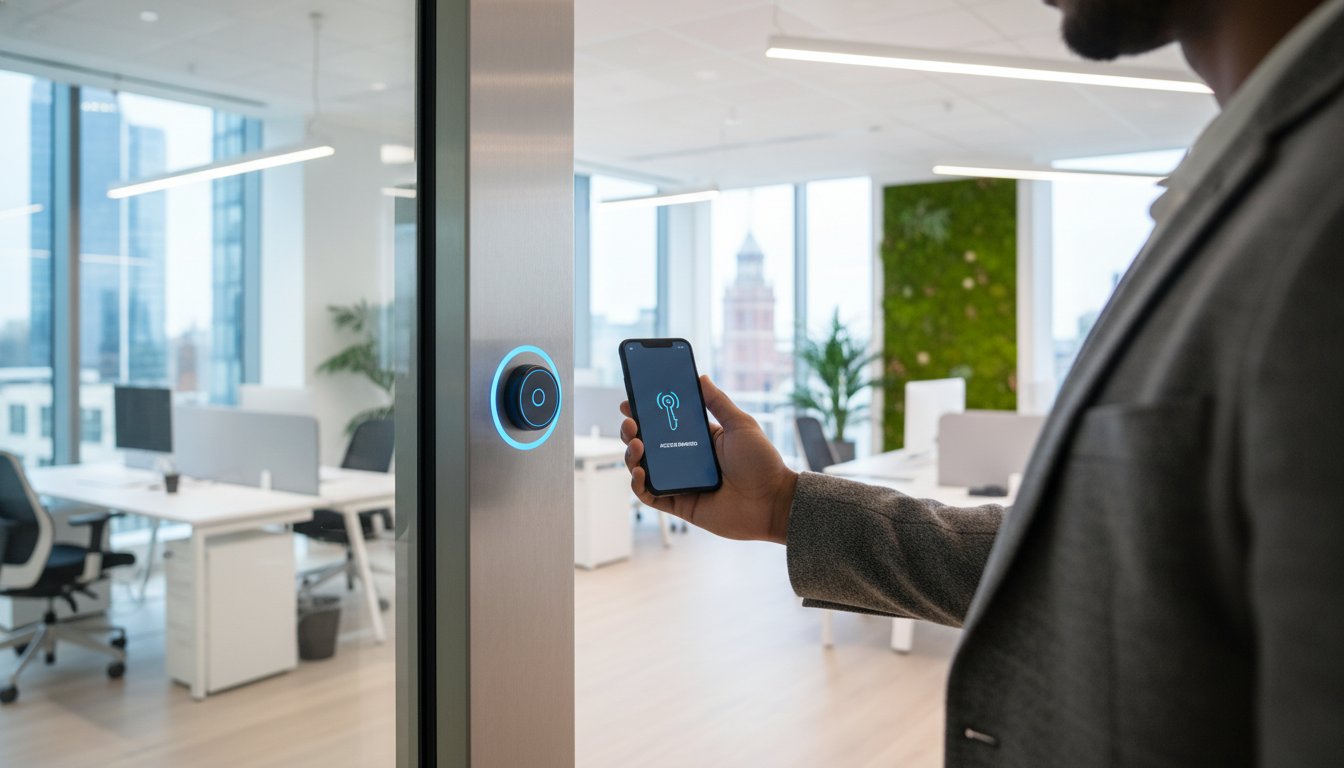
Over 60% of security breaches in commercial buildings are attributed to weak or outdated access control systems, according to industry data from December 2025. For many SME owners, the constant cycle of re-keying locks after staff turnover is a significant financial drain and a persistent security worry. You deserve a clear view of who enters your building and when. Implementing a professional key card entry system for small business eliminates these manual burdens and provides a foundation of stability for your operations.
This 2026 guide helps you choose, install, and maintain a reliable system that secures your premises and ensures you remain compliant with UK regulations. We'll explore how the latest standards like Aliro 1.0 are changing mobile access and what you must do to satisfy the Data Protection Act and fire safety requirements. From managing multiple doors to integrating with your existing commercial intruder alarms, you will find the technical expertise needed to make an informed investment for your site's long-term protection.
Key Takeaways
- Transitioning to a key card entry system for small business provides enhanced visibility and eliminates the recurring costs of physical lock replacements.
- Learn how to configure RFID and NFC hardware to maintain a secure perimeter while providing a frictionless entry experience for your workforce.
- Discover the critical technical requirements for integrating access control with fire alarm systems to ensure legal compliance and safe emergency egress.
- Evaluate the durability and practical advantages of cards, fobs, and mobile credentials to determine the most effective solution for your specific site.
- Understand why professional installation and bespoke system design are essential for meeting commercial insurance standards and long-term reliability.
The Evolution of Access Control: Why SMEs Are Moving to Key Cards
Electronic Access control systems represent a fundamental shift in how modern enterprises manage their physical perimeters. A key card entry system for small business is a specialized subset of this technology, replacing mechanical locks with digital readers and encrypted credentials. While SMEs once relied on complex master key suites, the operational demands of 2026 have made these traditional methods obsolete. Physical keys are static. They cannot be audited, limited by time, or easily revoked without compromising the entire hardware set. Central management software now acts as the brain of the installation. It coordinates every entry point from a single dashboard, allowing managers to view real-time logs and adjust permissions without visiting the door. This centralized approach transforms security from a reactive chore into a proactive management tool.
The Limitations of Physical Key Management
Relying on physical keys introduces hidden operational costs that many SME owners overlook. When an employee leaves or a key is lost, the only way to restore security is to replace the lock cylinders and issue new keys to every staff member. This process creates an expensive cycle of locksmith call-outs and administrative downtime. Additionally, physical keys are vulnerable to unauthorized duplication. Without a digital audit trail, you have no way to verify who entered your building after hours or how long a contractor remained on-site. These gaps in visibility leave your premises exposed to internal and external risks that traditional locks simply cannot address.
Immediate Benefits of Digital Credentials
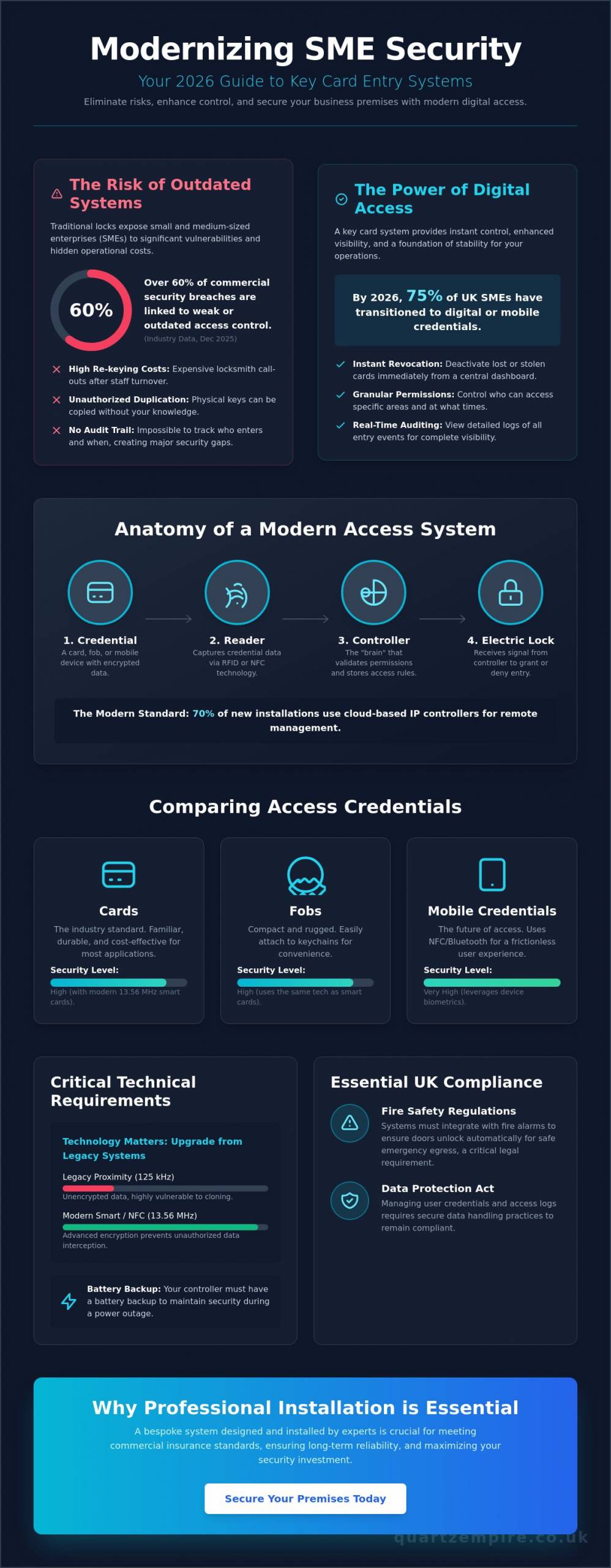
Digital credentials solve these vulnerabilities by providing instant, software-based control. If a card is lost, you can deactivate it immediately via the management interface. This ensures the lost card poses no threat to your site security. A key card entry system for small business also allows for granular access levels. You can restrict warehouse access to specific staff or ensure that office doors only unlock during designated business hours. By 2026, industry data indicates that 75% of UK SMEs have transitioned to digital or mobile-based credentials to capture these efficiencies. Beyond security, these systems project a professional image to your clients, demonstrating a commitment to meticulous safety standards and modern operational excellence. You gain peace of mind knowing your staff are protected by a system that is as flexible as your business requires.
How Key Card Systems Work: RFID and Proximity Technology
A functional key card entry system for small business operates through a coordinated four-part architecture. This includes the credential, the reader, the door controller, and the electric lock. When a staff member presents their card, the reader captures the encoded data and sends it to the controller. The controller validates this information against its internal database. If the user has permission to enter at that specific time, the controller sends a signal to release the electric lock. This entire process happens in milliseconds, providing a seamless experience for your team while maintaining a secure perimeter.
The technology behind the credentials typically involves Radio Frequency Identification (RFID). Low-frequency proximity cards (125 kHz) are a common legacy choice, but they offer limited security because their data is often unencrypted. Modern smart cards and Near Field Communication (NFC) devices operate at a high frequency of 13.56 MHz. These systems use advanced encryption to prevent card cloning and unauthorized data interception. By 2026, cloud-based controllers have become the standard for 70% of new installations. These systems allow you to manage permissions and view entry logs via a web browser, removing the need for dedicated on-site servers and complex IT maintenance.
The Role of the Door Controller
The controller acts as the brain of your security infrastructure. It stores the rules for who can enter which door and when. Most small businesses now opt for IP-based controllers that integrate directly with existing network cabling. This simplifies the installation process and allows for remote troubleshooting. It's vital to ensure your controller includes a dedicated battery backup. This prevents a total security failure during a power outage, keeping your database active and your locks functioning correctly until power is restored.
Electric Locking Mechanisms
Selecting the right lock depends on your door material and security requirements. Electromagnetic locks, or maglocks, use a powerful magnet to secure the door. They are frequently used on glass or aluminium doors where traditional latching is difficult. Electric strikes are an alternative that replaces the standard strike plate in the door frame. These work well with timber doors and existing handle sets. You must also consider the configuration of the lock. Fail-safe locks release automatically when power is cut, which is essential for emergency exit routes. Fail-secure locks remain locked during power failures, making them suitable for internal rooms containing high-value assets. Integrating these components correctly requires technical precision. You can explore professional access control and intercoms to see how these parts fit together for your specific building layout.
Comparing Access Methods: Cards, Fobs, and Mobile Solutions
Deciding on the right credential type requires a clear understanding of your daily operational needs. A key card entry system for small business must accommodate the specific workflow of your team while maintaining a robust security posture. While the underlying technology ensures the door stays locked, the physical form factor determines how easily your staff can navigate the building. You must choose between the durability of cards, the portability of fobs, or the modern flexibility of mobile-based access. Each method offers distinct advantages depending on whether you manage a professional office, a retail unit, or a busy warehouse.
Industry projections for 2026 suggest that 75% of UK SMEs will have transitioned to mobile-based credentials. This shift is accelerated by the introduction of the Aliro 1.0 open credential standard, backed by major technology providers like Apple and Google. This standard ensures better interoperability between digital wallets and card readers. Despite this trend, physical tokens remain a staple for many organizations due to their reliability and simplicity. Finding the correct balance between security and convenience ensures that your system remains an asset rather than a frustration for your employees.
Traditional Key Cards and Fobs
Plastic PVC cards are highly effective for professional office environments. They serve as identification badges when used with branded lanyards, which helps enhance your site's professional image and security. Key fobs are often the preferred choice for high-turnover retail environments or industrial sites. Their compact design allows them to be attached to existing key rings, making them less likely to be misplaced during busy shifts. Managing a stock of spare tokens is straightforward; you can quickly assign a temporary fob to a visitor or contractor and revoke their access the moment they leave the premises.
The Move Toward Mobile Access
Using smartphones as digital keys leverages Bluetooth Low Energy and NFC technology to provide a touchless entry experience. This approach significantly reduces the administrative burden and ongoing costs associated with purchasing and distributing physical cards. Employees generally appreciate the convenience of mobile access, as they don't need to carry an extra item to unlock doors. You should consider potential drawbacks, such as phone battery life or app compatibility across different device models. If an employee's phone loses power, they may be unable to enter unless you have provided a secondary method, such as a backup physical card or a pin code override.
Planning Your Installation: Compliance and Technical Requirements
The success of a key card entry system for small business depends on a meticulous site survey conducted before any hardware is mounted. You must identify every vulnerable entry point and map out the most efficient cabling routes to minimize disruption to your daily operations. This planning phase also involves checking the structural integrity of your door frames to ensure they can support electric strikes or magnetic locks. By addressing these technical details early, you ensure the system operates reliably and provides the stability your business requires. A professional assessment helps you avoid common pitfalls like poor reader placement or inadequate power supply capacity.
Legal standards dictate much of the physical installation process in the UK. To comply with the Equality Act 2010, you must mount all card readers and exit buttons at a height between 900mm and 1200mm to accommodate wheelchair users. Additionally, your entry logs are considered personal data under the UK GDPR and the Data Protection Act 2018. You'll need a clear data retention policy; most small firms keep these logs for no more than 30 days unless a specific security incident requires a longer hold. Providing clear privacy notices to your staff regarding this tracking is a vital part of maintaining regulatory adherence.
Fire Safety and Emergency Exit Regulations
Integration with your commercial fire alarm installation is a mandatory requirement for life safety. Every electronic lock on a designated escape route must release immediately when the fire alarm triggers. This setup follows the BS 7273-4 standard for the operation of fire doors. A green break glass unit acts as a final physical override, allowing occupants to exit even if the system software fails or power is cut. These safety measures ensure that your security hardware never becomes a barrier during an emergency evacuation.
System Integration and Scalability
Linking your access points to commercial CCTV systems provides a layer of visual verification that cards alone cannot offer. When a credential is presented, the system can trigger a nearby camera to record the event, giving you a clear image to match against the digital log. Think about future growth when selecting your door controllers. Choosing a scalable system allows you to add more doors or users as your SME expands without replacing your core infrastructure. Protecting your network with encrypted protocols and regular firmware updates is also essential to prevent unauthorized digital access. For a tailored assessment of your premises, you can find expert access control and intercoms support to guide your project.
Professional Installation and Maintenance in London and Kent
Professional installation isn't just about mounting hardware; it's about ensuring your business remains compliant with strict commercial insurance mandates. While some online forums suggest DIY alternatives, these often fail to meet the standards required for security systems in a professional environment. A key card entry system for small business must be installed with technical precision to ensure that fire safety overrides and data protection protocols function correctly. Choosing a specialist ensures that your system is legally sound and physically robust, providing a level of protection that consumer-grade kits cannot match.
Quartz Empire provides a meticulous approach to security design for SMEs across the South East. We understand that a business in central London has different operational pressures than a warehouse in Kent. Our specialists conduct detailed site assessments to identify specific risks and cabling requirements. This localized knowledge allows us to recommend hardware that withstands the unique demands of your specific location. We focus on delivering a dependable system that integrates seamlessly with your daily operations, providing safety without causing friction for your team.
The Importance of Regular Servicing
Your security infrastructure requires consistent attention to maintain peak performance. Regular servicing involves testing battery backups to ensure the system remains active during power outages. We also inspect electric locks for mechanical wear, as heavy use can lead to alignment issues over time. For cloud-managed systems, routine software updates and database backups are essential to protect against digital vulnerabilities. These proactive steps reduce the risk of system failure and ensure your key card entry system for small business continues to function without interruption.
Choosing a Local Partner in the South East
Working with a security specialist based in London and Kent offers significant logistical advantages. Local expertise means we understand the specific security challenges faced by businesses in the region. You benefit from rapid response times for emergency repairs and system adjustments, ensuring that any downtime is kept to an absolute minimum. Our proximity allows for regular site visits and a more personalized service relationship. If you're ready to secure your premises with a professional solution, you can Contact Quartz Empire for a bespoke access control quote to begin your site assessment.
Advancing Your Site Security for 2026 and Beyond
Modern security requires a definitive move away from static mechanical locks toward flexible digital solutions. Implementing a key card entry system for small business provides the visibility needed to manage staff and contractors effectively from a single dashboard. It's essential to prioritize technical compliance and integrate your locks with fire alarm systems to protect both your physical assets and your legal standing. This transition eliminates the administrative burden of physical keys while enhancing the professional image of your premises.
As accredited fire and security specialists, Quartz Empire provides expert installers serving London, Kent, and the South East. We deliver comprehensive maintenance and compliance support to ensure your infrastructure remains dependable throughout its lifecycle. Our meticulous approach to design and servicing guarantees that your access points remain functional and secure. Secure your business with a professional access control system from Quartz Empire to establish a foundation of long-term safety. Investing in the right technology today ensures your premises remain protected as your organization grows.
Frequently Asked Questions
How much does a key card system cost for a small business?
System costs depend on the number of doors you need to secure and the complexity of the hardware chosen. A basic standalone reader for a single door is the most accessible entry point, while networked systems for multiple doors involve higher hardware and software licensing requirements. You should account for both the initial installation and long-term maintenance when planning your security budget. Each site has unique cabling needs that will influence the final investment for your premises.
Are key card systems more secure than traditional locks?
Yes, digital systems provide significantly higher security because they remove the risk associated with unauthorized key duplication. If a staff member loses their credential, you can deactivate it instantly through the management software to prevent unauthorized entry. Modern encrypted smart cards also offer protection against cloning, a vulnerability that traditional mechanical keys cannot address. This level of control ensures your building remains secure even during periods of high staff turnover.
What happens to the door locks if there is a power cut?
Locks are configured as either fail-safe or fail-secure to determine their behavior during a power failure. Fail-safe locks release automatically to ensure safe exit routes, while fail-secure locks stay locked to protect sensitive internal areas. Professional installations include a dedicated battery backup within the controller. This keeps your security database active and your locks functioning correctly until the main power supply is restored to the building.
Can I use my smartphone instead of a physical key card?
Mobile credentials allow your team to use their smartphones as digital keys via Bluetooth or NFC technology. This is a major trend for a key card entry system for small business, as it eliminates the logistical burden of managing physical cards. With the 2026 adoption of the Aliro 1.0 standard, mobile access has become more reliable across different device types. This provides a touchless and convenient entry experience for employees who already carry their phones at all times.
Do key card systems comply with UK fire safety regulations?
Compliance is ensured by integrating your access control hardware with the building's fire alarm system. The Regulatory Reform (Fire Safety) Order 2005 requires that all electronic locks on escape routes release immediately when the fire alarm is triggered. This usually involves a combination of fail-safe locks and a green break glass unit for emergency overrides. These measures ensure that security never compromises the ability of occupants to evacuate the building safely during an emergency.
How many users can a small business access control system handle?
Modern controllers are designed for scalability and can typically manage hundreds of individual users with ease. This capacity allows your business to expand its workforce without the need to replace your core security infrastructure. You can assign different access levels to various groups, ensuring that only specific personnel can enter restricted areas like server rooms or stock cupboards. Managing these permissions is a straightforward process through the centralized software interface.
Can I track when my employees arrive and leave using key cards?
Yes, the system generates a digital audit trail that records every entry and exit event with a precise time stamp. This data provides valuable visibility into building occupancy and helps you monitor site attendance. You must handle these logs according to UK GDPR and the Data Protection Act 2018. Industry standards typically suggest a 30-day retention period for this data unless there is a documented security reason to keep the records for a longer duration.
How long does it take to install a key card system in a small office?
A typical installation for a small site with two or three doors usually takes between one and two days to complete. The duration of the project depends on the door materials and the ease of routing cables to your network points. Professional installers coordinate the work to ensure minimal disruption to your staff. Once the hardware is in place, the commissioning process involves setting up the software and testing every component of the key card entry system for small business before it goes live.