
Commercial Security System Monitoring London: The 2026 Guide

Could your current alarm system be the reason the Metropolitan Police don't attend your premises during an emergency? In London, a simple siren is no longer sufficient to guarantee a response if your system lacks a registered Unique Reference Number or fails to meet strict NSI or SSAIB standards. Professional commercial security system monitoring London has evolved from a luxury into a mandatory requirement for businesses that need to satisfy insurers and secure a priority police response.
We understand the challenges of managing commercial properties in boroughs with high crime rates while navigating the Metropolitan Police's strict "three false alarms" policy. You need a solution that provides total peace of mind overnight without the risk of heavy fines or losing your emergency coverage. This 2026 guide explains how 24/7 monitoring through a compliant Alarm Receiving Centre protects your business, ensures adherence to BS EN 50518:2019+A1:2023, and helps reduce your annual insurance premiums. As a reliable collaborator for your long-term safety needs, we'll examine the critical steps for maintaining your URN, including the updated April 2026 registration fee of £70.68, and how to integrate your CCTV and intruder alarms for a faster, verified response.
Key Takeaways
- Understand the vital distinction between standard "bells-only" alarms and professional monitoring to ensure your property receives an immediate emergency response.
- Learn how commercial security system monitoring london filters out false triggers through a rigorous verification process, protecting your police response status.
- Navigate the 2026 Metropolitan Police Service requirements, including mandatory URN registration and compliance with the latest BS EN 50518 standards.
- Discover how professional monitoring satisfies complex insurance mandates, providing the technical evidence required to potentially lower your annual premiums.
- Explore the advantages of an integrated safety strategy that combines intruder alarms, CCTV, and fire protection into a single, managed platform for operational resilience.
What is Commercial Security System Monitoring?
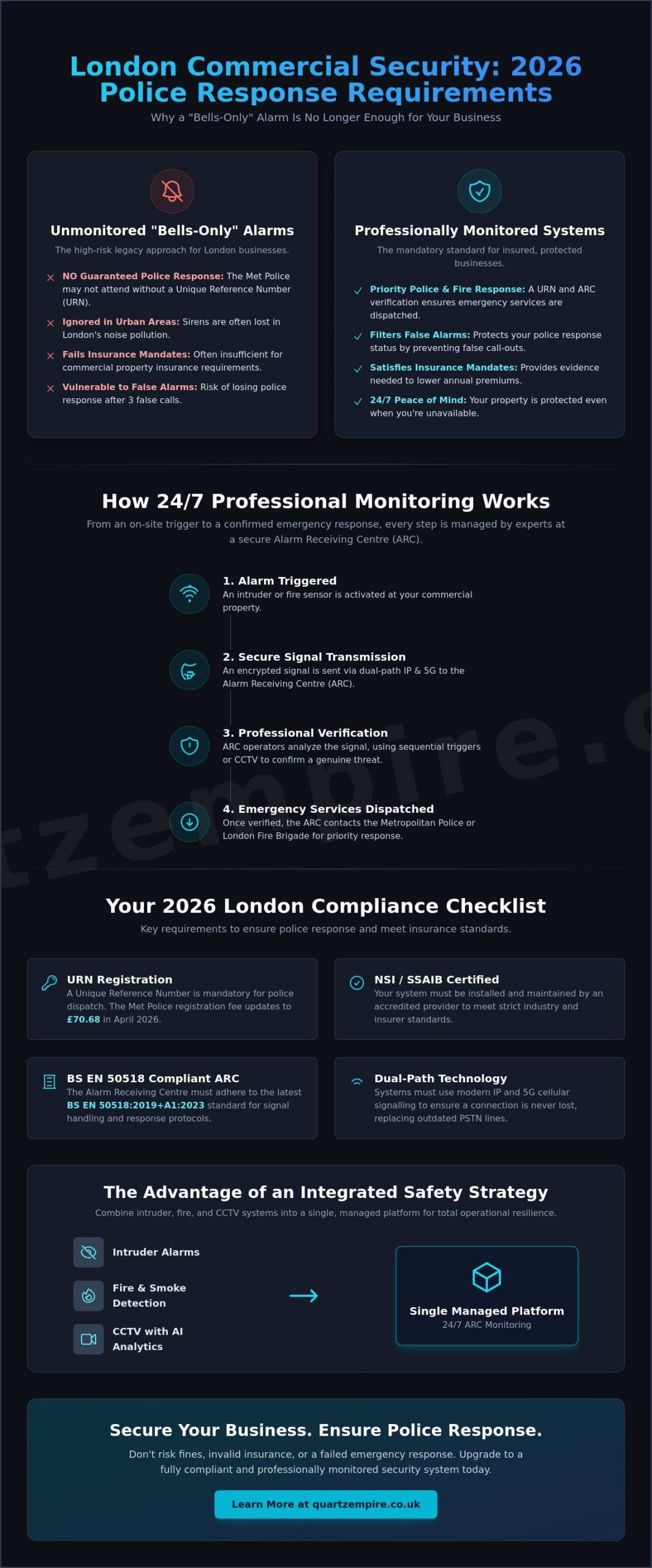
Professional commercial security system monitoring london is a sophisticated oversight service that connects your on-site hardware to a dedicated response team. Unlike traditional alarms that rely on a loud siren to deter intruders, a monitored system transmits a signal to an Alarm Receiving Centre (ARC). This facility is staffed by experts who verify the threat and initiate the appropriate emergency response. In 2026, this process is governed by the BS EN 50518:2019+A1:2023 standard, which ensures that every signal is handled with meticulous precision and speed.
Many London business owners previously relied on self-monitored app notifications. However, this approach has proven unreliable in a high-stakes environment. A missed notification due to poor signal or a silent phone can result in a total loss of property. Professional monitoring removes this single point of failure. It creates a unified safety net that covers both fire alarm systems and intruder detection. This ensures that a verified fire or security breach receives immediate attention from the relevant authorities, regardless of whether you're available to check your phone.
The Evolution of Monitoring Technology
The transition from legacy PSTN lines to IP and 5G dual-path signalling has transformed how security data travels. Modern systems use these multiple paths to ensure that if one connection fails, the alarm signal still reaches the ARC. We now see AI-driven video analytics integrated into commercial CCTV systems to distinguish between genuine intruders and harmless movement, such as urban wildlife. This technical advancement is critical for maintaining compliance with the UK Cyber Security and Resilience Bill. It utilizes end-to-end encryption to protect sensitive security data from external interference, providing a foundation of trust for your digital and physical infrastructure.
Why "Bells-Only" Systems Fail London Businesses
Unmonitored "bells-only" systems are increasingly ineffective in busy commercial districts. London's high levels of noise pollution mean that sirens are frequently ignored by the public. Relying on outdated hardware without commercial security system monitoring london can lead to significant operational risks. From a legal and financial perspective, these systems often fail to meet the complex insurance mandates required for commercial properties. Without professional oversight, you risk losing your police response eligibility if you can't provide a verified alarm signal. An unmonitored system also leaves a business vulnerable to internal theft, as there's no external record of when the system was armed or disarmed by staff members.
How Professional Monitoring Works: Inside the ARC
The effectiveness of commercial security system monitoring london relies on the seamless transition from an on-site trigger to a professional response. When a sensor on your premises is activated, it doesn't just sound a local siren. It sends an encrypted data packet via dual-path signalling to an Alarm Receiving Centre (ARC). This signal arrives at a secure facility where trained controllers are stationed to manage the incident. These controllers operate as a critical filter, ensuring that every alert is analysed before emergency services are contacted. This human intervention is what prevents your business from falling foul of the Metropolitan Police's strict false alarm policies.
Once the signal is received, the ARC staff follow a predetermined protocol. This involves categorising the incident based on its severity. Category A incidents represent a confirmed threat to life or property and receive the highest priority for dispatch. Category B incidents usually involve technical faults or unverified signals that require further investigation. By managing these distinctions, the ARC maintains a clear line of communication with the Metropolitan Police and the London Fire Brigade, ensuring that resources are directed where they're most needed. If you're considering a new installation, choosing an NSI-approved monitoring partner provides the assurance that these protocols meet the highest industry benchmarks.
The Signal Verification Process
Verification is the most important step in the monitoring chain. Most modern commercial systems use sequential verification, which requires two separate sensors to trigger within a specific timeframe to confirm an actual intrusion. Alternatively, controllers may use audio or visual verification by accessing live feeds from UK surveillance camera standards compliant systems. This level of evidence allows the ARC to issue a "verified alarm" status, which is essential for securing a priority police response. Keyholders also remain a vital part of this chain; they're contacted immediately to provide on-site access or to confirm if a staff member has accidentally triggered the system, preventing an unnecessary police call-out.
ARC Accreditation and Standards
An ARC is a highly secure, purpose-built facility dedicated to the 24/7 receipt and management of alarm signals in strict accordance with the BS EN 50518:2019+A1:2023 standard. This accreditation ensures the facility has the physical resilience, power redundancy, and cyber security needed to operate without interruption. For London businesses, using an ARC with NSI Gold or SSAIB approval isn't just a preference; it's often a mandatory requirement for commercial insurance. These standards guarantee that the monitoring station is regularly inspected and maintains the meticulous technical records required by the Metropolitan Police to maintain your Unique Reference Number (URN).
Comparing Monitoring Options: Finding the Right Fit
Selecting the optimal configuration for commercial security system monitoring london requires a detailed assessment of your property's vulnerability and your insurer's specific mandates. You shouldn't view monitoring as a generic add-on. It's a technical specification that determines how effectively your site is protected during high-risk hours. Choosing the right path involves balancing the speed of response with the technical resilience of the hardware installed on your premises.
A critical decision involves the signalling method used to transmit data to the ARC. Single-path signalling relies on one connection, such as a broadband line. If that line is cut or fails, the system cannot communicate the breach. Dual-path signalling, using technologies like CSL DualCom, provides a primary IP path with a secondary 5G or radio backup. This redundancy ensures that an alarm signal always reaches its destination, even if intruders attempt to sabotage your external communications. For most London businesses, dual-path signalling is now the baseline requirement for maintaining comprehensive insurance coverage.
Intruder vs. CCTV Monitoring
Intruder alarm monitoring is designed to detect a breach once a sensor is triggered inside the building. In contrast, CCTV remote monitoring offers proactive perimeter protection. By integrating a commercial CCTV installation with your alarm triggers, controllers can see what's happening in real-time. This allows for "audio challenges," where the ARC controller speaks directly to the intruder through on-site speakers. This verbal warning often deters criminals before they can cause physical damage to the building, turning a potential break-in into a failed attempt.
Response Levels Explained
The Security Industry Authority (SIA) and the National Police Chiefs' Council (NPCC) define the framework for how authorities respond to alarms. Understanding these levels is essential for your operational planning.
- Level 1: This is the highest priority. It guarantees an immediate police response and requires a valid Unique Reference Number (URN) and a professionally maintained system.
- Level 2: Historically, this meant police would attend if resources allowed. In 2026, most forces have moved away from this level, making Level 1 compliance the only reliable way to secure a police dispatch.
- Level 3: This is a keyholder-only response. While it's a lower-cost option, it doesn't involve the police unless the keyholder arrives on-site and confirms a crime is in progress.
Evaluating the cost-to-benefit ratio is essential for long-term resilience. While Level 1 dual-path monitoring carries higher monthly fees than basic alternatives, it's often the only way to secure comprehensive insurance for high-value stock. The peace of mind that comes from knowing your London premises are under constant, professional observation far outweighs the incremental cost of a superior monitoring package. Investing in high-level monitoring is a strategic decision that protects your assets and your business's reputation.
London-Specific Considerations: Compliance & Insurance
Operating a business in London requires a clear understanding of the city's complex regulatory environment. The Metropolitan Police Service (MPS) maintains strict criteria for alarm response that differ significantly from other UK regions. Because London's traffic congestion and ULEZ restrictions can delay physical keyholder arrival, having commercial security system monitoring london is essential. It ensures that the initial verification happens digitally and instantly. This data-driven approach allows the MPS to prioritise your call, bypassing the logistical delays that often hinder unverified responses. It's a strategic necessity for maintaining operational resilience in a high-traffic urban setting.
Commercial leases in districts like Canary Wharf or the City of London frequently include specific clauses regarding the installation and maintenance of security systems. Landlords often require evidence of a monitoring contract with an NSI-approved provider to protect the building's structural integrity and meet block insurance requirements. Failing to maintain these standards doesn't just risk your assets; it could put you in breach of your tenancy agreement. This makes professional oversight a fundamental part of your commercial obligations.
Managing False Alarms in the City
The MPS operates a "three strikes" policy that every business owner must take seriously. If your system generates three false alarms within a rolling twelve-month period, the police will withdraw their response status for your premises. Reinstating this status is a difficult and often expensive process. It requires a formal application and proof that the system has been upgraded or staff have been retrained. We recommend regular training for all employees who have access to the alarm codes to prevent accidental triggers. The financial impact of losing your police response status is high, as it often leads to a voiding of your theft insurance coverage.
Insurance Mandates for London Businesses
Insurers use granular postcode data to determine the level of protection required for your specific location. A high-street retail unit in a high-crime borough will face much stricter mandates than a secure office on an upper floor in Canary Wharf. Most insurers now view a professionally monitored system as a non-negotiable condition for coverage. This requirement is often linked to your latest fire risk assessment, as integrated monitoring provides a comprehensive record of your "Duty of Care" compliance. If you need to ensure your premises meet these strict regulatory and insurance standards, contact our expert team today for a professional evaluation.
The Quartz Empire Approach: Integrated Safety Monitoring
Quartz Empire delivers a unified safety strategy that prioritises reliability and technical precision. By centralising your commercial security system monitoring london, we eliminate the fragmented approach that often leaves businesses vulnerable. Our methodology focuses on the convergence of fire alarm systems, commercial intruder alarms, and access control into a single, high-performance platform. This integration ensures that your premises are protected by a system that's both resilient and easy to manage. It's a straightforward operational philosophy designed to provide safety and stability for your organisation.
We maintain a steadfast commitment to NSI-approved standards, ensuring every component of your security infrastructure meets the rigorous expectations of insurers and the Metropolitan Police. Our technical teams bring deep local expertise to businesses across London, Kent, and the South East. We focus on proactive maintenance to ensure 99.9% system uptime, preventing technical failures before they can compromise your safety. This meticulous attention to detail positions us as a dependable partner for organisations that can't afford gaps in their protection.
Why Integrated Monitoring is More Effective
Choosing an integrated approach reduces hardware overhead by utilising dual-purpose signalling for both fire and security alerts. Instead of managing multiple contracts, you benefit from a single point of contact for your fire alarm installation and intruder detection needs. This synergy simplifies the maintenance process and ensures all safety data is channeled through one secure ARC. Facilities managers receive streamlined reporting, allowing for better oversight of building access and emergency readiness. It's a practical solution that enhances the mental well-being of stakeholders by providing a clear view of the site's security status.
Getting Started with Quartz Empire
Our engagement begins with a comprehensive security audit and a detailed monitoring site survey. We evaluate your current hardware and identify any gaps in compliance with the latest British Standards. If you're looking to upgrade, we manage the transition from your current provider with a focus on zero downtime. We understand every London borough presents unique risks, so we customise response protocols to match your specific operational needs. This ensures the ARC knows exactly how to react based on your site's location and risk profile. Contact us today to receive a bespoke commercial security monitoring quote and take the first step toward long-term operational resilience.
Securing Your Business Resilience for 2026 and Beyond
Maintaining a robust security posture in London requires more than just high-quality hardware. It demands a verified connection to emergency services and a commitment to rigorous industry standards. Professional commercial security system monitoring london serves as the critical link between a detected breach and a guaranteed police or fire brigade response. By ensuring your system holds a valid Unique Reference Number and meets the latest BS EN 50518 requirements, you protect your assets. It's also the most effective way to satisfy complex insurance mandates for commercial properties.
Quartz Empire stands as a reliable collaborator for your long-term safety needs. As an NSI Accredited Provider, we specialise in Metropolitan Police compliant systems that integrate fire, intruder, and CCTV oversight into one dependable platform. Our technical expertise in London and Kent commercial security allows us to tailor response protocols that address the specific risks of your borough. We focus on providing the stability you need to operate with confidence.
Secure your London premises with 24/7 professional monitoring from Quartz Empire. Implementing a professionally monitored solution ensures your property remains protected and your business stays resilient against future challenges.
Frequently Asked Questions
What is a URN and why does my London business need one for police response?
A URN, or Unique Reference Number, is a specific identifier issued by the police to a monitored security system. In London, the Metropolitan Police require this number to verify that a system is professionally maintained and monitored by an accredited centre. Without a URN, the police won't provide a guaranteed response to an automated alarm trigger, as they only attend verified signals from compliant systems.
Can I monitor my commercial security system from my smartphone?
Yes, modern commercial systems allow you to view live feeds and receive notifications via a dedicated smartphone application. While this provides convenient oversight, it shouldn't replace professional commercial security system monitoring london. Professional centres manage alerts 24/7, ensuring that emergency services are contacted even if you miss a notification, your phone is switched off, or you're in an area with poor signal.
What happens if my business internet goes down during an intruder event?
A robust system uses dual-path signalling to ensure the alarm signal reaches the monitoring centre if your primary internet fails. This technology typically uses a secondary 4G or 5G cellular connection as a secure backup. If the main broadband line is cut or goes down, the system instantly switches to the mobile network to maintain constant, uninterrupted protection for your premises.
How much does commercial security system monitoring cost in London?
The cost of commercial security system monitoring london varies based on the complexity of your site and the required response level. Factors such as the number of integrated sensors, whether you require CCTV verification, and the type of signalling path used will influence the final fee. We recommend a professional site survey to determine the most effective configuration for your specific insurance and safety requirements.
Is fire alarm monitoring legally required for UK businesses?
While not a universal legal requirement for every small premises, fire alarm monitoring is often mandated by insurers and building regulations for larger commercial properties. It ensures that the London Fire Brigade is alerted instantly when a detector is triggered, even when the building is unoccupied. This proactive approach is a critical component of your overall fire risk management strategy and helps prevent total property loss.
What is the difference between single-path and dual-path monitoring?
Single-path monitoring relies on one communication link, such as a broadband connection, whereas dual-path monitoring uses two independent routes. Dual-path systems are significantly more secure because they provide redundancy. If one path is compromised by a technical fault or deliberate sabotage, the second path ensures the alarm signal is still transmitted to the receiving centre without delay.
How do I avoid Metropolitan Police fines for false alarms?
You can avoid fines and the withdrawal of police response by ensuring your system is professionally maintained and by training your staff on correct operation. Utilising sequential or visual verification through an accredited monitoring centre filters out false triggers. This ensures that the police are only called to genuine incidents, protecting your system's URN from being revoked under the strict "three strikes" policy.
Can Quartz Empire monitor a security system installed by another company?
Yes, we can often take over the monitoring of existing commercial systems after a thorough technical inspection and audit. Our team will verify that your current hardware meets the necessary British Standards and is compatible with our accredited Alarm Receiving Centre. This process allows you to upgrade your protection level and consolidate your safety services without necessarily replacing all your existing infrastructure.