
How to Prove Fire Safety Compliance: A Guide for UK Business Owners

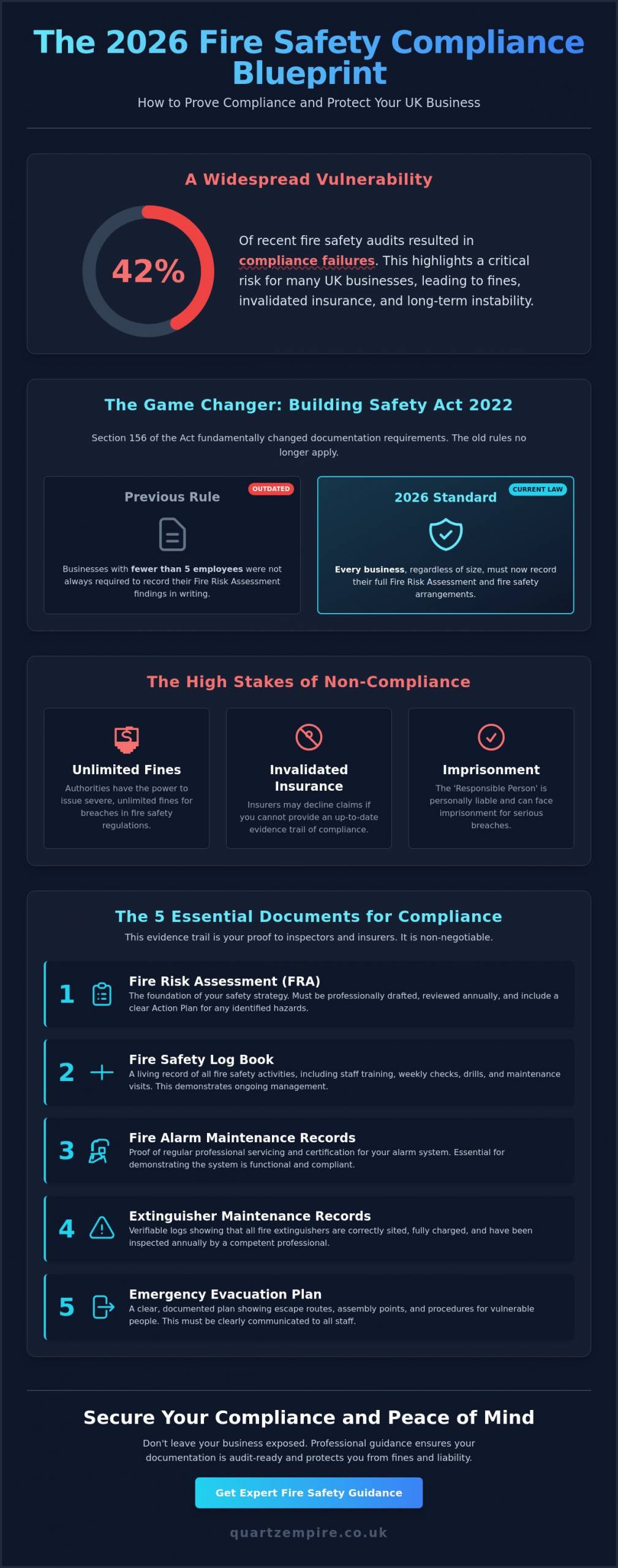
Did you know that 42% of fire safety audits conducted recently resulted in compliance failures? For many UK business owners, the risk of heavy fines or a failed inspection is a significant concern that impacts long-term stability. You may find the complex language of the Building Safety Act difficult to translate into practical action, leading to uncertainty about how to prove fire safety compliance under the 2026 standards. This uncertainty is common among professionals who prioritize safety but struggle with shifting legal requirements and the pressure of maintaining an audit-ready environment.
True compliance is not just a certificate on a wall; it's a living evidence trail of professional maintenance and documented risk management. This guide outlines the exact documentation required to satisfy fire inspectors and insurers in 2026, helping you secure lower premiums and total peace of mind. We'll provide a clear checklist of essential records, including fire risk assessments and fire alarm maintenance logs, to ensure you're fully prepared for any fire service inspection.
Key Takeaways
- Understand how recent amendments to the Building Safety Act 2022 have increased the mandatory documentation required for every UK business owner.
- Learn exactly how to prove fire safety compliance by maintaining a comprehensive evidence trail, including a current Fire Risk Assessment and a detailed Fire Safety Log Book.
- Identify the critical differences between basic internal checks and professional certification to ensure your building meets the rigorous standards expected by insurers.
- Establish a verifiable maintenance schedule for fire alarms and extinguishers to demonstrate ongoing regulatory adherence during a fire service audit.
- Discover how professional guidance and third-party accreditation can protect your organization from heavy fines and improve long-term stability.
Understanding the Legal Framework for Fire Safety in 2026
The Regulatory Reform (Fire Safety) Order 2005 remains the primary legislation governing fire safety for all non-domestic premises in England and Wales. While this order established the risk-based approach we use today, the legal environment has become significantly more rigorous. Understanding the History of UK Fire Safety Legislation provides essential context for why these standards continue to evolve toward higher accountability. For business owners in London and Kent, compliance is a mandatory operational requirement that ensures the safety of employees, visitors, and the physical assets of the organization.
The law identifies a "Responsible Person" who carries the legal burden for fire safety. This individual, often the employer, owner, or occupier, is personally liable for ensuring the premises meet all statutory requirements. This responsibility cannot be fully delegated. Even when hiring external specialists for Fire Risk Assessments or system maintenance, the Responsible Person must ensure the work meets current standards. Failure to meet these obligations can result in severe legal action, making it vital to understand exactly how to prove fire safety compliance through verifiable evidence.
The Building Safety Act 2022: What Changed?
Section 156 of the Building Safety Act 2022 introduced pivotal changes that have fundamentally altered documentation requirements. One of the most significant updates is the removal of the employee threshold for recording fire risk assessments. Previously, businesses with fewer than five staff members were not always required to document their findings in writing. As of 2026, every business, regardless of size, must record their full Fire Risk Assessment and fire safety arrangements. This change ensures that a clear, permanent record exists for every commercial property. The Act also mandates increased cooperation between different Responsible Persons in multi-tenant buildings, requiring shared documentation to ensure the entire building's safety strategy is cohesive.
Consequences of Non-Compliance
The risks associated with inadequate fire safety management are both financial and legal. Authorities have the power to issue unlimited fines, and serious breaches can lead to imprisonment. Statistics from 2024/2025 indicate that 42% of fire safety audits conducted in England resulted in compliance failures, highlighting a widespread vulnerability in business operations. Beyond the threat of prosecution, non-compliance frequently leads to the invalidation of commercial insurance policies. If an incident occurs and you cannot demonstrate how to prove fire safety compliance via an up-to-date evidence trail, your insurer may decline the claim. Maintaining a consistent record of Fire Alarm System Maintenance and equipment checks is the most effective way to protect your business reputation and ensure long-term stability in the South East.
The 5 Essential Documents to Prove Fire Safety Compliance
When an enforcing officer visits your premises, they aren't looking for verbal assurances. They require a physical or digital evidence trail that demonstrates your safety systems are functional and managed. This burden of proof lies with the Responsible Person. To satisfy the official government guidance on fire safety, you must maintain five core documents that reflect the current state of your building's protection. Without these, you cannot demonstrate how to prove fire safety compliance during a formal audit or insurance claim investigation.
The Fire Risk Assessment: Your Primary Proof
A professional fire risk assessment is the foundation of your safety strategy. While some small businesses attempt to use generic templates, a bespoke assessment conducted by a competent professional is far more defensible in court. It identifies specific hazards within your unique layout and provides a clear Action Plan. Inspectors don't just look for the assessment itself; they check if you've completed the remedial works listed in that plan. In 2026, your assessment must be reviewed annually or whenever significant changes occur to the building's use or occupancy. Given that 42% of audits currently result in compliance failures, having a professionally drafted assessment is your strongest protection against legal action.
The Fire Safety Log Book: The Daily Evidence Trail
Your log book serves as the operational diary of your building's safety. It's the primary tool used to show how to prove fire safety compliance on a week-to-week basis. Inspectors expect to see dated entries for several recurring activities. You must record weekly fire alarm tests from different call points and monthly emergency lighting "flick tests" to ensure functionality. Additionally, you must document fire drills at least twice a year, noting the evacuation time and any issues encountered. With fire services attending over 250,000 false alarms annually, your log book also helps identify faulty equipment that may be causing unnecessary call-outs. Whether you use a digital system or a physical folder, consistency is the key to passing an inspection.
Beyond these two pillars, you must maintain three other critical records:
- Service Certificates: Professional certificates for fire alarm systems and emergency lighting, typically issued every six months.
- Maintenance Records: Annual service labels and certificates for fire extinguishers and any specialized suppression systems.
- Training Logs: Proof of staff fire awareness training and certificates for designated Fire Marshals.
Maintaining these records doesn't have to be overwhelming. Partnering with a specialist for fire extinguisher services and system maintenance ensures your documentation is always up to date and audit-ready.
Professional Certification vs. DIY: Why It Matters to Insurers
There is a fundamental legal distinction between "checking" a fire safety system and "certifying" its compliance. While your internal team can perform routine visual inspections, they typically lack the technical credentials to issue a formal certificate of service. Under UK fire law, maintenance must be carried out by a "Competent Person," defined as someone with sufficient training, experience, and knowledge. For most business owners, how to prove fire safety compliance to an insurer or fire officer depends entirely on the validity of these professional certificates. Without third-party verification, your internal logs may be viewed as subjective and insufficient during a forensic investigation following an incident.
Professional certification does more than just tick a box; it effectively shifts the burden of proof. When an accredited specialist services your equipment, they take responsibility for confirming that the system meets British Standards, such as BS 5839 for fire alarms. If a fire occurs, having a stack of professional service certificates proves you've exercised due diligence. Insurers prioritize these documents because they represent a standardized level of safety that DIY efforts simply cannot replicate. In an environment where only 58% of fire safety audits are currently deemed satisfactory, professional certification is the most reliable way to stay within the compliant majority.
The Risks of DIY Fire Maintenance
Attempting to manage fire safety maintenance entirely in-house carries significant legal and operational risks. Common mistakes in self-servicing include failing to check the internal pressure of fire extinguishers or neglecting to test fire alarm sensors with calibrated equipment. These errors often go unnoticed until an inspection or, worse, a real emergency. While "in-house" checks are an essential supplement for weekly testing, they aren't a replacement for professional servicing. Legal precedents have shown that DIY maintenance rarely stands up in court when a serious breach occurs. If your records don't show professional oversight, you risk your insurance being invalidated, leaving your organization vulnerable to unlimited fines.
Choosing an Accredited Fire Safety Partner
Selecting the right provider is critical for maintaining your evidence trail. When evaluating fire alarm companies in London and the South East, look for those with BAFE accreditation or equivalent industry recognition. These credentials ensure the provider's work is audited by an independent body, giving you and your insurer confidence in the results. A long-term maintenance contract provides a consistent schedule of inspections, ensuring you never miss a deadline. This proactive approach is the most practical answer to how to prove fire safety compliance, as it builds a chronological history of professional care that satisfies both regulatory bodies and insurance providers.
Establishing a Verifiable Maintenance Schedule
Establishing a verifiable maintenance schedule is the practical application of your fire safety strategy. It transforms your legal obligations into a routine that creates a continuous evidence trail. For business owners, understanding how to prove fire safety compliance involves strictly adhering to specific testing frequencies. These frequencies are designed to ensure that life-saving equipment functions correctly at all times. A gap in your maintenance records is often the first thing a fire inspector or insurance investigator will flag during an audit.
Your schedule should be divided into internal checks and professional servicing. Each activity must be recorded immediately in your log book to ensure the data is accurate and contemporaneous.
- Weekly: Perform fire alarm tests from different manual call points each week to ensure the signal reaches the control panel.
- Monthly: Conduct emergency lighting function tests and visual inspections of all fire extinguishers to check for tampering or damage.
- Six-Monthly: Schedule professional fire alarm servicing to meet BS 5839-1 standards.
- Annually: Complete professional fire extinguisher maintenance and a full three-hour discharge test for emergency lighting systems.
Fire Alarm Maintenance Standards
The British Standard BS 5839-1 outlines the requirements for fire detection and alarm systems in non-domestic premises. To remain compliant, you must ensure your system is serviced by a competent professional at least twice a year. These six-monthly visits are the industry standard for demonstrating how to prove fire safety compliance to regulatory bodies. During these inspections, technicians verify that all detectors, call points, and sounders are operational. You should also use your log book to record any "false alarms." Documenting these incidents helps identify system faults or environmental triggers early, preventing the disruption caused by the 250,226 false alarms fire services attended in the 2024/2025 period.
Fire Extinguisher and Lighting Records
Your documentation must also confirm that your fire extinguisher types are appropriate for the specific risks in your building. For example, you must have CO2 extinguishers for electrical risks and water or foam for combustible materials. Annual servicing by a professional ensures these units are pressurized and functional. Similarly, emergency exit signage must be illuminated and documented as part of your monthly and annual lighting checks. If a test identifies a failure, the subsequent record of remedial works is a critical part of your evidence trail. It proves you've taken corrective action to maintain a safe environment for all occupants.
To ensure your building remains audit-ready and fully protected, contact us for professional fire alarm system maintenance and equipment servicing.
Partnering with Quartz Empire for Guaranteed Compliance
Maintaining a continuous evidence trail is a complex, ongoing obligation that requires meticulous attention to detail. Quartz Empire Fire & Security Ltd provides the technical expertise and administrative support needed to manage this burden effectively. We offer comprehensive fire safety services across London, Kent, and the South East, ensuring that every aspect of your protection meets the rigorous 2026 standards. By centralizing your maintenance with an accredited partner, you simplify the process of how to prove fire safety compliance to any visiting official or insurance investigator.
Our team specializes in Fire Risk Assessments that identify and mitigate real-world risks specific to your premises. We provide expert Fire Alarm System Installation & Maintenance alongside Fire Extinguisher Services and Fire Marshal Training. This integrated approach ensures that your safety infrastructure is not only robust but also fully documented. We also manage the installation and maintenance of integrated security systems, including commercial CCTV and access control, to provide a holistic safety solution. This allows us to serve as a reliable collaborator for your long-term safety needs.
Our Local Expertise in London and Kent
Operating extensively within the South East allows us to understand the specific expectations of regional fire authorities. We maintain a strong local presence, which enables rapid response for maintenance and emergency repairs. Our experience with diverse building types in London and Kent means we're familiar with the unique challenges of both historic structures and modern commercial developments. We've helped numerous local businesses transition from fragmented, insufficient records to a seamless, audit-ready evidence trail. Our straightforward, honest, and practical operational philosophy ensures that you receive clear guidance without unnecessary jargon or hidden costs.
Get Your Compliance Audit Today
A professional audit is the first step toward establishing total peace of mind for your stakeholders. Many business owners remain uncertain if their existing systems meet the latest regulatory updates from the Building Safety Act. Our meticulous consultation process evaluates your current status and identifies any gaps in your documentation or hardware. We offer custom maintenance packages tailored to your specific building type and risk profile, ensuring your organization remains protected. Contact Quartz Empire Fire & Security Ltd today to secure a professional consultation and discover how to prove fire safety compliance with absolute confidence.
Securing Your Organization’s Future Through Rigorous Compliance
Achieving full compliance in 2026 requires more than a reactive approach. It's a process that demands a proactive, documented strategy to remove any ambiguity during an audit. Moving away from DIY checks toward professional certification ensures your evidence trail remains defensible and robust under the scrutiny of fire officers and insurers. We've explored the necessity of a detailed Fire Risk Assessment and the role of a consistent maintenance schedule in protecting your organization from legal and financial risks.
Understanding how to prove fire safety compliance is the first step toward creating a stable and secure environment for your employees and stakeholders. As an accredited fire safety provider serving London, Kent, and the South East, Quartz Empire offers comprehensive fire and security maintenance packages designed for long-term reliability. Secure your business with a professional Fire Risk Assessment from Quartz Empire to ensure you meet every statutory requirement. Taking these steps today establishes a foundation of safety that supports your business's growth and continuity.
Frequently Asked Questions
How often do I need a fire risk assessment to remain compliant?
You should review your fire risk assessment annually to ensure it remains valid and reflects the current state of your premises. While the law doesn't specify a fixed timeframe, any significant changes to the building's layout, occupancy, or usage mandate an immediate update. Keeping this document current is a primary step in understanding how to prove fire safety compliance during an official inspection.
Can I do my own fire safety checks or do I need a professional?
You are responsible for performing routine internal checks, such as weekly fire alarm tests and monthly visual inspections of equipment. However, these do not replace the legal requirement for professional servicing by a competent person. Professional maintenance provides the technical certification that insurers and fire officers require to verify that your systems meet British Standards.
What happens if a fire officer visits and I don’t have my log book?
If a fire officer visits and you cannot produce a log book, they may issue an enforcement notice or, in serious cases, pursue prosecution. The log book is your primary evidence of ongoing maintenance and safety management. Without it, you lack the necessary documentation to satisfy an auditor that your building is safe for occupants.
Is fire marshal training a legal requirement for my staff?
Yes, appointing and training a sufficient number of fire marshals is a legal requirement under the Regulatory Reform (Fire Safety) Order 2005. These individuals must receive adequate training to assist with fire prevention and evacuation procedures. Documenting this training in your records is essential for demonstrating how to prove fire safety compliance to regulatory bodies.
Do I need to prove compliance for fire extinguishers every year?
You must have your fire extinguishers professionally serviced every twelve months to ensure they are functional and compliant with BS 5306 standards. A technician will check the pressure, internal components, and overall condition of each unit. Following the service, you'll receive a certificate and a service label on each extinguisher as physical proof of compliance.
What is the difference between a fire alarm test and a fire alarm service?
A fire alarm test is a weekly functional check performed by your staff to ensure the system activates when a call point is triggered. In contrast, a fire alarm service is a comprehensive technical inspection conducted by a professional every six months. The service involves testing every component, including smoke detectors and backup batteries, to ensure the entire system meets BS 5839-1 standards.
How does the Building Safety Act 2022 affect small businesses with fewer than 5 employees?
The Building Safety Act 2022 removed the previous exemption that allowed businesses with fewer than five employees to avoid documenting their fire risk assessments. Now, every business must record their full assessment and fire safety arrangements in writing. This change ensures that every commercial premises has a permanent, verifiable record of its safety strategy regardless of staff numbers.
How long should I keep fire safety records for audit purposes?
You should keep fire safety records for the lifetime of the building or the specific system being serviced. For audit purposes, it is advisable to maintain at least five years of maintenance history to demonstrate a consistent pattern of due diligence. This long-term evidence trail is vital for satisfying insurers and defending your organization during legal proceedings.