
Fire Marshal Responsibilities Checklist UK: The Complete 2026 Guide

Did you know that UK Fire and Rescue Services respond to more than 22,000 workplace fires every single year? This statistic highlights the persistent risks businesses face and the critical need for a clear fire marshal responsibilities checklist uk to maintain safety. It's understandable if you feel overwhelmed by technical equipment or the common confusion between fire marshal and fire warden roles. You're likely concerned about missing a specific legal requirement that could compromise the safety of your team and your building.
We've created this guide to help you master your legal duties with confidence and professional legitimacy. By following this framework, you'll ensure your organization remains compliant with the latest 2026 regulatory changes, including the new PEEP requirements and the BS 9792 code of practice. Our goal is to replace uncertainty with a structured approach to protection and reliability, ensuring your workplace stays secure and fully compliant with current UK law.
This article explores the core proactive duties of the role, from conducting regular equipment checks to managing emergency evacuations. You'll also find a clear breakdown of the essential documentation and training protocols needed to maintain professional standards in any commercial environment.
Key Takeaways
- Clarify the legal distinction between fire marshals and wardens to ensure your site roles align with the Regulatory Reform (Fire Safety) Order 2005.
- Implement a robust fire marshal responsibilities checklist uk to identify daily hazards and maintain clear escape routes throughout your premises.
- Master the 'Sweep' method for emergency evacuations to ensure isolated areas like storerooms and toilets are cleared safely and efficiently.
- Maintain a compliant Fire Safety Logbook by correctly documenting fire drills, false alarms, and regular system maintenance to satisfy official inspections.
- Determine the necessary frequency for 'suitable and sufficient' training to keep your marshals prepared and compliant with evolving safety standards.
Understanding the Fire Marshal Role and UK Legal Requirements
UK legislation requires every commercial entity to establish a clear hierarchy of safety. Under the Regulatory Reform (Fire Safety) Order 2005, the 'Responsible Person' holds the ultimate legal accountability for the premises. This is typically the employer, building owner, or landlord. However, they can't manage every safety detail alone. They must appoint 'competent persons' to assist in undertaking preventive and protective measures. This is where the role becomes essential. A robust fire marshal responsibilities checklist uk provides the framework these individuals need to support the Responsible Person and satisfy statutory requirements.
Fire Marshal vs. Fire Warden: Is There a Difference?
You'll often hear these terms used interchangeably across different industries. Fire marshals (sometimes known as 'fire wardens') typically share the same core objectives: protecting life and property. In smaller organizations, a single individual often performs both roles. In contrast, larger or more complex sites might use 'wardens' for specific floor clearances and 'marshals' for high-level coordination with emergency services. The specific number of marshals your business requires depends on your building's risk profile, the complexity of the layout, and total occupancy. A Fire Marshal is the proactive and reactive safety lead who manages hazard prevention and emergency evacuation procedures.
The Regulatory Reform (Fire Safety) Order 2005
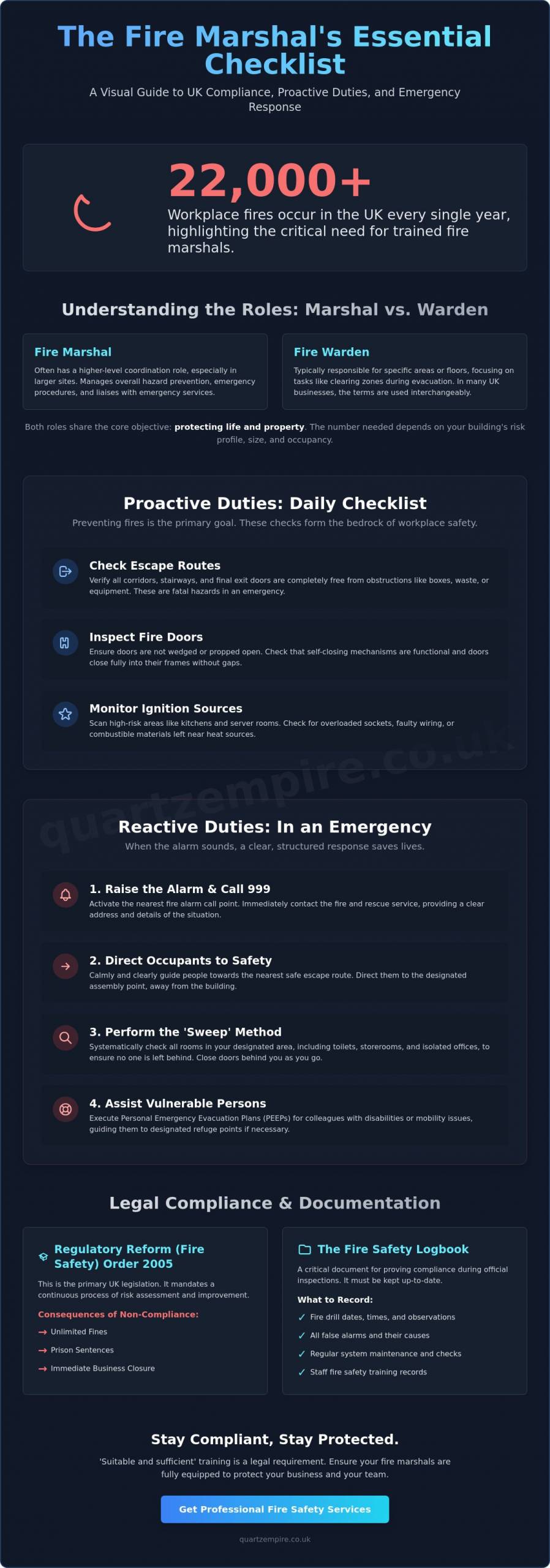
This Order is the primary legislation governing fire safety in England and Wales. It demands that fire safety is managed through a continuous process of assessment and improvement rather than a one-time check. Ignoring these duties carries heavy risks. Non-compliance can lead to unlimited fines, prison sentences, and the immediate closure of your business by the Fire and Rescue Service. Professional fire risk assessments are the foundation of this process. They provide the specific data needed to tailor your marshal's duties to your unique environment and ensure all technical equipment remains operational.
Marshals provide the professional legitimacy needed to maintain a safe environment. They ensure that daily operational habits, such as propping open fire doors or obstructing extinguishers, don't compromise safety standards. By following a fire marshal responsibilities checklist uk, these individuals help the business avoid the scrutiny of enforcement authorities. Their presence offers reassurance to staff and stakeholders that the organization is committed to long-term stability and protection.
Proactive Fire Marshal Duties: Your Daily and Weekly Checklist
Fire marshals provide the most value when they prevent emergencies from occurring. While reactive duties are vital, the proactive phase forms the bedrock of workplace safety. Utilizing a structured fire marshal responsibilities checklist uk ensures that potential hazards are identified before they escalate into incidents. This methodical approach fulfills the requirements of the Regulatory Reform (Fire Safety) Order 2005, which mandates that safety measures remain effective through regular maintenance and inspection. Proactive management creates a culture of stability where safety is a continuous process rather than an afterthought.
Daily Fire Safety Walk-Through Tasks
Daily inspections provide immediate protection against common workplace hazards. These checks should be performed at the start of each shift to ensure the building remains compliant and safe for occupancy. Focus on these three core areas:
- Escape Routes: Verify that all internal and external corridors, stairways, and final exit doors are completely free from obstructions. Items like delivery boxes, waste, or bicycles can become fatal trip hazards during a blackout.
- Fire Doors: Ensure fire doors are not wedged or propped open. Check that they close fully into their frames and that self-closing devices are operational.
- Ignition Sources: Monitor high-risk areas like kitchens, server rooms, and workshops for waste build-up or faulty electrical equipment. Remove any combustible materials stored near heat sources immediately.
Weekly and Monthly Equipment Inspections
Beyond daily habits, fire marshals must oversee the technical integrity of safety hardware. Weekly tests focus on system functionality, while monthly inspections ensure equipment remains ready for use. Maintaining a clear schedule helps coordinate with professionals for specialist fire alarm servicing to address complex technical faults.
Each week, test the fire alarm system by activating a different manual call point. This confirms the sounders are audible throughout the premises. You should also conduct a "flick test" of the emergency lighting to ensure the lamps illuminate upon power failure. On a monthly basis, inspect every fire extinguisher to verify the pressure gauge is in the green zone, the safety pin is intact, and the service tag is current. Ensure all fire safety signage remains visible and has not been obscured by furniture or decorations. If you identify gaps in your current safety protocols, booking a professional Fire Risk Assessment can provide the necessary clarity to refine your fire marshal responsibilities checklist uk and ensure full regulatory adherence.
Reactive Emergency Duties: Managing a Safe Evacuation
When the alarm sounds, the fire marshal's role shifts instantly from hazard prevention to active incident management. Speed and composure are vital during these high-pressure moments. Your first duty is to ensure the alarm has been raised and the Fire and Rescue Service contacted. While modern systems often automate this, a manual verification remains an essential part of any fire marshal responsibilities checklist uk. You must then initiate the 'Sweep' method. This involves a systematic check of all areas in your designated zone, including toilets, storerooms, and plant rooms, to ensure no one is left behind in the confusion.
Effective evacuation relies on clear communication and specialized support. As of April 2026, new regulations place a heavier emphasis on Personal Emergency Evacuation Plans (PEEPs). You must identify and assist individuals who require additional help, ensuring their pre-arranged evacuation strategy is executed without delay. This meticulous attention to detail aligns with the core principles of UK fire safety legislation, which prioritizes the protection of all occupants regardless of their mobility or sensory needs. Your presence as a calm, authoritative leader helps prevent panic and ensures an orderly exit.
Step-by-Step Evacuation Protocol
Don your high-visibility vest immediately to establish authority and ensure staff can identify you. If it's safe to do so, collect the fire logbook and exit the building while directing others toward the nearest emergency route. You must prevent the use of lifts, as these can become traps during a power failure or technical malfunction. As you move through the building, close all doors behind you. This simple action supports fire compartmentation, which helps contain smoke and flames to their area of origin and buys valuable time for the arriving emergency services.
Post-Evacuation and Debriefing
Your duties don't end once you've exited the building. You must manage the assembly point and conduct a thorough roll call to account for all staff, contractors, and visitors. It's your responsibility to prevent anyone from re-entering the premises until the Fire and Rescue Service gives the official 'all clear'. Once the incident is resolved, facilitate a debriefing session to analyze the evacuation's effectiveness and identify any bottlenecks. Documenting 'near misses' is a vital step in improving future safety protocols and preventing actual incidents. This data provides the professional legitimacy needed to refine your fire marshal responsibilities checklist uk for long-term reliability and site-specific accuracy.
Record Keeping and Coordinating with the 'Responsible Person'
The fire marshal serves as the eyes and ears of the 'Responsible Person'. While the Responsible Person holds ultimate legal liability, the marshal provides the essential evidence of compliance through meticulous record-keeping. A fire marshal responsibilities checklist uk is incomplete without a disciplined approach to the Fire Safety Logbook. This document acts as a primary piece of evidence during inspections by the Fire and Rescue Service. It demonstrates that the business is actively managing risks rather than just reacting to them. Meticulous records provide the professional legitimacy needed to prove that safety isn't just a policy but a daily practice.
Maintaining the Fire Safety Logbook
Accurate records are a statutory requirement in the UK. For every fire drill, you must record the date, the time of the alarm, and the total duration of the evacuation. You should also note any difficulties encountered, such as blocked exits or staff members who failed to follow protocol. Logging maintenance visits is equally critical. You must record which fire extinguisher types were serviced and whether any units were replaced or recharged. While traditional physical logbooks are common, many organizations now use digital versions to ensure records aren't lost or damaged. Digital systems offer better transparency and easier access during audits, though physical books remain a reliable on-site backup.
Reporting Hazards and Remedial Works
The relationship between the marshal and the Responsible Person relies on a rapid feedback loop. If you identify a broken fire door, a faulty detector, or a failing emergency light during your daily walk-through, you must report it immediately for remedial action. Your observations directly support the annual review of the site's Fire Risk Assessment. You also play a key role in ensuring all fire safety signage complies with BS 5499 standards. Working alongside professional security system providers helps integrate fire safety with wider building protection. This collaboration ensures that fire alarms, access control, and monitoring systems function as a single, dependable unit. To ensure your documentation and hardware meet the highest standards of professional legitimacy, book a professional Fire Risk Assessment today.
Coordinating with the Responsible Person also involves managing false alarms. Every time the system triggers without a fire, you must investigate the cause and record it in the logbook. Frequent false alarms can lead to 'alarm fatigue', where staff stop taking the signals seriously. By documenting these events, you help the Responsible Person identify if a specific detector is faulty or if environmental factors like steam or dust are causing issues. This data-driven approach ensures that the fire alarm system remains a trusted component of your workplace safety infrastructure.
Ensuring Compliance: Fire Marshal Training and System Maintenance
Legislation requires that those appointed to safety roles possess the necessary skills and experience. The "suitable and sufficient" training mandate ensures that your team isn't just following a fire marshal responsibilities checklist uk blindly but understands the underlying risks. In the UK, it's standard practice to refresh this training every two to three years. However, high-risk environments or sites with high staff turnover may require annual updates to maintain professional standards. Meticulous training ensures that your safety leads remain confident in their specialized knowledge and can adapt to the 2026 regulatory landscape.
Selecting the Right Fire Marshal Training
Comprehensive courses must bridge the gap between theory and action. A valid program covers the Regulatory Reform (Fire Safety) Order 2005 while providing hands-on experience with equipment. Practical extinguisher use is a core component. It builds the muscle memory needed to act decisively during an incident. While online courses provide a foundational overview, site-specific training is often more effective. It allows marshals to identify the exact location of their assembly points and high-risk zones. You must also ensure that deputies receive the same level of instruction to maintain coverage during holidays or sickness.
The Role of Professional Maintenance Partners
A fire marshal's effectiveness is often limited by the reliability of the building's hardware. Quartz Empire supports your safety leads through expert fire alarm installation and ongoing maintenance. When systems are professionally serviced, the burden of technical troubleshooting is removed from the marshal. This allows them to focus on person-centered safety and evacuation management. Reliable hardware acts as a silent collaborator in your long-term safety strategy.
Integrating monitored alarm and CCTV systems further enhances site security. These technologies provide real-time data that marshals can use to identify the source of a fire before it spreads. This integrated approach ensures that your fire marshal responsibilities checklist uk is backed by dependable infrastructure. Professional oversight provides the peace of mind that your business remains resilient against fire-related disruptions. Contact Quartz Empire today for a professional Fire Risk Assessment or to schedule a comprehensive system service.
The fire marshal is a cornerstone of business continuity. Their meticulous attention to daily hazards and their calm leadership during evacuations save lives and protect assets. By combining well-trained personnel with professionally maintained systems, you create a foundation of safety that satisfies both legal requirements and ethical obligations. This steadfast commitment to professional standards ensures your organization remains a secure environment for everyone.
Maintaining a Culture of Professional Safety
Mastering your legal duties requires a balance of proactive hazard management and reactive emergency readiness. By consistently applying a fire marshal responsibilities checklist uk, you protect your colleagues and ensure your organization meets the latest 2026 standards. Meticulous record-keeping and regular training sessions provide the professional legitimacy needed to satisfy enforcement authorities and maintain business continuity. These efforts transform fire safety from a statutory obligation into a dependable foundation for your daily operations.
Reliable safety infrastructure depends on the collaboration between trained personnel and high-quality hardware. It's essential to partner with experts who understand the complexities of regulatory adherence and system integrity. Secure your premises with expert Fire Risk Assessments and training from Quartz Empire. As accredited fire safety providers serving London, Kent, and the South East, we offer specialized expertise in BS 5839-1 compliance. Our team is dedicated to providing the stability and protection your business needs to thrive. You have the tools and knowledge to lead a safe workplace; now is the time to put them into practice with confidence.
Frequently Asked Questions
How many fire marshals do I need for my UK business?
The number of marshals required depends on your building's risk category and the total number of occupants. For low-risk environments, one marshal per 50 people is typically sufficient. Medium-risk sites usually require one per 20 people, while high-risk locations should have one for every 15. You must also account for shift patterns, sickness, and annual leave to ensure continuous coverage during all operating hours.
Is fire marshal training a legal requirement in the UK?
Providing adequate training is a legal requirement under the Regulatory Reform (Fire Safety) Order 2005. The legislation mandates that the Responsible Person must appoint "competent persons" to assist with fire safety measures. These individuals must receive "suitable and sufficient" instruction to carry out their duties effectively. Professional training ensures your team can manage a fire marshal responsibilities checklist uk with the necessary technical knowledge.
Can a fire marshal use a fire extinguisher?
Fire marshals can use extinguishers to tackle small fires, but only if they've received practical training and can do so without personal risk. Their primary responsibility is always to ensure a safe and complete evacuation of the premises. If a fire is larger than a small wastepaper bin or if smoke is obstructing visibility, the marshal should prioritize leading staff to the assembly point instead.
How often should fire drills be carried out?
You must conduct fire drills at least once every 12 months to satisfy UK legal requirements. However, organizations with high-risk profiles or significant staff turnover should consider holding drills every six months. These practice runs allow you to test your fire marshal responsibilities checklist uk in a controlled environment. Recording the results in your fire logbook provides the professional legitimacy required by enforcement authorities.
What should be included in a fire marshal's evacuation kit?
An effective evacuation kit should include a high-visibility vest to ensure the marshal is easily identifiable to staff and emergency services. It should also contain a torch, a whistle, a pen, and the current fire safety logbook. Including a copy of the building's floor plans and specific Personal Emergency Evacuation Plans (PEEPs) ensures that the marshal can account for all individuals and assist those with mobility issues.
Can one person be both the Fire Marshal and the Responsible Person?
One individual can hold both roles in very small organizations where the employer is also the sole person on-site. However, as a business grows, it's safer to delegate marshal duties to specific employees. This separation allows the Responsible Person to focus on high-level compliance while the marshals manage the practical, ground-level tasks of hazard identification and evacuation management.
What happens if a fire marshal fails in their duties?
If a marshal fails in their duties, the primary legal liability usually remains with the Responsible Person or the employer. However, individuals can be prosecuted under the Fire Safety Order if their specific actions or negligence led to a serious risk of death or injury. Beyond legal consequences, failure to perform duties can result in internal disciplinary action and significant risks to business continuity.
Do fire marshals need a specific certificate?
There isn't a single mandatory national certificate, but marshals must hold proof of completed training from a recognized provider. This documentation serves as evidence that the individual is a "competent person" as defined by UK law. Reputable training courses provide certificates that specify the curriculum covered, which is essential for demonstrating regulatory adherence during a local Fire and Rescue Service inspection.