
Fire Alarm System Design and Installation: The Complete Commercial Guide

Could your current safety strategy withstand the legal scrutiny of the latest BS 5839-1:2025 standards? For many business owners, the "Responsible Person" role feels more like a legal liability than a clear set of duties. You likely worry about the technical complexities of fire alarm system design and installation, fearing that a minor oversight today could lead to heavy penalties or significant business disruption tomorrow.
We understand that protecting your premises involves more than just mounting hardware. It requires a strategic approach to regulatory adherence and long-term reliability. This guide provides a clear roadmap to mastering these complexities, ensuring your business remains fully compliant with the April 2026 regulations regarding Personal Emergency Evacuation Plans and the new Class L fire classifications for lithium-ion batteries. We'll examine the essential stages of a professional installation, clarify confusing BS 5839-1 terminology, and show you how to establish a robust maintenance partnership that secures your site for years to come. By the end of this article, you'll have the knowledge to secure a certified system that protects your staff without compromising your daily operations.
Key Takeaways
- Identify your specific legal duties under the Regulatory Reform (Fire Safety) Order 2005 to ensure your detection zones are strategically planned.
- Master the technical requirements of BS 5839-1 to determine if a Category L or Category P fire alarm system design and installation is required for your premises.
- Evaluate the benefits of addressable technology versus conventional systems to ensure your hardware provides precise location data during an emergency.
- Understand the five-step commissioning process and the importance of fire-resistant cabling for a fully certified and reliable system handover.
- Secure long-term compliance by balancing mandatory weekly user checks with professional bi-annual (6-monthly) maintenance visits.
What is Fire Alarm System Design and Installation?
Professional fire alarm system design and installation is a structured discipline that ensures a building's occupants receive adequate warning during a fire emergency. It's not merely a collection of hardware; it's a strategic arrangement of detection zones and notification devices tailored to a specific environment. This process is governed by the Regulatory Reform (Fire Safety) Order 2005. This legislation mandates that every commercial building has a designated "Responsible Person" who is legally accountable for the safety of everyone on the premises. To understand the fundamental components involved, reviewing What is a Fire Alarm System? provides a useful baseline for the technical hardware required for life safety.
The liabilities for the Responsible Person are significant. Failure to meet these duties can lead to unlimited fines or criminal prosecution. Most commercial insurers also require evidence of professional certification to maintain policy validity. Without a system designed and installed by a qualified specialist, you risk a total loss of coverage should a fire occur. Professional oversight guarantees that the system is fit for purpose and remains operational when it's needed most.
The Legal Necessity of Professional Design
A comprehensive fire risk assessment is the mandatory first step for any project. This assessment identifies the specific hazards within your building and dictates the level of protection required. Neglecting this stage often leads to non-compliant systems that fail to meet BS 5839 standards. The consequences of a non-compliant design go beyond simple fines; they include potential imprisonment if negligence is proven. According to the British Standards, a "competent person" is defined as someone who has the necessary training, experience, and knowledge to carry out the specific task of fire safety design.
Design vs. Installation: Understanding the Difference
The design phase involves the strategic mapping of detection coverage, calculating decibel levels for sounders, and planning cable routes to ensure structural integrity. This is the blueprint for your safety. The installation phase is the physical deployment of the hardware and wiring according to those plans. While these are distinct stages, using a single provider for both fire alarm system design and installation ensures seamless certification. This collaborative approach reduces the risk of communication errors that could compromise the system's effectiveness and your final handover documentation. Choosing a reliable partner for both stages provides a foundation of trust and long-term reliability.
The Design Phase: Categories and BS 5839-1 Standards
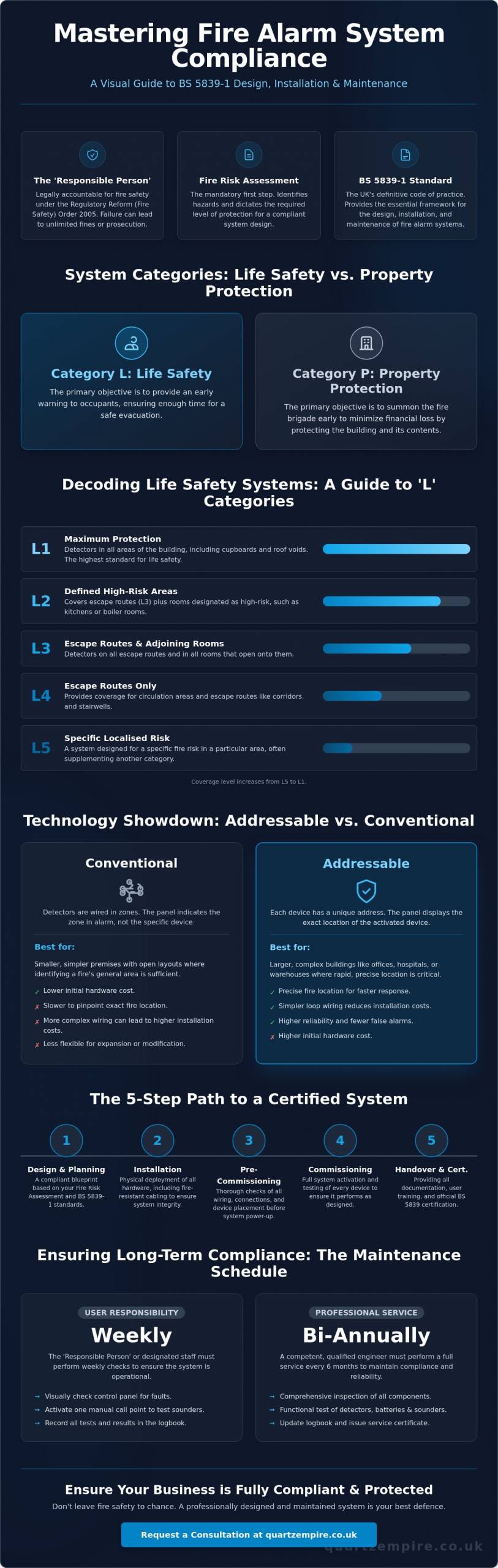
BS 5839-1:2025 serves as the definitive code of practice for fire detection in the UK. It provides the essential framework for every fire alarm system design and installation, ensuring that the technology used is appropriate for the building's specific risks. While global benchmarks such as the OSHA fire detection system standards emphasize general workplace safety, the British Standard focuses on specific categories of protection tailored to building use. These categories are split into Property (P) and Life (L) systems. A Category P system aims to minimize financial loss by protecting the building and its contents, whereas a Category L system focuses on providing early warning to occupants to facilitate safe evacuation.
Effective design also relies on strategic zoning. Large or complex buildings must be divided into manageable detection zones. This allows responding Fire and Rescue Services to identify the fire's location instantly upon arrival. This level of clarity is essential for commercial sites across London and Kent, where dense urban layouts or sprawling industrial estates demand precise information during an emergency. Proper zoning prevents confusion and significantly reduces response times.
Deciphering System Categories (L1, L2, L3, L4, L5)
System categories range from L1 to L5 based on the level of coverage provided. L1 represents the highest level of life safety, with detectors installed in all areas of the building, including cupboards and roof spaces. L2 systems protect escape routes and high-risk rooms, while L3 focuses on escape routes and any rooms opening onto them. L4 systems cover only the escape routes themselves. Finally, L5 is a bespoke category designed to meet unique fire safety objectives identified in a risk assessment. Your insurance provider will typically specify which category is required to maintain your policy coverage.
The Importance of a Professional Site Survey
A professional site survey is the only way to determine the correct placement of sensors and sounders during the fire alarm system design and installation process. This survey accounts for building occupancy, structural layout, and ambient noise levels. In industrial environments, high noise levels often require more powerful sounders or visual beacons to ensure the alarm is recognized. We also prioritize false alarm management at this stage. By selecting multi-sensor detectors that distinguish between real threats and environmental factors like steam or dust, we ensure system reliability. If you need clarity on your building's specific requirements, we can assist with a professional fire risk assessment to define your safety objectives.
Choosing the Right Technology: Addressable vs. Conventional
Selecting the appropriate technology is a pivotal decision in fire alarm system design and installation. For small commercial premises like independent shops or single-room offices, conventional systems provide a cost-effective and dependable solution. These systems use radial wiring to group detectors into broad zones. When a detector activates, the control panel identifies the zone but doesn't specify the exact room. While this is sufficient for simple layouts, larger or more complex environments require the precision of addressable technology.
Modern systems often function as a central component within a wider network of security systems. They can integrate with access control to release fire doors automatically or with CCTV to provide visual verification of an alarm. When planning these integrations, following established NFPA smoke alarm installation guidelines ensures that every component is positioned for maximum detection speed. Addressable systems excel here by providing "point identification," which tells the operator exactly which individual detector has been triggered. This level of detail is vital for large-scale operations where every second counts.
Addressable Systems for Complex Premises
Addressable systems utilize a loop configuration where a single cable connects all devices back to the control panel. This design significantly reduces the volume of cabling required compared to conventional setups. For multi-storey blocks or sprawling warehouses, it simplifies the fire alarm installation process and reduces material costs. The control panel communicates with each individual device, allowing for sophisticated cause-and-effect programming. This enables phased evacuation strategies, where only the areas at immediate risk are alerted first, preventing dangerous bottlenecks in stairwells.
Wireless Fire Alarms: The London Solution
London's architectural landscape often features historic or listed buildings where invasive cabling isn't permitted. Wireless fire alarms provide a sophisticated alternative that bypasses the need for extensive wiring through walls and ceilings. Modern wireless systems must be EN 54-25 compliant to ensure signal reliability and resistance to radio interference. These systems are incredibly fast to deploy. Since there's no need to lift floorboards or chase walls, business disruption is kept to an absolute minimum. It's a clean, efficient way to achieve full compliance without altering the building's aesthetic or structural integrity.
The Installation and Commissioning Process
A professional fire alarm system design and installation project follows a strictly defined five-step path: First Fix, Second Fix, Testing, Commissioning, and Handover. During the First Fix, we install the infrastructure using high-performance fire-resistant cabling like FP200. This specialized wiring is essential because it maintains circuit integrity during a fire, ensuring detectors and sounders continue to function under extreme heat. The Second Fix involves the physical mounting of detectors, call points, and the control panel itself. We ensure every component is positioned exactly as specified in the design phase to provide the coverage your risk assessment demands.
The transition from a blueprint to a live system requires meticulous attention to detail. Our engineers focus on the structural integrity of every connection to prevent future faults or system downtime. If you are ready to secure your premises with a compliant system, our team can help you manage the entire fire alarm installation process from start to finish.
Rigorous Testing and Commissioning
Once all hardware is mounted, the system enters a critical testing phase. We implement a "soak period" to monitor the system for stability and identify any intermittent faults before it officially goes live. This period helps us ensure that the environment doesn't trigger false alarms. Our engineers meticulously measure decibel levels across all areas to confirm the alarm is audible in every room, even in high-noise industrial settings. We also verify the battery backup duration to ensure the system remains operational during a total power failure. The Commissioning Certificate is your primary proof of compliance, confirming the installation meets all BS 5839-1 standards.
Handover and Staff Training
The final handover includes the delivery of the Fire Safety Log Book. The Responsible Person must use this document to record all future tests, faults, and professional maintenance visits. It's a vital part of your legal record-keeping duties. We provide comprehensive training for your designated Fire Marshals, teaching them how to operate the control panel and interpret specific fault codes. This knowledge is vital. It allows your team to respond effectively to real threats while managing day-to-day system status. We also verify that the system integrates correctly with other safety features. For example, the panel must trigger the release of emergency exits, which is a critical function of modern access control systems.
Maintenance: Ensuring Long-Term Compliance
The successful completion of your fire alarm system design and installation is only the start of your safety journey. UK law, specifically BS 5839-1, mandates that commercial fire systems undergo professional servicing at least every six months. This bi-annual requirement ensures that every component remains in peak condition and that the system hasn't been compromised by building changes or environmental wear. While professional visits are essential, the Responsible Person must also conduct weekly user tests. These tests involve activating a manual call point to confirm the panel recognizes the signal and the sounders activate correctly.
A structured maintenance contract provides a foundation of trust and long-term reliability. It ensures that any faults are addressed promptly, preventing the system from becoming a liability. When evaluating providers, businesses should prioritize those who offer rapid response times to minimize protection gaps. Quartz Empire Fire & Security Ltd acts as a collaborative partner for your long-term safety needs, ensuring your documentation remains audit-ready and your premises stay protected at all times.
The 6-Month Service: What is Involved?
During a professional 6-month service, a qualified engineer performs a comprehensive inspection of every detector, call point, and sounder on the loop. We don't just check if they work; we verify their sensitivity and structural integrity. A critical part of this visit is checking the battery standby capacity. Batteries must be able to power the system for the required duration during a mains failure, typically 24 hours plus a dedicated period of alarm. We meticulously record all results in the fire safety log book, providing the evidence needed for fire authority inspections and insurance renewals.
Why a Local South East Provider Matters
Choosing a local provider for your safety needs offers distinct advantages for businesses across London and Kent. Proximity allows for rapid response times when technical faults arise, minimizing the period your building is left without full protection. Local experts also possess a deep understanding of the specific requirements set out by regional fire authorities. This specialized knowledge ensures that your fire alarm system design and installation remains compliant with both national standards and local nuances. If you're looking for a steadfast partner to manage your safety requirements, contact Quartz Empire Fire & Security Ltd today for a bespoke design consultation tailored to your specific commercial site.
Securing Your Business for the Future
Navigating the technical requirements of BS 5839-1:2025 doesn't have to be a source of stress. Effective safety is built on a foundation of strategic fire alarm system design and installation that balances regulatory rigour with your specific operational needs. By selecting the correct system category and ensuring a rigorous commissioning process, you protect your staff and preserve your commercial insurance validity. Compliance is an ongoing commitment. It requires both weekly user checks and professional bi-annual servicing to maintain long-term reliability and system integrity.
Our team of CHAS-approved engineers at Quartz Empire Fire & Security Ltd specializes in protecting commercial properties across London and Kent. We deliver solutions that meet BAFE-compliant standards, providing you with the official documentation needed to prove your commitment to life safety. Partnering with a local expert ensures you have a dependable collaborator for every stage of your fire safety journey. Secure your business today with a professional fire alarm design and installation quote. We're ready to help you build a safer and more stable environment for your team and your assets.
Frequently Asked Questions
How often should a commercial fire alarm system be serviced in the UK?
Commercial fire alarm systems must be professionally serviced at least every six months to remain compliant with BS 5839-1 standards. This bi-annual inspection ensures all components function as intended during an emergency. In addition to these professional visits, the building's Responsible Person is required to conduct and record weekly user tests. Regular maintenance prevents system degradation and provides essential evidence for insurance and fire authority audits.
Do I need a fire alarm system if I only have a small office?
Most small offices require a fire alarm system to meet the requirements of the Regulatory Reform (Fire Safety) Order 2005. Even if your premises are modest, a fire risk assessment will typically dictate that a formal means of detection and warning is necessary. For very small units with simple layouts, manual interlinked alarms might suffice, but professional fire alarm system design and installation ensures you meet all legal obligations.
What is the difference between a L1 and L2 fire alarm system?
The primary difference lies in the extent of coverage provided for life safety. A Category L1 system offers maximum protection with detectors installed in all areas of the building, including roof voids and cupboards. A Category L2 system focuses on protecting escape routes and rooms identified as high-risk. Your specific category is determined by a professional risk assessment and is often dictated by your building's insurer to ensure adequate protection.
Can I install my own fire alarm system in a business premises?
You shouldn't install your own fire alarm system in a business premises. UK legislation requires that fire alarm system design and installation be carried out by a "competent person" with the necessary technical knowledge and experience. Self-installation often leads to non-compliance, which can result in criminal prosecution or the voiding of your commercial insurance policy. Professional certification is the only way to prove the system's legitimacy and safety.
What is a fire alarm commissioning certificate and why do I need it?
A fire alarm commissioning certificate is an official document that confirms your system has been tested and meets all BS 5839-1 requirements. You need this document to demonstrate compliance to fire authorities and insurance providers. It serves as your primary evidence that the system was installed correctly and is fully operational. Without this certificate, you may face legal challenges and difficulties during safety audits or future property transactions.
How long does a fire alarm installation typically take?
The duration of an installation depends entirely on the size and complexity of your building. A small retail unit might be completed within one to three days, while large multi-storey offices or industrial sites can take several weeks. We prioritize minimizing business disruption by planning the project stages carefully. Using wireless technology can significantly reduce these timelines, as it removes the need for extensive structural cabling and Associated remedial work.
What happens if my fire alarm system has a fault in the middle of the night?
If your system develops a fault outside of standard hours, a maintenance contract ensures you have access to professional support. While we don't claim specific response times, having a dedicated partner means you can receive guidance on silencing the panel or arranging a site visit. Addressing faults immediately is vital to ensure the building remains protected. You should check your specific maintenance agreement for details on emergency call-out procedures and engineer availability.
Are wireless fire alarm systems as reliable as wired ones?
Modern wireless fire alarm systems are just as reliable as wired ones, provided they are EN 54-25 compliant. These systems use sophisticated radio frequencies to communicate, ensuring signals bypass interference and maintain a constant connection. They are particularly beneficial for historic or listed buildings where cabling is restricted. Wireless technology offers the same level of safety and monitoring as traditional systems while providing a faster, less invasive installation process.