
Fire Alarm Panel Troubleshooting: A Professional Guide for UK Businesses

That persistent beep on your fire alarm panel isn't just an office annoyance; it's a legal liability that could result in unlimited fines under the Regulatory Reform (Fire Safety) Order 2005. It's understandable to feel frustrated when you need to perform fire alarm panel troubleshooting while managing a busy workplace, especially when you're unsure if the system will perform during a real emergency. Ignoring these signals doesn't just put your staff at risk, it can also invalidate your insurance coverage.
Effective troubleshooting is a critical compliance task that ensures your premises remain safe and fully aligned with the BS 5839-1:2025 standards that came into effect on April 30, 2025. This guide will help you decode common fault lights and understand what they mean for your building's safety. We'll show you how to handle minor issues safely and clarify the specific moments when you must call a certified engineer to avoid the risk of a two year prison sentence for serious safety breaches. By taking a proactive approach, you can maintain a reliable system that offers genuine peace of mind for everyone in your building.
Key Takeaways
- Distinguish between yellow fault indicators and red alarm lights to ensure your team reacts correctly during a system malfunction.
- Execute a structured fire alarm panel troubleshooting process to identify common issues like battery failures or ground faults.
- Define your legal responsibilities by learning which tasks a "Competent Person" can perform and when a certified engineer must be called for compliance.
- Follow a professional step-by-step protocol to safely silence panel buzzers while maintaining accurate records in your fire logbook.
- Understand the BS 5839-1:2025 requirements for six-monthly inspections to reduce false alarms and protect your insurance validity.
Understanding Your Fire Alarm Panel: Trouble vs. Alarm States
Every commercial building relies on a central hub to manage its life safety infrastructure. The Fire alarm control panel (FACP) acts as this hub; it continuously scans your premises for signs of smoke, heat, or internal system failure. When the panel begins to beep or illuminate, it's communicating a specific status that requires your immediate attention. Understanding these signals is the foundation of effective fire alarm panel troubleshooting and is essential for maintaining a safe workplace.
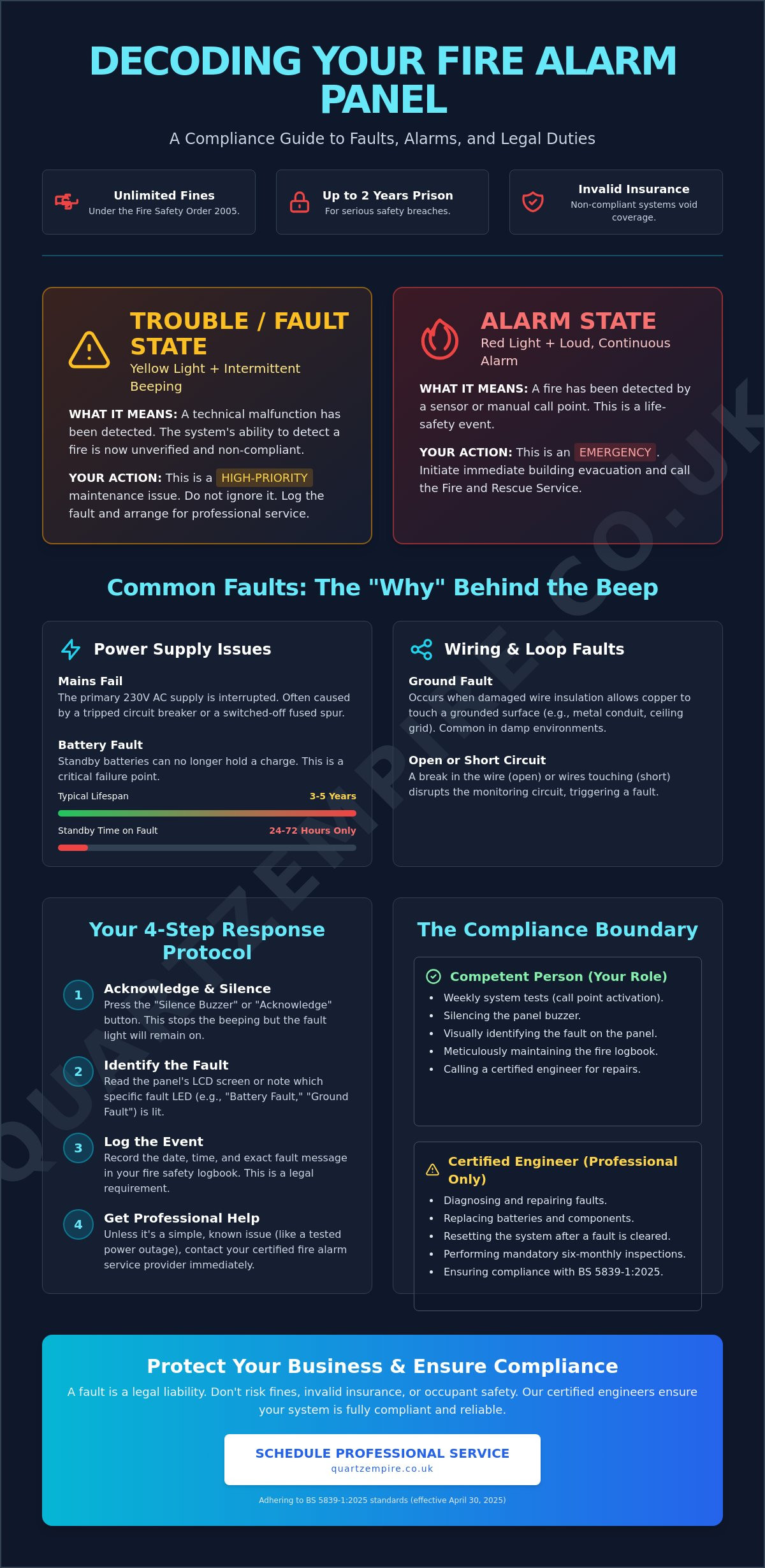
A "Trouble" or "Fault" state indicates that while the system remains operational, it has identified a monitored malfunction within its circuitry. This is fundamentally different from an "Alarm" state. While a red light signals an active fire, yellow or amber lights signify a technical flaw that needs fixing. These visual indicators are paired with an internal buzzer designed to demand attention to the system's compromised state. You can't afford to overlook these warnings. Under the BS 5839-1:2025 standards, any system in a fault state is considered non-compliant. This lack of compliance can lead to serious legal consequences, including the unlimited fines and potential imprisonment discussed in the introduction.
The "Trouble" Light: What is it telling you?
The internal monitoring circuit of your panel constantly checks for electrical continuity across every connected loop. When this circuit is interrupted, perhaps by a loose connection or a failing component, the yellow "Trouble" light activates. This signal differs from a "Supervisory" signal, which typically monitors the status of related safety equipment, such as a closed valve in a sprinkler system. You should never ignore a yellow light, even if the building seems perfectly safe. A fault light means the system's ability to detect a fire is currently unverified. Fire alarm panel troubleshooting ensures that these "minor" electrical issues don't lead to a total system failure when you need protection most.
The "Fire" Light: Immediate Action Required
When the red "Fire" indicator illuminates, the panel has received a confirmed signal from a smoke detector, heat sensor, or manual call point. This is not a maintenance issue; it's a life safety event. Your established fire safety protocol must begin the moment that red light appears. This involves a full building evacuation and immediate notification of the local Fire and Rescue Service. Distinguishing between these two states is a vital skill for any facility manager or business owner. A "Trouble" state is a non-emergency but high-priority maintenance requirement that must be logged and resolved to maintain your legal standing and insurance validity.
Common Fire Alarm Faults: A Deep Dive into the Causes
Identifying the root cause is the next critical stage of fire alarm panel troubleshooting once you've recognized a trouble light. Most faults fall into three distinct categories: power supply issues, wiring loop failures, or individual device malfunctions. Each requires a different level of technical response to ensure your building remains safe and aligned with your UK government fire safety responsibilities. Understanding these technical nuances allows you to provide accurate information when reporting a fault to your service provider.
Battery and Power Supply Issues
Your system relies on two power sources to remain operational. A "Mains Fail" signal indicates that the primary 230V AC supply has been interrupted. This is frequently caused by a tripped circuit breaker or someone accidentally turning off the dedicated fused spur. In contrast, a "Battery Fault" usually means the standby power supply is no longer capable of holding a sufficient charge. Fire alarm batteries have a finite lifespan, typically failing after 3 to 5 years of service. Running a system solely on backup batteries is a high-risk strategy; most batteries only provide 24 to 72 hours of standby time before the entire system shuts down. Regular fire alarm maintenance ensures these batteries are tested and replaced before they reach the point of failure.
Wiring and Loop Faults
Wiring issues are often more complex to diagnose because the cables are hidden within the building's structure. Ground faults occur when a wire's insulation is damaged, allowing the copper to touch a grounded metal surface like a conduit or a ceiling grid. This is a common issue in damp environments, such as older London basements, where moisture can compromise cable integrity over time. Other common loop issues include:
- Open Circuits: A physical break in the wiring loop. This prevents the panel from communicating with any detectors located "after" the break, effectively creating a blind spot in your fire detection.
- Short Circuits: These occur when two wires in the loop touch each other. Depending on the system design, a short circuit can potentially disable an entire loop of detectors, leaving large areas of your premises unprotected.
Device malfunctions also contribute to system downtime. Dirty smoke detectors are a primary cause of intermittent faults, as dust accumulation can interfere with the optical sensor's calibration. Additionally, issues with end-of-line resistors, which are small components used to monitor the integrity of conventional circuits, can trigger persistent fault lights if they become loose or damaged. Addressing these technical flaws promptly is the only way to ensure your system provides the reliable protection your business requires.
User Actions vs. Professional Intervention: The Compliance Boundary
UK fire safety legislation distinguishes between day-to-day management and technical maintenance. Under the Regulatory Reform (Fire Safety) Order 2005, the "Responsible Person" must appoint a "Competent Person" to oversee the system. While a facility manager often fills this role, their authority ends at the panel's interface. Performing advanced fire alarm panel troubleshooting that involves opening the cabinet or altering wiring is strictly reserved for certified professionals. Crossing this boundary doesn't just risk damaging expensive equipment; it can lead to personal liability if the system fails to activate during a blaze.
One of the most dangerous habits in building management is resetting a panel without a thorough investigation. A "Reset" command clears the fault from the display but doesn't fix the underlying issue. If you haven't identified why the system flagged a fault, you're effectively flying blind. Following official guidance on investigating a fire alarm is essential before you attempt to clear any status lights. Ignoring a persistent fault light can invalidate your insurance and leave your premises unprotected.
Safe Troubleshooting for Site Managers
Your primary role when a fault occurs is to manage the immediate situation and gather data for the engineer. You're legally permitted to use the "Silence Buzzer" button to stop the internal noise, which allows for clearer communication during the incident. This action doesn't disable the system; it simply mutes the local sounder while the fault remains active on the display. Once the noise is muted, perform a visual inspection of all manual call points and detectors in the affected zone to check for obvious damage or obstructions. Always consult your fire alarm logbook to see if the same zone has triggered recurring issues, as this data is invaluable for professional diagnostics during fire alarm panel troubleshooting.
When to Call a BAFE-Accredited Engineer
If a fault persists after you've followed the basic silence protocol, you must contact an expert. Internal component failures, "System Fault" messages, or flickering LCD screens indicate issues that require specialized diagnostic tools. A BAFE-accredited engineer has the specific training to handle complex repairs that go beyond simple maintenance. For new sites or major upgrades, ensuring a professional fire alarm installation is the best way to prevent these technical headaches from the start. Any fault that remains active for more than 24 hours must be reported to your service provider, as prolonged downtime leaves your business vulnerable and non-compliant with BS 5839-1 standards.
Step-by-Step Response: What to Do When Your Panel Beeps
A beeping fire alarm panel is a call to action that requires a calm, methodical response. Your immediate priority is to stabilize the situation while gathering the data necessary for a professional repair. By following a structured process, you ensure that your fire alarm panel troubleshooting is both effective and legally compliant. This sequence of actions protects your staff and keeps your documentation ready for any future fire service inspection.
Your first step is to identify the specific message on the LCD display or the LED indicators. Once you've noted the information, use the "Silence Internal Buzzer" button. This allows for clear communication with your team and reduces the stress of the situation without disabling the system's detection capabilities. Next, record the exact fault message and the precise time of the occurrence in your fire alarm logbook. You must then assess whether the fault is critical, meaning the entire system is offline, or non-critical, such as a single device fault. Finally, contact your maintenance provider to arrange a priority call-out based on the severity of the issue.
Interpreting LCD Display Messages
Modern addressable systems provide detailed feedback through their digital screens. You might see messages like "Zone Fault," which points to a specific area, or "Sounder Fault," indicating an issue with the alarm sirens. "Comm Fail" suggests a break in communication between the panel and its devices. The LCD message is the primary diagnostic tool for engineers when they arrive on-site. Always use your building's zone chart to map these digital messages to physical locations. This helps you determine if a specific environment, like a dusty warehouse or a damp basement, is causing the problem.
Maintaining the Fire Alarm Logbook
The fire alarm logbook isn't just a notebook; it's a legal document required by fire inspectors under the Regulatory Reform (Fire Safety) Order 2005. Every entry must be date-stamped and signed by the person who performed the check. Accurate fault logging significantly reduces complications during your next fire risk assessment. It provides a clear history of system performance and proves that you're fulfilling your duties as a responsible person. If you're currently dealing with a persistent fault, you can book a professional service visit to restore your system's integrity and compliance today.
Preventing Faults with Professional Servicing and Maintenance
Professional servicing is the most effective way to minimize the need for emergency fire alarm panel troubleshooting. While the reactive steps outlined in this guide are essential for immediate safety, a proactive maintenance strategy prevents technical issues before they trigger a system fault. Regular inspections identify degrading components, such as aging batteries or loose wiring connections, that often lead to the persistent beeping and false alarms that disrupt your business operations. A well-maintained system is a reliable system, providing the peace of mind that your property and people are truly protected.
The current British Standard, BS 5839-1:2025, mandates that commercial fire detection systems undergo professional inspections at least every six months. These biannual checks go far beyond the weekly testing performed by site managers. An accredited engineer will test every smoke detector, heat sensor, and manual call point to ensure the entire loop communicates correctly with the panel. Quartz Empire provides a no-nonsense approach to fire safety for businesses across Kent, London, and the South East. Our team focuses on clear communication and straightforward pricing, ensuring your building remains fully compliant without the stress of hidden costs or technical jargon.
The Benefits of a Maintenance Contract
Securing a maintenance contract offers significant operational advantages over ad-hoc repairs. Contract holders receive priority emergency response for fault resolution, providing 24/7 coverage when a system failure occurs outside of normal business hours. This rapid support is vital for maintaining compliance and keeping your insurance valid. Furthermore, a contract allows for the seamless integration of your fire detection with other security systems, creating a unified safety infrastructure for your premises. Proactive component replacement, such as installing fresh batteries every four years, extends the overall life of your equipment and prevents the "Mains Fail" or "Battery Fault" signals that often require urgent fire alarm panel troubleshooting.
Quartz Empire: Your Trusted Fire Safety Partner
Quartz Empire is a dedicated specialist with deep local expertise in the commercial environments of London and Kent. We hold BAFE and SSAIB accreditations, which serve as a mark of our commitment to the highest industry standards. Our engineers are meticulously trained to handle complex addressable and conventional systems in diverse settings, from high-rise offices to industrial warehouses. We understand that fire safety is a serious responsibility, and we position ourselves as your trusted partner in maintaining a secure, compliant workplace. If your system is currently showing a fault or if you are due for a mandatory inspection, contact Quartz Empire today for fire alarm servicing and emergency repairs.
Secure Your Compliance and Protect Your Premises
Mastering fire alarm panel troubleshooting is about more than just silencing a buzzer; it's about maintaining the integrity of your life safety systems. You've learned that every yellow light represents a monitored malfunction that requires a logged response to satisfy BS 5839-1:2025 standards. Ignoring these signals risks unlimited fines and compromises the safety of everyone in your building. Whether you're dealing with a battery fault or a complex loop issue, the goal is always to restore full protection as quickly as possible. Professional oversight is the only way to ensure your system remains a reliable shield for your property.
As a BAFE and SSAIB accredited provider, Quartz Empire Fire & Security Ltd acts as your trusted partner across Kent, London, and the South East. We offer 24/7 emergency support for our maintenance clients to ensure your building never stays vulnerable. Don't leave your fire safety to chance or wait for a minor fault to become a major failure. Book Your Professional Fire Alarm Servicing in London & Kent to ensure your systems are reliable and fully compliant. Our team is ready to provide the expert care your business requires to operate with total peace of mind.
Frequently Asked Questions
Why is my fire alarm panel beeping every few seconds?
The beeping indicates that your system has identified a fault or trouble state. This internal buzzer is a deliberate alert designed to notify you that a component like the power supply, backup battery, or a specific detector loop isn't functioning correctly. It's a high priority maintenance alert that requires immediate investigation to ensure your building remains protected.
Can I change the fire alarm panel battery myself?
You shouldn't attempt to replace the battery yourself because it involves accessing the internal circuitry of the panel. Under UK fire safety legislation, only a competent and certified engineer should handle internal component replacements. A professional will also perform a full system test after the replacement to ensure the new battery is charging correctly and the system is fully compliant.
What does a "Ground Fault" mean on a fire alarm system?
A ground fault occurs when an electrical path is created between the system's wiring and the building's earth or a grounded metal surface. This is frequently caused by moisture ingress or damaged cable insulation. It's a common issue in damp environments like London basements and requires professional fire alarm panel troubleshooting to locate the specific point of the leak.
How do I silence a fire alarm fault buzzer without turning off the system?
You can stop the noise by pressing the "Silence Buzzer" or "Mute" button located on the front of the control panel. This action stops the audible annoyance while keeping the detection sensors active. You must never turn off the main power or disconnect the batteries to stop the noise, as this leaves your premises completely unprotected and in breach of the law.
Is it illegal to have a fire alarm system in a fault state?
Operating a building with a fire alarm in a persistent fault state is a breach of the Regulatory Reform (Fire Safety) Order 2005. A fault means your system is non-compliant and may not function during a real fire. Serious breaches of these regulations can result in unlimited fines and up to two years of imprisonment for the responsible person.
What should I do if my fire alarm panel says "System Fault"?
You must contact a BAFE-accredited engineer immediately when you see this message. A "System Fault" usually indicates a failure of the internal processor or the main motherboard, which is a critical error. This type of failure goes beyond basic fire alarm panel troubleshooting and often requires the replacement of core hardware to restore the building's safety infrastructure.
How often should a fire alarm panel be serviced by a professional?
The BS 5839-1:2025 standard requires that a professional inspection is carried out at least every six months. These biannual services ensure that all detectors, sounders, and power supplies are tested under load. Regular professional maintenance is the most effective way to prevent unexpected faults and ensure your insurance coverage remains valid for your commercial property.
Why does my fire alarm keep going off for no reason?
Unwanted fire signals are typically caused by environmental factors like dust, steam, or poorly positioned detectors. In many cases, an aging detector may have become overly sensitive due to a buildup of contaminants. Professional servicing can reduce these false alarms by up to 90% by cleaning sensors and ensuring the system is correctly calibrated for your specific workplace environment.