
Avoiding Non-Compliance Fire Safety Fines: A 2026 Guide for UK Businesses

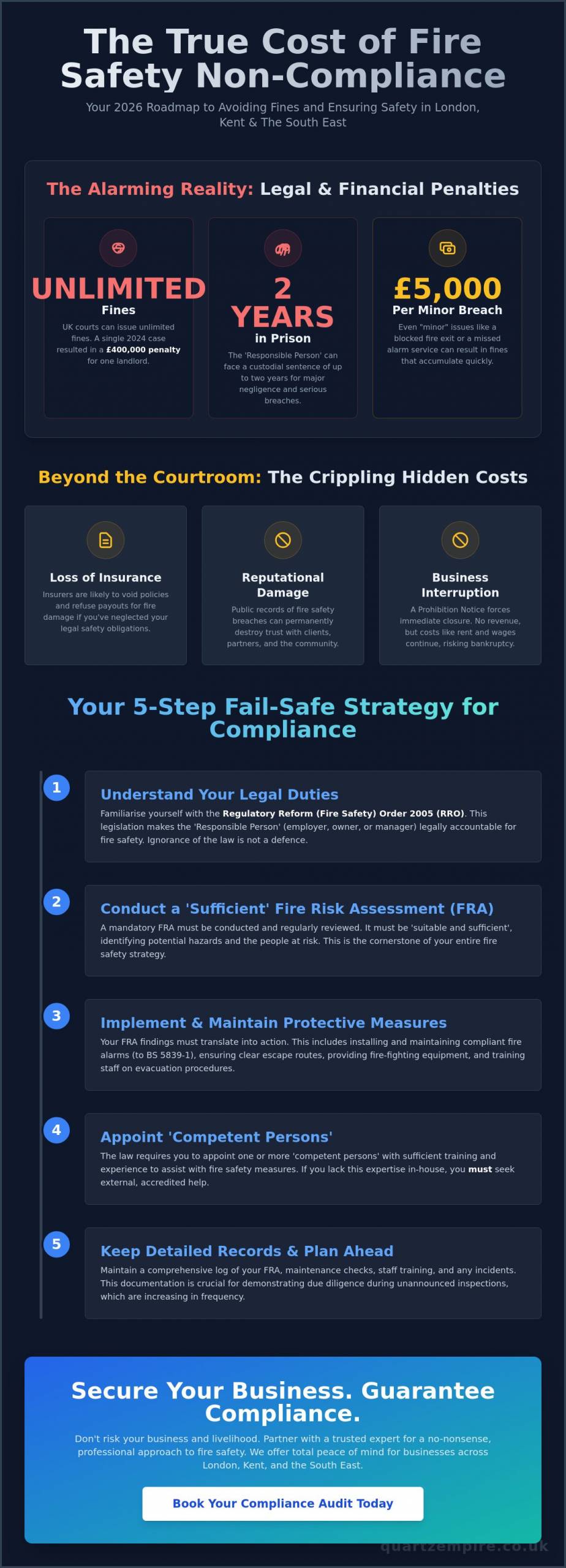
Did you know that UK courts now have the power to issue unlimited fines for fire safety breaches, with one 2024 case resulting in a £400,000 penalty for a single commercial landlord? Managing a property in London or the South East is a significant responsibility that carries heavy legal weight. It's natural to feel concerned about personal criminal liability or the complexity of the Fire Safety Act 2021. You want to protect your people and your assets, but avoiding non-compliance fire safety fines requires a meticulous approach that many busy managers struggle to maintain.
This guide provides a professional, no-nonsense roadmap for your business in 2026. As your trusted partner in safety, we'll show you how to navigate the latest regulations and implement a fail-safe strategy that offers total peace of mind during inspections. We'll explore the true cost of non-compliance and provide a clear schedule for fire safety maintenance to keep your business secure and accredited.
Key Takeaways
- Understand the severe legal and financial reality of the Regulatory Reform (Fire Safety) Order 2005, where non-compliance can lead to unlimited fines and prison sentences.
- Identify the specific legal duties of the 'Responsible Person' and the mandatory requirement for maintaining a 'suitable and sufficient' Fire Risk Assessment.
- Learn a fail-safe, five-step strategy for avoiding non-compliance fire safety fines by implementing accredited assessments and robust system maintenance contracts.
- Discover the critical differences between informal verbal advice and formal statutory notices to better navigate the fire safety inspection process.
- Explore how a trusted partner provides a no-nonsense approach to fire safety and commercial security for businesses across London, Kent, and the South East.
The Financial and Legal Reality of Fire Safety Non-Compliance
Fire safety non-compliance occurs when a business fails to meet the mandatory standards set out in the Regulatory Reform (Fire Safety) Order 2005. This legislation places the legal burden on the "Responsible Person" to ensure the premises are safe for employees, visitors, and residents. Failing this duty isn't just a matter of administrative oversight; it's a serious legal breach that carries heavy penalties. For major negligence, UK courts now regularly impose unlimited fines and can sentence the Responsible Person to up to two years in prison.
Even minor infractions can have a devastating impact on your bottom line. Minor breaches, such as a blocked fire exit or a missed annual alarm service, often result in fines of up to £5,000 per violation. These penalties accumulate quickly if an inspector identifies multiple issues during a single visit. Taking a professional approach to your premises is the only reliable method for avoiding non-compliance fire safety fines in the current regulatory climate.
The financial damage extends far beyond the initial court appearance. Non-compliance often leads to:
- Loss of Insurance Coverage: Most commercial insurers won't pay out for fire damage if they find you've neglected your legal safety obligations.
- Reputational Damage: Public records of fire safety breaches can destroy trust with clients and partners.
- Business Interruption: Legal proceedings and forced remedial works can stop your operations for weeks or months.
Recent Changes in Fire Safety Enforcement for 2026
In 2026, Fire and Rescue Authorities have increased the frequency of unannounced inspections across Kent, London, and the South East. This follows the tightening of the Fire Safety (England) Regulations 2022, which introduced stricter requirements for multi-occupied residential and commercial buildings. Judges have made it clear that "ignorance of the law" is no longer a valid defence. Business owners are expected to be meticulous and proactive, as the courts now prioritise public safety over "reasonable excuses" for oversight.
The True Cost of a Prohibition Notice
A Prohibition Notice is the most severe non-monetary penalty because it legally mandates the immediate closure of a building until all fire safety risks are resolved. When an inspector issues this notice, your business operations stop instantly. You'll still be responsible for staff wages and rent, but you won't be able to generate any revenue. Regaining access to your property is a slow process that requires a full re-inspection and certified proof that every safety deficiency has been professionally rectified. This long-term financial drain can be enough to bankrupt a small to medium-sized enterprise.
The Regulatory Reform (Fire Safety) Order 2005: Your Legal Roadmap
The Regulatory Reform (Fire Safety) Order 2005, often called the RRO, is the central piece of legislation governing fire safety for all non-domestic premises in England and Wales. It shifted the legal burden from the fire service to the individual business owner. You're now responsible for your own fire safety strategy. To understand your full obligations, you should consult the official text of the Fire Safety Order. This law doesn't sit in isolation; it works alongside specific British Standards. For example, BS 5839-1 dictates the requirements for fire detection and alarm systems. If your equipment doesn't meet these certified standards, you're at high risk of failing a local authority inspection. Avoiding non-compliance fire safety fines requires a meticulous approach to these overlapping regulations.
Who is the 'Responsible Person' in Your Business?
The 'Responsible Person' (RP) is the individual who holds the legal duty to ensure the building is safe. In most cases, this is the employer. However, if you're a building owner or a facilities manager, the role might fall to you. In multi-tenanted buildings across Kent and London, responsibility is often shared. The landlord typically manages the common areas, while the tenant is responsible for their specific unit. Both parties must cooperate and coordinate their safety plans. The law also mandates that you appoint 'competent persons' to help you manage fire prevention. These are individuals with enough training and experience to handle technical tasks like alarm maintenance or evacuation planning. If you don't have this expertise in-house, you must seek external accredited support.
The Role of Fire Risk Assessments in Avoiding Fines
A 'suitable and sufficient' Fire Risk Assessment (FRA) is the foundation of your fire safety strategy. It's the very first document a fire safety officer will demand to see. Since the Section 156 updates of the Building Safety Act 2022 took effect in October 2023, all businesses must now record their full FRA in writing, regardless of their size or number of employees. An outdated or incomplete FRA is a primary reason for enforcement notices. You should review your assessment at least every 12 months. You also need to update it immediately if you change your building's layout, change your work processes, or significantly increase your staff count. Investing in professional fire risk assessment services ensures your documentation is accurate and legally robust. This proactive step is the most effective way of avoiding non-compliance fire safety fines while protecting your people. Our team can act as your trusted partner to ensure your site remains fully compliant throughout the year.
Enforcement Notices vs. Fines: Understanding the Escalation
Fire safety officers generally prefer cooperation over litigation. During a routine inspection, an officer might start with informal verbal advice for minor issues like a missing sign or a slightly dusty detector. However, if the risk is significant or previous advice was ignored, they'll move to formal statutory notices. Understanding this hierarchy is the first step toward avoiding non-compliance fire safety fines. Most inspections follow a structured timeline: the initial site visit, the identification of deficiencies, and the delivery of a written report or notice, typically within 14 days of the visit.
Types of Fire Safety Notices Explained
- Alterations Notice: If your building has high-risk features or you plan complex structural changes, the authority issues this. It requires you to notify them before making any modifications. Failing to act on this notice leads directly to prosecution.
- Enforcement Notice: This identifies specific breaches of the Regulatory Reform (Fire Safety) Order 2005. You'll receive a clear deadline to fix these issues. It's a formal warning that legal action is the next step.
- Prohibition Notice: This is the most serious tool available. It's issued when an inspector finds an "imminent risk of death or serious injury." It can shut down your premises immediately until the risk is removed.
You can find more details on these legal obligations and how to manage them in the official government guidance on fire safety.
How Fines are Calculated in UK Courts
Since the 2015 Sentencing Council guidelines, UK courts calculate fines based on three main factors: culpability, the level of harm risked, and business turnover. Culpability ranges from "minor" failings to "flagrant disregard" for the law. The court ensures the penalty is "proportional" to the company's size. For a "large" company with a turnover exceeding £50 million, fines can easily reach six or seven figures for serious breaches. In 2023, a major UK retailer faced a £400,000 fine for blocked fire exits, proving that judges prioritize safety over profit margins.
Completing remedial works before your court date won't stop a prosecution if the initial breach was severe. It does, however, act as a mitigating factor that can significantly reduce the final penalty. If you disagree with an inspector's decision, you have a 21-day window to appeal to the local magistrates' court. This pauses an Enforcement Notice, but it rarely stops a Prohibition Notice due to the immediate risk involved. Working with an accredited partner ensures your systems meet the required standards before an inspector arrives. This proactive stance is the most reliable method for avoiding non-compliance fire safety fines across Kent, London, and the South East.
5 Essential Steps to Avoid Fire Safety Fines
To succeed in avoiding non-compliance fire safety fines, you must move beyond a simple checklist mentality. Since the implementation of Section 156 of the Building Safety Act 2022, the requirements for recording fire safety information have become significantly stricter. By 2026, the Fire and Rescue Service (FRS) expects every business to provide a digital or physical paper trail for every safety action taken. Start by commissioning a Fire Risk Assessment from an accredited professional. You can't rely on "generic" templates; your assessment must be specific to your premises and its unique hazards.
Address any identified remedial works immediately. If a report flags a faulty fire door or an obstructed escape route, don't wait for your next budget cycle. Inspectors view outstanding remedial actions as a sign of negligence, which often leads to formal enforcement notices. Keeping a meticulous Fire Logbook is your best defence during a spot check. This document should record every test, signature, and finding. If it isn't written down with a timestamp, the FRS considers it undone.
Prioritising Fire Alarm and Security System Maintenance
Reliable fire alarm servicing isn't just a recommendation, it's a legal obligation under BS 5839-1. You're responsible for performing weekly tests to confirm the system activates. However, a certified technician must conduct professional inspections every six months to check battery health and sensor sensitivity. We often integrate fire systems with CCTV and access control to enhance site safety. This ensures that in the event of an alarm, access gates automatically release, while cameras provide real-time visual confirmation of the incident. This integrated approach provides the peace of mind that your property is protected 24/7.
The Importance of Fire Extinguisher Servicing
Equipping your premises with the correct fire extinguisher types is the first step toward a compliant workplace. Whether you manage a kitchen with F-class risks or an office with electrical hazards, your equipment must match the environment. BS 5306-3 mandates annual servicing by a competent person. Common pitfalls that trigger fines include blocked extinguishers, missing ID signage, or failing to perform the five-year extended service pressure test. Ensure your extinguishers are visible, accessible, and clearly marked to avoid unnecessary penalties during an inspection.
Staff training is the final pillar of safety. Ensure your team receives regular Fire Marshal Training and participates in evacuation drills at least twice a year. Document these drills in your logbook, noting the evacuation time and any difficulties faced. When your staff knows exactly how to respond, you reduce the risk of injury and demonstrate to authorities that you're a responsible, compliant employer. Taking these steps ensures your business stays on the right side of the law while protecting your most valuable assets.
Ensure your business meets every legal requirement with our expert help. Book your professional fire safety assessment today to protect your team and your bottom line.
Partnering with Quartz Empire for Guaranteed Compliance
Quartz Empire Fire & Security Ltd delivers a straightforward, no-nonsense approach to commercial safety. We understand that for businesses in London, Kent, and the South East, fire safety isn't just a box-ticking exercise; it's a critical legal obligation. Our team supports you through every stage of the process, from initial system design and installation to comprehensive 24/7 maintenance contracts. By partnering with us, you gain access to an accredited team that acts as your "competent person," fulfilling the requirements of the Regulatory Reform (Fire Safety) Order 2005. This expertise is essential for avoiding non-compliance fire safety fines that can easily exceed £40,000 for serious breaches.
Our engineers are available around the clock because fire safety issues don't follow a nine-to-five schedule. We provide a reliable safety net for facilities managers and business owners, ensuring that your property remains protected and your legal standing remains secure. Whether you operate a single site or a multi-location portfolio, our local expertise across the South East ensures a rapid response and a personal touch that larger national firms often lack.
Why Accreditation Matters for Your Legal Defence
Using certified installers is your best line of defence if a fire officer visits or a legal dispute arises. Quartz Empire adheres strictly to British Standards, including BS 5839-1 for fire detection and alarm systems. This commitment ensures that your "due diligence" is documented and verifiable in a court of law. We provide a clear audit trail of maintenance logs, commissioning certificates, and system reports. If the authorities request proof of compliance, you'll have a complete digital and physical record ready for inspection. Professional accreditation isn't just about quality; it's about proving you've taken every reasonable step to protect your staff and premises.
Get a Compliance Health Check Today
Don't wait for a fire brigade inspection to find out your systems are inadequate. A proactive site survey identifies vulnerabilities before they become expensive liabilities. We create customised maintenance packages tailored to your specific building layout and business operations. Whether you manage a retail unit in Maidstone or a high-rise office in Central London, our solutions scale to your specific needs. Take the first step toward total peace of mind. You can protect your business and book a consultation with our expert team today to ensure your premises remain safe and fully compliant throughout 2026 and beyond.
Future-Proof Your Business Against Fire Safety Risks
The Regulatory Reform (Fire Safety) Order 2005 remains the definitive legal roadmap for UK business owners. As we look toward 2026, the financial stakes are higher than ever. Local fire authorities now have the power to issue unlimited fines for serious breaches, making proactive maintenance a commercial necessity rather than a choice. You've seen how enforcement notices quickly escalate into costly legal battles. By following the five essential steps outlined, including regular risk assessments and staff training, you protect both your workforce and your bottom line.
Successfully avoiding non-compliance fire safety fines requires a meticulous, accredited approach to system maintenance. Quartz Empire provides this peace of mind. As accredited and certified fire safety experts, we're a trusted partner for London and Kent businesses. We bring a no-nonsense approach to customer service, ensuring your alarms and access systems meet every legal standard without the stress of navigating complex regulations alone.
Secure your premises and avoid fines with Quartz Empire's expert maintenance services
Your safety is our priority, and we're ready to help you stay compliant and secure.
Frequently Asked Questions
How much are fire safety fines for UK businesses in 2026?
Fire safety fines for UK businesses are now unlimited for serious breaches of the Regulatory Reform (Fire Safety) Order 2005. While minor summary convictions in a Magistrates' Court can reach £5,000 per offence, major cases heard in Crown Court result in uncapped financial penalties. In 2024, several UK companies faced fines exceeding £400,000 for systemic safety failures. These escalating costs make avoiding non-compliance fire safety fines a critical financial priority for every director.
Can a business owner go to prison for fire safety breaches?
Yes, business owners and designated Responsible Persons can face up to two years in prison for serious fire safety violations. Custodial sentences are typically handed down for cases involving "reckless" or "deliberate" disregard for safety where lives were put at risk. Between 2010 and 2024, numerous UK landlords and directors received immediate prison sentences for failing to provide adequate escape routes or working fire alarms. It's a personal liability that can't be ignored.
What is the most common reason for a fire safety fine?
The most common reason for a fire safety fine is the failure to maintain clear escape routes and functional fire doors. Inspectors frequently issue penalties when they find fire exits blocked by stock or fire doors wedged open with extinguishers. According to Home Office data from 2023, these "housekeeping" failures account for a high percentage of enforcement notices. Neglecting your Fire Risk Assessment is another major trigger for prosecution and heavy financial penalties.
How often should a business conduct a fire risk assessment to stay compliant?
You should review your fire risk assessment at least once every 12 months to ensure it remains valid and accurate. While the law doesn't state a specific timeframe, it requires the assessment to be "regularly reviewed" and updated if the building's layout or purpose changes. If you hire new staff or renovate your premises, you must update the document immediately. Staying on this schedule is essential for avoiding non-compliance fire safety fines and protecting your team.
What happens if I ignore an enforcement notice from the fire service?
Ignoring an enforcement notice is a criminal offence that leads directly to prosecution and the potential closure of your premises. If a Fire and Rescue Service inspector finds deficiencies, they'll issue a notice with a specific deadline for repairs. Failing to act by this date usually results in a Prohibition Notice, which stops you from using the building until it's safe. In 2023, several UK businesses were shut down immediately for ignoring these legal warnings.
Is a fire risk assessment legally required for small businesses with fewer than 5 employees?
Yes, every UK business must conduct a fire risk assessment, regardless of how many people they employ. As of 1 October 2023, Section 156 of the Building Safety Act 2022 removed the "five employee" rule. Now, all businesses must record their completed fire risk assessment and safety arrangements in full. You can't skip this step just because you have a small team or a single-room office. It's a universal legal requirement for all commercial premises.
Who is legally responsible for fire safety in a rented commercial building?
Responsibility is typically shared between the landlord and the business tenant, depending on the terms of your lease. The employer is usually the "Responsible Person" for the areas they occupy and must ensure daily safety for their staff. The landlord is generally responsible for structural elements and shared areas like communal stairwells. It's vital to check your specific rental agreement to see who's in charge of maintaining the fire alarm system and emergency lighting.
Can I do my own fire safety maintenance to save costs?
You can only perform maintenance if you're a "competent person" with the necessary training, tools, and industry knowledge. While staff can do weekly visual checks on extinguishers, the law requires annual servicing by an accredited professional. Using a certified partner ensures your equipment meets British Standards like BS 5839 for fire alarms. Cutting corners on professional servicing often leads to system failure, which invalidates your insurance and results in heavy fines during inspections.