
Fire Safety Training for Employees in London: The 2026 Compliance Guide

A single oversight in your fire evacuation plan can lead to unlimited fines and a two year prison sentence under the Regulatory Reform (Fire Safety) Order 2005. Ensuring your business provides comprehensive fire safety training for employees in London isn't just a box-ticking exercise; it's a critical legal mandate that protects lives and livelihoods in our capital's complex high-rise landscape.
We know that managing safety in shared London buildings is difficult, especially when you're dealing with high staff turnover and the pressure of 2026 compliance standards. You want to feel confident that your team knows exactly what to do when an alarm sounds, without the stress of deciphering dense legislative jargon.
This guide offers a no-nonsense roadmap to mastering these requirements, providing you with the practical steps needed to protect your London-based workforce and achieve total regulatory peace of mind. We'll examine the specific responsibilities of Fire Marshals, the frequency of required drills, and the exact certification your business needs to remain a trusted and compliant employer.
Key Takeaways
- Understand your legal obligations under the Regulatory Reform (Fire Safety) Order 2005 and the specific duties assigned to the designated "Responsible Person."
- Learn how to deliver compliant fire safety training for employees london, focusing on the four pillars of prevention, response, evacuation routes, and reporting.
- Navigate the complexities of managing fire safety in London's high-rise buildings and multi-tenanted commercial spaces to ensure total workforce protection.
- Establish a reliable training schedule that prioritizes day-one inductions for new starters and essential annual refresher drills for long-term staff.
- Discover how accredited, professional instruction from a trusted partner can simplify your compliance through a "no-nonsense" approach to staff awareness.
Legal Requirements for Employee Fire Safety Training in London
The Regulatory Reform (Fire Safety) Order 2005 serves as the primary legislation governing fire safety in England and Wales. This order moved the focus from fire certificates to a risk-based approach, placing the burden of safety directly on the business owner. To understand how these laws evolved from earlier acts, you can review the UK fire safety legislation history. For any business operating in the capital, providing professional fire safety training for employees london isn't just a best practice; it's a non-negotiable legal obligation. The London Fire Brigade (LFB) carries out thousands of inspections annually, and they prioritize high-density commercial hubs where the risk to life is greatest.
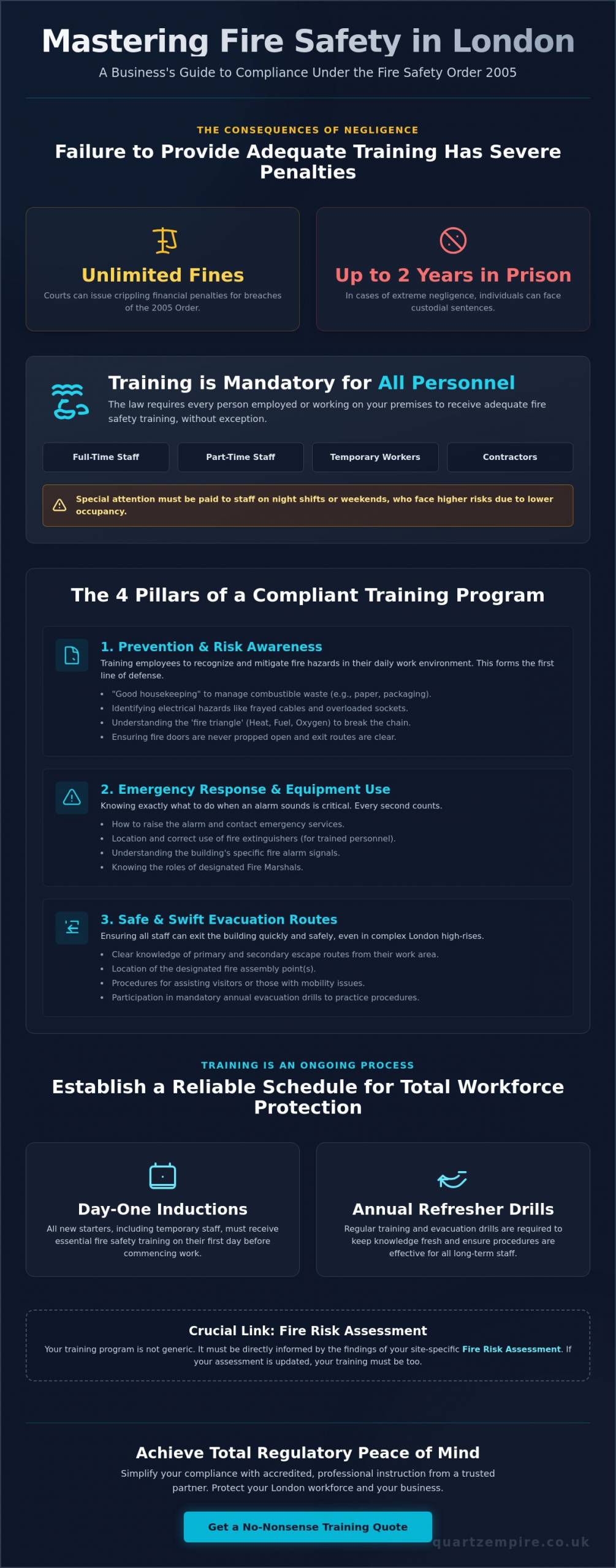
According to the 2005 Order, the "Responsible Person" is defined as the employer, owner, or occupier who has control over the premises and must ensure the safety of everyone on-site. This individual carries the legal weight of ensuring all staff are trained and that the building remains compliant with current safety standards. If a fire occurs and training is found to be inadequate, the consequences are severe. Courts have the power to issue unlimited fines and, in cases of extreme negligence, hand down prison sentences of up to two years. Furthermore, insurance companies frequently invalidate policies if they find that fire safety training for employees london was neglected, leaving the business liable for all property damage and legal claims.
Who Must Receive Fire Safety Training?
Legislation dictates that every person employed in your building must receive adequate fire safety instruction. This requirement covers:
- Full-time and part-time staff members.
- Temporary workers and seasonal employees.
- Contractors and third-party cleaning teams who may work out-of-hours.
Staff working night shifts or weekends often face higher risks because there are fewer people available to assist during an evacuation. You must ensure these individuals understand the specific alarm signals and exit routes for your London facility, regardless of their employment status.
The Link Between Training and Fire Risk Assessments
Your fire risk assessment is the document that dictates exactly what your training should cover. It identifies the specific hazards unique to your premises, such as industrial kitchen equipment or high-capacity server rooms. Staff must be trained to recognize these site-specific risks so they can act before a fire starts. A "no nonsense" approach to safety requires that you review your training programs during every annual assessment update. If you've changed your office layout or installed new machinery in the last 12 months, your previous training may no longer be compliant. Keeping these two elements synchronized ensures your team is prepared for the actual environment they work in every day.
Core Components of a Compliant Fire Safety Training Program
Effective fire safety training for employees london relies on four essential pillars: Prevention, Response, Routes, and Reporting. These core elements ensure your team doesn't just react to an emergency but actively works to stop one from starting. In 2024, the London Fire Brigade reported that electrical faults remained a leading cause of workplace fires. Understanding the "fire triangle"—the combination of heat, fuel, and oxygen—is the first step in staff education. If you remove just one of these elements, a fire cannot survive. In a typical London office environment, this means managing paper waste (fuel) and ensuring server rooms are properly ventilated (heat).
Fire Prevention and Risk Awareness
Prevention starts with daily habits. Staff must be trained to recognize "good housekeeping" as a vital safety tool rather than a simple chore. This includes identifying frayed cables on laptop chargers or ensuring that smoking areas are kept clear of combustible materials. Employees should understand their role in daily checks, such as verifying that fire doors aren't propped open. A proactive culture reduces the risk of a minor oversight turning into a catastrophic event. Clear policies on managing electrical equipment and avoiding overloaded sockets are fundamental to a compliant 2026 safety strategy.
Emergency Response and Equipment Use
When an alarm sounds, every second matters. Your training program must cover the exact location of the fire alarm control panel and how to raise the alarm manually using call points. While evacuation is always the priority, staff should know how to use basic equipment for small, contained fires. Matching the right tool to the risk is vital for safety. You can find detailed information in our fire extinguisher types guide, which explains why using a Water (Class A) extinguisher on an electrical fire is incredibly dangerous.
Staff should be familiar with the primary fire classes they might encounter:
- Class A: Combustible solids like wood, paper, and textiles.
- Class B: Flammable liquids such as petrol or oil.
- Class C: Flammable gases.
- Class F: Cooking oils and fats, common in office kitchens.
Every employee must follow the official government guidance regarding their specific duties during an evacuation. This includes knowing primary and secondary escape routes and the designated assembly point. It's critical to distinguish between "first-aid" firefighting and the point where an immediate exit is required. If a fire is larger than a wastepaper bin, the instruction is clear: get out and stay out. For a reliable assessment of your current training gaps, you can get in touch with our team to review your specific site requirements and ensure your London business remains fully compliant.
Navigating London-Specific Fire Safety Challenges
London's dense urban landscape presents unique risks that generic safety courses often overlook. With over 2,000 high-rise buildings across the capital, the complexity of evacuation increases significantly. Effective fire safety training for employees london must account for the vertical nature of The City and Canary Wharf, where traditional "everyone out at once" methods can lead to dangerous stairwell congestion. Our role as a trusted partner is to ensure your team understands the specific mechanics of their environment.
The hospitality and retail sectors in London face an additional hurdle: high staff turnover. Industry data from 2024 shows turnover rates in these sectors often exceed 30% annually. This means your training schedule cannot be a static, once-a-year event. It requires a robust induction process that ensures every new starter is competent from day one. Relying on a "no nonsense approach" to safety prevents compliance gaps during these frequent staffing transitions.
High-Rise Office Evacuation Protocols
Skyscrapers in Canary Wharf and the Square Mile typically utilize phased evacuation. This protocol involves clearing the fire floor and the floor directly above it first, rather than emptying the entire building simultaneously. It's a precise operation. Employees must be trained to wait for specific instructions via the voice alarm system to prevent crushing in stairwells.
Staff with limited mobility require dedicated Personal Emergency Evacuation Plans (PEEPs). Training must identify the exact location of refuge areas, which are fire-protected zones where individuals can wait for assistance. It's also vital to reinforce that standard passenger lifts are grounded during an alarm. Only designated fire-fighting lifts, operated by the brigade, should be used in an emergency. Clear communication during these drills builds the peace of mind necessary for a calm exit.
Shared Premises and Communal Safety
Many London businesses operate in multi-tenanted blocks where fire responsibilities are shared. Under the Regulatory Reform (Fire Safety) Order 2005, you're legally required to coordinate with other occupiers. This means your fire wardens must know the layout of the entire building, not just your specific office suite. Shared escape routes and communal stairways must remain clear at all times, a task that requires constant vigilance and cooperation between different firms.
The London Fire Brigade guidance on employee training highlights the importance of understanding the building's overall strategy. In mixed-use premises, your staff might encounter a "Stay Put" policy in residential sections while your commercial unit follows "Simultaneous Evacuation." Confusion between these two can be fatal. To ensure total coverage, an integrated commercial fire alarm installation is essential. This ensures that if a fire starts in a neighboring unit, your team receives an immediate, reliable alert. Regular unified fire drills with other tenants are the only way to test if these shared systems and strategies actually work in practice.
Planning Your Training Schedule: Frequency and Drills
Compliance starts the moment a new team member joins your organization. You must provide induction training on day one. This isn't just a best practice; it's a legal requirement under the Regulatory Reform (Fire Safety) Order 2005. Every person needs to know their primary exit routes, the location of assembly points, and how to raise the alarm before they start their first shift. For your long-term staff, annual refresher training is essential. Safety protocols fade from memory over time, and a 12-month cycle ensures that emergency procedures remain a priority. This consistent schedule helps maintain a culture of vigilance across your London office or facility.
You are legally required to conduct at least one fire drill every year. In high-occupancy buildings or multi-tenanted London blocks, two drills per year are often more effective at accounting for staff turnover and shift changes. Every session must be recorded in your fire logbook. The London Fire Brigade will prioritize these records during any inspection to verify your compliance. Your logbook should include the date of the training, the names of those who attended, the type of instruction provided, and the duration of the session. Keeping meticulous records provides the peace of mind that your business is fully prepared for a formal audit.
When to Provide Additional Training
Scheduled sessions aren't always enough to maintain safety. You must retrain your team if you make significant building alterations or change the internal layout of your workspace. If your business introduces new hazardous substances or specialized machinery, your staff needs updated instructions to handle these specific risks. A "near miss" incident also triggers a mandatory review of your protocols. Use these moments to update your fire safety training for employees london to reflect current site conditions. Legislative changes or updates to British Standards also require a prompt training update for all relevant personnel.
Conducting Effective Evacuation Drills
A drill is a performance test, not a simple box-ticking exercise. Set clear objectives for every drill, such as achieving a total building evacuation in under three minutes. It's helpful to appoint dedicated observers to identify bottlenecks, blocked exits, or staff who don't take the alarm seriously. Their feedback is vital for identifying doors that stick or corridors that become congested during a rush. A fire drill is only successful if it is followed by a debrief. This meeting allows you to address any failures in the process and ensures that fire safety training for employees london stays relevant to the actual challenges of your premises.
Build a safer workplace and ensure full compliance by partnering with an accredited fire safety expert to manage your training and maintenance schedule.
Professional Fire Safety Training with Quartz Empire
Quartz Empire Fire & Security Ltd delivers a no-nonsense approach to fire safety training for employees london, ensuring your team is prepared for real-world emergencies. We provide accredited Fire Marshal and Staff Awareness training designed by experts who understand the unique challenges of the capital's built environment. Our service area covers Kent, London, and the South East, bringing professional certification directly to your workplace. We focus on practical, actionable knowledge rather than just ticking boxes. This approach builds a culture of safety where every staff member feels confident in their role during an evacuation.
Bespoke Training for Your Business
Effective training must be relevant to the environment where your staff works. We conduct on-site sessions that use your building's actual escape routes and fire-fighting equipment. If your employees understand the exact layout of your premises, their response time during a late-night alarm or a busy shift improves significantly. We integrate our training with your existing fire alarm and CCTV infrastructure. This ensures your team knows how to interact with your security systems during a crisis. Following the session, we provide formal certification for all attendees. These records are vital for demonstrating compliance with the Regulatory Reform (Fire Safety) Order 2005 during an inspection.
The Quartz Empire Advantage
We offer a distinct advantage by combining hardware maintenance with training expertise. We're not just instructors; we're the engineers who design and install the systems your life depends on. Our team possesses deep local knowledge of London Fire Brigade enforcement patterns and common compliance failures found in city-centre offices. We act as your trusted partner, providing a personal touch that ensures your specific risks are addressed. By choosing an accredited provider, you secure peace of mind and protect your business from the legal and financial risks of inadequate training. Our goal is to make your workplace secure through reliable, expert-led fire safety training for employees london.
- Accredited Fire Marshal courses tailored to your specific floor plan and occupancy levels.
- Staff Awareness sessions that cover practical extinguisher use and initial fire response.
- Detailed certification provided for your digital compliance folder to satisfy insurance requirements.
- Flexible training schedules that minimize disruption to your daily business operations.
- Expert guidance on integrating your emergency procedures with modern access control and detection systems.
Don't leave your compliance to chance. A single hour of professional training can prevent a minor incident from becoming a catastrophic loss. Our instructors bring years of field experience to every session, ensuring your staff doesn't just hear the information but retains it. This hands-on method is why businesses across the South East rely on us as their long-term safety partner.
Secure Your Workplace Compliance for 2026
Maintaining a safe workplace in the capital requires more than a simple checkbox exercise. Under the Regulatory Reform (Fire Safety) Order 2005, every employer has a legal obligation to provide staff with adequate instruction and regular evacuation drills. You've seen that a compliant program must cover specific risk assessments and the correct use of fire-fighting equipment. Since the 2023 legislative updates, the demand for documented competency has never been higher. Proactive planning ensures your business avoids the severe penalties associated with non-compliance while protecting your most valuable assets.
Quartz Empire offers the no-nonsense compliance support you need to stay ahead of these evolving standards. As accredited fire safety experts, we deliver the specialized fire safety training for employees london firms require to operate safely. We proudly serve businesses across London, Kent, and the South East, acting as a trusted partner for your security needs. Our team focuses on practical, life-saving skills that give you and your staff genuine peace of mind. It's time to move beyond basic requirements and build a culture of safety that lasts. Book Professional Fire Marshal Training for Your London Team today and ensure your property remains fully protected.
Frequently Asked Questions
Is fire safety training for employees a legal requirement in London?
Yes, fire safety training for employees in London is a mandatory legal requirement under the Regulatory Reform (Fire Safety) Order 2005. This legislation dictates that every staff member must receive adequate safety instruction when they're first employed and whenever they're exposed to new or increased risks. Quartz Empire helps businesses across London and the South East remain fully compliant with these statutory obligations to protect both staff and property.
How often should employees receive fire safety training?
Staff should receive fire safety training at least once every 12 months to maintain high safety standards and ensure compliance. You must also provide refresher sessions if your building layout changes, if you introduce new hazardous materials, or if fire safety equipment is upgraded. Regular training ensures your team remains confident in evacuation procedures and understands how to use fire extinguishers correctly during an emergency.
What is the difference between fire awareness training and fire marshal training?
Fire awareness training provides basic knowledge for all staff, covering evacuation routes and general prevention. Fire marshal training is a more advanced, certified course for designated individuals who take charge during an emergency. These marshals learn how to conduct floor sweeps, manage assembly points, and liaise with the London Fire Brigade. Having a mix of both ensures a reliable safety network within your office or facility.
Do part-time or remote employees need fire safety training?
Yes, all staff members require training regardless of their contract type or working location. If a remote employee visits your London office even once a month, they must understand the specific fire risks and evacuation procedures of that building. UK legislation doesn't distinguish between full-time and part-time status; every individual on-site must be capable of exiting the premises safely during a fire.
How many fire marshals does my London office need?
The number of fire marshals you need depends on your building's risk level and the number of occupants. For a low-risk London office, the standard ratio is typically one marshal for every 50 employees. In higher-risk environments like industrial sites or kitchens, you'll need one marshal for every 15 to 20 people. It's essential to have enough trained staff to cover holidays, sickness, and different shift patterns across your site.
What should be included in a fire safety induction for new staff?
A fire safety induction for new staff must include the location of all fire exits, the sound of the fire alarm, and the designated assembly point address. You should also demonstrate how to use manual call points and explain any specific risks identified in your building's fire risk assessment. Providing this information on day one is vital for maintaining a compliant and safe working environment in the South East.
Can I do fire safety training online, or must it be in person?
You can complete fire safety training online or in person, as both methods are legally acceptable if they provide adequate instruction. Online courses offer a convenient way to cover theoretical knowledge and basic compliance. However, in-person sessions are often more effective for practical skills, such as the hands-on use of fire extinguishers. As an accredited provider, we recommend a blended approach to ensure maximum reliability and peace of mind.
Who is responsible for paying for employee fire safety training?
The employer is legally responsible for all costs associated with fire safety training for employees in London. Under the Health and Safety at Work etc. Act 1974, you can't charge staff for any equipment or training required for their safety at work. Investing in certified training is a core business expense that protects your people and ensures your company remains a trusted and compliant employer.