
Biometric Access Control Systems UK: The Complete 2026 Business Guide
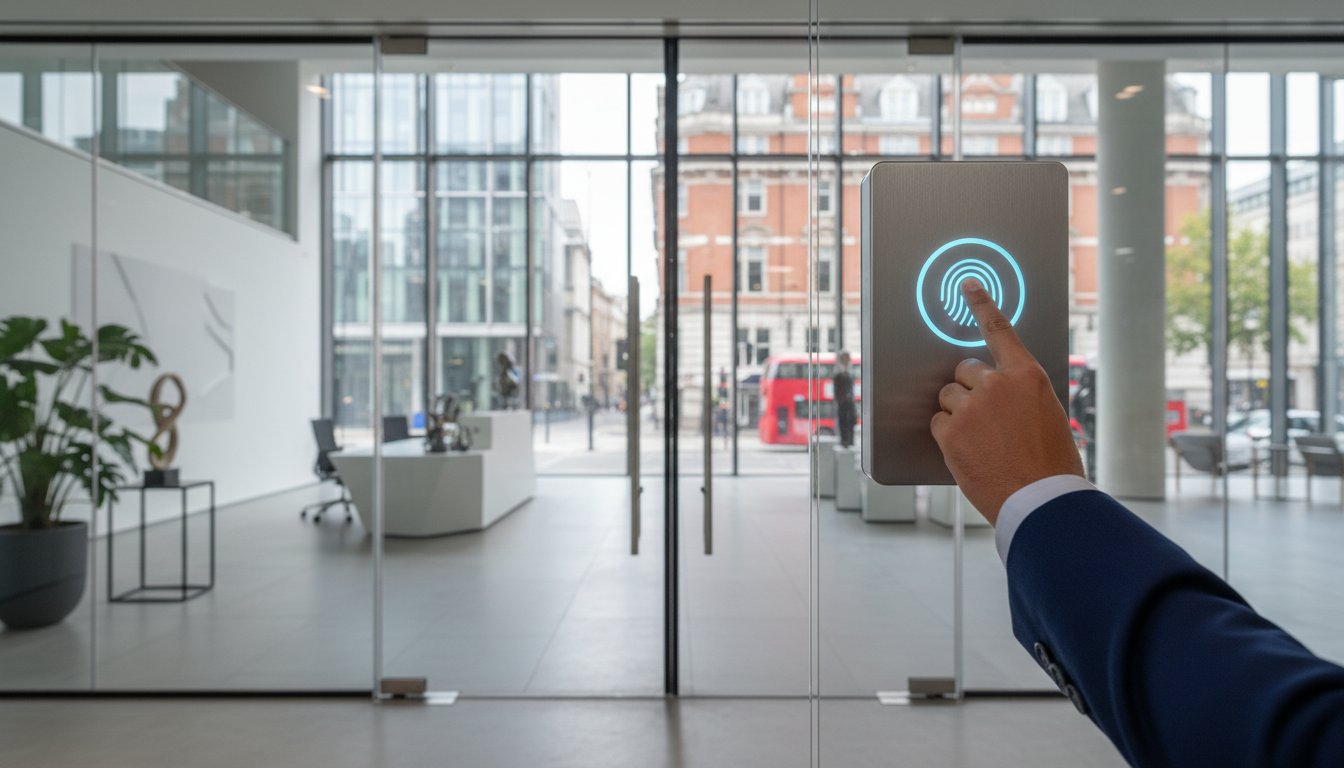
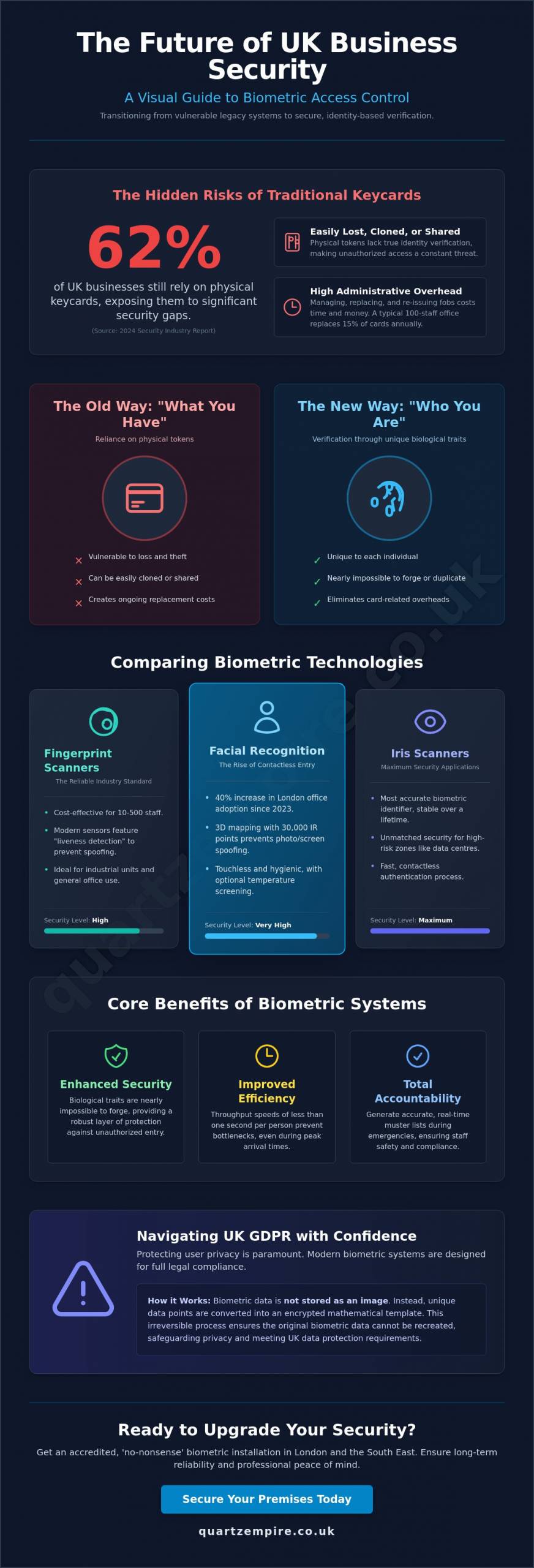
Did you know that a 2024 security industry report found that 62% of UK businesses still rely on physical keycards that are easily lost, cloned, or shared? You likely understand the frustration of managing a growing database of plastic fobs or the anxiety that follows a reported security breach. Relying on traditional methods often creates more administrative work than it prevents. Implementing biometric access control systems uk allows you to replace these outdated physical tokens with secure, unique identifiers like fingerprints or facial recognition.
We've designed this guide to help you secure your UK premises with advanced biometric technology while ensuring total compliance with UK GDPR and data protection laws. You'll learn how to implement a touchless entry experience that integrates seamlessly with your existing fire and CCTV systems. This article provides a comprehensive roadmap for upgrading your security to a certified, professional standard by 2026.
Key Takeaways
- Learn how to transition from vulnerable legacy card systems to identity-based verification using unique biological traits for enhanced security.
- Compare the performance of fingerprint, facial recognition, and iris sensors to select the most effective biometric access control systems uk for your specific business environment.
- Navigate UK GDPR requirements with confidence by understanding how encrypted biometric templates protect user privacy and ensure total legal compliance.
- Identify the essential infrastructure requirements, including Power-over-Ethernet (PoE) and network bandwidth, needed for a seamless system rollout.
- Discover how an accredited, "no-nonsense" installation approach in London and the South East provides long-term reliability and professional peace of mind.
Understanding Biometric Access Control Systems for UK Businesses
Biometric access control identifies individuals through unique biological characteristics like fingerprints, facial geometry, or iris patterns. This technology replaces traditional methods that rely on "what you have," such as a physical key or plastic card. Instead, it focuses on "who you are." This shift ensures that access is granted only to the specific person authorized. Modern Access control systems provide a robust layer of protection for premises across Kent, London, and the South East. By using biometric access control systems uk businesses can move away from easily compromised credentials toward a more secure, identity-based model.
The adoption of these systems has accelerated rapidly. By 2025, industry reports indicated that 62% of UK financial institutions had integrated biometric verification into their physical security protocols. Healthcare providers also rely on these systems to secure sensitive drug stores and patient records. In 2026, these systems are essential for managing hybrid workplaces. They provide real-time data on occupancy levels, helping facilities managers optimize office space and energy usage while ensuring only authorized personnel enter the building during flexible working hours.
Why UK Businesses are Moving Beyond Proximity Cards
Traditional proximity cards present significant security gaps. Card sharing and "buddy punching," where one employee clocks in for another, remain persistent issues for many firms. These practices lead to inaccurate payroll and compromised site integrity. Replacing lost or damaged fobs is also a recurring expense. A typical UK office with 100 staff might replace 15% of its card stock annually. This incurs costs for the hardware and the administrative time required for re-issuing credentials. Biometric systems eliminate these overheads entirely. They also create an unalterable audit trail. You can be certain that the person who accessed a restricted area is exactly who they claim to be, without the risk of a stolen card being used.
Key Benefits: Security, Efficiency, and Accountability
Security is the primary driver for biometric access control systems uk adoption. Biological traits are nearly impossible to forge or duplicate compared to standard 125kHz proximity cards. Efficiency also improves significantly. Modern scanners from trusted brands like Paxton or Hikvision offer throughput speeds of less than one second per person. This prevents bottlenecks during peak morning arrivals at busy London office hubs. Accountability is vital for safety compliance. During a fire incident, a biometric system provides an accurate, real-time muster list. It confirms exactly who is on-site, ensuring that emergency services don't search for staff who have already left the building. This level of precision provides peace of mind for both employers and employees.
Comparing Fingerprint, Facial Recognition, and Iris Scanners
UK businesses now choose from three primary biometric categories to secure their premises. Modern sensors operate reliably in the damp UK climate, with failure rates for high-quality hardware dropping below 0.1% in 2025 industry tests. Hygiene concerns have shifted a large portion of the market toward contactless options, though multi-modal systems combining two methods remain the most secure choice for high-risk zones. These hybrid systems ensure that even if one modality is compromised, the secondary check maintains site integrity.
Fingerprint Scanners: The Reliable Industry Standard
Optical sensors capture a visual image of the print, while capacitive sensors use electrical currents to map ridges and valleys. These units are a staple for biometric access control systems uk wide, particularly in Kent-based industrial units where rugged hardware is essential. Modern scanners from brands like Paxton include "liveness detection" to prevent bypass attempts using silicone moulds or lifted prints. This technology makes the "fingerprint lifting" myth a thing of the past for professional-grade installations. They're cost-effective and easy to manage for staff counts ranging from 10 to 500 employees.
Facial Recognition: The Rise of Contactless Entry
3D mapping technology analyzes over 30,000 infra-red points to build a depth map of a face. This makes it impossible to spoof the system with a high-resolution photo or a mobile screen. There's been a 40% increase in London office lobbies adopting these touchless systems since 2023. Many Hikvision models now integrate temperature screening, providing a dual-purpose health and security solution for modern workplaces. Because the process is entirely passive, it allows for faster throughput during peak morning shifts without the need for physical contact with a reader.
Iris and Retina Scanning: High-Security Specialisms
Iris scanners are the preferred choice for UK data centres and sensitive government facilities requiring the highest level of certainty. While the initial hardware cost is often two to three times higher than fingerprint readers, the false acceptance rate is near zero. Modern readers are non-intrusive; they scan from up to two metres away without requiring the user to press their eye against a viewfinder. For businesses needing this level of precision, consulting an accredited installer ensures the system integrates perfectly with existing fire and safety protocols. It's a "no nonsense" solution for environments where a security breach is not an option.
Navigating UK GDPR and Biometric Data Protection
UK data privacy laws are the primary concern for any firm installing biometric access control systems uk. Since the Data Protection Act 2018, biometric information is classified as "special category data." This classification means the data is sensitive and requires the highest level of protection under the law. You must identify a specific legal basis for processing this information before the system goes live. Most UK businesses rely on "explicit consent" from employees or "employment law obligations" to meet these strict requirements.
It's vital to distinguish between raw biometric data and biometric templates. High quality systems from providers like Paxton or Hikvision don't store actual images of fingerprints or faces. They convert these physical traits into an encrypted mathematical string known as a template. Even if a database is compromised, these strings cannot be reversed to recreate a person's physical image. Compliance is not an option but a legal cornerstone of UK biometrics.
Legal Requirements for Storing Biometric Data
Data minimisation is a core principle of UK security design. You should only collect the specific data points required to verify an identity and nothing more. This data must be protected by robust encryption both while stored on the device and while moving across your office network. Under UK law, employees retain the right to choose. You cannot make biometric enrolment a mandatory condition of employment without offering a reasonable alternative. We always recommend providing a secondary access method, such as a proximity fob or PIN, for staff who prefer not to use biometric hardware.
Conducting a Data Protection Impact Assessment (DPIA)
A DPIA is a mandatory requirement for any UK business using technologies that the ICO deems "high risk." Biometrics falls squarely into this category. This document identifies potential risks to staff privacy and outlines the steps you've taken to mitigate them. You'll need to document how you handle data breaches and how long you retain user records. Quartz Empire acts as a trusted partner during this technical phase. We provide the specific encryption protocols and system architecture details your Data Protection Officer needs to complete these hurdles. Our no-nonsense approach ensures your documentation is as solid as your physical security.
Planning Your Biometric Installation in London and the South East
Installing biometric access control systems uk requires more than just selecting a high-tech reader. Successful implementation depends on rigorous physical preparation and a clear understanding of your site's limitations. You must evaluate your network bandwidth early in the design phase. A single facial recognition terminal can require 2 to 4 Mbps of bandwidth during peak traffic. If your Power-over-Ethernet (PoE) infrastructure is outdated, the system will suffer from lag or intermittent failures. We recommend using Cat6 cabling as a standard to ensure your hardware receives stable power and data simultaneously.
Safety remains the priority during any rollout. You must distinguish between fail-safe and fail-secure configurations. A fail-safe lock releases when power is cut, which is vital for designated fire exits to allow occupants to escape. A fail-secure lock remains locked during a power cut, protecting high-value assets or server rooms. Getting this balance wrong doesn't just compromise security; it creates a significant legal liability for your business.
Assessing Your Building’s Infrastructure
Before committing to hardware, check your existing door frames and locks. Biometric readers often require specific electric strikes or magnetic locks that might not fit standard timber or aluminium frames without modification. You also need to choose between standalone units and central controllers. Centralised systems are better for London firms with multiple floors, as they allow for global management of user data from a single server.
Listed buildings in Kent and London present unique challenges. Approximately 25% of commercial properties in Central London carry heritage status, meaning you can't always drill into walls or modify historic doors. In these cases, we use non-invasive mounting solutions and wireless interfaces to maintain the building's integrity. Our team provides expert access control installation tailored to these sensitive environments.
Integrating Biometrics with Fire Alarms and CCTV
Your security system shouldn't operate in a vacuum. It's a legal requirement under BS 7273-4 for access control systems to interface directly with your fire alarm. When the alarm triggers, the biometric system must instantly release all fail-safe doors to prevent bottlenecks during an evacuation. We specialise in commercial fire alarm installation that links seamlessly with modern biometric readers.
Integration with CCTV provides another layer of utility. Modern facial recognition readers can send a signal to your Video Management System (VMS) to "bookmark" a specific moment in the footage. This makes auditing 100% faster. Instead of scrolling through hours of video, you can jump directly to the timestamp when a specific individual accessed a restricted zone. This creates a reliable, no-nonsense audit trail for your compliance records.
Ready to secure your premises with the latest technology? Contact Quartz Empire for an expert security assessment and ensure your installation is fully compliant.
Expert Installation and Maintenance with Quartz Empire
Quartz Empire Fire & Security Ltd delivers a no-nonsense approach to protecting your business. As an accredited provider serving Kent, London, and the South East, we understand that biometric access control systems uk requirements demand precision and long-term reliability. We don't just install hardware; we act as a trusted partner to ensure your premises remain secure and compliant with current UK safety regulations.
Choosing a single partner for your fire safety, CCTV, and access control needs provides a significant advantage. It eliminates the friction of managing multiple contractors and ensures all your security systems communicate effectively. This unified strategy simplifies your operations and provides a clearer audit trail for insurance and compliance purposes. We focus on building steadfast relationships with our clients, moving beyond one-off installations to provide ongoing support and peace of mind.
Our Accredited Design and Installation Process
Our process starts with a detailed site survey to assess your specific security risks and building flow. We create a bespoke system design that addresses your unique operational challenges, whether you're managing a high-traffic office in Central London or a secure warehouse in Kent. To ensure the highest standards of reliability, we exclusively use hardware from industry-leading brands like Hikvision and Paxton.
The installation phase is handled by our expert engineers who prioritize minimal disruption to your daily operations. Once the system is live, we perform a comprehensive handover. This stage is critical, as we provide thorough staff training on the new biometric hardware and management software. We make sure your team knows exactly how to manage permissions and pull reports before we consider the job finished.
Ongoing Maintenance: Ensuring 24/7 System Reliability
Regular servicing is vital for maintaining the accuracy of biometric sensors. Environmental factors like dust or physical wear can degrade sensor performance over time, leading to false rejections and operational delays. Our maintenance schedules are designed to prevent these issues before they occur. We provide proactive care that includes:
- Physical cleaning and recalibration of fingerprint and facial recognition sensors.
- Testing of backup battery systems to ensure functionality during power failures.
- Verification of emergency fail-safe releases in accordance with fire safety laws.
- Software updates and critical cybersecurity patching for all connected devices.
Cybersecurity is a major component of modern system maintenance. Since biometric data is sensitive, keeping your system firmware updated is a primary defense against digital vulnerabilities. Our team manages these technical updates so you don't have to worry about the integrity of your network. Reliability isn't just about the day of installation; it's about ensuring the system works perfectly every time a staff member reaches for a scanner.
Ready to upgrade your business security with a professional, accredited team? Contact Quartz Empire for a bespoke security consultation and let us design a system that fits your needs.
Future-Proof Your Business Security for 2026
As 2026 approaches, the transition to the biometric access control systems uk businesses are adopting is no longer optional for high-security environments. Implementing facial recognition or fingerprint technology eliminates the common risks associated with lost fobs and cloned access cards. It's vital that your system aligns with the strict requirements of UK GDPR to protect sensitive data and ensure legal compliance. We provide a no-nonsense approach to these regulations, ensuring every installation meets the latest British Standards for safety and privacy.
Quartz Empire operates as a trusted partner for companies across London, Kent, and the South East. Our team of accredited fire and security experts manages the entire lifecycle of your security infrastructure, from the initial planning stages to long-term maintenance. We've supported hundreds of local firms in upgrading their premises with reliable, certified technology that delivers genuine peace of mind. Don't leave your property's safety to outdated hardware when a modern solution is within reach.
Secure your business with an accredited biometric system from Quartz Empire
Take the next step toward a safer and more efficient workplace today.
Frequently Asked Questions
Is biometric access control legal for businesses in the UK?
Biometric access control is legal in the UK provided you comply with the UK GDPR and the Data Protection Act 2018. You must demonstrate that using the system is a proportionate way to meet your security needs. Our team helps you complete a Data Protection Impact Assessment (DPIA) to ensure your biometric access control systems uk setup meets all Information Commissioner’s Office (ICO) requirements.
What happens to the biometric system if the power goes out?
Your system remains operational during a power cut by using a dedicated battery backup or Uninterruptible Power Supply (UPS). These units usually provide 4 to 12 hours of standby power to keep your building secure. If the battery eventually fails, fail-safe locks will release to allow for safe exit, while fail-secure locks stay locked to protect your property.
Can biometric readers be used outdoors in the UK climate?
You can use biometric readers outdoors as long as the hardware has an IP65 or IP67 weather resistance rating. We install robust Hikvision and Paxton readers that are specifically designed to handle the UK's rain and frost. These units operate reliably in temperatures ranging from -30°C to 60°C, making them suitable for any external entrance in London or the South East.
How much does a biometric access control system cost to install?
Installation costs vary based on the hardware choice and the number of entry points in your building. Industry benchmarks suggest that professional installation for a single-door biometric setup typically starts at £650. We provide a clear, no-nonsense quote after a site survey to ensure you get an accurate price that reflects your specific security requirements and infrastructure.
Can I integrate biometrics with my existing fire alarm system?
You can and must integrate your biometric locks with your fire alarm to stay compliant with BS 7273-4 standards. This connection ensures that all doors automatically unlock the moment the fire alarm is triggered, allowing for a safe evacuation. It's a critical safety requirement that our accredited engineers handle during every installation to keep your people and property protected.
What is the difference between fingerprint and facial recognition security?
Fingerprint scanners are a reliable and cost-effective option, while facial recognition offers a faster, touchless experience. Facial recognition technology has improved significantly by 2026, often identifying a user in less than 0.5 seconds without physical contact. This makes facial recognition a preferred choice for high-traffic offices where hygiene and speed are top priorities for the business.
Do employees have the right to refuse biometric scanning?
Employees have a legal right to refuse to provide their biometric data under UK GDPR. You must provide an alternative access method for these individuals, such as a traditional proximity fob or a secure PIN code. Offering these alternatives ensures your business stays compliant with privacy laws while maintaining the overall integrity of your security system.
How long does it take to install a biometric system for a medium-sized office?
A professional installation for an office with 6 to 10 doors typically takes between 3 and 5 working days. This schedule includes the time needed for cabling, hardware mounting, and software configuration. Our expert team ensures your biometric access control systems uk are fully tested and your staff are trained on the software before we sign off the project.