
Getting Buy-In for Security System Upgrades: A Guide for UK Business Leaders

What if your security system functioned as a strategic asset rather than just an annual line item on the balance sheet? For many UK business leaders, security is often viewed as a "sunk cost" until a system failure occurs or a false alarm disrupts operations for the third time in a single month. You likely feel the pressure of ensuring 100% compliance with updated British Standards like BS 5839-1 while stakeholders remain hesitant to release the necessary budget. Successfully getting buy-in for security system upgrade requires shifting the conversation from technical specifications to long-term business resilience.
We understand that you want to move away from the anxiety of potential audit failures and the frustration of unreliable hardware. This guide will show you how to transform your security proposal into a strategic priority that earns board-level approval by demonstrating clear ROI and improved operational efficiency. We'll provide a practical roadmap for presenting your case, meeting rigorous UK regulations, and choosing the right accredited partners to protect your property in London and the South East.
Key Takeaways
- Learn how adhering to British Standards and NSI accreditation can significantly reduce your business insurance premiums and legal liability.
- Discover the strategic framework for getting buy-in for security system upgrade proposals by aligning technical needs with board-level commercial priorities.
- Compare the long-term financial benefits of proactive maintenance contracts against the hidden costs and operational downtime of reactive emergency repairs.
- Follow a structured, two-step process to conduct vulnerability audits that transform security from a "cost center" into a business enabler.
- Find out why working with local, certified experts in London and Kent provides the peace of mind and reliability necessary for a seamless system transition.
The Challenge of Securing Buy-In for Security Upgrades
Securing a commercial property requires more than just high-specification hardware. It demands a strategic alignment between technical requirements and corporate objectives. Effectively getting buy-in for security system upgrade initiatives involves demonstrating how these investments safeguard the company's long-term viability. Many UK business leaders encounter significant internal hurdles, including rigid budget constraints, a perceived lack of immediate urgency, and fears that installation will cause operational downtime.
The "if it isn't broken, don't fix it" mindset is particularly dangerous when applied to physical security. A system that appears functional can still be obsolete. We recommend a "Trusted Partner" approach to navigate these hurdles. This method focuses on clear communication and expert guidance to ensure every stakeholder understands the necessity of modern protection. Our no-nonsense approach helps translate complex technical needs into clear business benefits.
Why Stakeholders Often Resist Security Spend
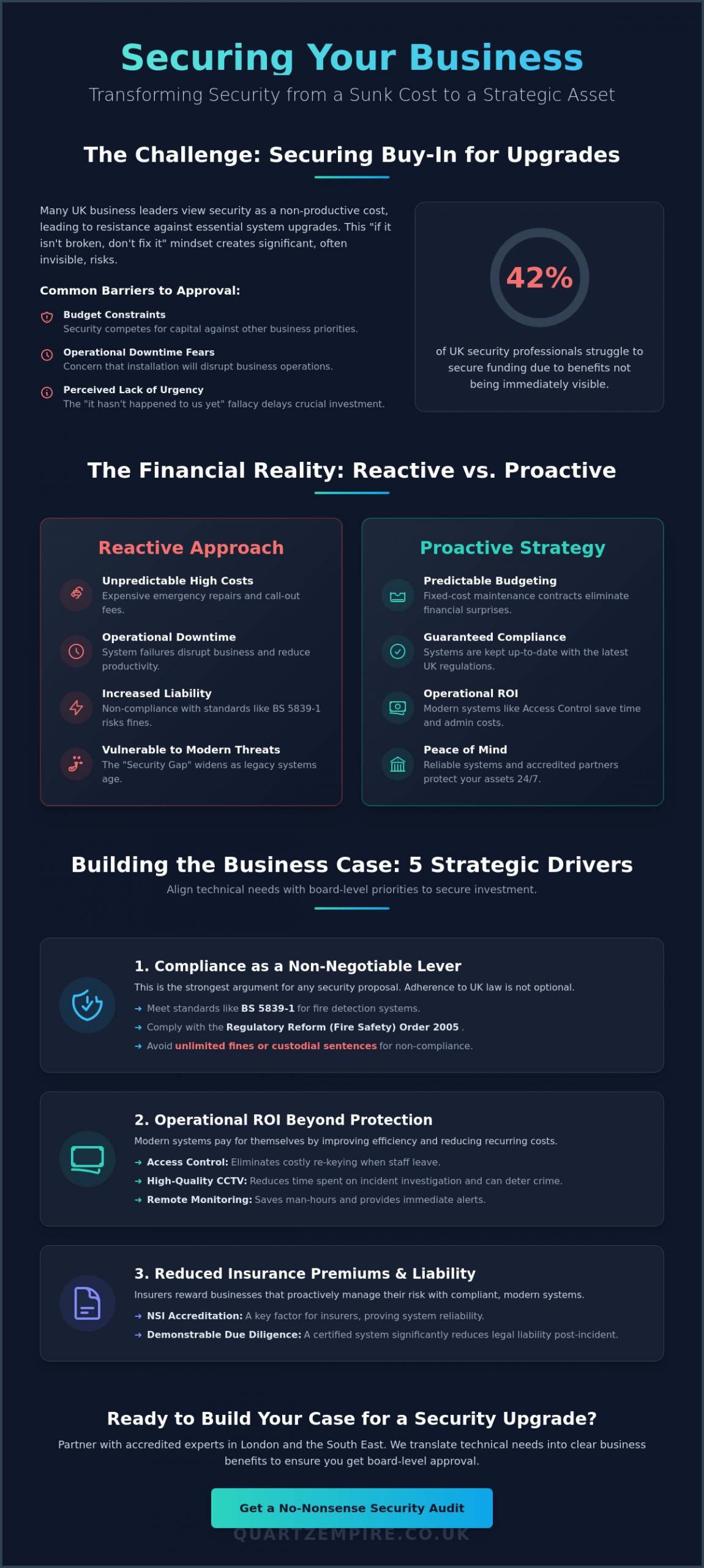
Security is often an invisible asset. When a system performs correctly, no breaches occur, which can lead to a false sense of safety. Decision-makers often view security as a non-productive cost rather than a vital tool for risk mitigation. This perspective creates a disconnect between technical teams, who understand the evolving threat landscape, and executives focused on immediate financial returns. Statistics from 2023 indicate that 42% of UK security professionals struggle to secure funding because the benefits aren't immediately visible on a balance sheet.
The Risks of Maintaining Legacy Systems
Maintaining outdated intruder alarms or CCTV systems exposes a business to modern vulnerabilities that older hardware wasn't designed to handle. Legacy fire safety systems also pose a significant risk, as they may no longer meet the strict standards of the Regulatory Reform (Fire Safety) Order 2005. Failure to comply can lead to heavy fines or even criminal prosecution for responsible persons. The Security Gap is the growing distance between the advanced tactics used by modern criminals and the static capabilities of hardware that is a decade old.
Common barriers to approval include:
- Budget constraints: Competition for capital is high in the current UK economic climate.
- Operational downtime: Concerns about business interruption during the transition phase.
- Perceived urgency: The "it hasn't happened yet" fallacy regarding security breaches.
By addressing these concerns directly, facilities managers can build a compelling case for investment. It's about moving away from reactive repairs and towards a proactive, compliant, and reliable security posture.
Building the Business Case: 5 Strategic Drivers
Securing approval for capital expenditure requires a shift from viewing security as a cost centre to seeing it as a strategic asset. When you're getting buy-in for security system upgrade projects, focus on five core drivers to align with board-level priorities. It's about demonstrating how a "no nonsense" approach to safety protects both people and profits.
Compliance as a Non-Negotiable Lever
Legal compliance is the strongest starting point for any proposal. In the UK, the Regulatory Reform (Fire Safety) Order 2005 mandates that every commercial premises must have a valid fire risk assessment. Failing to meet British Standards, such as BS 5839-1 for fire detection, carries severe penalties. Since the Fire Safety Act 2023 updates, the Home Office has empowered local fire authorities to issue stricter enforcement notices. Non-compliance can lead to unlimited fines or even custodial sentences for responsible persons. Working with accredited providers ensures your systems remain fully compliant and insurance-ready.
Operational ROI Beyond Protection
Modern technology offers returns that extend far beyond preventing theft. Implementing a professional access control system, like those from Paxton, eliminates the recurring costs of physical re-keying when staff leave or keys are lost. For a firm with 50 employees, the administrative time saved on key management is substantial. Similarly, a high-quality commercial CCTV installation using Hikvision technology provides critical evidence for dispute resolution and Health and Safety audits. Presenting these drivers effectively is the fastest way of getting buy-in for security system upgrade initiatives across the board. Smart systems also reduce false alarms, which cost UK businesses an estimated £1 billion annually in lost productivity and call-out fees.
Beyond the spreadsheets, three additional factors influence the decision-making process for London and Kent business owners:
- Insurance Premium Reduction: Most UK insurers offer lower premiums for premises protected by NSI or SSAIB accredited systems. This provides a direct, measurable reduction in overheads.
- Duty of Care: Employers have a legal and moral obligation to protect staff. Modern systems provide the peace of mind that your team is safe from both fire and security threats.
- Brand Reputation: A public security breach or fire safety failure can cause irreparable damage to client trust. The cost of a reliable upgrade is a fraction of the cost of a PR crisis.
If you're unsure where your current infrastructure stands, you can get in touch with our team for a professional site survey and expert advice.
Reactive vs. Proactive Security: The Financial Reality
Many UK business leaders view security as a grudge purchase until a failure occurs. This reactive mindset is inherently expensive. Emergency call-out fees for failing legacy hardware often start at £150 per hour, excluding parts and VAT. When you're getting buy-in for security system upgrade projects, it's vital to demonstrate that planned maintenance is a predictable operational expense, whereas reactive repairs are volatile and disruptive to your cash flow.
Old systems carry hidden costs that drain your budget silently. Analogue DVRs and aging servers are notoriously power-hungry. A system installed over eight years ago can consume 30% more electricity than modern, energy-efficient IP-based alternatives. Beyond power, poor image quality from legacy gear often results in "unsolved" incidents. If your footage is inadmissible in court or fails to identify a perpetrator, the original investment has effectively provided zero return when you needed it most.
The Cost of Inaction
A single preventable break-in can cost a UK SME over £14,000 in stolen assets and structural damage. Relying on unbranded legacy gear is a significant gamble. Sourcing parts for discontinued hardware is becoming nearly impossible; you'll often pay a premium for refurbished components that lack any formal warranty. We consistently see better results from Hikvision or Paxton systems compared to unbranded equipment. These professional brands offer long-term support and regular firmware updates, ensuring your business remains compliant with insurance requirements and GDPR data protection standards.
Long-term Savings Through Maintenance
Professional servicing can extend the functional lifespan of a security system by up to five years. Our no-nonsense maintenance agreements are designed to prevent major capital outlays by identifying minor faults before they cause a total system blackout. For expanding firms in Kent, London, and the South East, modern systems provide the scalability required for growth. You can add individual cameras or door controllers to your network without needing to replace the entire core infrastructure.
Modern technology also allows for remote monitoring, which significantly reduces the need for expensive on-site security personnel. Replacing a physical night guard with professional remote monitoring services can save a business upwards of £25,000 per year. This level of financial clarity makes getting buy-in for security system upgrade initiatives much simpler for stakeholders who prioritise the bottom line. Providing peace of mind for facilities managers isn't just about safety; it's about creating a stable, predictable environment for the business to thrive.
How to Pitch Your Security Upgrade to the Board
Securing approval from the board requires a shift from technical jargon to commercial logic. You aren't just buying cameras; you're protecting the company's balance sheet. Follow these five steps to streamline the process of getting buy-in for security system upgrade projects and ensuring your proposal is met with confidence.
- Step 1: Audit vulnerabilities and compliance gaps. Conduct a meticulous review of your current hardware against modern UK standards. Identify exactly where your coverage gaps leave the business exposed to physical breaches or GDPR non-compliance.
- Step 2: Align with business goals. Connect the upgrade to specific commercial KPIs. This might include reducing insurance premiums by 10% or enabling secure, 24/7 remote access for hybrid staff.
- Step 3: Present tiered solutions. Offer a "good, better, best" approach. Start with "essential compliance" to satisfy legal minimums, then move toward "future-proofed excellence" that uses AI-driven analytics.
- Step 4: Use local crime data. Ground your pitch in reality. Use Police.uk statistics to show crime trends in your specific Kent or London postcode. If local commercial burglaries rose by 12% last year, the board needs to see that data.
- Step 5: Partner with an accredited expert. Present a no-nonsense quote from a certified provider. This demonstrates that the project is vetted, costed, and ready for professional implementation without budget creep.
Gathering the Right Evidence
Hard data is the most effective tool for getting buy-in for security system upgrade investments. Start with your latest Fire Risk Assessment. If this document identifies aging infrastructure, it serves as a direct mandate for a professional fire alarm installation. You should also track the financial impact of system failures. For instance, the London Fire Brigade can charge £290 for attending false alarms at properties with persistent issues. If you've had five false alarms in the last 12 months, that's nearly £1,500 in avoidable costs. Collect case studies from other businesses in the South East to prove the system's reliability in similar environments.
The "Elevator Pitch" for the CFO
CFOs focus on risk mitigation and long-term liability reduction. Don't describe the technology; describe the protection of assets. Frame the upgrade as a strategic move to replace recurring losses from theft or downtime with a one-time capital investment. This shifts the conversation from an "expense" to a "protective asset."
The ROI Sentence: Modern security prevents costly operational downtime while ensuring we meet all legal insurance obligations.
Ready to present a professional proposal to your board? Partner with Quartz Empire for an accredited, no-nonsense assessment of your site.
Partnering with Accredited Experts for a Seamless Transition
The final step in getting buy-in for security system upgrade projects involves selecting a partner that the board can trust implicitly. Technical specifications are important, but for directors and stakeholders, accreditation acts as the ultimate proof of competence. In the UK, certifications from bodies like the National Security Inspectorate (NSI) and BAFE are essential. These aren't just badges; they represent a commitment to rigorous standards and regular audits. Choosing an accredited provider ensures that your new system meets British Standards such as BS 5839 for fire safety or BS EN 62676 for video surveillance.
Quartz Empire maintains a no-nonsense approach to complex security challenges. We understand that business leaders don't want to be bogged down by technical jargon or over-complicated proposals. Instead, we focus on delivering clear, reliable, and compliant solutions. This straightforward communication style helps bridge the gap between technical requirements and commercial reality. It makes the installation process transparent and ensures that the transition from your legacy system to a modern platform is handled without disrupting your daily operations.
The Value of Regional Expertise
London, Kent, and the South East possess unique security profiles that national providers often overlook. High-density urban environments in the City require different surveillance strategies than sprawling industrial sites in the Medway towns. A regional expert understands these local challenges intimately. They can navigate the specific logistical hurdles of the South East, from local planning permissions to rapid response maintenance.
Working with a local trusted partner offers a level of accountability that faceless national firms cannot match. When you need urgent support or an emergency repair, having a team nearby is vital. This personal touch ensures that your security infrastructure isn't just installed and forgotten. It's supported by people who are invested in the safety of the local business community. Reliable, local support is often the deciding factor for facilities managers who need to guarantee 100% uptime to their board.
Your Roadmap to a Secure Business
The path to a modernised facility involves a clear progression from identifying risks to final commissioning. By following this guide, you've moved through the stages of assessment, financial justification, and stakeholder engagement. The result is a business that's not only safer but also more efficient and fully compliant with UK regulations. This upgrade provides lasting peace of mind, knowing that your people and property are protected by the latest technology and expert oversight.
Ready to finalise your security strategy? Take the next step toward a safer workplace and a more resilient business.
Secure Your Commercial Future Today
Transitioning from reactive maintenance to a proactive strategy isn't just a safety choice; it's a vital financial decision. Data from the Office for National Statistics shows that the average cost of a commercial burglary in the UK is approximately £14,000. By focusing on the 5 strategic drivers we've discussed, you'll demonstrate a clear ROI that protects your bottom line. Getting buy-in for security system upgrade investments becomes much simpler when you align technical compliance with long-term business resilience. You now have the framework to pitch these improvements to the board with confidence.
Quartz Empire Fire & Security Ltd is your trusted partner for commercial fire safety and security compliance. We're accredited and certified fire and security experts serving Kent, London, and the South East. Our team takes a no-nonsense approach to ensuring your site meets all UK regulations, including BS 5839 standards for fire detection. We help you move past outdated equipment to a reliable, modern infrastructure that safeguards your people and property. Let's work together to build a more secure environment for your business.
Get a Professional Quote for Your Security Upgrade
We're ready to help you achieve the peace of mind that comes with professional, compliant protection.
Frequently Asked Questions
How do I calculate the ROI of a new security system?
You calculate ROI by weighing the total cost of installation against the financial value of mitigated risks and operational efficiency. In 2023, the British Retail Consortium reported that retail crime cost UK businesses £1.76 billion. By reducing theft and lowering the high maintenance costs of legacy hardware, a modern system often pays for itself within 24 to 36 months. This clear financial data is vital when getting buy-in for security system upgrade projects from your board.
Is a security system upgrade tax-deductible for UK businesses?
Yes, most security system upgrades qualify for the Annual Investment Allowance (AIA). This allows UK companies to deduct 100% of the cost of qualifying plant and machinery, including fire and security hardware, from their taxable profits up to a limit of £1 million per year. Utilizing these tax reliefs makes getting buy-in for security system upgrade initiatives much easier for financial directors. We recommend confirming specific deductions with your accountant based on current HMRC guidelines.
How long does a typical commercial security installation take?
A typical commercial installation for a medium-sized site in London or Kent takes between 3 and 10 working days. A smaller office might be fully commissioned in 48 hours, while a complex warehouse requires a structured 2-week schedule. Our expert team provides a fixed timeline during the design phase to ensure minimal disruption to your daily operations. We focus on a no-nonsense approach that ensures your property is protected as quickly as possible.
Can I upgrade my security system in stages to manage the budget?
You can certainly upgrade your security infrastructure in stages by prioritizing the most vulnerable areas of your premises first. We often design a modular roadmap where the core control panel is replaced in phase one, followed by peripheral sensors and cameras over the next 6 to 12 months. This method spreads the capital expenditure while ensuring each new component is fully compliant and integrated into your long-term security strategy.
What are the legal requirements for CCTV in a UK workplace (GDPR)?
UK businesses must comply with the Data Protection Act 2018 and UK GDPR by registering as a data controller with the Information Commissioner’s Office (ICO). You're legally required to complete a Data Protection Impact Assessment (DPIA) and display clear signage in all monitored areas. Failure to meet these standards can result in fines of up to £17.5 million or 4% of your annual global turnover, whichever is higher.
Will upgrading my fire alarm reduce my business insurance premiums?
Upgrading to a certified Category L1 or L2 fire alarm system often results in a 5% to 15% reduction in annual insurance premiums. Insurance providers view accredited systems as a significant reduction in risk for property damage and business interruption. You should provide your broker with the certificate of commissioning from your installer to negotiate these lower rates. A reliable, compliant system offers peace of mind and tangible financial savings.
What happens if we fail a Fire Risk Assessment due to an old system?
Failing a Fire Risk Assessment often results in an Enforcement Notice from the Fire and Rescue Service, providing a 28-day window to rectify the faults. If the old system is deemed a serious life-safety risk, they can issue a Prohibition Notice, which closes your business premises immediately. Non-compliance carries severe penalties, including unlimited fines and potential imprisonment for the designated Responsible Person under the Regulatory Reform (Fire Safety) Order 2005.
How do I know if my current security system is still compliant with British Standards?
You can verify compliance by checking your maintenance logs for NSI or SSAIB certification marks and ensuring the system meets BS 5839-1 for fire or BS EN 62676 for CCTV. If your hardware is more than 10 years old, it likely lacks the modern encryption and response capabilities required by current British Standards. Our accredited team can perform a professional audit to identify gaps in your protection and provide a certified compliance report.