
Fire Extinguisher Maintenance Certificate: A Guide for UK Business Compliance

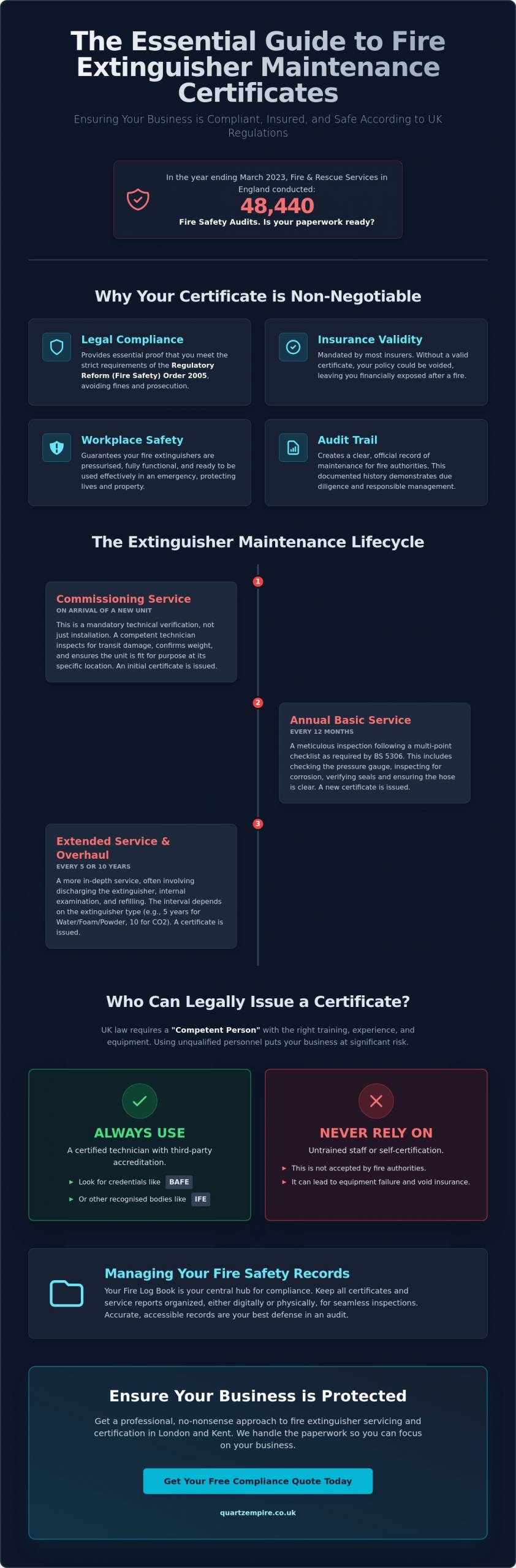
Imagine a Fire Authority officer walks into your London office tomorrow and asks to see your fire extinguisher maintenance certificate. According to Home Office reports, fire and rescue services in England conducted 48,440 fire safety audits in the year ending March 2023. If you're among the many business owners who struggle to locate specific compliance records during an inspection, that request likely triggers immediate anxiety. Keeping your extinguishers functional is vital, but having the accredited proof of that service is what keeps your business legally protected and your insurance valid.
We know that deciphering the technicalities of British Standard 5306 often feels overwhelming. It's difficult to track different service dates across your sites while ensuring every piece of equipment meets current UK regulations. This guide explains everything you need to know about obtaining and managing your certificates to ensure total compliance and workplace safety. You'll gain a clear understanding of the mandatory maintenance schedule and learn how a trusted partner can handle all your fire safety paperwork with a no-nonsense approach.
Key Takeaways
- Understand why a fire extinguisher maintenance certificate is essential for proving legal compliance with the Regulatory Reform (Fire Safety) Order 2005.
- Learn how BS 5306 standards govern both the technical servicing and the strategic positioning of your portable extinguishers.
- Identify the critical maintenance milestones your business must meet, from initial commissioning to the mandatory annual basic service.
- Discover best practices for managing your fire log book and organizing digital or physical records for seamless inspections.
- Find out how businesses in London and Kent benefit from an accredited, no-nonsense approach to fire safety and certification.
What is a Fire Extinguisher Maintenance Certificate?
A fire extinguisher maintenance certificate is a formal document issued by a qualified technician after they complete a scheduled inspection of your safety equipment. It serves as your primary evidence that every fire extinguisher on your premises is in working order and compliant with British Standard BS 5306-3. This document confirms that a professional has tested the pressure, checked the seals, and verified the integrity of the extinguishing agent. It's a vital record for any business owner who prioritises safety and legal adherence.
While a service report provides a granular breakdown of specific repairs or parts replaced, the certificate acts as the official validation of your safety status. Insurance providers typically mandate these certificates to maintain your policy's validity. If a fire occurs and you can't produce a valid fire extinguisher maintenance certificate, your insurer may refuse to pay out, citing a failure to maintain life-saving equipment. This simple piece of paper provides the peace of mind that your business remains protected and insured.
Who is Authorised to Issue a Certificate?
UK fire safety law requires a "competent person" to carry out these inspections. This individual must possess the necessary training, experience, and tools to perform the task safely and accurately. We recommend using technicians with third-party accreditations, such as BAFE (British Approvals for Fire Equipment) or the IFE (Institution of Fire Engineers), to ensure the highest standards. Self-certification is almost never accepted by fire authorities or insurers. Relying on an uncertified staff member to check your equipment leaves your business exposed to significant legal risks and potential equipment failure.
The Legal Framework: Regulatory Reform (Fire Safety) Order 2005
Under the Regulatory Reform (Fire Safety) Order 2005, the "Responsible Person" in a business has a legal duty to ensure all fire safety equipment is maintained in an efficient state. Failure to keep accurate records can lead to unlimited fines or prosecution during a fire service audit. Recent updates to fire safety regulations, including those stemming from the Building Safety Act 2022, place even stricter requirements on documenting safety activities. By 2026, commercial premises will face even more rigorous scrutiny regarding their maintenance logs. Maintaining a clear fire extinguisher maintenance certificate isn't just a recommendation; it's a core statutory requirement for every UK business.
- Compliance: Meets the requirements of the 2005 Fire Safety Order.
- Insurance: Validates your policy and ensures claims are processed.
- Safety: Guarantees that equipment will function in an emergency.
- Accountability: Provides a clear audit trail for fire authorities.
The Maintenance Lifecycle: When are Certificates Issued?
Compliance begins the moment a unit arrives at your premises. A fire extinguisher maintenance certificate serves as a legal audit trail, documenting every stage of a device’s operational life. Under UK fire safety regulations, these documents are issued at specific intervals to prove that equipment remains pressurized, unobstructed, and ready for immediate use. This documentation is vital for demonstrating due diligence to fire officers and insurance providers alike.
Commissioning vs. Installation: The Critical Difference
Many business owners assume a factory-new extinguisher is ready for use immediately. This is a misconception. While installation refers to the physical mounting of the bracket or stand, commissioning is a technical verification required by BS 5306-3. During this process, a technician checks for transit damage, verifies the weight matches the manufacturer’s specification, and ensures the safety pin moves freely. Commissioning is the process of ensuring an extinguisher is fit for purpose at its specific location. Without this initial fire extinguisher maintenance certificate, your insurance coverage may be compromised in the event of a claim.
The Annual Service Inspection Process
A standard service occurs every 12 months. Our technicians follow a meticulous 15 point checklist to ensure reliability. This process includes several critical steps:
- Inspecting the cylinder body for signs of corrosion or denting.
- Checking the discharge hose for blockages or age-related cracking.
- Testing the pressure gauge with a dedicated pump to ensure accuracy.
- Verifying the weight of the unit against its original recorded mass.
Once the unit passes these checks, the technician applies a new anti-tamper seal and updates the service label on the canister. The final documentation is then processed, providing you with a digital or physical record that confirms your site’s compliance for the coming year. If you haven't reviewed your equipment in the last 12 months, it's a good idea to book a professional assessment to identify any overdue units.
Overhaul and Extended Service Requirements
Beyond the yearly check, units require an "Extended Service" or "Overhaul" to maintain their certification. For water, foam, and powder extinguishers, this deep-dive occurs every 5 years. It involves a discharge test where the contents are emptied to inspect the internal lining for signs of failure. CO2 extinguishers are different; they must be sent to an accredited facility every 10 years for a hydraulic pressure test and valve overhaul. If an extinguisher is used or the seal is broken, a new certificate is issued only after a full recharge or repair by a competent person. This rigorous schedule ensures that 100% of your fire safety assets are functional when they are needed most.
Understanding BS 5306 Standards for Extinguisher Maintenance
Compliance in the UK isn't a matter of guesswork. It's governed by the British Standard BS 5306. Specifically, BS 5306-3:2017 provides the code of practice for the commissioning and maintenance of portable fire extinguishers. This standard dictates how a technician must inspect your equipment to ensure it functions during an emergency. Alongside this, BS 5306-8 focuses on the selection and positioning of extinguishers. It ensures you don't just have a working device, but the right type of device in the correct location for the specific risks in your building.
Your fire extinguisher maintenance certificate must explicitly reference these standards to hold any legal weight. If a certificate fails to mention BS 5306 compliance, it won't satisfy fire marshals or insurance providers during an audit. A common misconception among business owners is that all extinguishers follow an identical maintenance timeline. This isn't the case. Maintenance schedules vary significantly based on the contents and pressure mechanisms of the unit. Treating a CO2 canister the same as a water-based unit is a frequent error that leads to non-compliance.
Key Components of a BS 5306 Compliant Certificate
A professional report is more than a simple receipt. It serves as a legal record of your commitment to safety. Every valid fire extinguisher maintenance certificate must include the business name, the site address, and a unique technician ID, often linked to an accreditation body like BAFE. The document should provide a full inventory of equipment, noting the location and type of each unit.
- Pass/Fail Status: Each individual unit must have a clear status listed on the report.
- Remedial Work: If a unit fails, the technician must document the specific reasons and the recommended actions to rectify the issue immediately.
- Service Date: The report must show the exact date of inspection and the date the next annual service is due.
Maintenance Intervals by Extinguisher Type
Different fire-fighting agents require different levels of technical care. While all extinguishers require an annual basic service, the requirements for deeper inspections diverge at the five and ten-year marks. Water, foam, and powder units require an "Extended Service" every five years. This involves a discharge test to ensure the internal lining is intact and the contents haven't settled or degraded. It's a vital step for reliability in a crisis.
CO2 extinguishers operate under much higher pressure than water-based units. They don't require the five-year discharge test. Instead, they must undergo a comprehensive overhaul every ten years. This involves a hydraulic pressure test, often performed at a specialist facility, to ensure the cylinder can still safely hold its contents. Following these specific timelines is the only way to maintain a reliable and compliant fire safety strategy for your premises.
Managing Your Fire Safety Records and Log Book
Your fire extinguisher maintenance certificate is only effective if you can produce it during an inspection. This document serves as legal evidence that you've met your obligations under the Regulatory Reform (Fire Safety) Order 2005. You must store these certificates within your building’s Fire Log Book. This log book acts as the master record for every safety activity on-site, from alarm tests to emergency lighting checks. It's the first thing an enforcement officer will ask to see.
Effective record management requires a dual approach. While digital copies are easier to share, physical copies are essential if power or internet access fails during an audit. Use this checklist to ensure your records remain compliant:
- Physical Storage: Keep a hard copy in a fire-resistant folder near the fire alarm panel or main entrance.
- Digital Backups: Store scanned copies in a dedicated cloud folder accessible by multiple members of the management team.
- Accessibility: Ensure the "Responsible Person" on-site knows exactly where the folder is kept at all times.
- Retention: Legally, you should retain your fire extinguisher maintenance certificate for at least five years. This demonstrates a consistent history of compliance rather than a one-off effort.
The Importance of a Fire Log Book
A Fire Log Book is the central repository for all safety records. Your fire risk assessments inform your extinguisher maintenance schedule by identifying specific hazards that might require more frequent checks. Best practice involves logging monthly "user checks" alongside your annual professional certificates. These monthly checks are simple visual inspections of pins, tags, and pressure gauges. Documenting these ensures there are no gaps in your safety history between professional visits.
Preparing for a Fire Safety Audit
The London Fire Brigade (LFB) conducted over 16,000 fire safety audits in 2022/23. During an inspection, an officer will typically ask for three documents immediately: your current Fire Risk Assessment, staff training records, and your Fire Log Book. You must ensure your fire extinguisher maintenance certificate lists the unique ID numbers and locations for every unit on the premises.
Inspectors frequently cross-reference these ID numbers against the physical equipment. A common pitfall is having perfectly maintained extinguishers but losing the paperwork. If you cannot prove the service took place, the LFB may treat the equipment as non-compliant. This can lead to formal enforcement notices or even prosecution in cases of severe negligence. Keep your paperwork as organized as your equipment to avoid these risks.
Ensure your business stays compliant and audit-ready. Contact Quartz Empire today to book your professional extinguisher service and documentation review.
Professional Extinguisher Servicing in London and Kent
Finding a reliable service provider in London or Kent shouldn't be a headache. Quartz Empire acts as your trusted partner, delivering a no-nonsense approach to fire safety. We ensure your business stays on the right side of the law without unnecessary jargon or hidden costs. Our team understands that compliance is a non-negotiable part of business operations in the South East. We don't just tick boxes; we provide a thorough assessment of your site's specific risks. By integrating your extinguisher checks with fire alarm maintenance, you streamline your safety schedule. This consolidated strategy reduces site visits and ensures every component of your fire strategy works in harmony. Our expert technicians provide the professional documentation required to issue your fire extinguisher maintenance certificate, giving you absolute peace of mind.
Why Use a BAFE Accredited Provider?
Using a BAFE accredited provider isn't just a recommendation; it's a mark of quality. The BAFE SP101 scheme ensures that every technician who visits your site is competent and regularly assessed. We undergo rigorous third-party auditing to maintain this accreditation, proving our commitment to BS 5306 standards. For businesses across London and Kent, this means you receive service from professionals who understand the specific demands of South East commercial properties. You won't have to worry about whether your equipment will fail during an inspection or, more importantly, an emergency. This accreditation guarantees:
- Technicians have passed formal written exams on fire safety standards.
- Field assessments are conducted regularly by independent bodies.
- The company maintains a robust quality management system.
- Compliance with the latest British Standards is strictly monitored.
Get Your Compliance Certificate with Quartz Empire
Booking your annual service is a straightforward process. Once our team completes the inspection, we provide a digital fire extinguisher maintenance certificate. This electronic record offers instant proof of compliance for insurance providers and fire authorities. It's stored securely in our systems, so you'll never lose your paperwork again. We manage the scheduling and send reminders so you don't have to remember when your next visit is due. Our no-nonsense approach means we identify issues and fix them promptly, ensuring your business remains fully protected 365 days a year. Book your fire extinguisher maintenance with our expert team today and let us handle the technical details while you focus on running your business.
Protect Your Workplace and Ensure Compliance
Maintaining fire safety isn't just about ticking a box. It's about ensuring your equipment functions during an emergency. Under BS 5306 standards, your business must hold a valid fire extinguisher maintenance certificate to prove legal compliance and satisfy insurance requirements. This document confirms that a professional has inspected every unit on your site within the last 12 months. Neglecting these checks puts your staff at risk and leaves your business vulnerable to legal penalties. Quartz Empire acts as a trusted partner for businesses across London and Kent. We take a no-nonsense approach to fire safety, ensuring your records are always up to date. Our BAFE SP101 Accredited Technicians handle everything from annual servicing to detailed logbook management. We focus on the technical details so you can focus on running your company. Secure your business compliance; book your fire extinguisher service today. It's the simplest way to gain peace of mind and keep your workplace safe.
Frequently Asked Questions
Is a fire extinguisher maintenance certificate a legal requirement?
Yes, a fire extinguisher maintenance certificate is essential to demonstrate compliance with the Regulatory Reform (Fire Safety) Order 2005. While the law doesn't explicitly name a "certificate," Article 17 requires all fire safety equipment to be maintained by a competent person. This document serves as your legal proof during a Fire and Rescue Service inspection or for insurance claims. It shows you've met your duty of care to protect staff and visitors.
How long does a fire extinguisher maintenance certificate last?
A certificate lasts for exactly 12 months from the date of the inspection. British Standard 5306-3:2017 dictates that fire extinguishers must be serviced annually by a qualified technician to remain compliant. Once this period expires, your equipment is no longer considered reliable in the eyes of the law. You should schedule a new inspection at least 30 days before the anniversary of your last certificate to maintain continuous safety coverage.
Can I issue my own fire extinguisher certificate if I am the business owner?
You can only issue a certificate if you're a "competent person" with the specific training, tools, and qualifications required by UK standards. Most business owners don't meet the strict criteria defined in BS 5306-3. Hiring an accredited professional ensures the work meets rigorous safety benchmarks. It also protects you from personal liability and potential prosecution if the equipment fails during an emergency. It's a matter of safety and legal accountability.
What happens if I lose my fire extinguisher maintenance certificate?
You should contact your service provider immediately for a digital or physical replacement if you lose your document. Accredited companies like Quartz Empire keep records of all maintenance visits for a minimum of 5 years. Without this paperwork, you won't be able to prove compliance during a fire risk assessment or when renewing your commercial insurance policy. Keeping a digital backup in your fire safety logbook is a reliable way to avoid this issue.
Does a new fire extinguisher need a certificate immediately?
Yes, every new fire extinguisher requires a commissioning service and certificate before it's installed in your building. BS 5306-3 states that extinguishers must be checked on-site to ensure they weren't damaged or discharged during transit. A technician will verify the weight, pressure, and safety components. They then issue a fire extinguisher maintenance certificate to confirm the unit is ready for use and correctly positioned for your specific fire risks.
How much does it cost to get a fire extinguisher maintenance certificate?
The cost of obtaining a certificate depends on the number of units and the type of extinguishers being serviced at your premises. Most providers charge a basic call-out fee plus a fixed rate per extinguisher. Industry data from 2023 shows that basic service charges often start from £50 for small sites with a few units. You should request a transparent, no-nonsense quote to avoid hidden fees for replacement parts like O-rings or tamper seals.
What is the difference between a service label and a certificate?
A service label is a sticker attached to the individual extinguisher, whereas a certificate is a comprehensive document covering all equipment on your site. The label provides a quick reference for the last inspection date and the technician's details. The certificate acts as your official legal record for the building fire safety logbook. You need both to be fully compliant with UK fire safety regulations and to satisfy insurance requirements.
Do I need a certificate for every single extinguisher in my building?
You don't need a separate certificate for every unit; a single document typically lists every extinguisher inspected during the technician's visit. The technician records the location, type, and status of each device on one master certificate. This consolidated report makes it easier for facilities managers to track maintenance schedules across large sites in Kent or London. It provides a clear overview of your entire fire protection inventory in one place.