
Business Alarm Systems London: The 2026 Guide to Commercial Security & Compliance

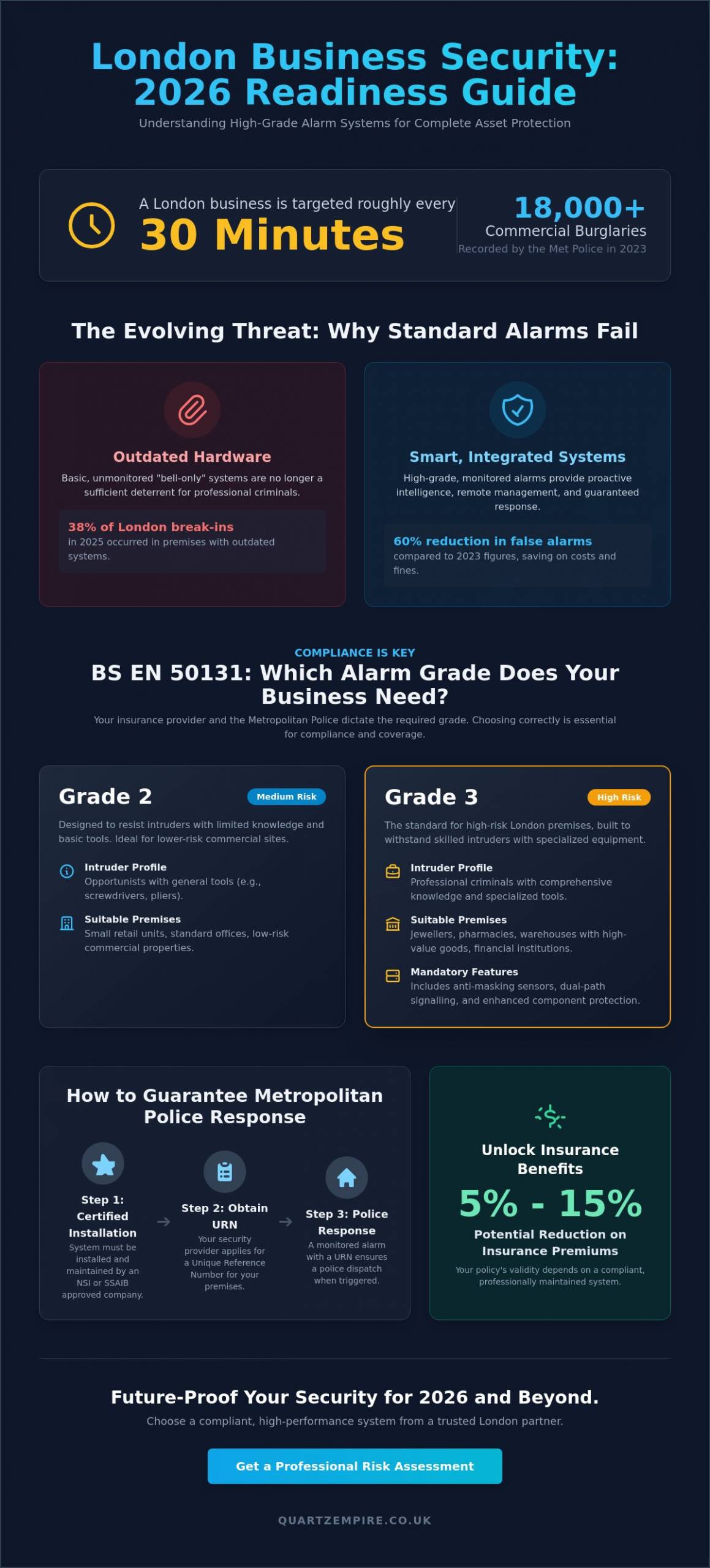
In 2023, the Metropolitan Police recorded over 18,000 commercial burglaries across the capital, which means a London business is targeted roughly every 30 minutes. You likely feel the weight of rising insurance premiums and the constant risk of urban crime. It's frustrating to manage complex security requirements while trying to avoid the heavy fines associated with false alarms. You need a system that's both a reliable deterrent and a tool for total regulatory compliance.
This guide helps you protect your premises with high-grade business alarm systems london that provide 24/7 peace of mind. We'll show you how to satisfy your insurers, integrate remote smartphone monitoring, and choose a no-nonsense maintenance partner to keep your equipment certified. You'll gain a clear understanding of how to safeguard your assets and ensure your security strategy is future-proofed for 2026 and beyond. We focus on delivering the facts so you can make an informed, confident choice for your company's safety.
Key Takeaways
- Understand why basic security is no longer sufficient for the evolving 2026 landscape and how high-grade systems protect your commercial assets.
- Navigate the technical requirements of BS EN 50131 standards to determine whether your premises requires a Grade 2 or Grade 3 system for full compliance.
- Discover the essential steps to obtaining a Unique Reference Number (URN) to guarantee a Metropolitan Police Service response when your alarm is triggered.
- Learn how to integrate business alarm systems london with modern access control to create a unified security hub that simplifies site management.
- Compare monitored and unmonitored solutions to see how a 24/7 Alarm Receiving Centre (ARC) provides a critical layer of protection for your property.
The Evolving Security Landscape for London Businesses in 2026
London's commercial environment is changing rapidly, demanding a shift in how we approach asset protection. By 2026, the density of the city and the sophistication of urban threats mean that a basic bell-only alarm is no longer a viable deterrent. High-grade Security alarm systems are now the baseline for any enterprise operating in the capital. These systems don't just react to a breach; they provide a proactive layer of intelligence that protects physical assets and staff safety.
Modern business alarm systems london must address the specific challenges of a high-footfall metropolis. Data from 2025 showed that 38% of commercial break-ins in London occurred in premises using outdated, unmonitored hardware. To counter this, businesses are moving toward smart, app-integrated solutions. Remote management allows facilities managers to monitor multiple sites from a single interface, providing real-time alerts and video verification. This shift has reduced false alarm call-outs by 60% compared to 2023 figures, saving businesses significant operational costs.
Why a "Standard" Alarm Isn’t Enough for London
There's a critical gap between residential-grade hardware and commercial-grade systems. While a home alarm might suffice for a quiet suburb, it won't withstand the professional tampering methods seen in high-risk urban areas. Commercial systems utilize Grade 3 or Grade 4 components, featuring anti-masking sensors and dual-path signalling to ensure the signal reaches the monitoring station even if phone lines are cut. Engaging an unaccredited installer to save on initial costs often leads to system vulnerabilities that criminals can easily exploit. For a robust defense, you need a security systems ecosystem that integrates intrusion detection with access control and CCTV.
The Impact of Commercial Security on Insurance
London insurers have become increasingly stringent about security requirements over the last year. They don't just look for an alarm; they look for professional certification. Installing high-specification business alarm systems london can lead to premium reductions of between 5% and 15% depending on your sector. This financial benefit is only accessible if the system meets specific UK standards. It's vital to remember that your insurance policy's validity depends on your system being installed and maintained by an NSI or SSAIB-approved company.
Quartz Empire Fire & Security Ltd takes a no-nonsense approach to these requirements. We ensure your installation isn't just a box-ticking exercise but a reliable shield for your business. As a trusted partner for firms across London, we focus on providing compliant, high-performance systems that meet the rigorous demands of the 2026 security climate. Our team understands that for a London business, peace of mind comes from knowing your security is handled by experts who understand the local landscape.
Understanding Commercial Alarm Grades and Standards
The foundation of any robust security strategy lies in compliance with BS EN 50131. This European standard categorises intruder alarm systems into four distinct grades based on their resilience and the level of risk they manage. For business alarm systems london, selecting the correct grade is not a choice but a requirement dictated by your insurance provider and the Metropolitan Police. A professional risk assessment evaluates the value of your assets, the building's physical vulnerabilities, and the likely sophistication of an intruder to determine the necessary grade.
A system's grade affects every component, from the control panel to the motion sensors and the signalling method used to alert the authorities. If your system fails to meet the grade specified in your insurance policy, your coverage may be void in the event of a claim. Most London commercial properties fall under Grade 2 or Grade 3, while Grade 1 is typically reserved for domestic properties with no insurance requirements.
Grade 2 vs. Grade 3: Which Does Your Business Need?
Choosing between Grade 2 and Grade 3 depends on the threat level your business faces. Grade 2 systems are designed to resist intruders with limited knowledge and basic tools. These are common in low-to-medium risk environments, such as small retail units or offices without high-value stock. They cover most entry points but offer less protection against sophisticated bypass attempts.
Grade 3 is the standard for high-risk London premises. This includes jewellers, warehouses, and pharmacies where intruders might use advanced tools or attempt to interfere with the system's electronics. Grade 3 systems include more rigorous anti-masking technology on sensors to detect if someone has covered them. While Grade 4 exists for ultra-high-risk sites like bullion stores or banks, it's rarely required for standard commercial operations. Your trusted partner will help you identify the specific grade that ensures both safety and compliance.
The Role of NSI and SSAIB Accreditations
Accreditation is the only way to verify that an installer meets the stringent requirements of the UK security industry. The National Security Inspectorate (NSI) and the Security Systems and Alarms Inspection Board (SSAIB) are the two primary bodies that audit security companies. They ensure that every installation follows the PD6662:2017 framework, which is the UK's interpretation of European alarm standards.
- Police Response: The Metropolitan Police will only issue a Unique Reference Number (URN) for systems installed and maintained by an accredited firm. Without this, you won't receive a prioritised police response.
- Insurance Validity: Most commercial insurers in the UK demand NSI or SSAIB certification as a condition of the policy.
- Reliability: Accredited companies undergo regular inspections to ensure their technical proficiency and staff vetting processes remain at the highest level.
Working with a certified expert removes the guesswork from security. It ensures your system is fit for purpose and provides the peace of mind that comes from knowing your property is protected by a fully compliant solution.
Comparing Monitored vs. Unmonitored Business Alarms
Selecting the right configuration for business alarm systems london involves weighing immediate response against initial cost. A standard bells-only system relies entirely on a high-decibel external siren to deter intruders. While effective for very low-risk sites, these systems depend on members of the public or staff to report the incident. In high-density commercial areas, sirens are frequently ignored, which creates a significant security gap. Statistics show that up to 33% of people ignore building alarms, assuming they are false triggers.
Professional monitoring shifts the responsibility from the public to an Alarm Receiving Centre (ARC). These accredited facilities operate 24/7, 365 days a year to oversee your premises. When a sensor triggers, the ARC receives a signal within seconds. Trained operators verify the threat and contact the relevant keyholders or emergency services. For London SMEs, this service is often a mandatory requirement for insurance compliance, particularly for Grade 2 and Grade 3 systems. Modern monitoring utilizes dual-path signalling, which uses two independent paths like IP and GPRS to ensure the ARC receives an alert even if a phone line is cut. Anti-masking technology adds another layer of protection by detecting if an intruder has covered a sensor with tape or spray paint to bypass detection.
The cost-benefit analysis for a London-based business is clear. While monitoring carries a monthly fee, it prevents the total loss of stock and equipment. A verified alarm also qualifies for a police response via a Unique Reference Number (URN), a priority that unmonitored systems don't receive under National Police Chiefs' Council (NPCC) policies.
The Benefits of 24/7 Professional Monitoring
Professional oversight provides a reliable filter against false alarms, which account for over 90% of all initial triggers in the UK. Operators use sequential verification to confirm a break-in before alerting the police, ensuring your URN remains valid and active. This system provides essential peace of mind for business owners when the premises are vacant. Dual-path monitoring prevents signal jamming by automatically switching to a secondary cellular frequency if the primary connection is blocked by a malicious device.
Self-Monitoring via Smart Apps
Smart apps allow you to integrate business alarm systems london with your smartphone for real-time notifications and remote control. You can arm or disarm the system and view event logs from any location. However, self-monitoring has limitations; you might miss a notification during a meeting or in an area with poor signal. We recommend using app-based control as a complement to ARC monitoring. This hybrid approach ensures you stay informed while an expert team manages the critical emergency response.
Compliance and Metropolitan Police Response Requirements
Operating business alarm systems london requires more than just high-end hardware; it demands strict adherence to the Metropolitan Police Service (MPS) requirements. Compliance isn't a suggestion. It's a prerequisite for police attendance. To receive a Level 1 police response, your system must have a Unique Reference Number (URN). The MPS only issues these numbers to systems installed and maintained by companies accredited by bodies like the NSI or SSAIB. Without this registration, your alarm is essentially a "bells-only" system, which the police will not attend unless a 999 call from a witness confirms a crime is in progress.
The legal landscape also includes the Health and Safety at Work Act 1974. This legislation requires business owners to ensure the safety of employees and visitors. A failing security or fire system isn't just a technical glitch; it's a breach of your duty of care. We provide the documentation necessary to prove your systems are functional during local authority or insurance inspections, keeping your business on the right side of the law.
How to Secure and Keep Police Response
Securing a URN involves a formal application through your service provider, typically costing £52.00 plus VAT per element as of 2024. Keeping it is harder. The MPS enforces a strict "two strikes" policy. If your system triggers two false alarms within a rolling 12-month period, your police response is downgraded or suspended. Reinstating it requires a 90-day period of zero false activations and a certificate of compliance from your engineer. We manage this process for you, ensuring your system meets the NPCC Security Systems Policy standards to avoid these costly suspensions.
Maintenance as a Legal and Functional Necessity
Preventative maintenance is the only way to guarantee reliability. We recommend that fire alarm servicing and intruder maintenance are scheduled together. This holistic approach ensures every sensor, battery, and communication link is tested bi-annually. Our no-nonsense approach focuses on identifying component wear before it causes a false alarm. We provide digital logs for every visit. These records are vital for insurance claims, as many providers will reject a claim if you can't prove the business alarm systems london were professionally maintained at the time of a break-in.
Reliability is built through consistency. Regular servicing doesn't just stop false alarms; it extends the lifespan of your investment. By catching a failing backup battery or a loose PIR sensor during a scheduled visit, you avoid the high costs of emergency midnight call-outs and potential fines from the local council for noise nuisance. Our team focuses on keeping your premises secure and your compliance records spotless.
Designing an Integrated Security Strategy with Quartz Empire
Modern security requires more than just a standalone siren on an external wall. As we move into 2026, the standard for business alarm systems london has shifted toward unified security hubs. At Quartz Empire, we don't believe in isolated components. We design systems where every piece of hardware communicates, creating a proactive shield rather than a reactive alert. This approach ensures your premises remain secure while simplifying the daily management of your site.
The Power of System Integration
True efficiency is found when you link your access control directly with your intruder detection. This integration allows for automated arming and disarming based on staff movements. For instance, when the last authorised person swipes out of a zone using a Paxton reader, the alarm can automatically arm that specific area. This reduces human error and has been shown to cut false alarm call-outs by approximately 40 percent in commercial settings.
Visual verification is another critical benefit of our integrated strategy. By linking CCTV triggers with alarm events, our systems provide immediate video snapshots to your mobile device or a central monitoring station the moment a sensor is tripped. This allows for instant confirmation of a breach. Additionally, using a single provider for fire and security streamlines your compliance. You'll have one point of contact for all certified inspections, ensuring your NSI or SSAIB standards are met without managing multiple contractors.
- Auto-Arming: System zones arm themselves based on real-time occupancy data.
- Visual Evidence: CCTV cameras automatically pivot to alarm trigger points for instant verification.
- Simplified Compliance: One maintenance contract covers both fire safety and intruder detection.
Why London Businesses Trust Quartz Empire
Our reputation is built on a no-nonsense approach to customer service. We understand the unique pressures of operating in Kent, London, and the South East, where response times and reliability are non-negotiable. We don't provide "off-the-shelf" kits. Instead, we follow a bespoke design process that begins with a meticulous site survey to identify specific vulnerabilities in your building's layout.
Choosing Quartz Empire means opting for a trusted partner model rather than a one-off installation. We stay with you long after the initial setup, providing scheduled maintenance and 24/7 support to ensure your business alarm systems london remain fully operational. Our engineers are highly trained and work with industry-leading brands like Hikvision and Paxton to deliver accredited, reliable protection. We're committed to keeping your people and property safe through expert engineering and straightforward, honest advice. Contact our team today to book your professional security assessment.
Future-Proof Your Commercial Security Strategy
Protecting your commercial assets requires more than a basic deterrent. By 2026, the Metropolitan Police Service requires businesses to strictly follow the NPCC Security Systems Policy to maintain a Level 1 police response. You've now seen how Grade 2 and Grade 3 business alarm systems london provide the specific protection levels needed to counter modern threats. Meeting BS EN 50131 standards isn't just a safety measure; it's a requirement for insurance validity and long-term operational continuity in a busy capital.
Quartz Empire delivers NSI and SSAIB compliant installations that meet these 2026 benchmarks. Our expert engineers cover London and Kent, acting as a trusted partner for commercial fire and security. We take a no-nonsense approach to your safety, ensuring every sensor and monitoring link functions perfectly. It's about more than hardware; it's about having a reliable system that responds when it matters most.
Secure your London business with a professional alarm system quote from Quartz Empire. We're ready to help you build a safer, more resilient workspace today.
Frequently Asked Questions
Do London businesses legally require a monitored alarm system?
London businesses aren't legally required to have a monitored alarm by a single statute, but most commercial insurance policies mandate them for coverage. Under the Regulatory Reform (Fire Safety) Order 2005, you must ensure your premises are safe for all occupants. A monitored system provides the 24/7 oversight needed to meet these risk assessment obligations. It's the most reliable way to secure your property when it's vacant at night or during weekends.
How often should a commercial intruder alarm be serviced in the UK?
You should have your commercial intruder alarm serviced twice every 12 months if it's a monitored system. This follows BS EN 50131 standards and is often a strict requirement of your insurance provider to maintain your policy's validity. If your system is audible only, a single annual inspection is the minimum industry standard. Regular maintenance by an accredited expert ensures your business alarm systems London remain fully compliant and operational.
What is the difference between a Grade 2 and Grade 3 alarm system?
The primary difference is the level of security and the type of property they're designed to protect. Grade 2 systems are suitable for low to medium risk environments like residential homes or small retail units with limited entry points. Grade 3 systems are built for higher risk commercial premises, such as warehouses or offices with high value stock. These sensors are more sophisticated and can detect if someone is trying to mask or tamper with the equipment.
Will the police automatically respond to my business alarm in London?
The Metropolitan Police won't automatically respond to a standard bell only alarm. To receive a police response in London, your system must be monitored by an Alarm Receiving Centre (ARC) and hold a valid Unique Reference Number. Even then, the police prioritize calls based on confirmed activity to avoid wasting resources on false alarms. This professional monitoring ensures that emergency services are only dispatched when there's a genuine threat to your property.
Can I integrate my business alarm with my existing CCTV system?
You can definitely integrate your alarm with existing CCTV systems using modern IP technology. This allows your security team to visually verify an intruder the moment a sensor is triggered. We often recommend brands like Hikvision or Paxton to create a unified security network that's easy to manage. Integration provides a more comprehensive layer of protection and simplifies the management of your London office security through a single interface.
What happens to my insurance if my alarm system is not accredited?
If your alarm system isn't installed by an accredited provider, your insurance policy might be void in the event of a claim. Insurers usually require systems to be fitted and maintained by NSI or SSAIB certified companies to ensure they meet British Standards. In the event of a break in, the insurer can refuse to pay out if the equipment doesn't meet the specific security grade. Non-certified systems can also lead to higher premiums compared to businesses with accredited protection.
How much does a commercial alarm system cost for a London office?
Costs for a commercial alarm system in London vary based on the size of the premises and the required security grade. According to 2023 industry data from Checkatrade, basic commercial installations often start around £800, but complex Grade 3 systems for larger offices will be higher. You should also factor in ongoing monitoring fees, which are essential for police response. We provide tailored quotes to ensure you get a reliable, cost effective solution for your specific site.
What is a URN and why does my business need one for security?
A Unique Reference Number (URN) is a specific code issued by the police to identify your individual security system. Your business needs a URN to qualify for a Level 1 police response, which is the highest priority for verified alarms. Without this number, the Metropolitan Police won't attend a site unless a member of the public reports a crime in progress. It's a vital component for any professional business alarm systems London setup that requires emergency service intervention.