
Fire Alarm Weekly Test Procedure: The Complete Guide for UK Businesses

Could a simple oversight during your Friday morning routine lead to a £350 fine for an accidental fire brigade call-out? Maintaining a safe workplace shouldn't feel like a legal minefield. We know that many business owners in Kent and London find the fire alarm weekly test procedure confusing, especially when trying to meet the strict requirements of BS 5839-1:2017. It's frustrating to feel uncertain about whether your records would stand up to scrutiny during a professional safety inspection or an insurance claim.
As your trusted partner in safety, Quartz Empire Fire & Security Ltd takes a no nonsense approach to compliance. We've created this guide to help you master a reliable testing routine that protects your people and your property. You'll gain a clear, repeatable process for your staff to follow, ensuring your premises remain fully compliant with UK fire safety law at all times. We'll walk you through the step by step testing sequence, explain how to record your findings to satisfy insurance providers, and show you how to maintain total confidence in your building's safety systems.
Key Takeaways
- Understand your legal obligations under the Regulatory Reform (Fire Safety) Order 2005 to ensure your business remains fully compliant and protected.
- Master the correct fire alarm weekly test procedure by rotating manual call points and using the appropriate test keys for your specific system type.
- Learn why verifying ancillary devices, such as magnetic door holders, is a critical step in maintaining a reliable and expert safety network.
- Discover how to accurately document results in your logbook and distinguish between minor faults and critical system failures for total peace of mind.
- Gain the confidence to fulfill your role as a "Responsible Person," ensuring your premises meet UK safety standards through a meticulous approach to maintenance.
Why the Fire Alarm Weekly Test Procedure is Legally Required
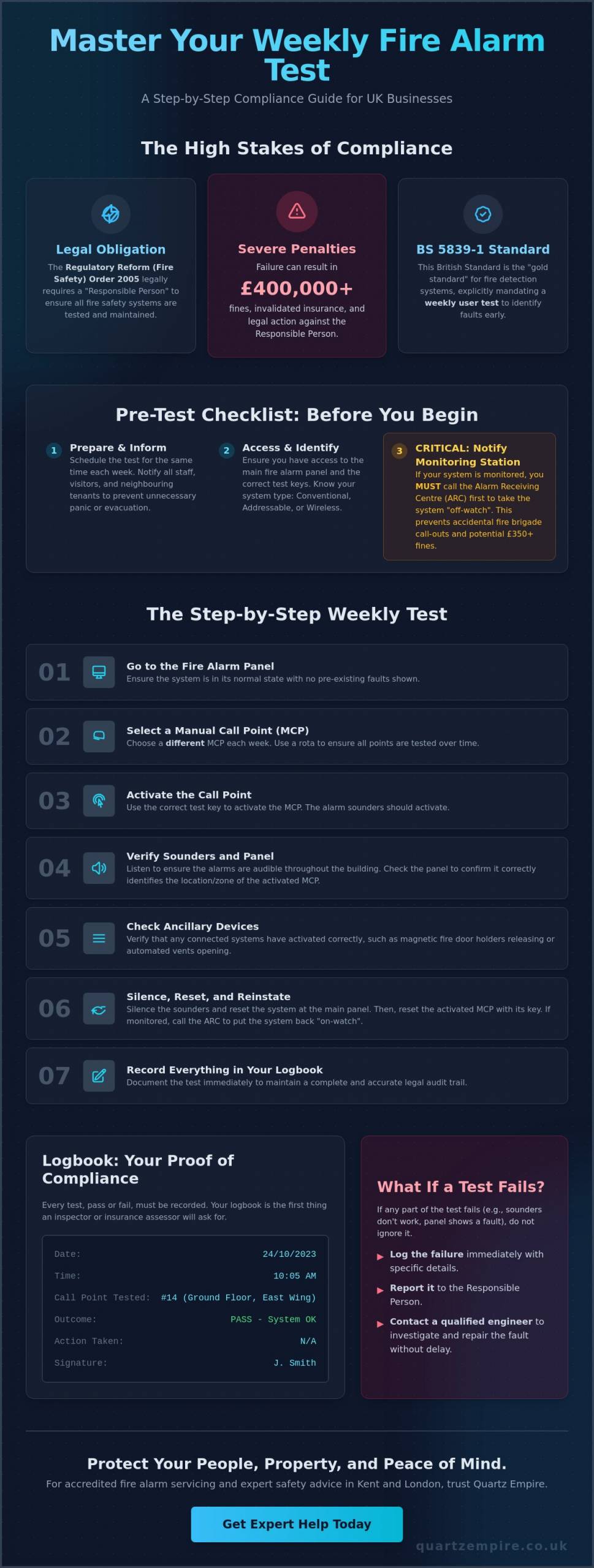
Under the Regulatory Reform (Fire Safety) Order 2005, every UK business must ensure their premises are safe for employees, visitors, and contractors. This legislation isn't a suggestion; it's a legal mandate that places the burden of safety on a specific individual. Failing to follow a consistent fire alarm weekly test procedure can lead to devastating consequences during an emergency. It's about more than just checking a box. It's about ensuring your fire alarm system functions exactly as intended when seconds matter most.
The "Responsible Person" is the individual, usually the employer or building owner, legally accountable for fire safety compliance within a UK business premises. This role carries heavy weight. If a fire occurs and you haven't maintained records of regular testing, you face severe legal repercussions. In recent years, UK courts have issued unlimited fines for fire safety breaches, with some penalties exceeding £400,000 for high-risk failings. Beyond fines, non-compliance often leads to invalidated insurance policies. If you can't prove your system was tested, your insurer may refuse to pay for fire damage, leaving your business financially vulnerable.
BS 5839-1: The Gold Standard for Fire Safety
BS 5839-1 is the British Standard that provides the technical framework for fire detection in commercial buildings. It defines the "gold standard" for how systems are designed, installed, and maintained. While professional servicing is required every six months, BS 5839-1 explicitly demands a weekly user test. This weekly check identifies faults like battery failures or faulty sounders before they become critical issues. Your fire risk assessment dictates the specific testing regime for your site. A large warehouse in Kent will have different requirements than a small retail unit in London, but the weekly frequency remains a constant requirement for almost all commercial premises.
The Role of the Designated Fire Warden
A designated fire warden or a trained staff member should carry out the fire alarm weekly test procedure. They don't need to be electrical engineers, but they must understand how to operate the control panel and reset the system safely. Consistency is the most important factor here. You should conduct the test at the same time and day each week to ensure staff are familiar with the sound and don't mistake a test for a real evacuation.
- Training: Wardens must know how to activate different call points on a rotational basis.
- Documentation: Every test must be recorded in a dedicated fire logbook to provide a legal audit trail.
- Fault Reporting: If a test reveals a failure, the warden must know how to contact an accredited service provider immediately.
By maintaining a disciplined approach to these checks, you protect your people and your property. Quartz Empire Fire & Security Ltd acts as your trusted partner, providing the expert guidance and accredited servicing needed to keep your business fully compliant and secure.
Pre-Test Preparation: What to Do Before Activating the Alarm
Effective preparation is the foundation of a reliable fire alarm weekly test procedure. Before you trigger any sounders, you must identify whether your building uses a conventional, addressable, or wireless system. Conventional systems use zones to indicate the location of a fire; addressable systems provide a specific device description on the panel. Wireless systems rely on radio frequencies. Knowing your system type ensures you use the correct panel codes and reset procedures without delay. You should also verify that you have full access to the control panel and all necessary test keys before starting. This preparation helps you fulfill your workplace fire safety responsibilities while maintaining a calm environment for your staff.
Communication is equally vital. You must notify all occupants, including visitors and contractors, of the scheduled test time. Clear communication prevents panic and ensures that people don't evacuate unnecessarily. If your business operates in a shared building, inform neighbouring tenants to avoid confusion. A simple announcement over a PA system or a scheduled email can save significant time and prevent business disruption.
Notifying Your Fire Monitoring Station
If your system is monitored by an Alarm Receiving Centre (ARC), this is the most critical step. A local alarm only sounds within the building; a monitored system sends a signal to a remote station that may automatically call the Fire and Rescue Service. According to Home Office data for the year ending March 2023, false alarms accounted for 39% of all incidents attended by fire services in England. You must call your monitoring provider and put the system "on test" to prevent these costly, unnecessary call-outs. Provide your account ID and security passcode to the operator and specify how long the test will last. Once the test is complete, remember to call them again to put the system back into "live" mode.
Equipment Checklist for the Responsible Person
The "Responsible Person" must have the right tools ready to ensure the test is compliant and efficient. Different manufacturers use specific manual call point (MCP) test keys. You should have a complete set on a dedicated keyring to avoid searching for them during the test. Your equipment list must include:
- A physical or digital fire alarm logbook to record the date, time, and specific call point tested.
- A set of manufacturer-specific MCP test keys (e.g., KAC, Gent, or Apollo).
- The master user code or key for the main fire alarm control panel.
- A rotation plan that ensures a different call point is tested every week.
A structured rotation plan is essential because it guarantees that every device in your building is functional over a set cycle. If you're unsure if your current equipment meets British Standards, you can get in touch with our team for professional guidance on system maintenance and compliance.
Step-by-Step: Carrying Out the Weekly Fire Alarm Test
Executing the fire alarm weekly test procedure requires a methodical approach to satisfy both legal requirements and safety standards. You aren't just making noise; you're verifying that the entire communication chain of the system functions correctly. This process ensures that every occupant in your Kent or London premises remains protected. Following these steps consistently provides the peace of mind that your equipment is reliable and fully compliant with BS 5839-1 standards.
Activating the Manual Call Point
The test begins at a manual call point (MCP), often referred to as a "break glass" unit. It's vital to select a different MCP each week on a rotational basis. If your building has 15 different units, your rotation cycle will last 15 weeks. This ensures that every single device in the building is eventually tested for functionality. To trigger the alarm, don't break the glass. Instead, insert the specialized plastic test key into the slot at the bottom or side of the unit. This slides the internal element down to simulate an activation.
Once the alarm sounds, check the fire alarm control panel immediately. You must verify that the specific zone where you triggered the MCP is the one identified on the display. If you activate a device in the "Warehouse" but the panel indicates "Reception," your system's zone mapping is incorrect. This is a serious compliance issue that requires an expert engineer to rectify. Accurate identification is critical for emergency services to locate a fire quickly.
Interpreting the Fire Alarm Control Panel
After confirming the sounders are audible in all areas of the building, return to the panel to manage the signals. You'll typically see a bright red "Fire" indicator. Your first action is to press the "Silence" button. This stops the internal buzzer and the external sounders but keeps the system in an active alarm state. Only after the sounders are quiet should you press the "Reset" button to clear the event memory.
- System Normal: This is the goal. It's usually indicated by a single green power LED and an absence of amber fault lights.
- Fault Indicators: If an amber light appears, the system has detected an internal issue like a battery failure or a wiring loop break.
- Failure to Reset: If the panel refuses to clear, the MCP key might still be inserted, or the resettable element hasn't clicked back into place.
If your system is monitored by an Alarm Receiving Centre (ARC), your final step is to contact them. Confirm they received the test signal and notify them that the system is back in "Normal" mode. Failure to do this can lead to accidental emergency service call-outs. In the UK, false alarms account for roughly 40% of all fire and rescue service incidents, so clear communication with your ARC is a hallmark of a responsible business owner. Once confirmed, record the result in your fire safety logbook to maintain your legal audit trail.
Checking Ancillary Devices and Fire Safety Systems
A robust fire alarm weekly test procedure involves much more than listening for a siren. While the sounders confirm the panel is communicating with the audible devices, they don't account for the physical barriers that protect your escape routes. Your fire alarm acts as the central brain of the building's safety infrastructure. It must signal ancillary devices to act instantly. If a magnetic door holder fails to release, a fire door remains open, allowing smoke to bypass a compartment and enter a protected stairwell. This single failure compromises the entire safety strategy for your premises in Kent or London.
Reliable fire safety depends on every component working in unison. According to the Fire Door Inspection Scheme (FDIS) 2022 data, 75% of fire doors inspected in the UK failed to meet the required standards. Many of these failures relate to hardware issues that are only identified when the alarm is triggered. You must verify that the fire alarm panel effectively drops power to all magnetic locks and hold-open devices every single week.
Fire Doors and Magnetic Hold-Open Devices
During your test, walk the site to confirm every magnetic holder releases. Fire doors must close fully into the rebate without assistance. Check for obstructions like door wedges or furniture that staff might have placed in the way. The integrity of intumescent seals and hinges is vital; a door that doesn't close flush won't hold back smoke for its rated 30 or 60 minutes. These devices are frequently integrated with your access control systems. If the alarm triggers, these systems must fail-safe to an open position to allow an unhindered exit for all occupants.
Lifts, Shutters, and Ventilation Systems
Complex buildings require additional checks to remain compliant with the Regulatory Reform (Fire Safety) Order 2005. Lifts must return to the ground floor and stay out of service with the doors open. This prevents people from becoming trapped in a lift shaft during a fire. Fire shutters must descend at a controlled rate without manual intervention to protect shopfronts or canteen hatches. It's essential that your integrated security systems work as a single, cohesive unit. You should also monitor fire damper activations where applicable, as these prevent the spread of flame through ventilation ductwork. Our expert team ensures these complex integrations are tested and maintained to the highest standards.
Quartz Empire provides a no nonsense approach to compliance across the South East. We help you move beyond basic testing to ensure your entire life safety system is dependable. Contact Quartz Empire for a professional compliance review of your fire and security systems.
Documentation and Dealing with Test Failures
Carrying out the fire alarm weekly test procedure is only half the battle. If you don't document the results accurately, you can't prove compliance during a local fire authority inspection. Under the Regulatory Reform (Fire Safety) Order 2005, failing to maintain a proper logbook can lead to enforcement notices or even prosecution if a fire occurs. Reliable record-keeping is the only way to demonstrate that you've fulfilled your legal duty of care to employees and visitors.
Correct Logbook Entry Requirements
Every test needs a clear, chronological entry. You must record the date and exact time of the test, the specific manual call point location (for example, "Zone 2, Ground Floor Rear Exit"), and the full name of the person who conducted the test. If the system functioned correctly, state this clearly. If you find a fault, you must record the nature of the issue and the date you contacted your service provider for repairs.
While many businesses use digital systems, we recommend keeping a physical logbook or a printed backup on-site. Fire inspectors in London and Kent often request to see physical evidence immediately during an unannounced visit. A hard copy ensures you're never caught out by a software glitch or a lost password during a high-stakes audit.
What to Do if the Test Fails
A failure isn't always a total system collapse. You must distinguish between a minor fault, like a low battery indicator, and a critical failure where sounders don't activate or the panel fails to trigger. If the alarm doesn't sound during your fire alarm weekly test procedure, you must treat the building as "unprotected." This requires an immediate fire watch, where designated staff patrol the building every 30 to 60 minutes to look for signs of smoke or fire until the system is restored.
You need to arrange emergency fire alarm servicing right away. At Quartz Empire, we provide a no nonsense approach to remedial works across London and the South East. We focus on getting your system back to a compliant state without unnecessary delays or complex jargon. Our certified engineers identify the root cause, whether it's a wiring fault or a faulty sensor, and provide a transparent fix. Don't leave your property at risk; a failed test is a serious liability that requires professional intervention from an accredited partner. We act as your trusted partner to ensure your peace of mind remains intact.
Maintain Compliance and Protect Your Premises
Staying compliant with the Regulatory Reform (Fire Safety) Order 2005 isn't just a legal obligation; it's a critical step in safeguarding your staff and assets. Following a consistent fire alarm weekly test procedure ensures that your system functions exactly as intended during an emergency. You've learned how to prepare your team, activate different call points each week, and document results to meet BS 5839-1 standards. These small, disciplined actions prevent system failures and provide the documented evidence required by fire authorities during inspections.
Quartz Empire Fire & Security Ltd takes the stress out of fire safety management. As accredited fire safety experts, we provide a no-nonsense approach to compliance for businesses across London, Kent, and the South East. We ensure your systems remain reliable, fully certified, and ready to perform when it matters most. Our team acts as a trusted partner, helping you navigate complex safety requirements with professional, straightforward advice.
Book a Fire Alarm Maintenance Visit with Quartz Empire
Taking control of your fire safety today ensures your business stays protected and operational for the long term.
Frequently Asked Questions
How long should a weekly fire alarm test last?
A weekly fire alarm test should typically last between 30 and 60 seconds. This duration ensures all occupants hear the sounders and can confirm the system is operational without causing undue disruption to your operations. It's important to keep the test short so staff can easily distinguish it from a real emergency evacuation, which would require a continuous alarm signal.
Do I need to evacuate the building during a weekly fire alarm test?
You don't need to evacuate the building during your fire alarm weekly test procedure. This routine check is designed to test the equipment rather than staff response times. Full evacuations are part of fire drills, which British Standard 5839-1 requires you to conduct at least once every 6 months for most commercial premises in the UK.
What happens if I forget to do the weekly fire alarm test?
Forgetting a weekly test means you're failing to comply with the Regulatory Reform (Fire Safety) Order 2005. This neglect can lead to formal enforcement notices from the Fire and Rescue Service or even prosecution if a fire occurs. You should record the missed test immediately and resume the schedule to maintain your status as a compliant and responsible business owner.
Can I test my fire alarm at any time of the day?
You can test your fire alarm at any time, but you should stick to a consistent day and time each week. Most UK businesses choose a Tuesday or Wednesday morning at 9:00 AM or 10:00 AM. This consistency helps employees and visitors recognize the sound as a scheduled test rather than a genuine alarm that requires immediate action and evacuation.
What is the difference between a weekly test and a monthly test?
A weekly test is a simple functional check of a manual call point performed by the site's responsible person. In contrast, British Standard 5839-1 mandates a professional inspection every 6 months. During this bi-annual visit, an accredited technician performs a comprehensive system audit, checking batteries, signal strengths, and all detectors to ensure the entire installation remains fully operational and compliant.
Should I test smoke detectors manually every week as well?
You don't need to test smoke detectors manually every week. The fire alarm weekly test procedure focuses on activating one manual call point to ensure the control panel receives the signal and the sounders activate. Professional engineers test the smoke and heat detectors using specialized equipment during your scheduled 6-monthly maintenance visits to prevent system damage and ensure safety.
Do wireless fire alarms have a different weekly test procedure?
Wireless fire alarms follow the same weekly testing routine as wired systems. You must still trigger a manual call point and confirm the sounders activate across the premises. However, you should also check the control panel for any low battery warnings or signal faults. These systems are highly reliable but require this extra visual check to maintain 100% connectivity and peace of mind.
Who is legally allowed to perform a weekly fire alarm test?
Any competent person designated by the building's Responsible Person can perform the weekly test. You don't need to be a certified engineer, but you must receive basic training on how to operate the panel and use the test key safely. Our team provides this training to clients across Kent and London to ensure every test is recorded accurately in the fire logbook as a trusted partner.