
Fire Risk Assessment for Shops UK: The Complete 2026 Compliance Guide

Could a single overcrowded stockroom shelf be the reason your business insurance is declared void or your retail license is put at risk? For many shop owners across London and the South East, the fear of heavy fines or even prosecution for non-compliance is a constant source of stress. You already understand that keeping your staff and customers safe is your top priority, but the legal requirements often feel unnecessarily complex. Since the October 2023 updates to the Building Safety Act, every business must now record their full fire safety findings, regardless of their number of employees.
This guide offers a clear roadmap to mastering your legal obligations with an expert breakdown of the fire risk assessment for shops uk. We provide a no nonsense approach to identifying retail-specific hazards and ensuring your documentation is robust enough to satisfy any fire officer. You will learn how to manage stockroom safety, address the latest legislative changes, and maintain a certified environment that protects both your people and your property. By following this roadmap, you can secure the peace of mind that comes from knowing your shop is fully compliant and your insurance remains valid.
Key Takeaways
- Understand your legal obligations under the Regulatory Reform (Fire Safety) Order 2005 and the critical duties of the 'Responsible Person'.
- Master the five-step process for conducting a thorough fire risk assessment for shops uk to ensure your premises remain safe and compliant.
- Identify and mitigate specific retail hazards, such as stockroom overcrowding and packaging waste, to protect your staff and customers.
- Establish a reliable maintenance schedule for fire alarms and extinguishers to ensure your safety systems are always ready for an emergency.
- Learn when to seek expert guidance from accredited professionals to provide total peace of mind for complex or high-risk retail environments.
Understanding Legal Fire Safety Requirements for UK Shops
Compliance isn't just a box-ticking exercise; it's a legal obligation that protects your staff and customers. The Regulatory Reform (Fire Safety) Order 2005 remains the core legislation for shops in England and Wales. This law requires every retail unit to have a designated "Responsible Person" who oversees safety protocols. By 2026, the Fire Safety (England) Regulations and Section 156 of the Building Safety Act 2022 have tightened these rules significantly. This is especially true for high-street premises and multi-use buildings where shops sit beneath residential flats.
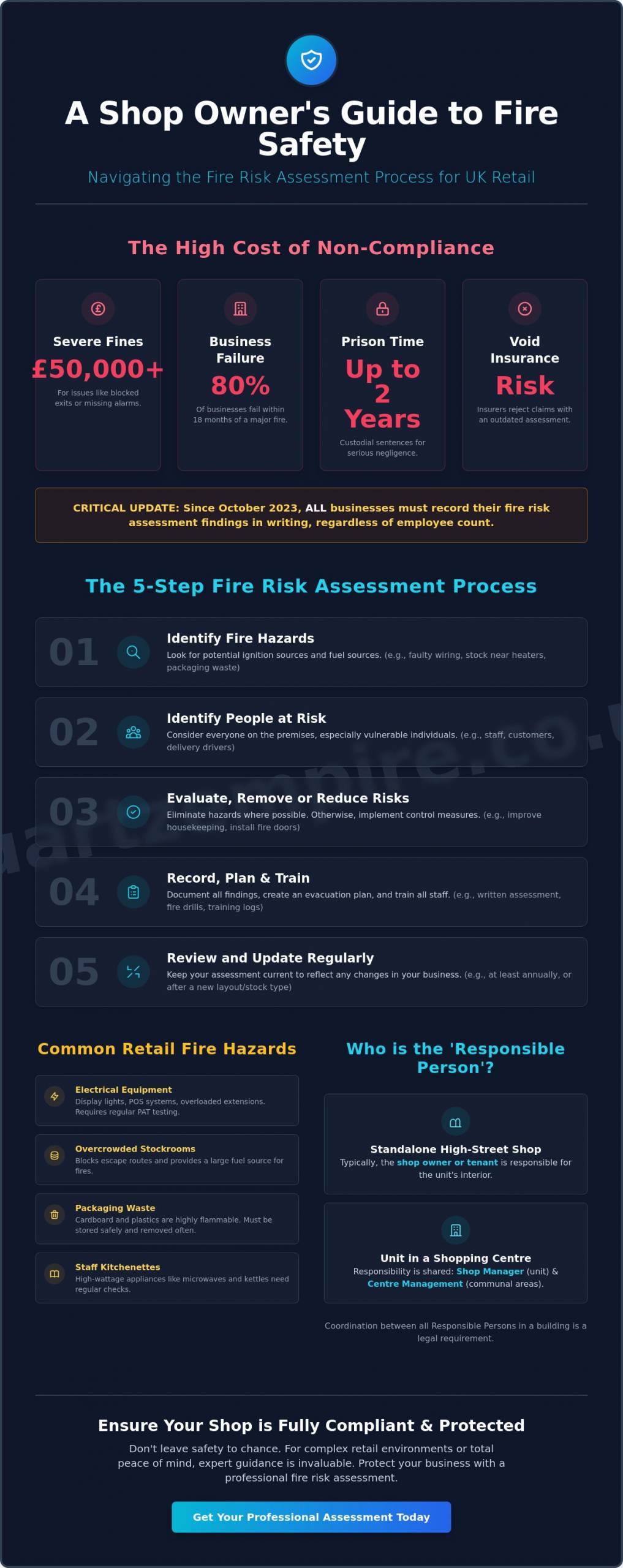
A vital change involves written documentation. Previously, only businesses with five or more employees had to record their findings. Under the updated regulations, all businesses must now record their fire risk assessment for shops uk in writing, regardless of the number of staff members. This ensures a clear audit trail for fire inspectors. Understanding fundamental fire safety principles helps you identify hazards like stock blocking exits or faulty electrical displays before they lead to a crisis.
Who is the Responsible Person in a Retail Setting?
The "Responsible Person" (RP) is usually the shop owner, employer, or the person in control of the premises. In a standalone high-street unit, the tenant often holds this role for the interior, while the landlord manages the building's structure. In shared shopping centres, duties are split; the centre management handles communal corridors and fire alarms, while the individual shop manager is responsible for their specific unit. You must coordinate with other RPs in the building to ensure the entire site is safe. Failure to clearly designate a Responsible Person leads to immediate legal liability for all parties involved.
The Consequences of Non-Compliance for Shop Owners
The Fire and Rescue Service conducts regular inspections to ensure shops meet 2026 compliance standards. If your premises are found lacking, the penalties are severe. Minor breaches might result in an enforcement notice, but serious risks can lead to a "prohibition notice," which closes your shop instantly until the issues are fixed. In 2023, several UK retailers faced fines exceeding £50,000 for blocked fire exits and missing alarms. Serious negligence can even result in custodial sentences of up to two years.
Beyond legal fines, a fire can destroy your business continuity. Statistics show that 80% of businesses that experience a major fire never reopen or fail within 18 months. Insurance providers frequently reject claims if they find the fire risk assessment was outdated or ignored. Maintaining a valid fire risk assessment for shops uk is the only way to protect your livelihood and satisfy both the law and your insurers.
The 5 Steps of a Shop Fire Risk Assessment
Completing a fire risk assessment for shops uk involves a systematic evaluation of your premises to protect lives and ensure business continuity. This process follows a five-step framework designed to identify vulnerabilities before they lead to an emergency. Every retail manager or owner must treat this as a rigorous safety audit rather than a simple administrative task.
- Step 1: Identify fire hazards. Look for anything that could start a fire or provide fuel, such as faulty wiring or stock stored near heaters.
- Step 2: Identify people at risk. Consider who is in the building, including full-time staff, delivery drivers, and shoppers who may be unfamiliar with your layout.
- Step 3: Evaluate, remove, or reduce risks. Take immediate action to eliminate hazards. If a risk can't be removed, implement measures to control it.
- Step 4: Record findings and prepare an emergency plan. Document your assessment, create a clear evacuation strategy, and provide comprehensive staff training.
- Step 5: Review and update. Revisit your assessment at least once every 12 months or whenever you make significant changes to the shop floor.
Identifying Ignition Sources in a Retail Environment
Electrical equipment represents the most common fire trigger in modern shops. High-intensity display lighting and Point of Sale (POS) systems generate significant heat over long trading hours. Staff kitchenettes, often tucked away in small backrooms, frequently contain high-wattage appliances like kettles and microwaves that require regular PAT testing. A major hidden danger involves the use of overloaded extension leads for temporary seasonal displays. During peak periods like Christmas, shops often create elaborate setups that exceed the safe capacity of their electrical circuits. Additionally, arson remains a critical concern for street-facing units. Home Office data for the year ending March 2023 showed that deliberate fires continue to be a leading cause of property damage in non-residential buildings. Securing external waste bins and maintaining robust shutters are essential preventative steps.
Protecting Vulnerable People and High-Footfall Areas
The safety of customers is complex because they lack the fire safety training provided to your employees. High-footfall areas require clear, unobstructed exit routes that remain wide enough for wheelchairs and pushchairs. In multi-floor retail environments, you must establish Personal Emergency Evacuation Plans (PEEPs) for customers with limited mobility. Cramped changing rooms and basement sales floors present unique evacuation challenges, as smoke can quickly disorient shoppers in confined spaces. Under the Regulatory Reform (Fire Safety) Order 2005, the 'Responsible Person' has a legal duty to account for the safety of children and elderly shoppers who may require extra assistance during an alarm. If you feel your current safety measures are insufficient, our team offers expert fire safety consultations to help you achieve full compliance. A professional fire risk assessment for shops uk ensures that every person in your building is protected by a reliable and tested strategy.
Common Fire Hazards Specific to Retail Premises
Identifying potential ignition sources and fuel loads is the foundation of a robust fire risk assessment for shops uk. Retail environments face unique pressures, particularly during peak seasons like Black Friday or Christmas. Stockroom overcrowding often leads to boxes stacked dangerously close to light fittings. If a high-intensity bulb remains in contact with cardboard for an extended period, the risk of combustion increases significantly. Retailers should transition to LED lighting where possible, as older halogen bulbs can reach surface temperatures exceeding 200°C.
Packaging waste represents a significant fuel load. Accumulated cardboard and plastic wrap near delivery bays or internal corridors provide an easy path for fire to spread. Managing these materials is a daily requirement, not a weekly one. Additionally, the rise of lithium-ion batteries in stock, such as e-scooters or rechargeable electronics, introduces the risk of thermal runaway. These fires are notoriously difficult to extinguish and require specific storage protocols to ensure your premises remain compliant and safe.
Managing Stock and Storage Safety
Effective storage management prevents small accidents from becoming uncontrollable disasters. Quartz Empire recommends a "no-nonsense approach" to stockroom organization. Use this checklist to maintain safety standards:
- Maintain a minimum 45cm gap between the top of any stock and the ceiling or sprinkler heads to ensure effective water distribution.
- Store flammable liquids, such as perfumes, aerosols, or cleaning supplies, in fire-rated cabinets or dedicated areas away from ignition sources.
- Ensure all staff members are trained to recognize which fire extinguisher types are required for the specific stock you carry.
- Keep heavy items on lower shelves to prevent damage to electrical housing or fire sensors.
Escape Routes and Emergency Signage
The 'Golden Rule' of retail fire safety is absolute: fire exits must never be locked or blocked during trading hours. While it's tempting to use a corridor for temporary stock overflow, this practice is a direct violation of safety standards. In London and Kent, many shops operate out of converted older buildings with complicated, narrow layouts. These premises require meticulous planning to ensure customers can evacuate within the 2.5 to 3-minute window recommended by fire professionals.
Clear communication is vital for public safety. You must install illuminated 'Running Man' exit signs and emergency lighting that activates automatically if the power fails. Detailed instructions on these requirements can be found in the UK Government Fire Safety Guidance, which outlines the legal expectations for commercial floor plans. Whether you're managing a boutique in Kent or a high-street store in London, your fire risk assessment for shops uk must account for these structural challenges to protect both your staff and your customers.
Maintaining Fire Safety Systems and Records
Your fire risk assessment for shops uk is a living document that requires consistent action to remain valid. Hardware failure is a leading cause of safety breaches. Home Office statistics for 2023 indicate that approximately 15% of non-dwelling fires occur in retail premises, making rigorous maintenance schedules non-negotiable. You must conduct weekly fire alarm tests using different call points each time to ensure the entire circuit functions. Monthly checks are required for emergency lighting, where you must simulate a power failure to confirm each unit illuminates for its full 3-hour rated duration.
Professional intervention is required for deeper technical compliance. You should arrange annual servicing for fire extinguishers and six-monthly inspections for fire alarm systems by accredited professionals. These experts check battery health, sensor sensitivity, and signal integrity. Every test, fault, and repair must be documented in your Fire Log Book. This book serves as your primary evidence during a local authority inspection. If you cannot produce a clear trail of maintenance, your business may be deemed non-compliant, regardless of how modern your equipment is.
Fire Alarm and Detection Standards for Shops
Retail spaces typically follow BS 5839-1 standards, categorizing systems as L1, L2, or L3. An L3 system focuses on protecting escape routes and corridors. An L2 system adds detection to high-risk areas like electrical intake rooms or stockrooms. Large department stores often require L1 systems, providing total coverage throughout the building. Choosing the correct category is vital for life safety and insurance validity. We strongly advise professional fire alarm installation to ensure sensors are placed away from dead air spaces. Use smoke detectors for sales floors, but opt for heat detectors in staff kitchens or dusty loading bays to minimize disruptive false alarms.
Staff Training and Fire Drills
Training shouldn't be a one-time event. New staff members require a safety induction on day one, with refresher courses for the entire team every 12 months. Retail environments face unique challenges, particularly during Saturday peak times or seasonal sales. You must design evacuation procedures that account for high footfall and vulnerable customers who are unfamiliar with your building's layout.
- Fire Marshals: Appoint at least two trained marshals per floor to manage evacuations.
- Drill Frequency: Conduct full evacuation drills at least twice a year.
- Role Responsibilities: Marshals must be trained to check changing rooms and stock areas before exiting.
Floor managers and supervisors acting as Fire Marshals need accredited training every two years to stay current with legislative changes. They're responsible for ensuring fire doors remain unobstructed and that extinguishers aren't being used as doorstops during deliveries.
Keep your retail business compliant and secure by booking a professional service. Contact our expert team today for reliable maintenance across Kent, London, and the South East.
Choosing Professional Fire Risk Assessment Services
While a basic checklist might suffice for a tiny kiosk, most retail environments require a higher level of expertise. A DIY approach often fails when shops deal with high-risk stock like flammable textiles, complex multi-floor layouts, or shared building access. If your shop is larger than 60 square meters or employs more than five people, the legal stakes are too high to guess. Hiring a professional ensures your fire risk assessment for shops uk is thorough, accurate, and legally defensible.
Accreditation is the most critical factor when selecting a provider. You should look for assessors certified by BAFE or the Institution of Fire Engineers (IFE). These third-party accreditations prove the assessor has undergone rigorous training and adheres to the latest British Standards. It shifts the burden of technical compliance from the shop owner to the expert, providing a robust layer of legal protection if an incident occurs. Professional assessments also help you integrate fire safety with your broader security systems. This ensures that emergency exits and fire doors work in harmony with your anti-theft measures without compromising life safety.
The Quartz Empire Approach to Retail Safety
We pride ourselves on a "no-nonsense" audit process that respects your trading hours. We know that a closed shop is a shop losing money. Our team has extensive experience working across Kent high streets and busy London shopping districts, from the bustle of Bromley to the commercial hubs of Maidstone. We don't just point out problems; we provide the solutions. Whether you need fire extinguisher installation, emergency lighting testing, or full alarm servicing, we handle the remedial works ourselves. This makes us a trusted partner for retail managers who need a single point of contact for all safety requirements.
Booking Your 2026 Shop Assessment
Securing your compliance for the coming year is a simple, three-step process. We begin with a brief consultation to understand your shop's specific risks. This is followed by a physical site visit where our certified assessors inspect every corner of your premises. Finally, you receive a comprehensive, easy-to-read report that details necessary actions and timelines. This report is your shield against fines and your guarantee of safety for staff and shoppers alike. Don't leave your 2026 compliance to chance. Book your professional fire risk assessment today and gain the peace of mind that comes with expert protection.
Protect Your Retail Business and Ensure Compliance
Adhering to the Regulatory Reform (Fire Safety) Order 2005 is a non-negotiable responsibility for every shop owner. By implementing the 5-step assessment process, you identify critical hazards and safeguard the lives of your employees and customers. It's vital to maintain accurate records; fire authorities can request these documents at any time. Proactive management reduces the risk of significant legal penalties and ensures your shop stays operational without interruptions.
Navigating a fire risk assessment for shops uk doesn't have to be a burden. Quartz Empire acts as your trusted partner, offering a no-nonsense approach to compliance that removes the guesswork from fire safety. Our team consists of accredited fire safety experts who understand the specific challenges of retail environments. We're proud to serve businesses across London, Kent, and the South East with reliable, certified solutions that offer total peace of mind.
Secure your shop with a professional Fire Risk Assessment from Quartz Empire
Investing in professional safety today creates a secure foundation for your shop's growth and long-term success.
Frequently Asked Questions
Is a fire risk assessment a legal requirement for a small shop in the UK?
Yes, a fire risk assessment is a legal requirement for every small shop in the UK under the Regulatory Reform (Fire Safety) Order 2005. Section 156 of the Building Safety Act 2022 updated these rules on 1 October 2023. Now, all businesses must record their full fire risk assessment in writing, even if they employ fewer than 5 people. Quartz Empire provides these assessments to ensure your retail space remains fully compliant with current Home Office standards.
How often should a shop fire risk assessment be reviewed?
You should review your fire risk assessment for shops uk at least once every 12 months to maintain safety standards. The Fire Safety Order 2005 requires a review if the building's layout changes or after a near miss incident. If you introduce new stock types or change your staff numbers by 20% or more, an immediate review is necessary. Our team in Kent and London recommends annual professional audits to ensure your documentation stays up to date.
Can I do my own fire risk assessment for my retail business?
You can legally complete your own assessment if you're a competent person with the necessary training and experience. However, the Home Office Guide for Small and Medium Places of Assembly warns that complex layouts require technical expertise. If your shop has multiple floors or a basement, a DIY approach might miss critical risks. Many owners choose an accredited provider to gain peace of mind and avoid the liability of an insufficient assessment.
What are the most common causes of fire in UK shops?
Electrical distribution and lighting account for 33% of fires in UK retail premises according to Home Office statistics from 2023. Arson remains another significant threat, causing 25% of commercial fires annually. Overloaded sockets and faulty wiring in stockrooms are frequent ignition points. We focus on these high-risk areas during our inspections to protect your property and staff from avoidable disasters.
Do I need a fire alarm in a small shop unit?
Most small shops require a fire alarm system unless a fire can be detected and all occupants alerted simultaneously from any point. British Standard 5839-1 provides the framework for these installations. If your shop has a basement, a back office, or a storeroom where a shout of fire wouldn't be heard, you must install an electronic system. We design and maintain compliant systems across the South East to meet these specific safety regulations.
What fire extinguishers are required in a retail environment?
Standard retail units typically require a minimum of two Class A extinguishers, such as 6-litre water or foam units, for every 200 square metres of floor space. You also need a 2kg CO2 extinguisher near any electrical equipment like tills or computers to meet BS 5306-8 standards. Our certified technicians ensure your extinguishers are correctly positioned and serviced annually. This setup provides the necessary protection for both your stock and your people.
What happens if a fire officer visits my shop and I don't have a risk assessment?
Failure to produce a written fire risk assessment during a Fire and Rescue Service inspection can lead to an enforcement notice. Under the Fire Safety Order 2005, serious breaches result in unlimited fines or up to 2 years in prison. In 2022, UK courts issued several fines exceeding £20,000 to small business owners for non-compliance. Having an accredited partner manage your safety records prevents these legal and financial risks.
How much does a professional fire risk assessment cost for a shop?
The cost of a professional fire risk assessment for shops uk depends on the square footage and complexity of your premises. While we don't provide fixed prices without a site survey, industry data suggests small retail units often start from around £200 to £300 for a basic audit. Larger department stores or multi-site businesses require bespoke quotes. Contact our team for a transparent, no-nonsense quote tailored to your specific shop location.