
Fire Extinguisher Types for Business Premises: A Complete UK Buying Guide

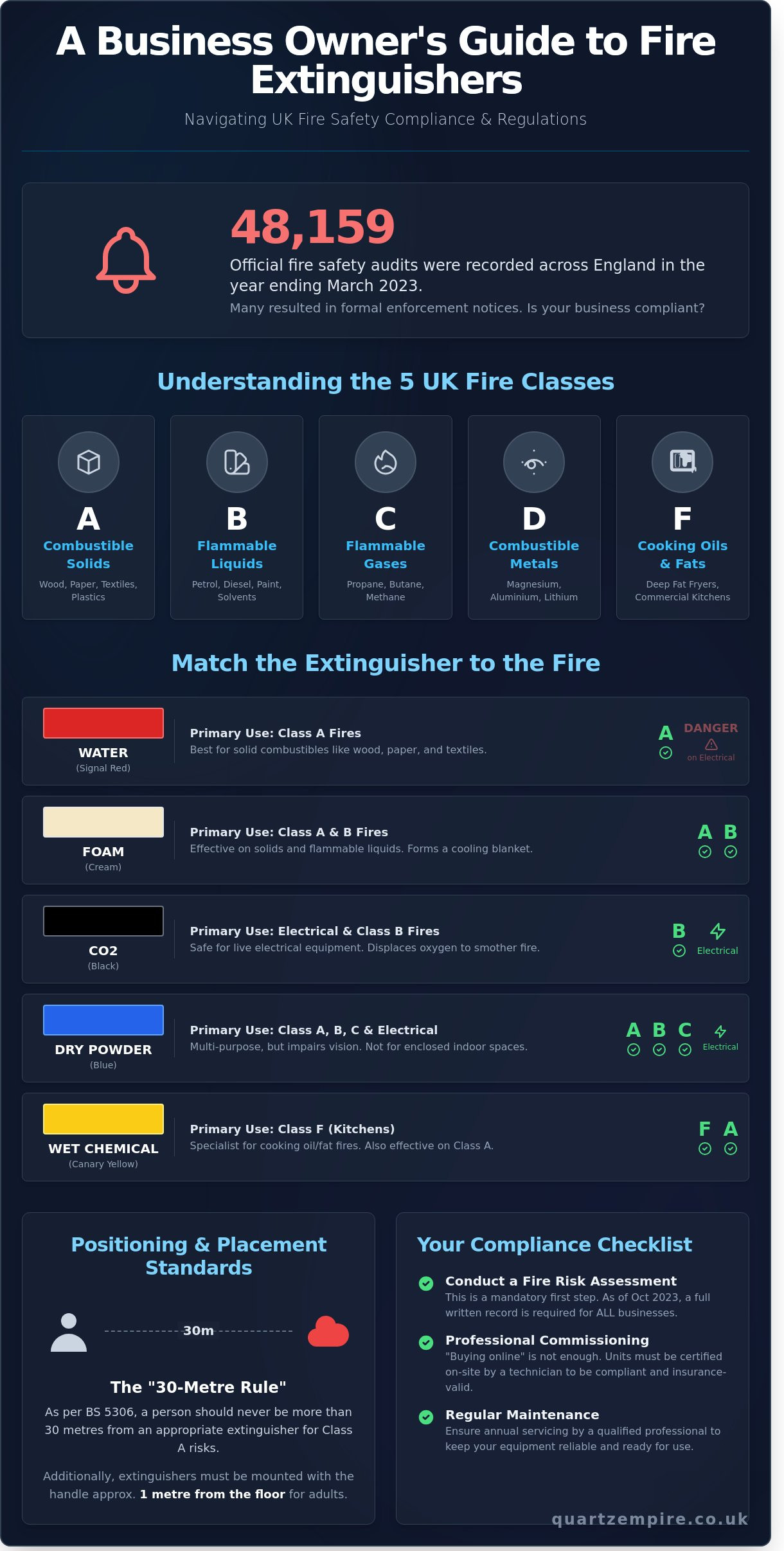
Did you know that the Home Office recorded 48,159 fire safety audits across England in the year ending March 2023, with many resulting in formal enforcement notices? It's a daunting figure that highlights why so many business owners feel anxious about their own safety protocols. You probably find the various colour codes and British Standards confusing, especially when you're trying to determine exactly which fire extinguisher types for business premises are necessary to meet your legal obligations. It's a significant responsibility, and the fear of failing an audit or being under-protected during an emergency is a heavy burden to carry.
We understand these challenges and have developed this guide to provide the clarity you need. We'll show you how to follow UK fire safety regulations so you can identify the precise equipment your premises require for total compliance. You'll gain a clear list of required extinguishers for your specific sector, a straightforward explanation of maintenance duties, and the peace of mind that comes from being a responsible, accredited employer. From calculating the correct number of units per square metre to understanding our no-nonsense approach to maintenance, we've got you covered.
Key Takeaways
- Understand your legal obligations as a 'Responsible Person' under the Regulatory Reform (Fire Safety) Order 2005 to ensure your business remains fully compliant.
- Identify the correct fire extinguisher types for business premises by matching UK fire classes to your specific workplace risks, from electrical hazards to kitchen fires.
- Learn the essential colour-coding system and fire classifications to help your team select the right unit instantly during an emergency.
- Master the '30-metre rule' and British mounting standards to ensure your fire safety equipment is correctly positioned and visible for all staff.
- Discover how professional commissioning and regular maintenance provide peace of mind by keeping your safety systems reliable and ready for use.
Understanding Fire Extinguisher Types for Business Premises: The Legal Framework
The Regulatory Reform (Fire Safety) Order 2005 serves as the cornerstone of fire safety law in England and Wales. Since it came into force on 1 October 2006, it has placed the burden of safety directly on the 'Responsible Person'. This individual, usually the business owner, employer, or landlord, carries the legal weight of ensuring every occupant is safe. You can't simply guess which units you need. The law requires that the fire extinguisher types for business premises are selected based on the specific combustible materials found on-site. Choosing the wrong medium for a specific hazard can be as dangerous as having no protection at all.
Following a generic 'one of everything' approach often leads to failure during inspections; it also leaves your staff vulnerable. British Standard BS 5306 provides the technical framework for this process. It outlines exactly how many extinguishers you need based on floor area and the maximum travel distance between units. For most Class A risks, you shouldn't have to walk more than 30 metres to reach a Fire extinguisher. If your equipment doesn't meet these standards, you're not just risking a fine; you're risking lives and your livelihood.
The Fire Risk Assessment: Your Starting Point
A professional fire risk assessment is your mandatory first step. It acts as a roadmap for your entire safety strategy. As of 1 October 2023, new legislation under Section 156 of the Building Safety Act requires all businesses to record their full assessment in writing, regardless of the number of employees. Your assessor will identify 'significant findings', such as high-risk kitchen areas or server rooms, which dictate your extinguisher selection. Documenting these findings is a legal necessity that proves you've taken proactive steps to mitigate hazards.
Why 'Buying Online' Can Risk Your Insurance
It's tempting to browse discount websites for cheap safety gear, but uncommissioned extinguishers on commercial sites are a liability. Most insurance providers in the UK won't pay out if they find your equipment wasn't professionally installed and maintained. They demand proof that your units are fit for purpose and compliant with current standards. Commissioning is the process of on-site verification by an accredited technician to ensure the unit is fully functional and hasn't been compromised during delivery. Without this certification, your brand-new extinguisher is effectively just a red canister. We focus on providing accredited services across Kent and London to ensure your business stays compliant and fully insured.
The Five Essential Fire Extinguisher Types and Fire Classes Explained
Selecting the correct fire extinguisher types for business premises starts with a clear understanding of the UK fire classification system. Under British Standard EN3, fires are categorised into five distinct classes based on the fuel source. Understanding these categories is a fundamental requirement for anyone managing fire safety in the workplace, as your risk assessment must dictate your equipment choice. The five classes include:
- Class A: Combustible solids such as wood, paper, and textiles.
- Class B: Flammable liquids including petrol, diesel, and oils.
- Class C: Flammable gases like butane, propane, and methane.
- Class D: Burning metals such as magnesium or aluminium.
- Class F: High-temperature cooking oils and fats found in commercial kitchens.
To ensure rapid identification during an emergency, every extinguisher follows a strict colour-coding system. While all modern units are primarily signal red, they feature a specific colour band above the operating instructions. Water units are solid red, foam units have a cream band, CO2 units feature a black band, dry powder uses a blue band, and wet chemical units are identified by a canary yellow band.
Water and Foam Extinguishers (Class A & B)
Standard water extinguishers remain a reliable choice for Class A risks. However, many modern facilities now opt for water additive units. These canisters contain chemicals that reduce the surface tension of the water, which can increase fire-fighting capacity by up to 300% compared to a standard 9-litre water unit. This allows for smaller, lighter extinguishers that are easier for staff to handle.
AFFF (Aqueous Film Forming Foam) is the preferred multi-risk solution for most offices and warehouses. It's effective on both Class A and Class B fires because it creates a cooling film that smothers flames and prevents re-ignition. For optimal protection, BS 5306-8 regulations suggest placing these units near fire exits and along escape routes. You should ensure that no person is more than 30 metres away from a Class A extinguisher at any point on your floor plan.
CO2 and Specialist Agents (Electrical & Class F)
CO2 extinguishers are non-negotiable for modern offices and server rooms. Because CO2 is a non-conductive gas, it tackles electrical fires without damaging sensitive components or leaving messy residues. It's the cleanest option for protecting high-value digital assets. Our technicians often recommend pairing a CO2 unit with a foam or water extinguisher to provide comprehensive coverage. Our team can help you determine the exact quantity required for your floor plan during a fire safety survey.
Wet chemical extinguishers are the only safe solution for commercial kitchens dealing with Class F risks. Using water or foam on a deep-fat fryer fire is extremely dangerous and can cause an explosive reaction. The wet chemical agent creates a "saponification" layer, essentially turning the burning oil into a thick soap that cannot reignite.
It's vital to note the limitations of dry powder. Since the 2012 update to BS 5306-8, dry powder is generally not recommended for use inside enclosed office spaces. The powder creates a sudden, dense cloud that results in a near-total loss of visibility and can cause respiratory distress for occupants. Powder should typically be reserved for outdoor risks, boiler rooms, or specific industrial applications.
Matching Extinguisher Types to Your Specific Business Environment
Every commercial setting presents a unique risk profile that dictates your equipment needs. Selecting the correct fire extinguisher types for business premises isn't just a matter of safety; it's a legal obligation under the Regulatory Reform (Fire Safety) Order 2005. To ensure your site meets the standards set by UK government fire safety legislation, you must conduct a thorough risk assessment that identifies the specific combustible materials present in your workspace.
The Modern Office: Servers, Laptops, and Open Plans
The standard configuration for UK offices is the "CO2 and Water/Foam" pairing. This combination is designed to tackle the two primary hazards found in administrative environments: electrical equipment and Class A combustibles like paper, cardboard, and office furniture. While a 6-litre foam extinguisher handles the furniture, a 2kg CO2 unit is essential for computers and server racks because it leaves no residue that could further damage sensitive circuitry.
For high-value data centres where even a small fire could lead to 100% data loss, we recommend clean agent alternatives. These gaseous systems extinguish fires without liquid or powder, protecting your hardware investment. Safety in these spaces is holistic; for instance, your access control systems must be professionally integrated with your fire alarm to ensure doors fail-safe to an open position during an evacuation.
Commercial Kitchens and Restaurants
In a professional kitchen, a fire blanket is a vital tool, but it's often insufficient for deep fat fryers containing more than 5 litres of oil. Cooking oils can reach temperatures exceeding 360°C, which is hot enough to cause a fireball if you use a standard water or foam unit. You must install LPCB-approved Wet Chemical extinguishers (Class F) to manage these risks.
Wet chemical units work by creating a thick, soapy layer that smothers the flame and cools the oil simultaneously to prevent re-ignition. It's critical that staff receive training on the specific discharge pattern of these units. Unlike other types, the wet chemical nozzle should be held at a distance to avoid splashing the burning oil onto surrounding surfaces.
Industrial, Warehousing, and Managed Properties
- Warehouses: These sites often require high-capacity 9kg units due to the heavy fire load from wooden pallets and plastic packaging. The maximum travel distance between extinguishers should never exceed 30 metres.
- Retail and Hospitality: In customer-facing areas, you might opt for polished stainless steel units. These provide the same certified protection as red canisters but maintain the aesthetic standards of high-end boutiques or hotels.
- HMOs: For managed residential properties, fire extinguishers must be situated in communal hallways. A 6-litre foam extinguisher is typically the standard choice to protect escape routes from fires involving soft furnishings or floor coverings.
Whether you manage a small retail unit or a sprawling industrial complex, the goal is the same: providing the right tools to stop a small incident from becoming a total loss. We take a no-nonsense approach to compliance, ensuring every unit we install is correctly rated for the specific fire extinguisher types for business premises required by your industry.
Legal Placement and Maintenance Standards for Commercial Premises
Selecting the correct fire extinguisher types for business premises is only the first step toward safety. Proper installation and ongoing care are what ensure these tools work when they're needed most. Under British Standard 5306-8, the 30-metre rule is the fundamental benchmark. You shouldn't have to travel more than 30 metres from any point in your building to reach a Class A fire extinguisher. For higher-risk environments involving flammable liquids or gases, this distance is significantly reduced to just 10 metres to account for the rapid spread of fire.
Mounting heights are strictly defined to ensure accessibility for all occupants. If an extinguisher weighs less than 4kg, it's mounted so the handle is 1.5 metres from the floor. For heavier units, the handle height must be 1 metre. Every extinguisher must be accompanied by a high-visibility ID sign positioned directly above it. These signs identify the contents and the fire classes they're designed for, ensuring no one uses the wrong agent on a live fire. It's a simple step that prevents catastrophic errors in high-stress situations.
Where to Position Your Fire Points
Placement should always follow your building's natural paths of egress. By positioning extinguishers along exit routes, you ensure staff are moving toward safety when they reach for a device. We recommend placing fire points near fire alarm call points to encourage simultaneous activation of the alarm. In multi-storey premises across London, fire points are usually required on every floor level, typically located on landings or near stairwell entrances. This provides a protected area for staff to attempt a first-aid fire response before evacuating.
Maintenance and The Fire Log Book
The Regulatory Reform (Fire Safety) Order 2005 makes the business owner or "Responsible Person" legally accountable for equipment upkeep. You must perform monthly visual inspections to check for blocked nozzles, broken seals, or pressure gauge drops. These internal checks don't replace the need for professional intervention. Annual maintenance must be performed to BS 5306-3 standards to remain compliant.
Extended maintenance schedules are also mandatory. Every five years, water, foam, and powder extinguishers require a discharge test and refill to ensure the internal lining hasn't corroded. CO2 extinguishers are subject to a 10-year cycle, involving a hydraulic pressure test and a primary valve overhaul. A BAFE-accredited technician will record every check in your Fire Log Book. This document serves as your legal proof of compliance if the Fire and Rescue Service conducts a spot audit of your premises. Choosing the right fire extinguisher types for business premises is a long-term commitment to these rigorous maintenance cycles.
Ensuring Total Compliance with Professional Fire Extinguisher Services
Quartz Empire Fire & Security Ltd acts as your trusted partner across Kent, London, and the South East. We manage the entire lifecycle of your fire safety equipment to ensure you remain fully compliant with UK fire safety regulations. Our comprehensive four-stage process Survey, Supply, Commission, and Maintain removes the administrative burden from your shoulders. We start by conducting a thorough site survey to identify the specific fire extinguisher types for business premises that your specific environment requires. This ensures you don't over-spend on unnecessary equipment or leave high-risk areas unprotected.
Our accredited engineers hold BAFE certifications and follow BS 5306 standards strictly. We believe that safety shouldn't be complicated. By bundling your services, such as fire alarms, extinguishers, and fire risk assessments, you create a unified safety strategy. This integrated approach provides peace of mind, knowing that every component of your life safety system is managed by a single, reliable provider. We currently support over 200 businesses across the South East, ensuring their staff and assets stay protected 24/7.
The Quartz Empire 'No-Nonsense' Approach
We pride ourselves on transparent pricing. Many fire safety companies attract clients with low initial fees, only to add hidden "per-pin" or "per-seal" maintenance charges that can increase an invoice by 25% or more. We don't use these tactics. Our quotes are fixed and upfront. We also take responsibility for your compliance calendar. Our team will contact you 30 days before your service is due, so you never have to worry about missing a legal deadline.
Our commitment to reliability is best demonstrated through our recent work with a multi-site commercial property owner in Kent. We took over the management of 12 separate retail units that had previously failed a local authority audit. By implementing a consistent maintenance schedule and replacing outdated units with the correct fire extinguisher types for business premises, we brought all 12 sites into full compliance within 14 days. This project resulted in a 15% reduction in the client's annual service costs through our bundled maintenance package.
Next Steps for Your Business Safety
Protecting your property requires more than just buying equipment off a shelf. You can book a professional site survey today to receive a definitive list of requirements tailored to your building's layout. It's often beneficial to integrate your handheld suppression tools with a wider fire alarm system. This ensures that detection and manual firefighting capabilities work together seamlessly during an emergency.
Our team is ready to provide a bespoke compliance quote that reflects the specific needs of your industry. Whether you run a small office in Maidstone or manage a large warehouse in London, we provide the same meticulous attention to detail. Get in touch with us to secure your premises with accredited expertise and straightforward, honest service.
Secure Your Workplace Compliance and Safety
Navigating the legal requirements for your workplace safety doesn't have to be a complex burden. Choosing the correct fire extinguisher types for business premises is a critical step in meeting the Regulatory Reform (Fire Safety) Order 2005. It's about more than just having a red canister on the wall; it's about matching the right suppressant to specific risks like server rooms or commercial kitchens. Proper placement and mandatory annual maintenance ensure your equipment performs reliably when it's needed most.
Quartz Empire provides a no-nonsense approach to fire safety for commercial clients. Our BAFE Accredited Technicians deliver expert guidance across London, Kent, and the South East. As a fully insured and certified provider, we help you maintain total compliance while protecting your staff and property. Don't leave your legal obligations to chance or outdated equipment. We're here to provide the peace of mind you need to focus on running your business effectively.
Book Your Professional Fire Extinguisher Survey Today
We look forward to becoming your trusted partner in fire safety.
Frequently Asked Questions
What are the legal fire extinguisher requirements for a small office in the UK?
You must have at least two Class A extinguishers on every floor of your office to comply with BS 5306-8. This typically involves two 13A rated water or foam extinguishers, though a single 3-litre foam unit can sometimes suffice for very small areas under 50 square metres. We ensure your installation meets the Regulatory Reform (Fire Safety) Order 2005 to keep your staff safe and your business compliant.
Can I use a multi-purpose powder extinguisher in my business premises?
You should generally avoid using multi-purpose powder extinguishers inside business premises because they create a dense cloud that obscures vision and affects breathing. BS 5306-8:2012 recommends these units only for high-risk areas like fuel stores or specific industrial settings. For standard offices or shops, we recommend water, foam, or CO2 alternatives that don't cause the same level of collateral damage or safety risks during an evacuation.
How many fire extinguishers do I need per square metre of floor space?
British Standard 5306 requires a minimum 26A fire rating for any floor up to 400 square metres. You calculate the required coverage by multiplying the floor area in square metres by 0.065. For a 200 square metre shop, you need a total A rating of 13, but the law still mandates a minimum of two extinguishers per floor regardless of the calculation result. Selecting the correct fire extinguisher types for business premises ensures you meet these specific mathematical safety requirements.
What is the difference between a red and a black fire extinguisher?
A red extinguisher with a red label contains water, while a red extinguisher with a black label or band contains Carbon Dioxide (CO2). All modern extinguishers in the UK are signal red (RAL 3000) over 95% of their body, with a colour-coded zone representing the contents. CO2 units feature a distinct discharge horn and are essential for electrical fires, whereas water units are strictly for combustible solids like paper and wood.
Is it a legal requirement to have fire extinguisher signage in a shop?
Yes, you must display fire extinguisher ID signs at every fire point to comply with the Health and Safety (Safety Signs and Signals) Regulations 1996. These signs allow staff and customers to identify the equipment type and its uses from a distance. We provide photoluminescent signs that remain visible even if the power fails, ensuring your shop stays fully compliant with UK fire safety legislation and provides peace of mind.
How often must fire extinguishers be serviced on commercial premises?
You must have your extinguishers serviced by a competent person once every 12 months in accordance with BS 5306-3. Water, foam, and powder units also require an extended service or discharge test every 5 years. CO2 extinguishers are different; they require a major overhaul and pressure test every 10 years to ensure the high-pressure cylinder remains safe for use on your commercial premises.
Do I need a special extinguisher for a server room or IT suite?
You need a CO2 extinguisher for any server room or IT suite to prevent permanent damage to sensitive electronics. CO2 is a non-conductive gas that leaves no residue, unlike foam or powder which would destroy your hardware immediately. We often recommend a 2kg or 5kg CO2 unit depending on the room size to protect your digital infrastructure and ensure business continuity after a small electrical incident.
What happens if my business fails a fire safety inspection due to wrong extinguishers?
Failing a fire safety inspection can result in an enforcement notice or a fine of up to £5,000 for minor breaches in a magistrates' court. For serious negligence regarding fire extinguisher types for business premises, the Fire and Rescue Service may pursue unlimited fines or even custodial sentences of up to 2 years. We act as your trusted partner to prevent this by installing only certified equipment that meets current UK standards.