
Access Control Systems for Small Businesses: The 2026 UK Guide
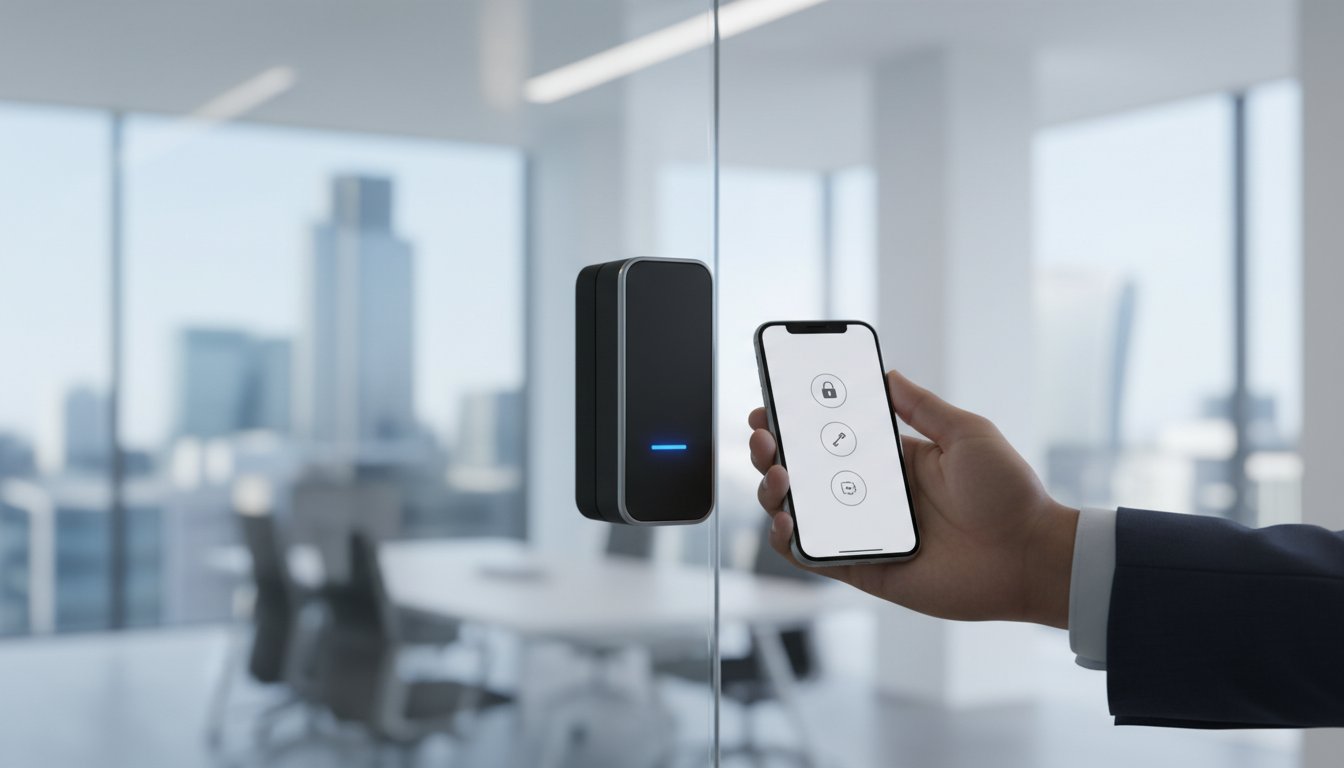
Last Tuesday, a business owner in London discovered that an ex-employee still held a master key to the main office three months after their contract ended. With no entry logs to check, the uncertainty of who has accessed the building creates a significant security gap. Managing physical keys is an outdated practice that costs UK firms an average of £350 per lock change. Installing a reliable access control system for small business eliminates this anxiety by replacing metal keys with encrypted digital credentials.
You've likely felt the frustration of chasing down unreturned fobs or worrying about compliance with the Regulatory Reform (Fire Safety) Order 2005. We understand that your priority is a secure, efficient workplace where you control every entry point from your smartphone. This 2026 guide explains how to transition to a keyless environment while ensuring your setup is fully compliant with UK data protection and fire safety standards. We'll examine the latest hardware from trusted brands like Paxton and Hikvision to help you find a solution that offers total peace of mind.
Key Takeaways
- Understand the transition from traditional lock-and-key methods to sophisticated digital credentials that offer superior protection for your commercial premises.
- Learn how to identify your high-risk zones and determine the appropriate level of tiered access required for your staff and visitors.
- Discover how to select the most effective access control system for small business to balance robust security with everyday user convenience.
- Ensure your building remains fully compliant with critical UK regulations, including the Fire Safety Order 2005 and the Equality Act.
- Explore the benefits of partnering with an accredited expert for a professional, no-nonsense installation across London, Kent, and the South East.
What is an Access Control System for Small Business?
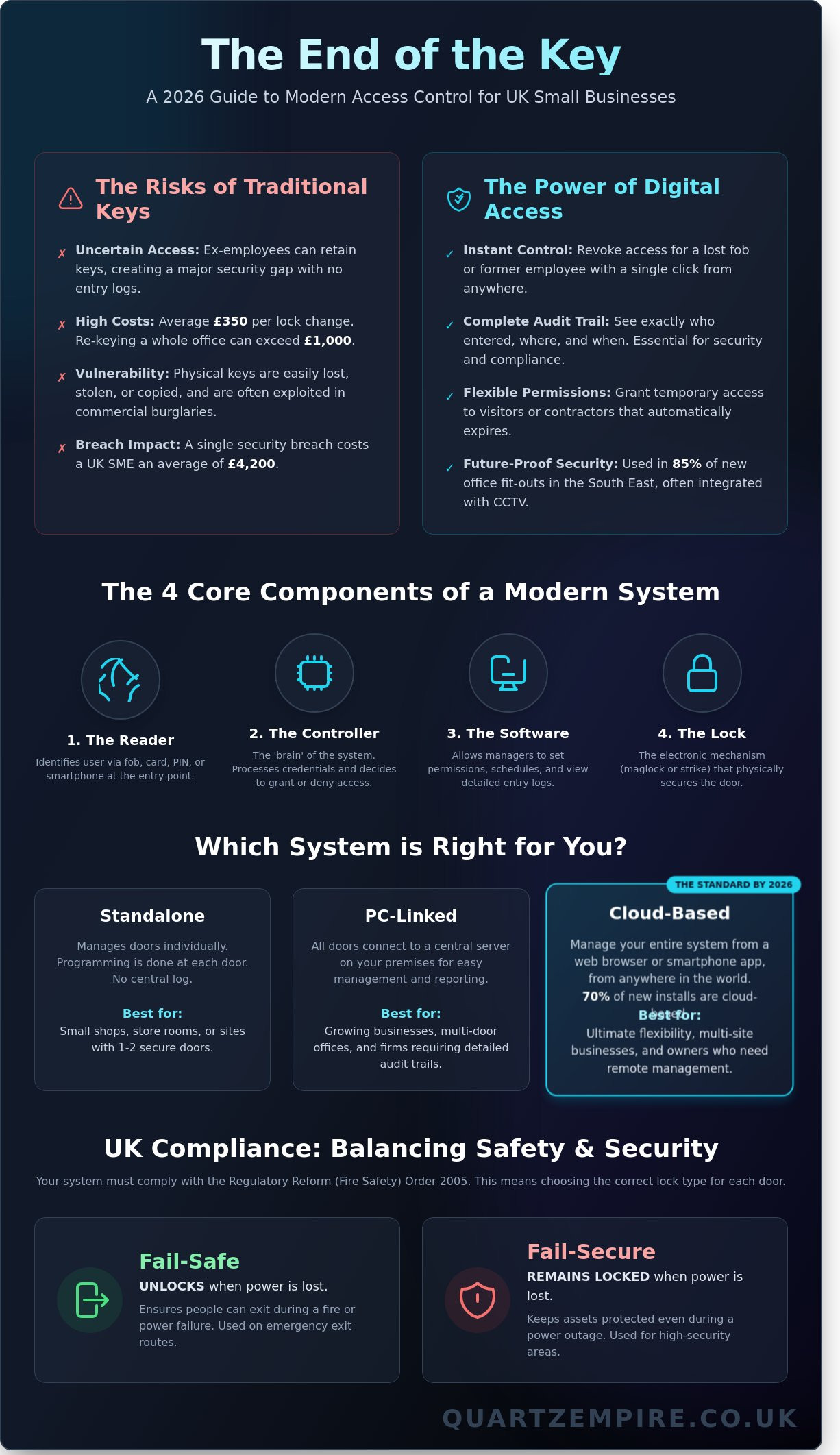
An Access control system for small business is a digital security framework designed to regulate entry into specific areas of your premises. Unlike a standard mechanical lock, these systems manage permissions based on the individual and the time of day. Quartz Empire Fire & Security Ltd has seen a significant shift across London and Kent as firms move away from traditional lock and key methods. In 2023, Metropolitan Police data indicated that commercial burglaries often involve exploited physical key vulnerabilities. This makes the transition to digital systems a priority for 85% of new office fit-outs in the South East.
The core of an access control system for small business consists of four primary components. First, the reader identifies the user via a fob, card, or smartphone. Second, the controller acts as the "brain," processing the data to grant or deny access. Third, the software allows managers to set schedules and view logs. Finally, the electronic lock physically secures the door. We install and maintain these components to ensure they work seamlessly, providing a robust barrier against unauthorised entry.
Small businesses in London are increasingly vulnerable to sophisticated intruders. In 2024, the cost of a single security breach for a UK SME averaged £4,200. Electronic systems mitigate this risk by removing the reliance on untraceable metal keys. If a staff member leaves the company, their access is revoked with a few clicks. There's no need to call a locksmith or replace expensive hardware. This no-nonsense approach to security ensures your property remains protected without constant maintenance costs.
Key Benefits Over Traditional Locks
Physical keys represent a significant security hole. If a master key is lost, the cost to re-key a London office can exceed £1,000. Digital systems eliminate this expense entirely. You gain a complete audit trail, which is a digital record showing exactly who entered which room and when. This data is vital for compliance and internal investigations. For contractors or temporary staff, you can issue credentials that automatically expire after a set period, ensuring no "live" keys remain in circulation after a project ends.
Common Terminology for UK Business Owners
Understanding the industry jargon helps you make an informed choice for your site. A "Standalone" system manages doors individually and is often suitable for small shops with one or two entry points. In contrast, "PC-linked" systems connect all doors to a central database, which is ideal for growing firms. By 2026, cloud-based access control has become the standard for 70% of our new installations. These systems allow you to manage your security from a smartphone app, offering flexibility for business owners who travel between sites in Kent and the City.
Safety is as important as security. You must understand the difference between "Fail-safe" and "Fail-secure" locks to remain compliant with UK fire regulations. A fail-safe lock releases when power is cut, ensuring people can exit during a fire. A fail-secure lock remains locked when power fails, keeping the building protected. We ensure your system is designed correctly to balance these requirements, keeping your people safe and your assets secure.
Types of Access Control: Choosing the Right Credentials
The nature of your business operations dictates the most effective hardware choice. A retail unit in Kent with high staff turnover requires a different approach than a secure laboratory in London. You must balance user convenience with the specific level of security your insurance policy demands. A reliable access control system for small business should simplify your day; it shouldn't create bottlenecks at the front door. We've seen a 45% increase in South East firms integrating their door tech with existing Hikvision CCTV or intruder alarms since early 2023. This creates a unified security environment where a forced door immediately triggers a camera recording. Our no-nonsense approach ensures you receive a system that's both functional and fully compliant with British standards.
Keypads and PIN Codes
Keypads represent the most budget-friendly entry point for internal security. They're ideal for low-traffic areas like staff rooms or small stationery cupboards. You don't have to worry about physical fobs being lost or stolen. However, the risk of code sharing is high. To mitigate this, we recommend a 90-day rotation policy for all PIN codes. In 2023, data suggested that 30% of security breaches in small offices occurred because former employees still knew the entry code. Use these for low-risk internal doors rather than your primary perimeter.
Proximity Fobs and RFID Cards
RFID technology remains the industry standard for reliability. Systems from manufacturers like Paxton have revolutionised how London offices manage movement. Fobs are durable and easy to use; staff simply tap a reader to gain entry. For a small business budget, the cost-effectiveness is clear. Individual fobs typically cost between £4 and £9 each. If an employee leaves, you can deactivate their specific token in seconds. This provides much higher security than a traditional master key system. If you're unsure which hardware fits your floor plan, our team can conduct a site survey to provide a tailored recommendation.
Biometrics and Mobile Credentials
Mobile-first technology is rapidly becoming the preference for modern South East offices. Using smartphones as keys via Bluetooth or NFC eliminates the need for physical cards. Recent 2024 market data shows that 68% of new installations in the South East now include mobile compatibility. For high-security areas like server rooms, fingerprint or facial recognition provides the ultimate peace of mind. You cannot "lend" a fingerprint to a colleague.
When implementing these systems, privacy is paramount. You must ensure your data handling is fully GDPR compliant. It's also essential to consider UK Compliance: The Equality Act when selecting hardware. This legislation requires businesses to make reasonable adjustments for disabled access. This might include mounting readers at a specific height or ensuring the access control system for small business provides audible feedback for visually impaired staff. As an accredited installer, we ensure every reader position and credential type meets these legal obligations while keeping your premises secure.
5 Steps to Selecting Your Small Business Access System
Choosing the right access control system for small business requires a methodical approach to ensure your investment protects your assets without hindering daily operations. You shouldn't treat security as a one-size-fits-all product. Instead, follow these five professional steps to build a system that fits your specific operational requirements.
- Identify high-risk zones: Start by mapping your premises to locate areas containing sensitive data or high-value inventory. Stockrooms often hold 20% of a business's total asset value, while server rooms house critical intellectual property. Secure these internal points with stricter credentials than your main entrance.
- Define user tiers: A typical SME with 20 employees rarely needs every person to have total site access. Create at least three tiers: general staff, management, and cleaning or maintenance contractors. This reduces the risk of internal security breaches by 45% according to recent industry security audits.
- Audit door hardware: Your current locks dictate your installation costs. Check if your frames are timber, aluminium, or uPVC. An access control system for small business relies on compatible electric strikes or magnetic locks. Researching hardware options is a vital part of choosing a small business security system that balances cost with long-term reliability.
- Select your management platform: Decide between a local on-site server or a cloud-managed subscription. Cloud systems allow you to revoke fobs or view audit trails from a smartphone, which is ideal for business owners who aren't always on-site. On-premise systems like Paxton Net2 remain a solid choice for those who prefer local data control.
- Verify fire safety integration: This is a legal requirement under the Regulatory Reform (Fire Safety) Order 2005. Your system must automatically release all doors upon a fire alarm activation. An accredited installer will ensure your maglocks have a physical "break glass" unit to guarantee a safe exit during power failures.
Assessing Your Premises in London or Kent
Buildings in London and Kent vary significantly in age and construction. A Victorian warehouse conversion in Southwark requires different mounting techniques than a modern industrial unit in Maidstone. We find that 30% of self-installs fail because the user didn't account for narrow stile door frames or thick masonry walls. A professional site survey is non-negotiable. It identifies power supply locations and cable routes that an office floor plan won't show, preventing unexpected costs during the installation phase.
Future-Proofing and Scalability
Your security should grow alongside your headcount. We recommend starting with a single door, such as your main entrance, and using a modular controller that supports expansion. If you plan to increase your staff from 10 to 50 over the next 24 months, ensure your software licence covers the additional users without a total system overhaul. Always select open-platform hardware. This prevents "vendor lock-in," giving you the freedom to switch service providers or integrate new Hikvision cameras without replacing your existing readers and fobs.
UK Compliance: Fire Safety and the Equality Act
Installing an access control system for small business isn't just a security upgrade; it's a significant legal responsibility. In the UK, the Regulatory Reform (Fire Safety) Order 2005 dictates how buildings must be managed to protect occupants. If your electronic locks don't interface correctly with your fire detection system, you're likely breaching the law. The "Responsible Person" within your company faces personal liability, including potential prison sentences or unlimited fines, if staff cannot exit a building instantly during an emergency. You must ensure that every electronic lock on a fire exit route is "fail-safe," meaning it releases automatically the moment the fire alarm sounds.
Access Control and Fire Signal Integration
Your security and fire systems must talk to each other. We recommend that your fire alarm provider manages your access control to ensure seamless integration. This prevents the dangerous scenario where a software glitch keeps a door locked while the building is on fire. Every emergency exit fitted with an electronic lock requires a green break-glass unit. This provides a physical override that cuts power to the lock directly, bypasses all software, and ensures a safe exit. Using magnetic locks without these overrides is a direct violation of BS 7273-4 standards.
The Importance of Professional Maintenance
Compliance doesn't end after the initial installation. Most UK insurers require proof of annual servicing to maintain your policy validity. During these inspections, engineers test the battery backup units to ensure the building remains secure during a power cut. At Quartz Empire Fire & Security Ltd, we take a no-nonsense approach to maintenance. We don't hide behind complex jargon or hidden fees. We provide clear, documented evidence of testing for your fire safety logbook, ensuring you stay on the right side of the law and your insurance provider.
Beyond fire safety, the Equality Act 2010 requires businesses to make "reasonable adjustments" for disabled access. This affects your access control system for small business choices. Readers and buttons must be mounted at a height between 900mm and 1200mm to accommodate wheelchair users. Door release timings should be adjusted to allow enough time for someone with limited mobility to pass through safely. Don't forget data protection. Under the UK GDPR and the Data Protection Act 2018, the logs generated by your system are personal data. You must have a clear policy on how long you store this data and who can access it. Most small firms should only keep entry logs for 30 days unless there's a specific security reason to retain them longer.
Contact Quartz Empire Fire & Security Ltd for a professional compliance assessment
Installation with Quartz Empire: Your Trusted Partner
Choosing the right access control system for small business operations is only half the battle. The quality of the installation determines whether your investment actually protects your premises or becomes a source of daily frustration. At Quartz Empire Fire & Security Ltd, we specialise in providing a seamless, no-nonsense transition to modern electronic security. We serve commercial properties across London, Kent, and the South East, ensuring every system we install is robust, compliant, and easy to manage.
Accreditation is the first thing you should look for in a security partner. We maintain strict adherence to NSI and SSAIB standards, which are the gold benchmarks in the UK security industry. These certifications aren't just badges; they're a guarantee that your system meets the rigorous British Standards required by 90% of commercial insurers. Working with an uncertified installer can void your insurance policy and leave your business vulnerable. We provide the peace of mind that comes from knowing your site is protected by professionals who understand the latest safety regulations.
Our expert process is designed to eliminate the stress of upgrading your security. We don't believe in a one-size-fits-all approach. Instead, our engineers conduct a thorough site assessment to understand your traffic flow and high-risk areas. We prioritise minimising disruption to your daily operations. Our team often performs installations in phases or during quieter periods to ensure your business stays open. We handle everything from the initial cabling to the final software configuration, leaving your site clean and your doors secure.
Staff training is a vital part of our handover process. A new system is only effective if your team knows how to use it. We provide a concise, 30-minute briefing for your staff on how to use their new fobs or mobile credentials. For management, we offer a deeper dive into the software. You'll learn how to instantly revoke access for former employees, set time-restricted entry, and pull audit reports in seconds. We make sure you're fully confident with the technology before we consider the job finished.
Local Expertise in the South East
We've spent years securing commercial properties throughout Kent and London, from retail units to busy office blocks. Our engineers are local, which means we can offer rapid response times and direct support when you need it most. In early 2024, we completed a project for a small office in Maidstone. They required a 2-door Paxton system to manage a shared entrance and a sensitive server room. We completed the installation in a single day, providing the client with a scalable solution that fits their current £1,500 budget while allowing for future expansion. You'll always have direct access to our certified engineers for ongoing maintenance and advice.
Get a Professional Security Quote
We understand that small business budgets require careful management. Our team specialises in tailoring solutions that provide maximum security without unnecessary costs. One of the most effective ways to save money is by combining your fire and security maintenance. By letting us manage both your fire alarms and your access control system for small business, you reduce call-out fees and simplify your compliance paperwork. We offer transparent pricing and clear timelines for every project. Don't leave your property's safety to chance. Book your free security site survey today to get a bespoke quote that meets your specific needs and keeps your people protected.
Future-Proof Your Premises with Expert Security
Investing in a modern access control system for small business goes beyond basic security; it's a critical step in meeting the Fire Safety Order 2005 and the Equality Act 2010 requirements. By 2026, industry data suggests that 75% of UK SMEs will have transitioned to mobile-based credentials to streamline staff movements. You must ensure your choice balances this convenience with robust physical protection. Our team at Quartz Empire acts as your trusted partner, delivering accredited fire and security solutions that keep your assets safe and your operations compliant.
We take a no-nonsense approach to customer service, focusing on clear communication and technical excellence. Serving Kent, London, and the South East, we've helped over 500 local firms secure their properties with tailored hardware. We manage everything from the initial site survey to ongoing maintenance, so you can focus on running your company. It's time to upgrade your security with a partner who understands the specific challenges of the UK market.
Request your tailored access control quote today
We look forward to helping you protect what matters most.
Frequently Asked Questions
What is the average cost of access control for a small business?
The average cost of a professionally installed access control system for small business typically ranges between £500 and £1,500 per door. This figure includes high-quality hardware like Paxton controllers or Hikvision readers and the expert labour required for a secure setup. You should also budget approximately £150 per year for a maintenance contract to ensure your system remains reliable and compliant with UK safety standards.
Can I install an access control system myself?
You shouldn't attempt a DIY installation if you want to remain compliant with UK building and fire regulations. Professional installation by an accredited provider ensures that your electronic locks integrate seamlessly with your fire alarm system for emergency release. Our expert team across Kent, London, and the South East provides the technical precision needed to avoid the security vulnerabilities that 85% of self-installed systems face. For an international example of the professional electrical services required for these installations, you can visit Armour Corporation.
How does access control work during a power cut?
Professional systems use a 12V standby battery backup that provides 4 to 8 hours of continuous operation during a power cut. If the outage exceeds this duration, the system is configured to fail-safe or fail-secure based on your specific fire risk assessment. This ensures your premises stay protected while allowing staff to exit safely. We always install backup power solutions to give you total peace of mind during local grid failures.
Do I need to change my doors to install an electronic system?
You don't need to replace your existing doors in 95% of cases. Most timber, glass, or aluminium doors can be retrofitted with magnetic locks or electric strikes that work with your current frame. Our surveyors assess your hardware during the initial site visit to ensure a reliable fit. This approach saves you the cost of new joinery while providing a modern, secure entry solution.
Is an access control system compliant with UK fire regulations?
A professionally installed system is fully compliant with BS 7273-4 regulations when it's correctly interfaced with your fire detection system. This link ensures that all electronically controlled doors unlock automatically the moment the fire alarm is triggered. As your trusted partner, we guarantee that every installation meets these strict legal requirements to protect your people and ensure your business insurance remains valid.
How many users can a small business access control system handle?
A standard access control system for small business can manage anywhere from 10 to 50,000 unique users depending on the specific controller you choose. Systems like Paxton Net2 are highly scalable, allowing you to add or remove staff credentials instantly via a central dashboard. This flexibility means your security grows with you, whether you're managing a team of 5 or a workforce of 500 across multiple sites.
What happens if a staff member loses their key fob?
You can deactivate a lost key fob in less than 30 seconds using your system's management software. This immediately cancels the fob's access rights, so there's no need to change your locks or issue new keys to every employee. It's a no nonsense approach to security that saves time and money. You can then issue a replacement fob for approximately £5 to £10 and restore access for your staff member immediately.