
How Often Should Commercial Fire Alarms Be Serviced? A UK Compliance Guide

Your weekly fire alarm test is not enough to keep your business legal in 2026. While pressing a manual call point every seven days is a vital routine, it doesn't satisfy the strict maintenance requirements set out in BS 5839-1. We understand that managing fire safety logbooks often feels overwhelming, especially when the threat of a £5,000 fine or an invalidated insurance policy hangs over your head. You need a trusted partner to cut through the confusion and provide clear, professional guidance.
This guide clarifies exactly how often should commercial fire alarms be serviced by an accredited engineer to ensure your premises stay fully compliant with UK law. We'll define what constitutes a 'competent person' under the Regulatory Reform (Fire Safety) Order 2005 and provide a straightforward, no-nonsense servicing schedule. By the end of this article, you'll have the peace of mind that your business is protected and ready for any unexpected fire safety audit.
Key Takeaways
- Understand your legal obligations under the Regulatory Reform (Fire Safety) Order 2005 to ensure your business remains fully compliant with current UK legislation.
- Discover exactly how often should commercial fire alarms be serviced by a professional to satisfy the mandatory six-month inspection interval required by British Standards.
- Identify the specific qualifications of a "competent person" and why BAFE or SSAIB accreditation is the gold standard for your fire safety provider.
- Learn how your Fire Risk Assessment (FRA) dictates your servicing schedule, particularly for high-risk sectors like care homes and industrial units.
- Secure peace of mind for your premises in London and the South East with a no-nonsense approach to professional maintenance and system reliability.
Understanding the Legal Requirements for Fire Alarm Servicing
The Regulatory Reform (Fire Safety) Order 2005, often abbreviated as the RRO, serves as the cornerstone of fire safety legislation across England and Wales. Since it came into effect on 1 October 2006, this order has placed the burden of safety directly on the shoulders of business owners and managers. It replaced over 70 separate pieces of fire safety law, creating a unified framework that demands rigorous attention to detail. Under Article 17 of the RRO, it's a strict legal requirement that all fire protection systems are subject to a suitable system of maintenance. This means your equipment must be kept in an efficient state, in effective working order, and in good repair to ensure it functions perfectly during an emergency.
Determining Fire alarm system reliability isn't left to chance or guesswork. British Standard BS 5839-1 provides the essential code of practice for non-domestic premises, offering a detailed roadmap for design, installation, and commissioning. British Standard BS 5839-1 acts as the definitive benchmark for fire alarm servicing frequency in the UK, ensuring every commercial building meets a recognised safety threshold. When we partner with businesses in Kent, London, and the South East, we use this standard to build a compliant maintenance schedule that stands up to scrutiny from fire authorities.
One of the most common questions our team hears is how often should commercial fire alarms be serviced to satisfy a fire inspector. While the RRO provides the legal mandate, BS 5839-1 provides the specific timing. It recommends that a professional technician should inspect the system at least every six months. For complex sites or high-risk environments, these intervals might be more frequent. Failing to adhere to these windows doesn't just risk a failed inspection; it puts lives at risk and leaves your business exposed to significant legal peril.
The Role of the 'Responsible Person'
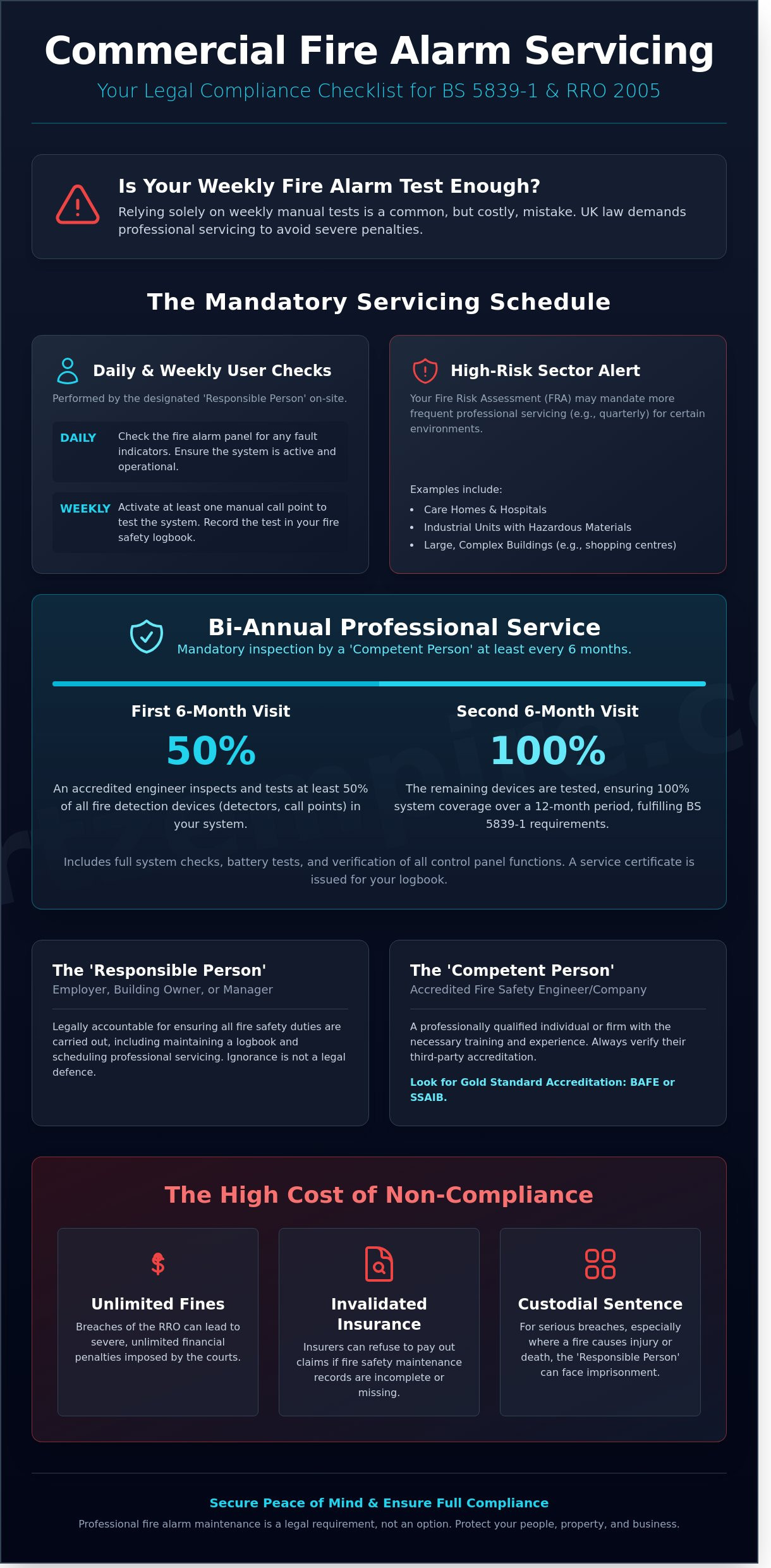
The RRO identifies a "Responsible Person" for every business, usually the employer, building owner, or facilities manager. This individual carries the legal weight of ensuring the premises are safe. It's a heavy burden because the law is very clear: ignorance of servicing intervals is never a valid legal defence. If a fire occurs and your records show a gap in maintenance, the Responsible Person can face unlimited fines or even a custodial sentence. We've seen instances where insurance providers refuse to pay out claims totalling hundreds of thousands of pounds because the fire alarm servicing wasn't up to date. Valid business insurance relies on your ability to prove your system is fully operational through a robust logbook of professional service certificates.
BS 5839-1: The Industry Standard
The UK government points directly to British Standards to define what constitutes "adequate maintenance" under the law. BS 5839-1 is a comprehensive document that categorises systems based on their purpose. Systems are generally split into Category L (Life Protection), Category P (Property Protection), and Category M (Manual Systems). Each category has specific requirements, but they all share the same need for expert oversight. While the standard provides a universal framework, it's also vital to follow manufacturer-specific maintenance instructions. Different components from brands like Hikvision or Paxton may have unique requirements that run alongside the British Standard. Our accredited engineers ensure that every sensor, sounder, and control panel is tested according to both the broad industry rules and the specific technical needs of the hardware installed in your building.
The Commercial Fire Alarm Servicing Schedule
Understanding how often should commercial fire alarms be serviced is a fundamental part of your role as a "Responsible Person" in any business. Fire safety isn't a static achievement; it's a continuous process of verification. The legal framework for this in the UK is the Regulatory Reform (Fire Safety) Order 2005. This legislation requires that all fire safety equipment is maintained in an efficient state, in efficient working order, and in good repair. For commercial premises, this translates to a structured, tiered maintenance programme that combines internal checks with professional, accredited inspections.
The core of this schedule is the six-monthly professional inspection. BS 5839-1 standards dictate that a competent person must inspect your system at least twice a year. This isn't just a box-ticking exercise; it's a deep-dive into the system's integrity. During these visits, an engineer will test at least 50% of your devices, ensuring that over a 12-month period, 100% of the system has been verified. If your building is particularly large or complex, such as a high-occupancy office block in Central London or a sprawling warehouse in Kent, these visits might occur quarterly to spread the testing load.
Every 12 months, the requirements become even more rigorous. Your accredited engineer will perform a full system check, including a battery health assessment. Lead-acid batteries in fire panels typically have a lifespan of 3 to 5 years. An annual check ensures they can still provide the mandatory 24-hour standby power required in the event of a mains failure. If your batteries are over 4 years old, we recommend proactive replacement to prevent a system fault at an inconvenient time.
Weekly Testing vs. Six-Monthly Servicing
Weekly tests are user-led and mandatory. You must activate a different manual call point each week during a set time to confirm the control panel receives the signal and the sounders activate. It's a quick "heartbeat" check that takes less than 5 minutes. However, a weekly test doesn't replace the need for a professional service. An engineer uses specialised equipment to check smoke detector sensitivity and circuit voltages. They ensure the system hasn't been compromised by dust, insects, or structural changes to the building.
Daily and Monthly Vigilance
Daily checks should be integrated into your standard facility routine. This involves a simple visual inspection of the fire alarm control panel. You're looking for a healthy green "Power On" light and ensuring no amber "Fault" lights are illuminated. Monthly, you should test any secondary power supplies, such as backup generators, to ensure they kick in if the primary grid fails. These small, consistent actions prevent 85% of common system failures from escalating into costly emergency call-outs.
Managing compliance across multiple locations requires a coordinated approach. If you operate sites across London and Kent, synchronising your servicing dates can significantly reduce administrative overheads. We provide tailored maintenance contracts that ensure every site in your portfolio meets the same high standard of safety. Whether you manage three shops in Maidstone or twenty offices in the City, consistency is the key to total peace of mind and full legal compliance.
Who Can Legally Service a Commercial Fire Alarm?
UK fire safety law is explicit about who can touch your life safety systems. The Regulatory Reform (Fire Safety) Order 2005 requires the "Responsible Person" to appoint a competent person to carry out any necessary maintenance. Competence isn't a subjective term. It refers to an individual with sufficient training, experience, and knowledge of the BS 5839-1:2017 standards to prevent faults and ensure system reliability. Determining how often should commercial fire alarms be serviced is only half the battle; the other half is ensuring the person performing the work is legally qualified to do so.
Quartz Empire Fire & Security Ltd provides a team of engineers who specialise exclusively in fire and security protocols across London, Kent, and the South East. We don't use general handymen for these tasks. Our engineers carry the specific diagnostic tools and software keys required to interrogate modern addressable panels. This technical expertise is vital because 22% of fire system failures are linked to improper maintenance by unqualified individuals. The foundation of any safety strategy begins with a competent fire risk assessor who identifies specific site requirements, followed by a certified engineer who executes the service programme.
Why Accreditation Matters
Third-party certification through BAFE (British Approvals for Fire Equipment) or the SSAIB acts as a guarantee of technical excellence. It's the gold standard for fire security providers. When you hire a BAFE SP203-1 accredited company, you're choosing a partner that undergoes regular, rigorous audits of their work and management systems. This protects the Responsible Person from liability. If a fire occurs and your records show the system was serviced by a non-certified electrician, your insurance provider may refuse to pay the claim. A general electrician might understand basic wiring, but they rarely have the specialist training to calibrate smoke sensors or test battery standby capacities to the exact requirements of British Standards.
Documentation and the Fire Logbook
Your fire logbook is a legal document, not a suggestion. It serves as the primary evidence of compliance during an unannounced inspection by a Fire Officer. Every test, fault, and service visit must be recorded clearly. We've seen that 35% of enforcement notices in the South East are issued because of inadequate record-keeping rather than equipment failure. A proper logbook entry should include:
- The date and time of the service or test.
- The name and signature of the competent engineer.
- Details of any faults found and the specific remedial actions taken.
- A confirmation that the system is fully operational.
Quartz Empire offers both traditional physical logbooks and secure digital records. Digital logbooks are becoming the preferred choice for many facilities managers in London as they ensure data is accessible, backed up, and cannot be lost in a building fire. When considering how often should commercial fire alarms be serviced, remember that your logbook must mirror the frequency of your service contract. Our no-nonsense approach ensures that every visit is documented to the highest standard, giving you total peace of mind that your business remains on the right side of the law.
Sector-Specific Servicing: When Once Every 6 Months Isn't Enough
The standard six-month interval is a baseline, not a universal rule for every business. Your Fire Risk Assessment (FRA), required under the Regulatory Reform (Fire Safety) Order 2005, determines the actual schedule for your specific premises. If your FRA identifies high-risk factors, you'll need to increase the frequency of professional inspections. We've found that for 14% of our clients in London and Kent, a standard biannual check doesn't provide sufficient protection against system degradation. A certified technician must evaluate your environment to decide if how often should commercial fire alarms be serviced needs to be adjusted to a quarterly or even monthly schedule.
Large London office blocks often utilise addressable systems. These are far more sophisticated than conventional systems because they identify the exact location of a triggered device. While efficient, these systems require expert software updates and loop testing that shouldn't be delayed. In high-rise environments, the complexity of the wiring and the number of interfaces with lifts or HVAC systems mean that a single fault can compromise the safety of hundreds of people. Regular, meticulous testing ensures these connections remain robust and compliant with BS 5839-1 standards.
High-Occupancy and Sleeping Risk Premises
Hotels, care homes, and Houses in Multiple Occupation (HMOs) present unique challenges because residents are often asleep or unfamiliar with escape routes. For these high-risk environments, quarterly visits every three months are the industry standard for maintaining compliance. False alarms are a significant burden; in 2023, the London Fire Brigade attended over 52,000 false alarms. Frequent servicing helps our team recalibrate sensors to distinguish between a real threat and steam or cooking fumes. Historic London buildings often feature complex layouts where older wiring requires expert monitoring to prevent intermittent faults that lead to system downtime.
Industrial and High-Dust Environments
Manufacturing hubs across Kent industrial estates, particularly those involved in joinery, textiles, or food processing, face rapid dust accumulation. This debris settles on optical sensors, leading to sensitivity drift or total failure. When considering how often should commercial fire alarms be serviced, industrial managers should look at quarterly cleaning cycles. Proactive maintenance prevents the need for expensive remedial works; replacing a contaminated detector head costs significantly more than a scheduled cleaning visit. Regular calibration ensures your system remains reliable despite the harsh conditions of a working factory floor. Data from 2022 suggests that 22% of detector failures in industrial settings stem from preventable environmental contamination.
Harsh environments don't just affect the sensors. Corrosive atmospheres in chemical plants or high-humidity areas in commercial kitchens can degrade the physical integrity of call points and sounders. Our no-nonsense approach involves a thorough physical inspection of all components, ensuring that every part of the system functions exactly as intended during an emergency. We provide a clear, documented audit trail that proves your commitment to safety and satisfies both insurers and local fire authorities.
Ensure your high-risk premises remain fully compliant by booking a professional fire safety assessment with our expert team today.
Professional Maintenance with Quartz Empire
Managing fire safety shouldn't be a guessing game for business owners or facilities managers. At Quartz Empire, we provide a no-nonsense approach to compliance across London and the South East. We focus on clear communication, technical excellence, and absolute transparency. We understand the confusion regarding how often should commercial fire alarms be serviced, so we provide a structured schedule that meets all British Standards while fitting your operational needs. Our goal is to remove the administrative burden of fire safety from your shoulders.
Our maintenance contracts are designed to be active safety nets rather than just pieces of paper. When we visit your site, we don't just tick boxes; we perform a deep dive into your system's health. A standard Quartz Empire service includes:
- Full functional testing of all smoke, heat, and carbon monoxide detectors.
- Inspection of backup batteries to ensure they provide at least 24 hours of standby power.
- Cleaning of detector chambers to reduce the risk of dust-led false alarms.
- Testing of all manual call points and sounder circuits.
- A complete audit of your fire alarm logbook to ensure it meets fire officer expectations.
Faults and false alarms can disrupt your operations and lead to significant financial losses. Government data suggests that false alarms cost UK businesses roughly £1 billion every year in lost productivity and fire brigade charges. Our 24/7 emergency support ensures that if your system develops a fault at 2:00 AM, an accredited engineer is available to resolve it. This level of reliability is exactly why hundreds of firms in the South East view us as their trusted partner in fire safety. We don't just repair hardware; we protect your people and your bottom line.
The Benefits of a Maintenance Contract
Predictable budgeting is a major advantage for Kent businesses. Our fixed-price servicing models mean you won't face unexpected financial shocks when it's time for an inspection. We manage the schedule on your behalf. Our administrative team sends automatic reminders 30 days before your next service is due. This ensures you never miss a legal deadline or fall out of compliance with BS 5839-1 regulations. Contract holders also benefit from priority response times, with our team aiming to be on-site within 4 hours for any critical system faults.
Get Started with a Compliance Audit
We often encounter businesses that are struggling with legacy systems or incomplete maintenance records. Our team excels at transitioning these sites from a state of non-compliance to full safety certification. We provide professional servicing across Kent, London, and the South East, ensuring every sensor and sounder meets current UK regulations. We provide the documentation you need to satisfy insurers and local authorities alike. Don't leave your property to chance. You can book your 6-monthly fire alarm service with our accredited team today to secure your building and ensure your business remains fully protected.
Prioritise Your Compliance and Site Safety
Adhering to the Regulatory Reform (Fire Safety) Order 2005 isn't just about ticking boxes; it's about protecting lives. You've now seen that BS 5839-1 standards require professional inspections at least every 6 months to ensure system reliability. However, high-risk sectors or complex buildings frequently require quarterly visits to maintain full coverage. Knowing how often should commercial fire alarms be serviced is the first step toward total legal compliance and operational safety.
Quartz Empire acts as your trusted partner across Kent and London, removing the stress of maintenance through our no-nonsense approach. Our BAFE and SSAIB accredited engineers bring technical expertise to every site visit, ensuring your equipment meets the highest industry benchmarks. We've built our reputation on being dependable and meticulous so that business owners can focus on their daily operations without fear of system failure or legal penalties.
Don't leave your property's safety to chance. Secure your business with an accredited fire alarm maintenance plan and ensure your protection is always up to standard. We're ready to help you build a safer future for your team.
Frequently Asked Questions
Is it a legal requirement to service a fire alarm every 6 months?
Yes, British Standard BS 5839-1 states that commercial fire alarms must be serviced at least every six months by a competent person. This requirement ensures your business remains compliant with the Regulatory Reform (Fire Safety) Order 2005. Failing to meet this 180-day interval can lead to heavy fines or prosecution by the Fire and Rescue Service if your building is inspected.
Can I carry out fire alarm servicing myself if I own the business?
You cannot legally perform the six-monthly service yourself unless you have specific technical training and the correct diagnostic equipment. While your staff should handle the weekly bell tests, the professional service requires an accredited engineer to check battery voltages, smoke chamber sensitivity, and signal integrity. Our certified team provides the necessary paperwork to prove your system is reliable and safe for your employees.
What happens if I miss a fire alarm service date?
Missing a scheduled service date puts your business at immediate risk of non-compliance and could invalidate your commercial insurance policy. If a fire occurs and your 180-day maintenance window has lapsed, your insurer might refuse to pay out for property damage or liability claims. You also risk receiving a formal enforcement notice from the local fire authority during a routine safety audit.
How much does a commercial fire alarm service cost in London?
A professional fire alarm service in London typically starts from £125 for a small system with up to 20 devices. Prices increase based on the size of the premises and the total number of detectors, call points, and sounders. We offer transparent, no-nonsense quotes for businesses across Kent and the South East to ensure you get expert maintenance without hidden costs.
Do I need to keep a physical logbook of all fire alarm tests?
You must maintain an accurate record of all fire safety activities, including weekly tests, false alarms, and professional services. While digital records are acceptable, they must be instantly accessible for inspection by a Fire Officer or insurance surveyor. This logbook serves as your primary evidence that you've fulfilled 100% of your legal duties to protect your property and staff.
What is the difference between fire alarm testing and fire alarm servicing?
Testing is a simple weekly check performed by your staff to confirm the alarm sounds, while servicing is a deep technical inspection by an expert. When considering how often should commercial fire alarms be serviced, the legal answer is twice per year to examine internal components that a weekly test won't cover. Servicing identifies hidden faults like battery degradation or sensor contamination before they cause a system failure.
How long does a professional fire alarm service take to complete?
A standard service for a small-to-medium office usually takes between 90 minutes and 3 hours. Larger commercial sites or multi-storey buildings in London can take 1 to 2 days depending on the complexity of the network. Our engineers work meticulously to test every device while ensuring minimal disruption to your daily business operations.
Does a new fire alarm system still need servicing in its first year?
Yes, a new system requires its first professional service exactly six months after the installation date. Early maintenance is vital to identify any "infant mortality" faults in electronic components and to ensure the system hasn't been compromised during final building works. Regular servicing from day one keeps your manufacturer's warranty valid and ensures your peace of mind.