
Professional Fire Risk Assessment London: Secure Your Business Compliance in 2026

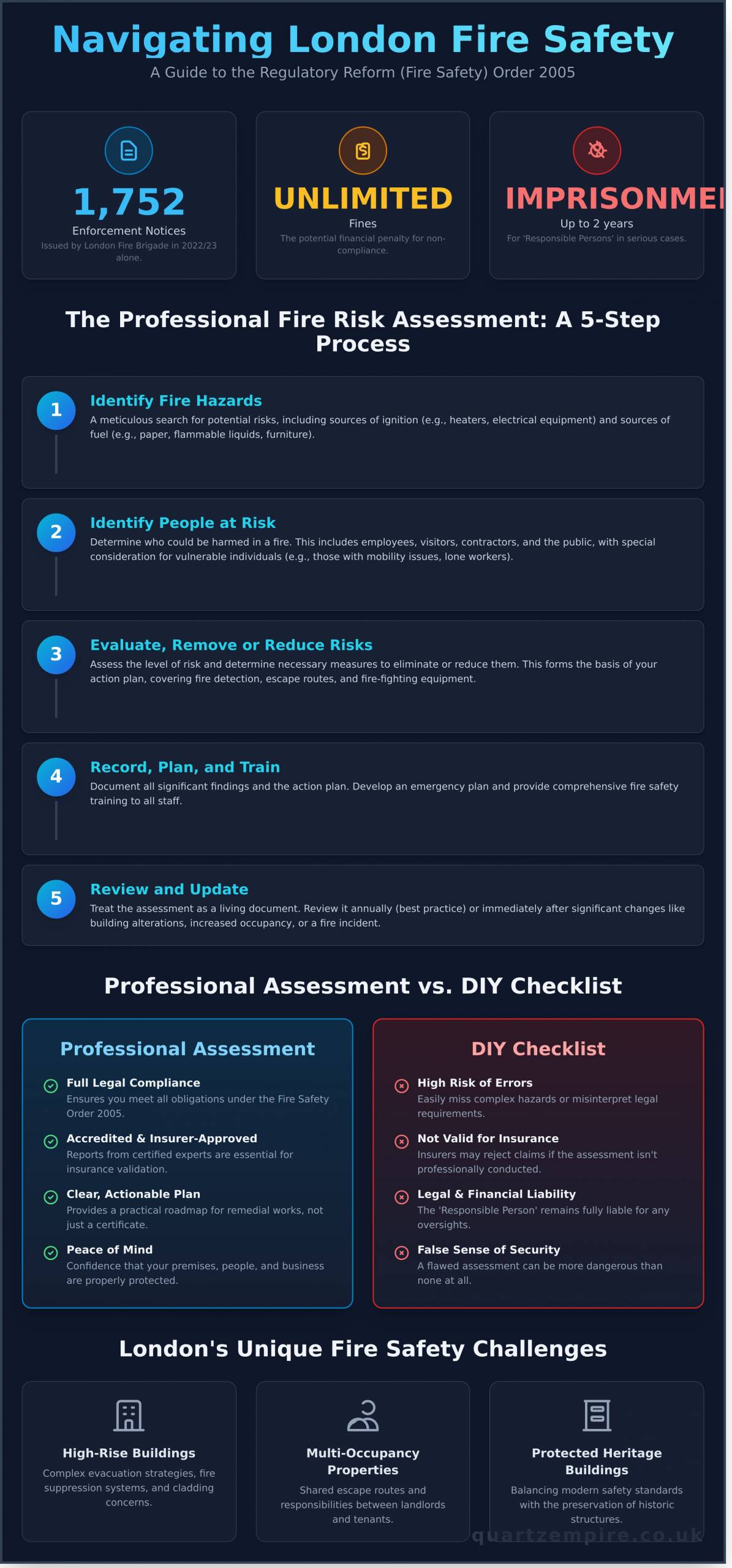
In 2022/23 alone, the London Fire Brigade issued 1,752 enforcement notices to businesses failing to meet their fire safety obligations. A single oversight doesn't just risk a disruption; it can lead to unlimited fines or even imprisonment for the responsible person. It's understandable why navigating the complexities of the Regulatory Reform (Fire Safety) Order 2005 feels overwhelming for many London business owners. The legal stakes are incredibly high, and getting clear, straightforward advice can be a challenge.
This guide provides a no-nonsense approach to securing your full compliance and protecting your future. We will show you precisely how a professional fire risk assessment London businesses can trust delivers more than a certificate; it provides a clear action plan, safeguards your team, and gives you complete peace of mind. We'll walk you through the entire process, from what to expect during the assessment to understanding your report and implementing the necessary remedial works.
Key Takeaways
- Understand your legal obligations under the Regulatory Reform (Fire Safety) Order 2005 and why a compliant assessment is non-negotiable.
- Discover the critical difference between a DIY checklist and a professional fire risk assessment london, and why accredited reports are essential for insurance purposes.
- Learn how to navigate the unique fire safety complexities found in London's high-rise, multi-occupancy, and protected heritage buildings.
- Identify the key credentials a fire safety expert must have to ensure your assessment provides true peace of mind and legal protection.
What is a Fire Risk Assessment and Why is it Mandatory in London?
A fire risk assessment is a methodical and comprehensive evaluation of your premises to identify potential fire hazards, assess the risk they pose to people, and implement measures to ensure their safety. It's not simply a compliance document; it is the cornerstone of your entire fire safety strategy, designed to protect lives, property, and your business's continuity. The process involves a deep look into potential ignition sources, fuel sources, and the adequacy of your existing safety measures. Understanding the fundamentals of this process is the first step toward creating a safer environment, and you can explore a broader overview by asking What is Fire Safety? in a wider context.
In the UK, the legal requirement for this assessment is enshrined in the Regulatory Reform (Fire Safety) Order 2005. This legislation places a direct legal duty on businesses and property owners to ensure the safety of anyone on their premises. For businesses operating in the capital, the London Fire Brigade acts as the primary enforcing authority. They carry out inspections and have the power to take legal action if they find that a property is not compliant. A professional fire risk assessment London businesses can rely on is therefore not an optional extra, but a fundamental legal obligation.
The consequences of failing to comply with the Fire Safety Order are severe and can be life-altering. The London Fire Brigade actively prosecutes non-compliant businesses, with penalties ranging from enforcement notices that can disrupt your operations to unlimited fines. In the most serious cases where a significant risk to life is identified, individuals can face custodial sentences of up to two years. This underlines the critical importance of treating fire safety with the seriousness it demands.
Who is the 'Responsible Person'?
The 2005 Order legally defines a 'Responsible Person' who holds the ultimate accountability for fire safety. This individual is typically the employer, the business owner, a landlord, or anyone else with control of the premises, like a facilities manager. Their duties include commissioning the assessment, implementing its findings, keeping detailed records, and ensuring all staff are trained. While you can appoint a competent, accredited professional to conduct the assessment, you cannot delegate the final legal responsibility.
When should you update your assessment?
A fire risk assessment is a living document that must be reviewed regularly to remain valid. While an annual review is the accepted best practice, an update is legally required as soon as any significant changes occur within your premises. These changes can introduce new hazards or render existing safety measures inadequate. Key triggers for a review include:
- Alterations to the building's layout, such as new partitions or blocked escape routes.
- A significant change in the number of people using the premises.
- The introduction or increased storage of hazardous materials.
- Updates or changes to your fire alarm or detection systems.
- A fire or a near-miss incident occurring at the property.
For London businesses, a review trigger is any material change that could affect your original fire risk assessment's validity.
The 5-Step Process of a Professional Fire Risk Assessment
Conducting a fire risk assessment is a fundamental legal duty for all non-domestic premises in the UK. This isn't simply a box-ticking exercise; it's a methodical process designed to protect people and property from the devastating impact of fire. The government outlines your core duties in its guidance for a Mandatory Fire Risk Assessment, and a professional assessor follows a trusted five-step framework to ensure nothing is missed.
The entire process is built on a logical progression, moving from identification to action and review. A competent assessor will systematically work through these stages to provide you with a clear, compliant, and actionable report.
- Identify the Fire Hazards: The first step is a meticulous search for potential fire risks. This involves pinpointing both sources of ignition (heaters, naked flames, electrical equipment) and sources of fuel (paper, flammable liquids, furniture).
- Identify People at Risk: We then determine who could be harmed in the event of a fire. This includes not just your employees but also visitors, contractors, and members of the public. Special consideration is given to vulnerable individuals, such as those with mobility issues or lone workers.
- Evaluate, Remove or Reduce Risks: With hazards and people identified, the assessor evaluates the level of risk. They then determine what measures are needed to remove or reduce these risks to an acceptable level. This involves assessing both passive and active fire protection systems.
- Record, Plan, and Train: For businesses with five or more employees, findings must be formally recorded. This record forms the basis of your emergency evacuation plan, which details escape routes, assembly points, and procedures. Staff must be trained on this plan.
- Review and Update: A fire risk assessment is a living document. It must be reviewed regularly and updated whenever there are significant changes to the premises, processes, or personnel.
Identifying Hazards in Commercial Premises
London's diverse commercial landscape presents unique challenges. A modern office in Canary Wharf might have risks from overloaded electrical sockets or unventilated server rooms. Industrial units in Greater London require a focus on the safe storage of flammable materials. The city’s vast stock of older buildings, particularly in areas like Soho or Covent Garden, often contains hidden risks like compromised fire compartmentation from previous refurbishments or aged electrical systems that demand expert inspection.
Evaluating Fire Protection Systems
A key part of a professional fire risk assessment London businesses receive is the scrutiny of existing fire protection. This involves assessing the fire alarm system's grade-from a complex Grade A system for high-risk environments to a simple Grade F domestic unit-to ensure it's appropriate. We also conduct rigorous checks on passive fire protection, such as the integrity of fire doors and compartment walls, which are critical for slowing the spread of fire and smoke. For a deeper dive into these systems, our Ultimate Guide to Business Fire Risk Assessments provides comprehensive details.
Finally, the review cycle is critical. The Regulatory Reform (Fire Safety) Order 2005 requires you to keep your assessment under regular review. Best practice dictates an annual review, or sooner if there have been significant changes to your workplace. If you're unsure whether your current assessment is compliant, our accredited assessors provide the expert guidance you need for complete peace of mind.
London's Unique Fire Safety Challenges: Beyond the Basics
London's dense and diverse architectural landscape presents fire safety challenges that are far more complex than in other UK cities. A standard, box-ticking exercise is simply not enough to ensure compliance or, more importantly, to protect life and property. While the foundation of any competent assessment follows the government's official 5-Step Fire Risk Assessment Process, applying it effectively in the capital demands specialist knowledge of these distinct local risks.
The legacy of the Grenfell Tower fire in 2017 has profoundly reshaped UK fire safety legislation. The Building Safety Act 2022 introduced stringent new duties for building owners, particularly concerning high-rise residential buildings and their external wall systems. A comprehensive fire risk assessment London service must now include a meticulous evaluation of cladding and insulation materials, ensuring they meet the latest fire performance standards to protect your occupants and assets.
High-Rise and Multi-Occupancy Risks
Evacuating a 50-storey skyscraper in Canary Wharf or The City requires more than just functioning fire alarms. These complex structures demand sophisticated, phased evacuation strategies and robust emergency voice communication systems. Our assessments for these properties focus on verifying the compliance of evacuation lifts (as per BS 9999), coordinating with multiple 'Responsible Persons' in shared buildings to create a unified safety plan, and ensuring robust protocols are in place for disabled access, including Personal Emergency Evacuation Plans (PEEPs).
Managing Heritage and Older Properties
London's vast portfolio of Grade I and Grade II listed buildings demands a delicate balance between historic preservation and modern safety. Victorian and Georgian properties, with their hidden voids, original timber frames, and lath-and-plaster walls, can allow fire to spread with alarming speed. Our expert assessors specialise in recommending discreet passive fire protection solutions, like intumescent seals and fire-resistant boarding, that maintain architectural integrity. We often specify advanced wireless fire alarm systems to avoid damaging irreplaceable interiors with extensive cabling.
Emergency access is another critical factor often overlooked. Many of London's historic streets in areas like Kensington or Covent Garden are simply too narrow for modern fire appliances, which can be up to 2.5 metres wide. A reliable assessment must account for this logistical reality, ensuring your on-site firefighting provisions are sufficient to manage an incident in its crucial early stages, compensating for potential delays in emergency service response.
Finally, simple logistics can complicate assessments. Scheduling site visits within the Congestion Charge zone (£15 daily) and the Ultra Low Emission Zone (ULEZ) (£12.50 daily for non-compliant vehicles) requires careful planning. As a trusted partner serving London and the South East, we manage these details seamlessly, ensuring your assessment is completed efficiently and without unexpected costs. It's part of our no nonsense approach to providing complete peace of mind.
Professional vs. DIY: The True Cost of a Fire Risk Assessment
When managing budgets, the temptation to download a free template or opt for the cheapest quote for a fire risk assessment is understandable. However, this approach carries significant hidden costs and legal risks that can far outweigh the initial savings. The true cost isn't measured by the upfront fee, but by the potential for non-compliance, invalidated insurance, and catastrophic failure in an emergency.
The myth of the 'free template' is particularly dangerous. While seemingly a cost-effective solution, a generic checklist offers no real legal protection. In the event of a fire, a court or the London Fire Brigade (LFB) won't scrutinise the template; they will scrutinise the competence of the person who completed it. A simple tick-box document cannot adequately assess the unique risks of a London commercial property, from its specific layout and occupancy patterns to its structural materials. An assessment that fails to identify a critical flaw because it wasn't on the template is considered insufficient, leaving the Responsible Person liable for prosecution under the Regulatory Reform (Fire Safety) Order 2005.
Similarly, a 'cheap' assessment often proves to be the most expensive. These cut-price reports are frequently superficial, missing crucial remedial works needed to achieve compliance. This creates a false sense of security, leaving your business, staff, and visitors exposed. The real bill arrives later, either through LFB enforcement notices demanding costly, urgent upgrades or, in the worst-case scenario, the devastating financial and human cost of a fire.
The Value of Competent Advice
The LFB defines a 'competent' assessor as someone with the necessary training, experience, and knowledge to conduct a suitable and sufficient assessment. This is where professional accreditation becomes non-negotiable. Assessors with certifications from bodies like BAFE (British Approvals for Fire Equipment) or memberships with the Institution of Fire Engineers (IFE) have proven their expertise. This accreditation is your assurance that the assessment is a strategic safety plan, not just a tick-box exercise. It's an investment in peace of mind, directly addressing your legal duty of care.
A professional fire risk assessment in London conducted by an accredited expert can also have a direct financial benefit. Many insurers now offer reduced premiums, sometimes by as much as 5-10%, for businesses that can demonstrate robust fire safety management backed by a comprehensive, professional FRA. This potential saving can quickly offset the initial assessment fee.
Remedial Works and Compliance
A professional fire risk assessment is not the end of the process; it is the beginning of a clear, actionable compliance strategy. The report's findings are translated into a prioritised maintenance and action schedule, outlining precisely what needs to be done, from installing new fire doors to upgrading an entire alarm system.
At Quartz Empire, our BAFE-accredited team manages the seamless transition from assessment to installation and maintenance. We don't just identify problems; we provide the certified solutions to resolve them, ensuring your property is fully protected and compliant. This plan often includes a schedule for ongoing servicing, which is a legal requirement for systems like alarms. You can learn more about your obligations in our guide to Fire Alarm Servicing: Your Legal Responsibilities.
Don't leave your safety to chance with a DIY approach. Book your accredited fire risk assessment with our expert team today and ensure your business is genuinely protected.
Quartz Empire: Your Trusted Partner for London Fire Safety
Ensuring your commercial property is compliant with the Regulatory Reform (Fire Safety) Order 2005 is not just a legal obligation; it's a fundamental responsibility. At Quartz Empire Fire & Security Ltd, we deliver a no-nonsense approach to fire safety and security. We move beyond simple box-ticking to provide comprehensive, integrated solutions that genuinely protect your people, property, and assets. Our fully accredited team operates across London, Kent, and the South East, offering a single, reliable point of contact for all your safety needs.
We believe in a seamless safety journey. For us, a risk assessment is the critical first step, not the final destination. Our process is designed to provide you with a clear, actionable roadmap to total compliance and security. This integrated approach includes:
- Expert Risk Assessments: A thorough evaluation of your premises by a certified assessor to identify hazards and outline necessary actions.
- Compliant System Design: Using the assessment findings, we design bespoke, BS 5839 compliant fire alarm and detection systems tailored to your specific environment.
- Professional Installation: Our certified engineers install all equipment to the highest industry standards, ensuring reliability from day one.
- Ongoing Maintenance: We offer scheduled maintenance contracts to guarantee your systems remain fully operational and compliant, providing you with complete peace of mind.
Why Choose Quartz Empire Fire & Security Ltd?
When you work with us, you gain direct access to our team of certified engineers and assessors, each with an average of over 15 years of field experience. We possess deep, practical knowledge of London's diverse commercial and industrial sectors, from Grade II listed buildings in Westminster to modern industrial units in Park Royal. Our commitment is to clear, factual communication. We deliver reports that are easy to understand and provide the precise information you need to make informed decisions.
Start Your Compliance Journey Today
Booking your professional fire risk assessment london is a straightforward process. It begins with an initial consultation to understand your requirements, followed by the scheduling of a convenient site visit. During the assessment, our expert will conduct a meticulous inspection of your premises, examining everything from escape routes to fire-fighting equipment and ignition sources. You will then receive a comprehensive report detailing all findings and providing clear, prioritised recommendations for action.
Don't leave your legal compliance and the safety of your premises to chance. Take the definitive step towards securing your business. Secure your London premises with a professional Fire Risk Assessment and partner with a team dedicated to your protection.
Secure Your London Business for 2026 and Beyond
Meeting your fire safety obligations is a critical, non-negotiable responsibility. Given London's unique structural challenges and stringent regulations, the true cost of an inadequate or DIY assessment can be catastrophic. A professional fire risk assessment london isn't just about compliance; it's about the fundamental protection of your people, property, and livelihood.
Don't leave your safety to chance. As your trusted partner, Quartz Empire delivers expert guidance with a no-nonsense approach. Our team consists of Fully Accredited & Certified Engineers who are specialists across London, Kent, and the South East. We ensure your business meets all necessary standards, including full expertise in BS 5839-1 compliance, giving you complete peace of mind.
Take the decisive step towards securing your business's future. Get a No-Nonsense Fire Risk Assessment Quote for Your London Business and let's ensure you're fully protected.
Frequently Asked Questions
Who is responsible for making a fire risk assessment in a London office?
The 'Responsible Person' holds the legal duty for fire safety in a London office. Under the Regulatory Reform (Fire Safety) Order 2005, this is typically the employer, the building owner, or any individual with control over the premises, such as a facilities manager. This person must ensure a suitable and sufficient assessment is completed and regularly reviewed to protect occupants and property. They are accountable for implementing the findings to maintain a safe environment.
How much does a fire risk assessment cost in London for 2026?
While prices are subject to inflation, we project the cost for a professional fire risk assessment in London for 2026 to start from approximately £350 for a small, low-risk business. For larger or more complex premises, such as a multi-storey office block over 500 square meters, costs could range from £600 to over £1,000. The final price depends entirely on the size, complexity, and specific use of your building, so a direct quote is always recommended.
How often should a commercial fire risk assessment be reviewed?
Your fire risk assessment should be reviewed regularly, with industry best practice being at least once every 12 months. A review is also legally required immediately following any significant changes to your premises. These triggers include altering the building's layout, introducing new hazardous substances, a change in the type or number of occupants, or after any fire-related incident. A consistent review process ensures your safety measures remain effective and compliant.
Can the London Fire Brigade do my fire risk assessment for me?
No, the London Fire Brigade (LFB) will not conduct a fire risk assessment for your business. The LFB's role is to enforce fire safety legislation, not to provide a commercial assessment service. They may inspect your premises to ensure you are compliant and have a valid assessment in place. The legal responsibility to arrange and pay for a competent person to complete the assessment lies solely with your organisation's 'Responsible Person'.
What happens if my London business fails a fire risk assessment?
An assessment doesn't result in a simple "pass" or "fail". Instead, it produces a prioritised action plan detailing necessary improvements. If you fail to act on significant risk findings, the London Fire Brigade can issue an enforcement notice compelling you to make changes. In cases of severe danger, they can issue a prohibition notice to restrict access or even close the premises until it's made safe. Non-compliance can lead to unlimited fines and prosecution.
Do I need a fire risk assessment for a small retail shop in London?
Yes, you absolutely need one. A fire risk assessment for a London shop is a legal requirement under the 2005 Fire Safety Order, regardless of its size. If you employ anyone, or if the public has access to your premises, you must have a formal assessment. This document demonstrates you have identified potential fire hazards, evaluated the risks to people, and implemented adequate safety measures to protect everyone who uses your shop.
What is the difference between a fire risk assessment and a fire safety audit?
A fire risk assessment is a proactive, in-depth evaluation to identify fire hazards and determine the necessary safety measures for your specific premises. It's the foundation of your fire safety plan. A fire safety audit, on the other hand, is a reactive inspection. It's a systematic check, often conducted by an external body like the fire service, to verify that you are correctly following the procedures and maintaining the precautions outlined in your assessment.
How long does a professional fire risk assessment take to complete?
The on-site inspection for a typical small office or retail unit in London usually takes between two and four hours. The duration depends on the building's size and complexity; a simple, single-floor space might take 90 minutes, while a large, multi-use building could require a full day. Following the site visit, you can expect to receive the comprehensive written report, including the action plan, within 5 to 7 working days.