
Fire Compartmentation: Your Guide to UK Compliance in 2026

Navigating UK fire safety regulations can be a complex and daunting task for any commercial property owner or facilities manager. The technical requirements, particularly surrounding effective fire compartmentation, often create confusion and concern, leaving you to question if your building truly meets the strict legal standards. The fear of non-compliance, coupled with uncertainty about potential costs and disruption, is a heavy burden to carry when the safety of your people and property is at stake.
Modern buildings require numerous services like pipes, cables, and ventilation ducts to pass through fire-resistant walls and floors. Each of these openings, or 'penetrations', creates a potential breach in the compartment. Firestopping is the process of sealing these gaps with certified materials like fire-rated mastics, pillows, and collars that expand to block fire spread. This is one of the most common areas for compliance failure, especially when new services are installed after the initial construction, making professional Fire Stopping services essential to ensure these seals remain intact and effective.
This guide is designed to provide clarity and peace of mind. We will break down the essential principles of fire compartmentation, explain your legal responsibilities under UK law, and provide a clear, no-nonsense action plan. By the end of this article, you will have the expert knowledge needed to assess your building, identify potential issues, and confidently ensure your property is not just compliant by 2026, but fundamentally safe for everyone who uses it.
Key Takeaways
- Understand that effective fire compartmentation is a legal requirement designed to contain fire and smoke, protecting escape routes, personnel, and property.
- Discover why even compliant buildings can develop hidden breaches in fire barriers over time, often in unseen areas like ceiling voids and service risers.
- Learn why a professional survey is the only reliable method to verify the integrity of your building’s fire protection and ensure every component is correctly installed.
- Identify the essential steps required to achieve and maintain compliance for your commercial property, providing peace of mind and ensuring the safety of your occupants.
What is Fire Compartmentation & Why is it a Legal Requirement?
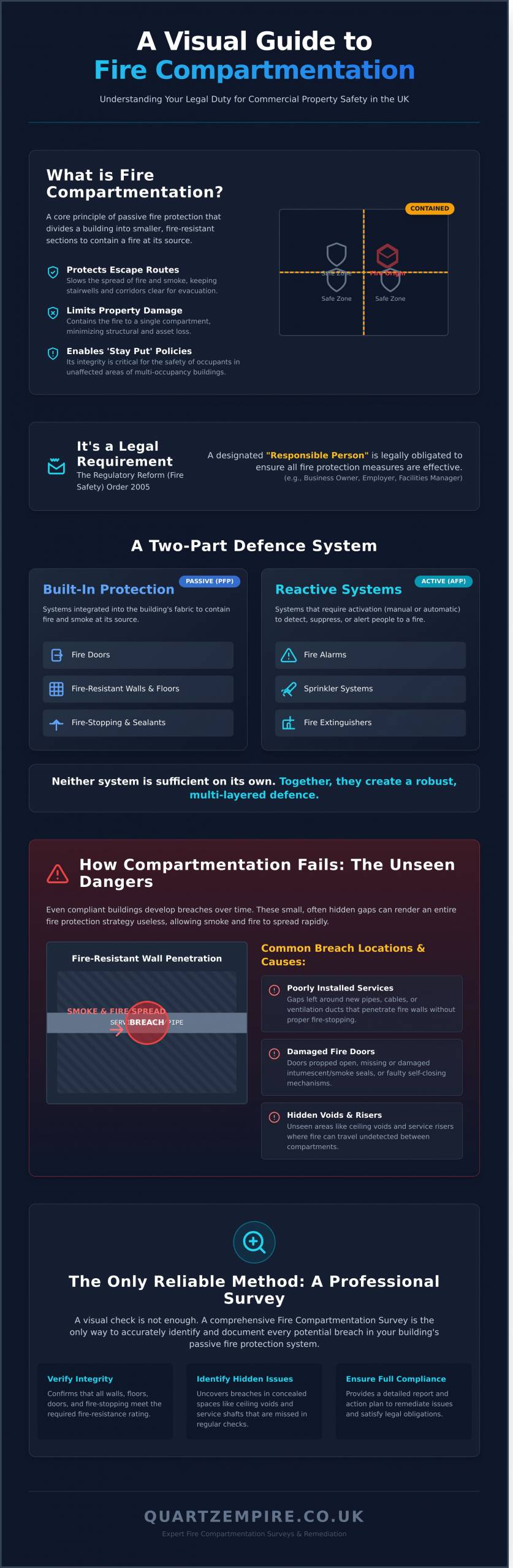
In simple terms, fire compartmentation is a fundamental principle of passive fire protection. It involves systematically dividing a building into smaller, manageable sections or 'compartments' using fire-resistant walls, floors, ceilings, and fire doors. The primary goal is to contain a fire and the smoke it produces within the area where it originates. This vital strategy slows the spread of fire, protecting escape routes for occupants and limiting damage to the property, giving the fire and rescue service valuable time to respond.
In the UK, maintaining effective fire compartmentation is not just best practice-it is a legal duty. The responsibility falls under The Regulatory Reform (Fire Safety) Order 2005. This legislation designates a 'Responsible Person' for every commercial property, typically the business owner, employer, or facilities manager. This individual is legally obligated to conduct regular fire risk assessments and ensure all fire protection measures, including compartmentation, are correctly installed, maintained, and remain effective throughout the building's life.
The 'Stay Put' Policy and Its Reliance on Compartmentation
Many multi-occupancy buildings, such as apartment blocks and large offices, operate a 'Stay Put' policy. This strategy advises residents or occupants not directly affected by a fire to remain in their secure compartment rather than evacuating. The safety of this policy is entirely dependent on the integrity of the building's compartmentation. If fire-resistant barriers are breached-for example, by poorly installed cables or pipes-fire and smoke can spread rapidly, placing those 'staying put' in extreme danger.
Passive vs. Active Fire Protection: Where Compartmentation Fits
A compliant fire safety strategy relies on two distinct but complementary systems working in unison:
- Active Fire Protection (AFP): These are systems that require activation to work, such as fire alarms, sprinkler systems, and fire extinguishers. They are designed to detect and react to a fire once it has started.
- Passive Fire Protection (PFP): This is built into the fabric of the building to contain fire at its source. Fire compartmentation is a cornerstone of PFP, alongside fire doors, fire-stopping sealants, and cavity barriers.
Neither system is sufficient on its own. An active alarm alerts occupants, while passive compartmentation provides them with a protected route to safety. Together, they create a robust, multi-layered defence to protect people and property.
Core Components: The Building Blocks of Fire Compartmentation
Effective fire compartmentation is not a single product but a meticulously designed system where every component works in unison to contain a fire. Think of a fire compartment as a waterproof box: even one small, unsealed hole renders the entire structure ineffective. Each element is tested and rated to provide a specific period of fire resistance-typically 30, 60, 90, or 120 minutes-giving occupants time to evacuate and emergency services time to respond. For this system to be compliant and reliable, every component must be correctly specified, installed, and maintained by certified experts.
Fire-Resistant Walls, Floors, and Ceilings
The primary barriers of any fire compartment are its structural elements. These are the walls, floors, and ceilings constructed from materials with inherent fire-resistant properties, such as concrete, blockwork, and specialist fire-rated plasterboard. These elements form the 'box' that contains fire and smoke. To ensure they perform as required, their construction must strictly adhere to building regulations. The official guidance on UK compliance in 2026, known as Approved Document B, outlines the precise technical requirements for these structures to achieve the necessary fire-resistance rating.
Fire Doors and Their Critical Role
A fire door is much more than a standard door; it is an engineered safety device designed to maintain the integrity of a fire wall while allowing for transit. A compliant fire door assembly is a critical active component of fire compartmentation. Key elements include:
- Intumescent Seals: These strips expand when exposed to heat, sealing the gap between the door and the frame to block flames and hot gases.
- Smoke Seals: Often integrated with intumescent seals, these prevent the passage of cold smoke, which can travel far from the fire and is a leading cause of injury.
- Self-Closing Devices: This mechanism ensures the door automatically closes and latches shut, maintaining the barrier. A fire door propped open is no longer a fire door.
Penetration Sealing and Firestopping
Modern buildings require numerous services like pipes, cables, and ventilation ducts to pass through fire-resistant walls and floors. Each of these openings, or 'penetrations', creates a potential breach in the compartment. Firestopping is the process of sealing these gaps with certified materials like fire-rated mastics, pillows, and collars that expand to block fire spread. This is one of the most common areas for compliance failure, especially when new services are installed after the initial construction. Professional installation and regular inspection are essential to ensure these seals remain intact and effective.
How Compartmentation Fails: Common Breaches and Their Consequences
A common assumption is that a building, once constructed to standard, remains compliant indefinitely. However, the integrity of a building’s fire compartmentation is frequently compromised by post-construction work. Breaches are often not immediately obvious, hidden away in ceiling voids, service risers, and wall cavities. Neglecting these breaches is not just a safety risk; it carries severe legal and financial consequences, including substantial fines, prosecution under the Regulatory Reform (Fire Safety) Order 2005, and the potential invalidation of your building’s insurance policy.
Unsealed Gaps and Penetrations
Every time a new IT cable, water pipe, or electrical conduit is run through a fire-rated wall or floor, a penetration is created. If these openings are not correctly sealed with appropriate firestopping materials, they become direct pathways for fire and toxic smoke. A small, unsealed gap around a cable tray is more than enough to allow a fire to bypass a 30 or 60-minute fire-rated barrier in seconds, rendering the entire compartment useless and endangering lives.
Incorrectly Installed or Damaged Fire Doors
Fire doors are a critical and active component of compartmentation, yet they are one of the most common points of failure. Issues that compromise their effectiveness include:
- Excessive gaps between the door and the frame.
- Faulty or disconnected closing mechanisms that prevent the door from latching securely.
- Missing or damaged intumescent and smoke seals.
- Damage from daily use, such as propping doors open or impact from trolleys.
These defects must be identified and rectified as part of your regular fire risk assessment to ensure the doors perform as designed in an emergency.
Incompatible or Incorrectly Specified Materials
Attempting to seal a penetration with non-fire-rated materials, such as standard expanding foam or generic fillers, is exceptionally dangerous. Firestopping is a precise science; products must be tested and certified for the specific wall or floor construction and the type of service passing through it. Understanding the Core Components of Fire Compartmentation, as detailed by leading UK bodies like the Association for Specialist Fire Protection (ASFP), is essential. Using an incorrect or incompatible product can be as hazardous as leaving a hole completely unsealed, creating a false sense of security while offering no real protection.
Verifying Your Protection: The Fire Compartmentation Survey
Over time, even the most robustly designed buildings undergo changes. New data cables are run, plumbing is updated, and general wear and tear occurs. Each of these modifications can create unseen gaps and breaches in your fire-resistant barriers, silently compromising your building's safety. Assuming your protection is intact is not enough; verification is essential.
The only certain method to confirm the integrity of your passive fire protection is through a professional fire compartmentation survey. This is a detailed, non-destructive inspection carried out by a competent expert. Its primary goal is to systematically identify any and all breaches in the fire-resistant lines of your building, from walls and floors to ceilings and service risers. For the designated Responsible Person, a comprehensive survey report provides invaluable, documented evidence of due diligence, demonstrating a proactive approach to fire safety compliance.
What Does a Surveyor Look For?
A certified surveyor conducts a meticulous inspection, focusing on areas where failures are common. Their assessment is comprehensive and includes:
- Hidden Voids: Inspecting spaces above suspended ceilings and within riser cupboards, where services often penetrate fire barriers without being properly sealed.
- Penetration Seals: Checking the integrity and correct specification of all fire-stopping seals around services like pipes, cables, and ductwork that pass through fire-rated walls and floors.
- Fire Doorsets: Assessing the condition, certification, and installation of all fire doors, including their frames, intumescent seals, smoke seals, and self-closing devices.
- Compliance with Strategy: Comparing the building's current layout and condition against its original fire strategy drawings to identify any unauthorised or non-compliant alterations.
The Survey Process and Report
Our expert-led surveys follow a structured, no-nonsense process to deliver clear and actionable results, providing you with complete peace of mind.
- Initial Consultation: We begin by reviewing your existing building plans, fire strategy documents, and any previous risk assessments to build a complete picture of your property.
- On-Site Inspection: Our accredited surveyors conduct a thorough visual inspection of all accessible areas, using their expertise to pinpoint potential weaknesses and non-compliant installations.
- Detailed Reporting: You receive a comprehensive report that documents every identified issue. Each breach is catalogued with clear photographic evidence, its precise location, and a description of the defect.
- Remedial Recommendations: The report concludes with a clear list of recommended remedial works required to rectify all identified issues and bring your building's fire compartmentation back to full compliance.
To ensure your building is fully compliant and your people are protected, it is essential to work with a trusted partner. Contact the expert team at Quartz Empire to discuss your fire safety survey needs.
Achieving Compliance in Kent & London with Quartz Empire
Understanding the principles of fire compartmentation is the first step; ensuring your commercial building is fully compliant is the next, critical one. For businesses across Kent, London, and the South East, navigating the complexities of fire safety regulations can be a significant challenge. At Quartz Empire Fire & Security Ltd, we provide a straightforward, no-nonsense approach to passive fire protection, acting as your trusted partner to ensure your premises are safe, secure, and legally compliant.
Achieving compliance doesn't need to be a daunting process. With an expert team guiding you, you can confidently address any vulnerabilities in your building’s structure and fulfil your duties as a Responsible Person under the Regulatory Reform (Fire Safety) Order 2005.
From Survey to Certification
Our accredited team manages the entire process, from an initial, meticulous survey to final certification. We don't just identify breaches and imperfections in your building's fire barriers; we have the in-house expertise to carry out all necessary remedial works to the highest industry standards. This end-to-end service ensures a seamless and efficient journey to compliance, providing you with the official documentation and complete peace of mind that comes from knowing your building is certified and your people are protected.
Your Next Steps to Ensuring Safety
Proactive fire safety is non-negotiable. Don't wait for a fire risk assessment to flag a critical issue or, worse, for an incident to occur. Taking action today is the most effective way to protect your people, property, and business continuity. If you have any doubts about the integrity of your building's fire compartmentation, our team is ready to provide expert guidance and a clear path forward.
Contact our expert team today to book your Fire Compartmentation Survey.
Secure Your Compliance with a Trusted Fire Safety Partner
As the 2026 compliance landscape approaches, it is clear that robust fire safety measures are more than a recommendation-they are a critical legal duty. This guide has shown that effective fire compartmentation is the cornerstone of passive fire protection, essential for containing a blaze and allowing for safe evacuation. We have also seen how easily these vital systems can be breached through everyday modifications, turning a compliant building into a significant risk.
Verifying the integrity of your building doesn't have to be a complex challenge. As accredited and certified fire safety experts, Quartz Empire offers a trusted, no-nonsense approach for businesses across Kent, London, and the South East. Our comprehensive surveys identify every potential breach, providing a clear pathway to full compliance through our expert remedial works services.
Don't wait for an incident to reveal a weakness in your defences. Ensure your building is compliant and your people are protected. Request a Fire Compartmentation Survey today and gain the peace of mind that comes from proven expertise.
Frequently Asked Questions About Fire Compartmentation
What is the difference between fire compartmentation and fire separation?
These terms are closely related and often used together. Fire compartmentation is the overall passive fire protection strategy of dividing a building into smaller, manageable sections using fire-resistant construction. Fire separation refers to the individual physical barriers, such as fire-rated walls, floors, and doors, that are used to create these compartments. Essentially, fire separation is the method used to achieve effective compartmentation, ensuring fire and smoke are contained for a specified period to allow for safe evacuation.
How often should fire compartmentation be checked or surveyed?
While UK law does not mandate a specific survey frequency, the Regulatory Reform (Fire Safety) Order 2005 requires that fire safety provisions are maintained. Best practice, as part of a robust fire risk assessment review, is to conduct a survey annually. More frequent checks may be necessary in high-risk environments, older buildings, or following any construction work where services have been altered. This proactive approach ensures the integrity of your passive fire protection remains compliant and effective.
Who is legally responsible for maintaining fire compartmentation in a commercial building?
In the UK, the legal duty falls upon the 'Responsible Person' as defined by the Regulatory Reform (Fire Safety) Order 2005. This individual is typically the employer, building owner, landlord, or anyone with control of the premises, such as a facilities manager or managing agent. This person or entity has a legal obligation to ensure all fire safety measures, including the maintenance of fire compartmentation, are adequate and kept in good working order to protect occupants.
What is a 'fire compartmentation survey report' and what does it include?
A fire compartmentation survey report is a comprehensive document detailing the findings of an intrusive inspection. It identifies and records any breaches or defects in a building’s fire-resisting structures, such as walls and floors. A professional report from an accredited provider will include photographic evidence of each breach, its precise location marked on floor plans, a description of the defect, and clear recommendations for the necessary remedial works required to achieve compliance and ensure safety.
Can new cables be run through a fire-rated wall?
Yes, new services like data or electrical cables can be run through a fire-rated wall, but it is critical that any penetration is correctly fire-stopped. Simply drilling a hole and leaving a gap, or using standard filler, compromises the wall's integrity. Certified fire-stopping products, such as intumescent sealants or fire collars, must be installed by a competent and certified professional to reinstate the wall's original fire-resistance rating and maintain the safety of the compartment.
Are fire compartmentation surveys a legal requirement in the UK?
The law does not explicitly state that you must have a 'fire compartmentation survey'. However, the Fire Safety Order legally requires the Responsible Person to ensure all general fire precautions are properly maintained. A professional survey is the most effective method to inspect, identify, and document the condition of your building's compartmentation. It provides the necessary evidence to demonstrate due diligence and forms an essential part of any robust fire safety management plan for a commercial property.
How much does a fire compartmentation survey typically cost?
The cost of a professional fire compartmentation survey is not fixed and depends on several key factors. The final price is influenced by the size, age, and complexity of the building, as well as the accessibility of areas like ceiling voids and service risers. A small, simple office will cost significantly less than a large, complex site like a hospital. For an accurate, no-obligation quotation tailored to your premises, we recommend contacting our expert team for a detailed assessment.