
Access Control Installation: A Step-by-Step Guide for Businesses

The prospect of a new access control installation can seem complex, raising valid concerns about potential disruption, choosing a qualified installer, and the long-term reliability of the system. For many business owners and facilities managers, these unknowns can make a critical security upgrade feel like a daunting task rather than a straightforward investment in protecting people and property.
This step-by-step guide is designed to provide clarity and peace of mind. We will walk you through every critical phase of the process, from the initial site survey and system design to the final commissioning and handover. By understanding what a professional, compliant installation involves, you will be equipped to manage your project with confidence, ensure minimal disruption to your operations, and secure a reliable security solution that serves your business for years to come.
Key Takeaways
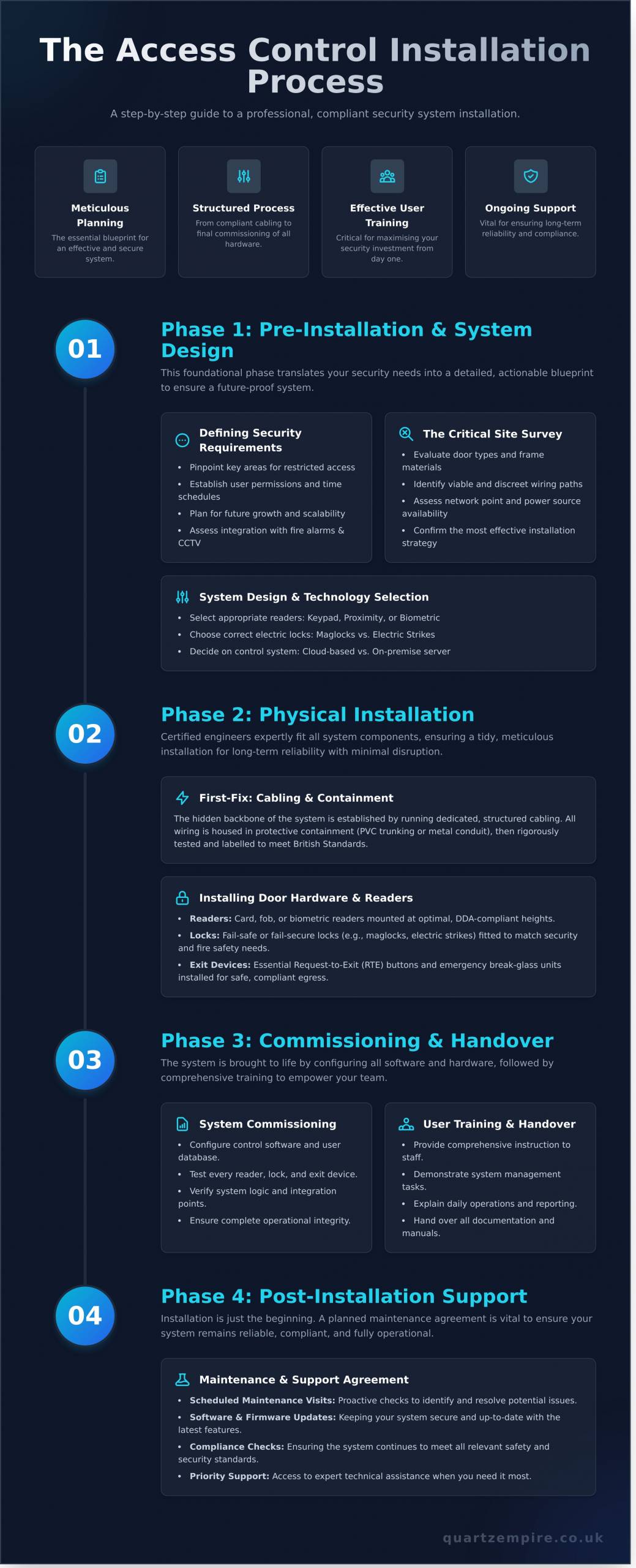
- Meticulous planning is non-negotiable. The pre-installation phase, including a site survey and system design, forms the essential blueprint for a secure and effective system.
- A professional access control installation follows a structured, multi-stage process. This guide outlines the key steps, from running compliant cabling to the final commissioning of all hardware and software.
- Effective user training is a critical part of the handover. Ensure your team receives comprehensive instruction on system management to maximise your security investment from day one.
- Installation is just the beginning. A planned maintenance and support agreement is vital to ensure your access control system remains reliable, compliant, and fully operational long-term.
Phase 1: Pre-Installation Planning & System Design
A successful access control installation begins long before any tools are brought to your premises. This foundational phase is dedicated to translating your specific security needs into a detailed, actionable blueprint. Proper planning is not an optional step; it is the most critical factor in preventing costly mistakes, avoiding future system limitations, and ensuring the final solution provides the security and peace of mind you expect. At its core, this stage is about defining the rules and methods of physical access control for your building. A professional site survey by a certified expert is the cornerstone of this entire process, forming the basis for a reliable and compliant system.
Defining Your Security Requirements
The first step is a thorough consultation to understand exactly what you need to protect. Our experts work with you to establish a clear security brief, considering every angle of your operation. This involves:
- Identifying Key Areas: Pinpointing which zones require restricted access, such as main entrances, server rooms, stockrooms, or executive offices.
- Establishing User Permissions: Determining who needs access to which areas and defining specific time schedules for entry.
- Planning for Future Growth: Considering scalability from day one. Will you need to add more doors, sites, or users in the future? A well-designed system can grow with your business.
- Assessing Integration Needs: Discussing how the access control system should interact with other building systems, like fire alarms for emergency egress or CCTV for visual verification.
The Critical Site Survey
Once your requirements are defined, an expert engineer conducts a meticulous site survey. This is a technical assessment of your building’s infrastructure to identify any potential challenges and confirm the most effective installation strategy. Our engineer will evaluate door types and frame materials (e.g., wood, uPVC, aluminium), check for viable and discreet wiring paths, and assess the availability of network points and suitable power sources for controllers and locks. This survey is essential for creating an accurate system design and providing a transparent, no-nonsense quote.
System Design and Technology Selection
Using the data from the site survey and your security brief, we design a complete system tailored to your property. This involves selecting the right combination of accredited hardware and software from trusted partners like Paxton and Hikvision. Key decisions made at this stage include choosing the most appropriate readers (keypad, proximity fob/card, or biometric), selecting the correct electric locks (maglocks for high-security doors vs. electric strikes for standard traffic), and deciding between a flexible cloud-based control system or a traditional on-premise server. The result is a detailed plan showing all component locations, providing a clear roadmap for a seamless installation.
Phase 2: The Physical Installation Process
Following the detailed design phase, we move to the physical build. This is the core stage where the system's components are expertly fitted into your premises by our certified engineers. The quality of this work is paramount; a tidy, meticulous installation not only looks professional but is fundamental to the system's long-term reliability and performance. Our team works efficiently and methodically, ensuring that any disruption to your daily operations is kept to an absolute minimum throughout the entire access control installation process.
First-Fix: Cabling and Containment
The first-fix stage establishes the hidden backbone of your security system. Our technicians run dedicated, structured cabling from the central controller locations to each designated door. To protect this critical infrastructure and ensure compliance, all wiring is housed in appropriate containment, such as PVC trunking or metal conduit. Before any hardware is connected, every cable is rigorously tested and clearly labelled, guaranteeing it meets all relevant British Standards for safety and performance.
Installing Door Hardware and Readers
With the cabling in place, we proceed to fit the high-quality door hardware. This involves the precise installation of electric locking mechanisms, such as electromagnetic locks (maglocks) or electric strikes, onto doors and their frames. Key components include:
- Readers: Card, fob, or biometric readers are mounted at optimal, DDA-compliant heights for user convenience and accessibility.
- Locks: Fail-safe or fail-secure locks are fitted to match the door's specific security and fire safety requirements.
- Exit Devices: We install essential safety components, including Request-to-Exit (RTE) buttons and emergency break-glass units, ensuring a safe and compliant exit path.
Our engineers ensure all hardware is securely fitted and operates flawlessly before moving to the final stage.
Fitting Control Panels and Power Supplies
The final step is to install the system's brain. The main access control panels are mounted in a secure, central location like an IT or server room. To safeguard against power outages, we connect them to dedicated, uninterruptible power supplies (PSUs) with battery backup, ensuring your security is never compromised. Our engineers then make the final, precise connections between the door hardware and the control panels, bringing the entire system online. Our accredited engineers ensure a compliant and reliable installation.
Phase 3: System Commissioning and Handover
The commissioning phase transforms the physical components into a fully functional security solution. This is a meticulous quality assurance step where our certified engineers configure software, test every component, and ensure the system is perfectly aligned with your operational needs. A successful access control installation is defined by this critical stage, which culminates in the handover of a reliable, compliant, and user-friendly system to your team.
Software Configuration and Network Integration
Our experts install and configure the core access control management software, such as systems from industry leaders like Paxton, integrating it seamlessly with your existing network for straightforward administration. We meticulously establish all system parameters, including door schedules, access time zones, and specific user groups. If specified in the initial design, we also integrate the system with your CCTV, intruder, or fire alarm systems to create a unified and more powerful security platform.
Enrolling Users and Setting Access Levels
We populate the system database by enrolling all authorised personnel and creating profiles for different visitor types. Credentials, such as key fobs or access cards, are issued and securely assigned to individual users. Crucially, we apply specific access levels to user groups, ensuring staff can only enter areas relevant to their role. This process strictly adheres to the security principle of least privilege, a best practice that significantly reduces internal risks and protects sensitive areas of your premises.
Comprehensive Testing and Final Handover
The final stage of the installation is rigorous, methodical testing designed to provide complete peace of mind. Our engineers exhaustively check every aspect of the system to confirm flawless operation. This includes:
- Component Functionality: Testing every card reader, door lock, and request-to-exit (RTE) button for correct and immediate response.
- Resilience Testing: Simulating a power failure to verify that battery backup systems engage correctly and maintain security without interruption.
- Data Logging: Generating and reviewing event logs to confirm that all access attempts and system events are being accurately recorded for audit and security purposes.
Upon successful completion of all tests, we provide you with comprehensive handover documentation, administrator logins, and full training for your designated staff. This ensures a smooth transition and empowers your team to manage the system effectively from day one.
Phase 4: Post-Installation Support and Maintenance
A professional access control installation is not a one-time transaction; it is the beginning of a long-term security partnership. The handover of your new system marks the start of its operational life, and ensuring its continued reliability is crucial for protecting your people and property. Ongoing support and proactive maintenance are essential components that deliver true peace of mind and maximise the return on your investment.
At Quartz Empire, we believe our responsibility extends far beyond the initial setup. We establish ourselves as your trusted security partner, providing the expert guidance and technical support needed to keep your system performing flawlessly for years to come.
Administrator and User Training
An access control system is only as effective as the people who manage it. That is why we provide comprehensive training for your key personnel. Our experts ensure your team is confident in handling the day-to-day operations, including using the management software to add or remove users, modify access permissions, and generate audit trail reports. This vital knowledge transfer empowers your staff to respond to system events and manage site security efficiently.
The Importance of a Maintenance Contract
Regular, preventative maintenance is the most effective way to ensure the longevity and reliability of your security system. A tailored maintenance contract moves you from a reactive to a proactive security posture, identifying potential issues before they can cause a system failure. Our service includes:
- Regular testing of all backup batteries and power supplies.
- Thorough inspection and cleaning of all readers, locks, and sensors.
- Verification of all wiring and network connections.
- Functional checks to ensure the system operates as designed.
This not only guarantees optimal performance but also ensures your system remains compliant with industry standards and insurance policy requirements, while giving you access to priority support when you need it most.
System Updates and Future-Proofing
The security landscape is constantly evolving, and your access control system must evolve with it. Software and firmware require periodic updates to patch potential security vulnerabilities and introduce new features. As your trusted partner, we manage these updates to keep your system secure and effective. We also provide strategic advice on future-proofing your investment, helping you plan for expansion or integration with other security platforms as your business grows. A successful access control installation is one that adapts to your future needs. Protect your investment with our expert maintenance plans.
Your Trusted Partner for a Seamless Access Control Installation
As this guide has shown, a successful security system is the result of a meticulous, multi-stage process. It begins with comprehensive planning tailored to your unique needs, followed by a precise physical installation. Crucially, the process extends to expert system commissioning and dedicated post-installation support, ensuring your investment remains effective and reliable for the long term and provides lasting peace of mind.
For a compliant and robust access control installation, partnering with a certified expert is non-negotiable. As SSAIB and BAFE accredited installers, Quartz Empire is the trusted security partner for businesses throughout Kent, London, and The South East. Our team has extensive expertise with industry-leading systems from Paxton and Hikvision, providing you with a reliable, high-quality solution designed to protect your people and property.
Ready to enhance your security with a professional, no-nonsense approach? Book a free site survey for your access control installation today.
Frequently Asked Questions About Access Control Installation
How long does a typical access control installation take?
The timeframe for an access control installation depends entirely on the project's scale and complexity. A simple, standalone system for a single door can often be completed within a few hours. However, a comprehensive networked system for a multi-storey office building, involving dozens of doors and complex wiring, could take several days or more to install and commission correctly. Our expert team provides a clear project timeline after an initial site survey to ensure you know exactly what to expect.
Will the installation process disrupt my business operations?
We understand that business continuity is critical. Our certified engineers work meticulously to minimise disruption during any installation. We achieve this by scheduling work during off-peak hours or weekends where possible and by completing the project in logical phases. Clear communication is key; we will coordinate with your team throughout the process to ensure your operations can continue smoothly and safely with minimal impact. Our goal is a seamless and efficient installation.
What qualifications should an access control installation company have?
When choosing an installation company, you should always verify their accreditations. Look for a provider certified by a UKAS-accredited body like the NSI (National Security Inspectorate) or SSAIB. This ensures they meet high technical standards and are properly vetted. Furthermore, an expert company will have engineers trained and certified directly by leading manufacturers like Paxton or Hikvision, guaranteeing a compliant and reliable installation that protects your people and property.
Can a new access control system be integrated with my existing CCTV or fire alarm?
Yes, integration is a key benefit of modern security systems. A professionally installed access control system can be seamlessly integrated with your existing CCTV, intruder, and fire alarm systems. For example, access events can trigger specific cameras to record, or the fire alarm can automatically unlock all doors for safe evacuation. This creates a unified, intelligent security solution that provides enhanced protection and operational efficiency for your business.
How much does professional access control installation cost?
The cost of a professional access control installation varies significantly based on your specific requirements. A basic standalone keypad for one door may start from a few hundred pounds. A sophisticated, multi-door networked system using biometric readers for a large commercial property could cost several thousand pounds or more. We provide a detailed, no-nonsense quote after a thorough site assessment to ensure the solution is perfectly tailored to your security needs and budget.
What is the difference between a standalone and a networked access control system?
A standalone system controls a single door and is programmed directly at the device, making it ideal for securing individual rooms like a server room or stock cupboard. In contrast, a networked system connects multiple doors to a central computer. This allows for centralised management, real-time monitoring, detailed user reports, and the ability to grant or revoke access permissions instantly from one location, offering far greater control and scalability for your premises.
Is a maintenance contract for an access control system really necessary?
A maintenance contract is essential for ensuring the long-term reliability and security of your access control system. Regular servicing by certified technicians prevents faults, ensures software is up-to-date against new threats, and confirms all components are functioning correctly. It provides peace of mind that your security is never compromised and protects your initial investment, often preventing more costly emergency repairs and ensuring your system remains fully compliant with industry standards.