
Disabled Refuge System: A Complete Guide for UK Businesses
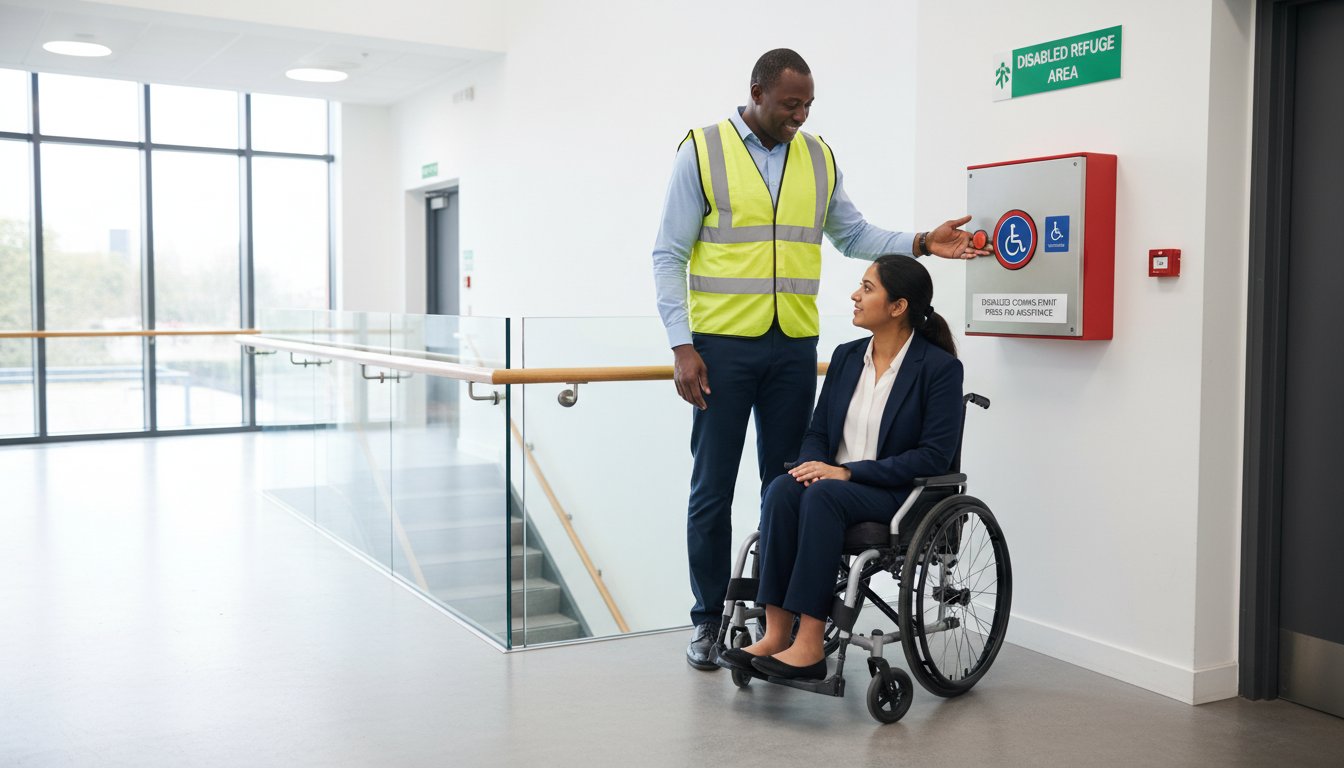
As a business owner or facilities manager, ensuring the safety of every person in your building during an emergency is your highest priority. Navigating the complexities of UK fire safety regulations, particularly for those with mobility issues, can be a significant source of concern. A correctly specified and installed disabled refuge system is not just a legal necessity; it is a fundamental part of providing a safe environment for everyone. Yet understanding the technical jargon, your precise legal obligations, and the installation process can feel overwhelming.
This comprehensive guide provides the clarity you need. We will demystify the requirements, explain the core components, and outline the steps to ensure your building is fully compliant and, most importantly, safe for all occupants. By the end of this article, you will understand your duties and be equipped to make informed decisions, securing peace of mind and protecting your people and property with a reliable, accredited solution.
Key Takeaways
- Determine if your building legally requires a disabled refuge system based on its specific design, layout, and use.
- Identify the key components of a compliant system to ensure any proposed solution meets all necessary safety standards.
- Understand that your legal duties extend beyond the initial setup; regular maintenance and testing are mandatory under UK fire safety law.
- Recognise why professional installation by certified engineers is essential for guaranteeing both compliance and reliable performance in an emergency.
What is a Disabled Refuge System and Why is it Essential?
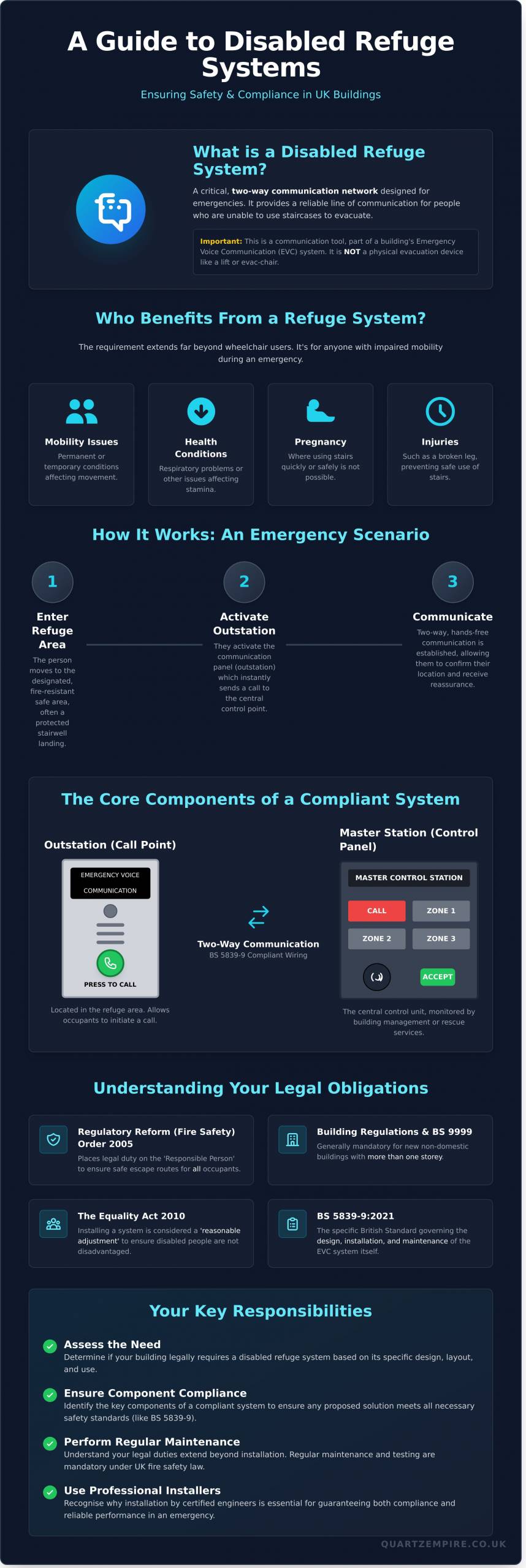
A disabled refuge system is a critical, two-way communication network designed to assist in the orderly and safe evacuation of all individuals from a building during an emergency. Its primary function is to provide a reliable line of communication for people who are unable to use staircases to reach a final exit. These systems create a temporary, safe waiting area, allowing individuals to speak directly with building management or rescue services.
It is important to understand that this is a communication tool-a vital part of a building's overall Emergency Voice Communication (EVC) system-and not a physical evacuation device like a lift or evac-chair. Its purpose is to ensure no one is left isolated or unheard during a critical incident, providing peace of mind and facilitating a coordinated rescue.
The Purpose of a Designated Refuge Area
This area is a specifically designed, fire-resistant space, often a protected stairwell landing or lobby. The concept of an Area of Refuge is to provide a safe location where individuals can await assistance without obstructing the main evacuation routes. This designated space offers both physical protection from fire and smoke for a limited time and the psychological reassurance of a direct communication link to those coordinating the rescue effort.
Who Needs a Disabled Refuge System?
While often associated with wheelchair users, the need for these systems extends to a much wider group of people. In an emergency, anyone with impaired mobility could require assistance. This includes:
- Individuals with permanent or temporary mobility issues.
- People with respiratory conditions or other health problems that affect their stamina.
- Pregnant women.
- Anyone with an injury, such as a broken leg, that prevents them from using stairs safely.
How the System Works in an Emergency Scenario
The process is designed for simplicity and reliability under pressure. When a person enters the refuge area, they activate the communication 'outstation'-typically a clearly marked, push-button panel. This immediately sends a call to the central 'master station', alerting building management or the fire and rescue service. Two-way, hands-free communication is established, allowing the individual to confirm their location and status, and for rescuers to provide reassurance and coordinate an effective evacuation.
UK Legal Requirements: Is a Disabled Refuge System Mandatory?
For business owners and facilities managers, understanding the legal obligations surrounding fire safety is critical. The requirement for a disabled refuge system is not a blanket rule but is dictated by a building's design, size, and use. In short, if your building's layout prevents a person with mobility issues from evacuating immediately to a place of ultimate safety, you are legally required to provide a temporary safe space. This duty is enforced by a combination of UK legislation and standards, all designed to ensure a safe means of escape for everyone. Failure to comply can lead to significant fines and prosecution.
The Regulatory Reform (Fire Safety) Order 2005
This order places the legal responsibility for fire safety squarely on the 'Responsible Person' for the premises. A core part of this duty is to conduct a thorough fire risk assessment and ensure that safe escape routes are available for all building occupants. In multi-storey buildings where simultaneous evacuation is not practical, providing a designated refuge area is a key measure to fulfil this legal duty of care and protect vulnerable individuals during an emergency.
Building Regulations and British Standard BS 9999
For new non-domestic buildings with more than one storey, a disabled refuge area is generally a mandatory requirement from the design stage. As outlined in the official UK Building Regulations (Approved Document B), these systems are a fundamental part of compliant fire safety. The code of practice for this, BS 9999, provides detailed guidance on the design and provision of refuge areas, particularly in buildings with phased evacuation strategies.
The Equality Act 2010
The Equality Act 2010 requires service providers and employers to make 'reasonable adjustments' to ensure that disabled people are not at a disadvantage. Installing a compliant refuge system is considered a crucial reasonable adjustment for fire safety. This legal duty extends to everyone who might use the building, including employees, visitors, and members of the public, ensuring equal access to safety measures in an emergency.
Guidance from BS 5839-9:2021
While other regulations mandate the need for a refuge, BS 5839-9:2021 is the specific British Standard governing the design, installation, commissioning, and maintenance of the Emergency Voice Communication (EVC) systems within them. Adherence to this standard is the hallmark of a professional, reliable installation. It ensures the communication equipment is fit for purpose and will perform correctly when it is needed most, providing peace of mind for the Responsible Person.
The Key Components of a Compliant Disabled Refuge System
To ensure complete reliability during an emergency, a compliant disabled refuge system is constructed from several key components, all working in seamless unison. It is best understood as a specialised, life-safety intercom system, purpose-built to function under the most demanding conditions. Each part has a critical role, and failure in one component can compromise the integrity of the entire system, undermining the safety of vulnerable individuals.
The Master Station (Control Panel)
Consider the master station the central hub or 'brain' of the system. Typically installed in a building's control room, reception area, or another constantly monitored location, this panel provides a complete overview of all refuge points. From here, a building manager or fire warden can communicate directly with individuals at each outstation, acknowledge calls, and coordinate a safe and orderly evacuation, providing vital reassurance.
Outstations (Remote Units)
Outstations are the robust, high-visibility call points located within each designated refuge area. They allow individuals who need assistance to communicate clearly with the master station. There are two main types specified in British Standards:
- Type A: A traditional telephone-style handset, typically used by fire wardens or fire and rescue service personnel.
- Type B: A hands-free unit operated by a single push button, which is the standard for disabled refuge points due to its ease of use.
System Wiring and Power Supply
A disabled refuge system must remain operational even in the event of a fire and a mains power failure. To achieve this, the system is wired using enhanced fire-resistant cabling that can withstand extreme temperatures for a specified period. Furthermore, a dedicated, uninterruptible power supply with battery backup is essential, ensuring that communication lines remain open when they are needed most.
Location, Spacing and Signage
Correct placement is dictated by strict building regulations to ensure accessibility and visibility. Refuge areas must be clearly identified with photoluminescent signage that remains visible even in low light. The outstations themselves must be installed at a height accessible to wheelchair users. As detailed in the code of practice for fire safety, BS 9999:2017, a refuge point is generally required on every storey above the ground floor, ensuring comprehensive coverage throughout the building.
The Installation Process: A Step-by-Step Overview
Implementing a disabled refuge system is a critical safety measure, and the installation process should be straightforward and meticulous. A professional, compliant installation is essential for protecting lives and meeting your legal obligations. We follow a proven, no-nonsense methodology designed to ensure full compliance with minimal disruption to your daily operations. Here’s what business owners and facility managers can expect from initial consultation to final handover.
Step 1: Site Survey and System Design
The process begins with a comprehensive site survey conducted by an expert engineer. We assess your building’s unique layout, size, and operational needs to determine the optimal number and location for all refuge points. Based on this detailed assessment, we create a bespoke system design that is fully compliant with the stringent requirements of the British Standard BS 5839-9, ensuring your system is fit for purpose.
Step 2: Professional Installation
Once the design is approved, our certified engineers carry out the physical installation. This involves the precise fitting of all master stations and outstations and the running of specialist, fire-resistant cabling throughout the building. All work is completed meticulously to meet the highest electrical and safety standards, guaranteeing the reliability and integrity of your new communication system.
Step 3: Commissioning and Handover
The final stage is commissioning and handover. We rigorously test every component of the entire disabled refuge system to confirm it is fully operational and performs exactly as required in an emergency scenario. We then provide comprehensive training for your designated staff on how to operate the master station effectively. You will receive a full handover pack, including all necessary certification and a site logbook for your records, giving you complete peace of mind.
Why You Must Choose an Accredited Installer
Choosing the right installer is as important as the system itself. Using an accredited company, such as one certified by BAFE or NSI, is non-negotiable for fire safety. Accreditation is your guarantee that the engineers are competent, their work is of the highest quality, and the installation strictly adheres to the latest British Standards. It ensures your system is not just installed, but installed correctly. Quartz Empire provides accredited installations across Kent and London.
Essential Maintenance and Testing for Your Disabled Refuge System
Installing a compliant disabled refuge system is a critical first step in protecting vulnerable individuals, but the legal responsibility does not end there. Under the Regulatory Reform (Fire Safety) Order 2005, the designated ‘Responsible Person’ for a building has an ongoing duty to ensure all fire safety equipment is maintained in an efficient state and in good working order. A system that fails during an emergency is no different from having no system at all, representing a serious breach of compliance and putting lives at risk.
To ensure your system remains reliable and fully operational, a structured schedule of routine checks and professional servicing is not just recommended-it is a legal requirement.
Routine Checks by the Responsible Person
Regular, simple checks should be carried out in-house to catch potential issues early. These checks are straightforward but vital for day-to-day assurance and must be meticulously recorded in your fire safety logbook.
- Weekly: A visual check of the master station panel should be performed to ensure there are no fault indicators showing and that the system has power.
- Monthly: A more detailed check is required. The Responsible Person should activate at least one outstation to test the two-way communication with the master station, confirming the link is clear and functional.
Bi-Annual Professional Servicing
While routine checks are essential, they do not replace the need for expert technical servicing. A certified engineer must service your disabled refuge system at least every six months to ensure it remains fully compliant with the BS 5839-9 code of practice. This comprehensive service includes testing the functionality of every single outstation, checking the health and charge of backup batteries, and verifying the integrity of all system components.
The Importance of a Fire Safety Logbook
Your fire safety logbook is the definitive legal record of your building's fire safety management. It provides fire authorities with clear, auditable proof that you are meeting your obligations. Every test, fault, and professional service visit must be documented. A professional maintenance contract is the most effective way to ensure this crucial record is always accurate and up to date, giving you complete peace of mind. For expert support across Kent, London, and the South East, you can explore our commercial fire system maintenance plans.
Your Trusted Partner for Disabled Refuge System Compliance
Ultimately, a correctly specified and fully operational disabled refuge system is more than a regulatory requirement-it is a fundamental commitment to the safety of every individual within your premises. As this guide has shown, from understanding the legal mandates under BS 5839-9 to appreciating the importance of professional installation and consistent maintenance, every detail matters. A compliant system ensures that in an emergency, no one is left vulnerable, providing a vital communication lifeline and a secure area for those with limited mobility.
Navigating the complexities of fire safety regulations requires specialist knowledge. As your trusted partner in fire safety compliance for businesses across Kent, London, and the South East, Quartz Empire provides the peace of mind that comes from working with accredited and certified engineers. We are dedicated to delivering reliable, compliant solutions that protect your people and your property.
Don't leave safety to chance. Take the definitive step towards ensuring your building is fully prepared and legally compliant. Ensure Your Building is Compliant. Contact Our Experts for a Free Site Survey.
Disabled Refuge Systems: Frequently Asked Questions
Where should disabled refuge areas be located in a building?
Disabled refuge areas must be located in a designated safe space, typically an enclosed stairwell landing or a protected lobby. These locations are designed to provide a fire-resisting barrier, offering at least 30 minutes of protection from fire and smoke. The placement is critical for ensuring a temporary safe waiting area, allowing for clear two-way communication with building management or rescue services. All locations must comply with UK Building Regulations and BS 9999 standards for fire safety.
What is the difference between a disabled refuge system and a fire telephone?
While both provide communication during an emergency, their primary users differ. A disabled refuge system is specifically designed for occupants who are unable to use stairs to evacuate, allowing them to communicate with a central control point. A fire telephone system, however, is primarily for the fire and rescue service to use during an incident, enabling communication between key points throughout the building. A disabled refuge system is a mandatory life safety system focused on occupant assistance.
How many disabled refuge points does my building need?
The number of required refuge points is determined by your building's fire risk assessment and compliance with BS 9999. As a general rule, any storey above or below the final exit level should have at least one refuge area. For larger buildings, the maximum travel distance to a refuge point must also be considered. A professional fire safety assessment is essential to determine the precise number and placement of points needed to ensure your building is fully compliant and safe.
Can a disabled refuge system be integrated with the main fire alarm system?
Yes, a disabled refuge system can and often should be integrated with the building's main fire alarm system. This integration ensures that when the fire alarm is activated, the refuge system’s master control panel is immediately alerted and ready for incoming calls. This creates a more cohesive and responsive life safety strategy, streamlining communication during an emergency. Our expert technicians are certified to carry out these integrations, ensuring seamless and reliable operation between both critical systems.
How much does a disabled refuge system installation cost?
The cost of a disabled refuge system installation varies significantly based on the building's size, the number of required outstations (refuge points), and the complexity of the cable routing. A small system with two or three points might cost from £1,500, while larger, more complex installations can exceed £10,000. For an accurate, no-obligation quote tailored to your specific premises and compliance needs, we recommend booking a site survey with one of our accredited engineers.
What training is required to operate the system's control panel?
Operating the master control panel is straightforward, but formal training is crucial for designated personnel, such as fire wardens or front-of-house staff. The training covers how to receive a call, identify the caller's location within the building, communicate effectively, and reassure the individual until help arrives. As part of our professional installation service, Quartz Empire provides comprehensive on-site training to ensure your team is confident and competent in using the system during a real emergency.