
Commercial Fire Alarm Maintenance: A Complete UK Guide

As a UK business owner or facilities manager, the responsibility for fire safety rests squarely on your shoulders. The thought of a system failing during an emergency, coupled with the complex web of legal duties and the risk of heavy fines, can be a significant source of concern. This is where a robust plan for commercial fire alarm maintenance becomes not just a legal requirement, but a fundamental part of protecting your people and property.
This complete guide provides the clarity you need to achieve total peace of mind. We will walk you through your legal obligations under UK law, explain precisely what a professional service includes, and offer expert guidance on selecting a reliable, accredited maintenance partner. You will gain a clear understanding of the difference between routine user checks and expert servicing, ensuring your premises are fully compliant and, most importantly, safe.
Key Takeaways
Key Takeaways
- Understand your legal duties under UK fire safety law and why regular maintenance is a non-negotiable business responsibility.
- Learn the crucial difference between the simple weekly checks you must perform and the bi-annual service only a professional can complete.
- Discover what a compliant commercial fire alarm maintenance service involves, from battery tests to detector checks, as required by BS 5839-1.
- Identify the key third-party accreditations that separate a competent, certified fire alarm company from unqualified providers.
Table of Contents
- Why Regular Fire Alarm Maintenance is a Non-Negotiable Business Duty
- User Checks vs. Professional Servicing: Understanding Your Role
- What a BS 5839-1 Compliant Service Involves: A Detailed Breakdown
- Choosing Your Fire Alarm Maintenance Partner in London & The South East
Why Regular Fire Alarm Maintenance is a Non-Negotiable Business Duty
For any business owner or facilities manager, a fire alarm system is a critical asset. However, simply having one installed is not enough. Regular, professional commercial fire alarm maintenance is not merely a recommendation-it is a fundamental business duty. This proactive approach is essential for protecting your people, preserving your property, and ensuring the continuity of your operations. Neglecting this responsibility exposes your organisation to severe legal, financial, and reputational risks.
Meeting Your Legal Obligations Under UK Law
In the UK, fire safety is governed by the Regulatory Reform (Fire Safety) Order 2005. This legislation places the responsibility for fire safety squarely on the shoulders of a designated ‘Responsible Person’. It is their legal duty to ensure all fire safety equipment is maintained in an efficient state. For fire alarms, this means adhering to the BS 5839-1 guidelines. Meticulously documented maintenance serves as crucial evidence of your due diligence, protecting you from prosecution in the event of an incident.
The True Cost of a System Failure
The consequences of a malfunctioning fire alarm system are severe. Beyond the catastrophic potential for loss of life, the financial fallout can be devastating. Insurance providers often include clauses that can invalidate a policy if maintenance records are not up to date, leaving you to cover the immense costs of recovery, which can easily run into hundreds of thousands of pounds. This doesn't account for the prolonged business downtime, loss of contracts, and damage to your hard-earned reputation.
Preventing False Alarms and Unnecessary Call-Outs
A poorly maintained Fire alarm system is a primary cause of disruptive false alarms. Simple issues, such as dust accumulating in smoke detector heads or developing system faults, can trigger unwanted activations. These incidents not only cause significant business disruption and desensitise staff to real alerts but can also lead to charges from local fire and rescue services for repeated call-outs. A scheduled programme of commercial fire alarm maintenance by a certified expert identifies and rectifies these minor faults before they become major problems.
User Checks vs. Professional Servicing: Understanding Your Role
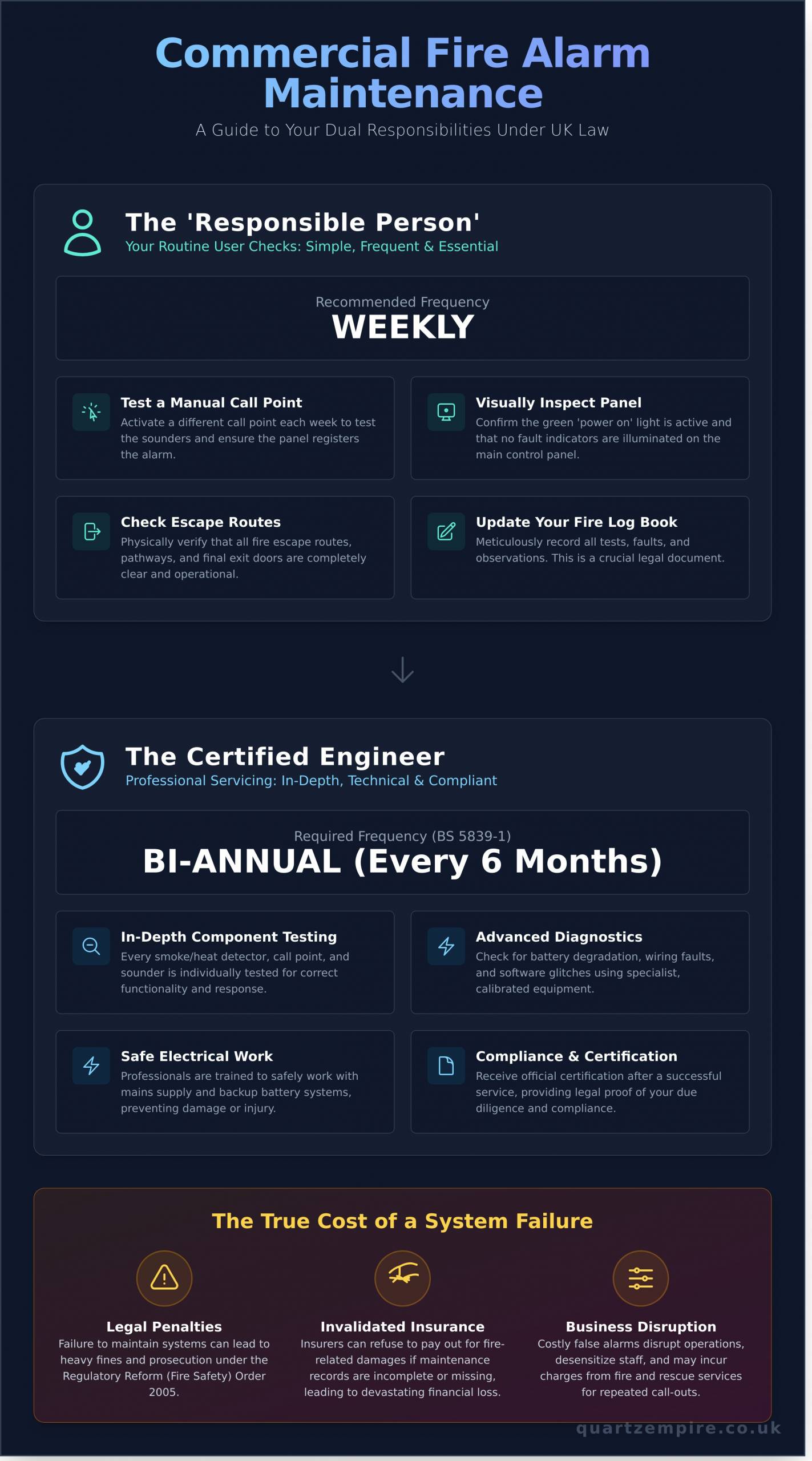
Maintaining a compliant and effective fire alarm system is a dual responsibility. As the designated 'Responsible Person' for your premises, you have specific duties outlined by UK fire safety legislation. These routine user checks are essential, but they are designed to complement, not replace, the in-depth servicing performed by a qualified engineer. Understanding your role is fundamental to ensuring your system is fully operational and compliant, as detailed in official guidance like the government's Approved Document B. This proactive approach protects your people and property.
Your Weekly and Monthly Responsibilities: A Simple Checklist
Performing regular user checks is a straightforward but critical task that helps identify obvious faults early. We recommend following this simple checklist to fulfil your obligations:
- Weekly Alarm Test: Once a week, activate a single manual call point to test the alarm. Confirm that the control panel registers the activation and that the sounders operate correctly. Use a different call point each week to cycle through them all over time.
- Visual Panel Check: Look at your main fire alarm control panel to ensure the green power light is on and that no fault indicators are illuminated.
- Ensure Clear Exit Routes: As part of your checks, physically verify that all fire escape routes and final exit doors are completely unobstructed and fully operational.
- Update Your Fire Log Book: Meticulously record the date, time, call point used, and any faults or observations in your fire log book. This is a legal document and a crucial record of your diligence.
The Role of the Professional Fire Alarm Engineer
While your weekly checks are vital, professional commercial fire alarm maintenance goes far deeper to ensure long-term reliability and legal compliance. A certified engineer performs complex tasks that users are not equipped or qualified to handle.
- In-Depth Component Testing: Engineers test every individual component, including smoke detectors, heat detectors, and interfaces, to ensure they respond correctly.
- Advanced Diagnostics: Using specialist, calibrated equipment, they can identify underlying issues like battery degradation, wiring faults, or software glitches that are not visible on the control panel.
- Safe Electrical Work: Our engineers are trained to work safely with the system’s high-voltage mains supply and backup battery systems, mitigating any risk of electric shock or damage.
- Compliance and Certification: Following a successful service, the engineer provides the necessary certification to prove your system meets BS 5839-1 standards, giving you documented proof of compliance.
What a BS 5839-1 Compliant Service Involves: A Detailed Breakdown
Understanding what a professional maintenance visit entails provides peace of mind and ensures you are meeting your legal obligations. As a business owner, your responsibilities for fire safety are defined by legislation, including the Health and Safety at Work etc. Act 1974. A BS 5839-1 compliant service is not just a box-ticking exercise; it is a meticulous process designed to verify that every component of your fire alarm system is functioning correctly, protecting your people and property. A high-quality commercial fire alarm maintenance plan is typically structured around two key visits per year.
The Bi-Annual Service: A Routine Health Check
Think of the six-monthly visit as a vital health check for your system. Our certified engineers perform a series of structured tests and inspections to ensure ongoing reliability. Key activities include:
- Log Book Review: The engineer will first check your fire alarm log book for any faults, false alarms, or incidents reported since the last visit.
- Device Testing: A proportion of all devices (typically 50%) are tested, including smoke detectors, heat detectors, and manual call points, ensuring a different set is checked on each visit.
- Visual Inspection: All major components, such as the main fire alarm panel and visible wiring, are visually inspected for signs of damage or interference.
- Power Supply Verification: We test the standby batteries and power supply units to confirm they will perform as required during a mains power failure.
The Annual Inspection: A Comprehensive System Audit
The annual inspection is a more in-depth audit that, combined with the bi-annual visit, ensures 100% of your system’s devices have been tested over a 12-month period. This comprehensive service confirms the system's integrity and includes checking the audibility of all sounders and beacons to ensure they meet required levels across the entire premises. We also verify the system's connection to any Alarm Receiving Centre (ARC) for monitored systems. Upon successful completion, a full service certificate is issued for your compliance records.
Managing Remedial Works and System Upgrades
If our engineers identify any faults or components that are failing or nearing the end of their operational life, these are classified as 'remedial works'. You will receive a clear, no-nonsense report detailing the issues and a quote for the necessary repairs. Common examples include replacing expired smoke detectors or failing standby batteries. In cases where an older system requires frequent and costly repairs, we may advise that a partial or full system upgrade is a more cost-effective long-term solution. Get a professional assessment of your current system.
Choosing Your Fire Alarm Maintenance Partner in London & The South East
Selecting the right company for your commercial fire alarm maintenance is a critical decision that directly impacts the safety of your people and the compliance of your premises. Your chosen provider is more than a contractor; they are a trusted partner in your fire safety strategy. To ensure you select a competent and reliable expert in London and the South East, it is essential to look beyond the initial quote and evaluate their credentials, responsiveness, and contractual transparency.
Why Third-Party Accreditation is Essential (BAFE & NSI)
In the fire safety industry, third-party accreditation is the definitive mark of quality and competence. Certifications from bodies like BAFE (British Approvals for Fire Equipment) and the NSI (National Security Inspectorate) are not just logos on a van; they are proof that a company is regularly audited against stringent industry standards. Insurers and local authorities often require these accreditations as a condition of cover and compliance, giving you complete peace of mind that you are working with vetted, accountable professionals.
Key Questions to Ask a Potential Provider
Before committing to a contract, arm yourself with a set of direct questions to gauge the provider's expertise and service level. A professional company will welcome this scrutiny and provide clear, confident answers.
- Are your engineers trained to the latest BS 5839-1 standards?
- What is your guaranteed emergency call-out response time?
- Can you provide references from similar businesses in our sector or area?
- Is your company BAFE or NSI accredited for fire alarm design, installation, and maintenance?
Understanding Your Maintenance Contract
The Service Level Agreement (SLA) is the foundation of your partnership. A transparent, comprehensive contract protects both parties and ensures there are no hidden surprises. Scrutinise the document for the following critical details:
- Service Frequency: It should clearly state the number of planned maintenance visits per year, as required by British Standards (typically two or four).
- Inclusions and Exclusions: Check what is covered in the standard fee, such as routine labour, and what is chargeable, like call-outs or replacement parts.
- Emergency Support: Ensure the contract guarantees access to a 24/7 emergency support line and specifies a maximum response time for critical faults.
- Contract Terms: Review the contract length, renewal process, and any terms for cancellation.
Taking the time to perform this due diligence ensures you secure a reliable partner for your commercial fire alarm maintenance, safeguarding your business for years to come.
Your Trusted Partner for Compliant Fire Alarm Maintenance
As we've explored, regular and professional fire alarm servicing is not an optional extra-it is a non-negotiable legal and moral duty for every UK business. Understanding the critical distinction between your own routine user checks and the comprehensive, bi-annual servicing required under BS 5839-1 is the first step towards robust protection. Ultimately, investing in professional commercial fire alarm maintenance is the cornerstone of a safe and resilient business, providing you with invaluable and lasting peace of mind.
Choosing the right provider is paramount. At Quartz Empire, we are the trusted partner for businesses throughout Kent, London, and the South East. Our BAFE and NSI accredited engineers bring a no-nonsense approach to fire safety compliance, delivering meticulous service you can depend on. We handle the complexities of compliance so you can focus on your business, confident that you are fully protected.
Ensure your business is protected. Request a free maintenance quote today. Take the definitive step towards securing your premises and fulfilling your critical safety responsibilities.
Frequently Asked Questions About Commercial Fire Alarm Maintenance
How often must a commercial fire alarm be serviced in the UK?
In the UK, it is a legal requirement for your commercial fire alarm system to be professionally serviced at least every six months. This is stipulated by the British Standard BS 5839-1. These biannual checks must be carried out by a competent, certified engineer. In addition to professional servicing, the designated Responsible Person on-site should also conduct weekly tests of the system to ensure it is functioning correctly, recording all results in your fire log book.
What is BS 5839-1 and why is it important for fire alarm maintenance?
BS 5839-1 is the British Standard code of practice for the design, installation, commissioning, and maintenance of fire detection and alarm systems in non-domestic premises. Following this standard is the recognised way to comply with UK fire safety law. For maintenance, it provides the framework for ensuring your system remains reliable and effective, protecting both people and property. Adherence to BS 5839-1 gives you peace of mind that your system is fully compliant and fit for purpose.
Can I perform my own commercial fire alarm maintenance?
While the designated Responsible Person is expected to carry out and log weekly alarm tests, you cannot perform the legally required biannual servicing yourself. This comprehensive inspection must be completed by a competent and certified fire alarm engineer. Attempting your own full commercial fire alarm maintenance can lead to non-compliance, invalidate your insurance, and critically, result in a system that fails when it is needed most. Always rely on an accredited professional for this essential task.
How much does commercial fire alarm maintenance cost?
The cost of a maintenance contract varies depending on several key factors. These include the size of your premises, the complexity of your system (e.g., the number of detectors, call points, and panels), and the type of system installed. A small office will naturally cost less than a large warehouse. We provide a no-nonsense, bespoke quote based on your specific needs to ensure you receive a fair and accurate price. Investing in a professional contract provides long-term value and ensures compliance.
What are the legal penalties for not maintaining our business fire alarm?
Failure to adequately maintain your fire alarm system is a breach of the Regulatory Reform (Fire Safety) Order 2005. The legal consequences can be severe and are enforced by the local Fire and Rescue Service. Penalties can include substantial, unlimited fines for the business. In cases where negligence leads to serious injury or loss of life, the Responsible Person can face criminal prosecution, including imprisonment. These measures underscore the critical importance of diligent maintenance.
What is a fire log book and what do I need to record in it?
A fire log book is a legal document and an essential record of all fire safety management at your premises. It provides evidence that you are meeting your legal duties. You must record all fire safety activities, including the dates and outcomes of weekly fire alarm tests, details of all professional servicing visits, any system faults and the actions taken to rectify them, records of false alarms, and dates of staff fire safety training and drills.
My fire alarm panel is beeping, what should I do?
A persistent beeping or chirping from your fire alarm panel typically indicates a system fault, not a fire. Do not ignore it. First, check the panel's display for any specific fault messages or lights, which can help diagnose the issue. You can usually silence the audible fault sounder. However, do not reset the entire system. Your next step should be to contact your certified fire alarm maintenance provider immediately to ensure a qualified engineer can resolve the fault promptly.