
Fire Extinguisher Types: A Complete Guide for UK Businesses
As a UK business owner, navigating your fire safety responsibilities can feel overwhelming. Faced with a confusing array of coloured labels and technical jargon, it's easy to worry about failing a fire inspection or choosing the wrong equipment for your specific workplace risks. Getting this wrong can have serious consequences for both safety and legal compliance. That's why a clear understanding of the different fire extinguisher types is not just a box-ticking exercise-it's a fundamental part of protecting your people, property, and business.
This complete guide is designed to provide that clarity. We offer a straightforward, no-nonsense breakdown of each extinguisher, its colour code, and the specific classes of fire it is designed to fight effectively. We’ll help you decode your legal responsibilities under UK regulations so you can make informed decisions with confidence. By the end of this article, you will have a reliable reference to ensure your premises are safe, compliant, and equipped correctly, giving you essential peace of mind.
Key Takeaways
- Understanding your legal duty as the 'Responsible Person' under the Regulatory Reform (Fire Safety) Order 2005 is the first step to ensuring your business is compliant.
- Matching the correct fire extinguisher types-Water, Foam, CO2, Powder, and Wet Chemical-to the specific fire risks in your workplace is critical for effective safety.
- Learn to identify extinguishers by their colour codes and select the appropriate units for different fire classes (A, B, C, D, F, and Electrical).
- Achieving full compliance extends beyond selection; it requires correct installation, clear signage, and a certified maintenance schedule for all units.
Why Understanding Fire Extinguisher Types is a Legal Duty
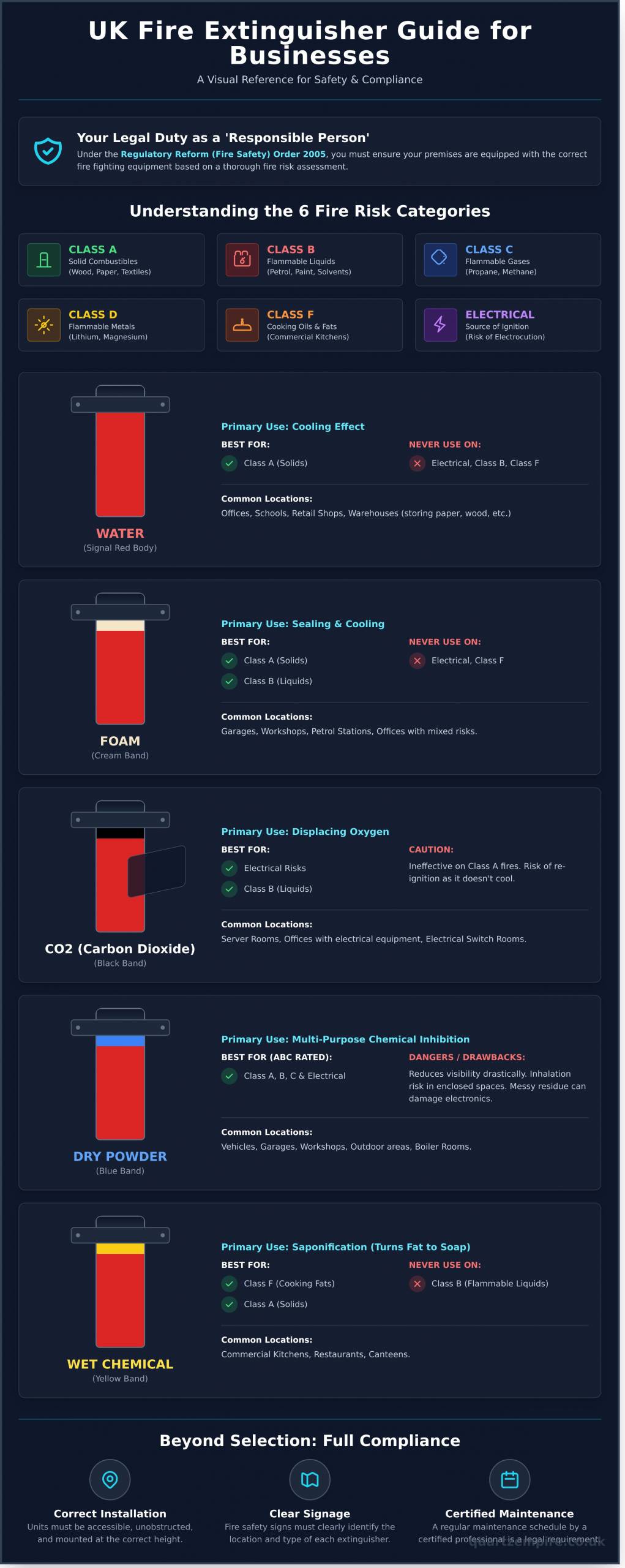
In the United Kingdom, providing the correct fire safety equipment is not just good practice-it is a mandatory legal requirement. The cornerstone of this legislation is The Regulatory Reform (Fire Safety) Order 2005, which places the responsibility for fire safety squarely on the shoulders of a designated ‘Responsible Person’ within any non-domestic premises. This individual, typically a business owner, director, or facilities manager, has a legal duty to protect staff and visitors from fire risks.
A core part of this duty is to ensure the premises are equipped with appropriate fire fighting equipment. This process begins with a professional fire risk assessment to identify potential hazards. Based on these findings, selecting and installing the correct fire extinguisher types is a critical decision that directly impacts safety and compliance. Making the wrong choice can have severe consequences, both in an emergency and during a safety inspection. To make an informed decision and choose from the available fire extinguisher types, you must first understand the different classes of fire and the UK's extinguisher identification system.
Understanding Fire Classes (A, B, C, D, F)
Fires are categorised into classes based on the type of fuel they burn. A compliant fire safety strategy means matching the extinguisher to the specific fire risks present in your environment. The main UK fire classes are:
- Class A: For fires involving solid combustible materials. Common examples include wood, paper, textiles, and coal.
- Class B: For fires involving flammable liquids. This includes substances like petrol, diesel, paint, and industrial solvents.
- Class C: For fires involving flammable gases. Examples are propane (LPG), butane, and methane.
- Class D: For fires involving flammable metals such as magnesium, lithium, or aluminium. These are specialist risks typically found in industrial or laboratory settings.
- Class F: For fires involving cooking oils and deep fats. This is a primary risk in commercial kitchens and catering facilities.
The 'Electrical Fire' Risk Explained
It is a common and dangerous misconception that there is a 'Class E' for electrical fires. In the UK, electricity is correctly identified as a source of ignition that can start a fire (e.g., a Class A fire in surrounding materials), not a class of fire itself. The primary danger is electrocution from conductive extinguishing agents. Using the wrong extinguisher, such as water or foam, on live electrical equipment can be fatal. Therefore, extinguishers must be specifically tested and certified as safe for this risk, which is indicated on the cylinder.
UK Fire Extinguisher Colour Codes (BS EN 3)
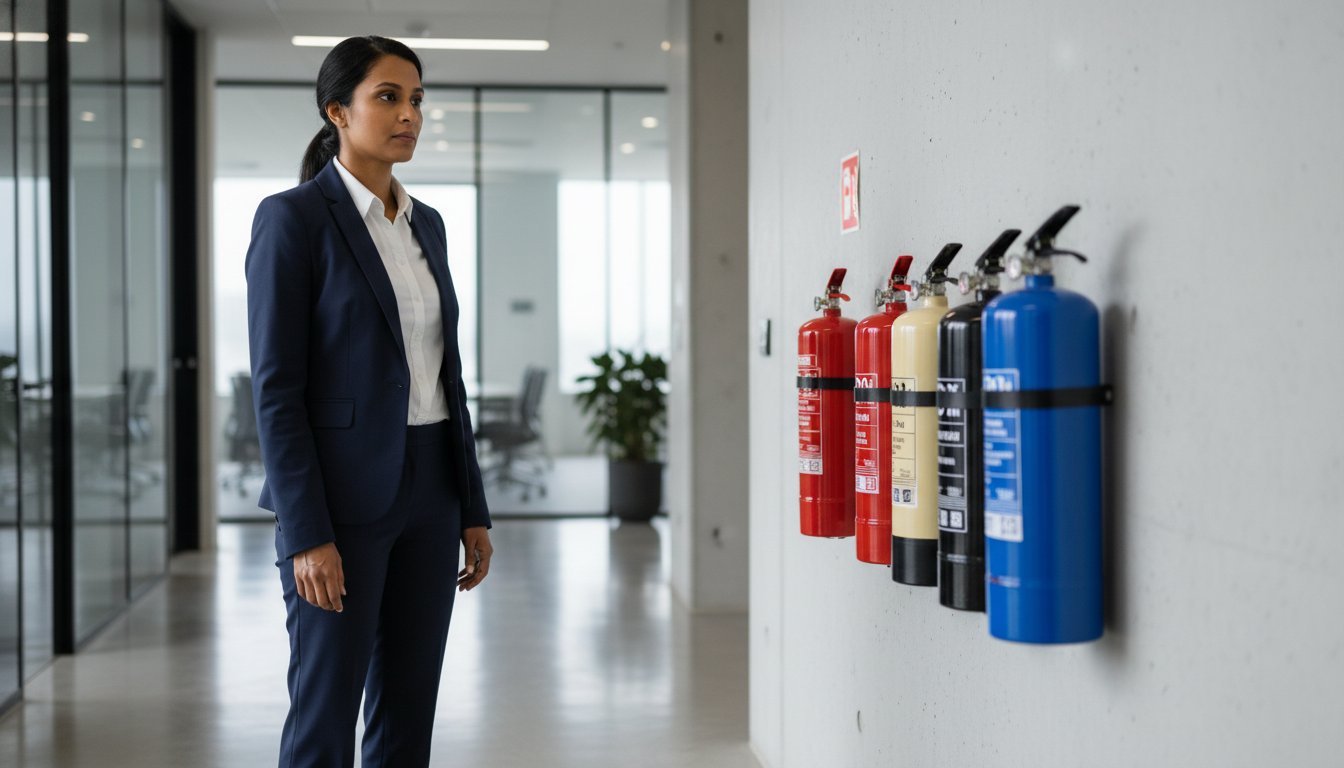
For quick and clear identification, all modern fire extinguishers manufactured to the BS EN 3 standard have a solid red body. A coloured band or panel across the top of the cylinder indicates the type of extinguishing agent inside. This system provides an immediate visual guide in an emergency, allowing for rapid selection of the correct unit:
- Red Band: Water
- Cream Band: Foam
- Blue Band: Dry Powder
- Black Band: Carbon Dioxide (CO2)
- Yellow Band: Wet Chemical
The 5 Main Fire Extinguisher Types Explained
Selecting the correct fire extinguisher is not a matter of guesswork; it is a critical safety decision based on the specific fire risks present in your environment. Each of the main fire extinguisher types is designed to tackle different classes of fire, and using the wrong one can be ineffective or even dangerously counterproductive. Understanding these distinctions is a fundamental part of your fire risk assessment and your legal duty for fire safety. Below, we provide a clear, no-nonsense breakdown of the five primary extinguishers used in UK businesses.
Water Extinguishers (Signal Red)
The most common and traditional type, water extinguishers work by cooling the burning material to a point where combustion can no longer occur. They are a reliable and cost-effective solution for specific risks.
- Best for: Class A fires involving solid combustibles like wood, paper, and textiles.
- NEVER use on: Electrical fires, flammable liquids, or cooking fat fires, as this can spread the fire or cause electrocution.
- Common Locations: Offices, schools, retail shops, and warehouses storing general combustible materials.
Foam Extinguishers (Cream Band)
Foam extinguishers offer a dual-action approach. They cool the fire like water but also create a sealing film over the fuel's surface, cutting off the oxygen supply and preventing re-ignition. This makes them more versatile than standard water units.
- Best for: Class A and Class B (flammable liquid) fires.
- Not suitable for: Commercial kitchen (Class F) fires or significant electrical hazards.
- Common Locations: Workshops, offices, petrol stations, and factories.
Dry Powder Extinguishers (Blue Band)
Also known as ABC extinguishers, these units fight fires by forming a crust over the fuel, which smothers it and inhibits the chemical reaction of the fire. Their versatility is a key advantage, but they come with cautions.
- Best for: Class A, B, and C (flammable gas) fires. Also safe for use on live electrical equipment.
- Cautions: The powder can obscure vision and cause breathing difficulties in enclosed spaces. Cleanup can also be extensive.
- Common Locations: Vehicles, workshops, outdoor areas, and premises with mixed fire risks.
Carbon Dioxide (CO2) Extinguishers (Black Band)
CO2 extinguishers displace the oxygen in the air to suffocate the fire and have a rapid cooling effect. Their primary benefit is that they are a clean agent, leaving no residue behind after discharge.
- Best for: Live electrical equipment and Class B flammable liquid fires.
- Key Benefit: Ideal for protecting sensitive electronics and machinery without causing damage.
- Common Locations: Server rooms, electrical switch rooms, and offices with high-value IT equipment.
Wet Chemical Extinguishers (Yellow Band)
These are specialist units designed specifically for the unique dangers of commercial cooking environments. The agent is discharged as a fine mist that cools the flames and reacts with hot oil in a process called saponification, creating a soap-like barrier to prevent re-ignition.
- Specifically designed for: Class F fires involving deep-fat fryers and cooking oils.
- Also effective on: Class A fires.
- Common Locations: Essential for commercial kitchens, restaurants, canteens, and food processing plants.
Specialist and Multi-Purpose Fire Extinguishers
While the core fire extinguisher types cover most common risks, certain environments demand specialist solutions. Modern premises often contain a complex mix of hazards, from sensitive electronics to volatile materials, necessitating advanced or multi-purpose extinguishers. Understanding these units is critical for comprehensive fire safety, as using the wrong type can be ineffective or even dangerous. Selecting the correct unit is only the first step; ensuring its compliant installation and maintenance by certified professionals is essential for reliable protection.
Water Mist Extinguishers (White Band)
Water Mist extinguishers represent a significant advancement in fire safety technology. They work by releasing an ultra-fine mist of microscopic water droplets, which cools the fire and smothers it by cutting off the oxygen supply. A key benefit is their versatility and safety; they are effective on most fire classes (A, B, C, F) and are non-conductive, making them safe for use on live electrical equipment up to 1000V. Because they leave minimal residue, they are an excellent choice for protecting irreplaceable assets and minimising downtime.
- Ideal for: Hospitals, data centres, museums, offices with sensitive electronics, and clean rooms.
Class D Powder Extinguishers (Blue Band - Specialist)
It is crucial to distinguish these specialist units from standard ABC Dry Powder extinguishers, even though they share a blue colour band. Class D extinguishers are designed exclusively for tackling fires involving flammable metals, such as lithium, magnesium, sodium, or potassium. They contain a specialist powder agent (e.g., L2 or M28) that smothers the fire and absorbs the intense heat produced by burning metals. These are non-negotiable in high-risk industrial environments where such materials are present.
- Found in: Specialist industrial settings, laboratories, aviation, and engineering workshops.
Lithium-ion Battery Fire Extinguishers (e.g., AVD)
The proliferation of lithium-ion batteries in devices from laptops and power tools to electric vehicles (EVs) presents a unique and growing fire risk. When these batteries fail, they can enter thermal runaway-a violent and self-sustaining chain reaction that traditional extinguishers cannot stop. Specialist agents like AVD (Aqueous Vermiculite Dispersion) are designed to cool the battery cells and create a protective film, effectively containing the fire and preventing re-ignition. These specialist fire extinguisher types are becoming essential for modern risk assessments.
Concerned about specific risks? Contact our experts for advice.
How to Choose the Right Extinguishers for Your Business
Understanding the different fire classes and extinguisher colours is the first step. The next, most critical stage is applying this knowledge to your premises. Selecting the correct fire extinguisher types for your business is a fundamental part of your legally required fire risk assessment. This process ensures you have the right tools to effectively and safely combat the specific fire hazards present in your environment, providing peace of mind and ensuring compliance.
Quick Reference Chart: Extinguisher Type vs. Fire Class
Use this chart for a quick overview of which extinguisher tackles which type of fire. A tick (✔) indicates suitability, while a cross (❌) means it should not be used.
| Extinguisher Type | Class A | Class B | Class C | Class D | Electrical | Class F |
|---|---|---|---|---|---|---|
| Water | ✔ | ❌ | ❌ | ❌ | ❌ | ❌ |
| Foam | ✔ | ✔ | ❌ | ❌ | ❌ | ❌ |
| Dry Powder | ✔ | ✔ | ✔ | ❌ | ✔ | ❌ |
| CO2 (Carbon Dioxide) | ❌ | ✔ | ❌ | ❌ | ✔ | ❌ |
| Wet Chemical | ✔ | ❌ | ❌ | ❌ | ❌ | ✔ |
| Water Mist | ✔ | ✔ | ✔ | ❌ | ✔ | ✔ |
Scenario 1: A Standard Office Environment
An office presents two primary fire risks: Class A fires from combustible materials like paper, cardboard, and furniture, and fires involving live electrical equipment. A compliant setup typically involves:
- Water or Foam Extinguishers: Positioned in main office areas and corridors to tackle Class A fires.
- CO2 Extinguishers: Located near significant electrical risks, such as server rooms or main switchgear cupboards, as they extinguish fires without damaging sensitive equipment.
Scenario 2: A Restaurant or Commercial Kitchen
Commercial kitchens are high-risk environments, primarily due to Class F fires involving cooking oils and fats. The extreme heat and flammable nature of these materials require specialist equipment. The correct provision includes:
- Wet Chemical Extinguishers: These are essential within the kitchen area itself. They are specifically designed to extinguish deep fat fryer fires safely and effectively.
- Foam or CO2 Extinguishers: Deployed in front-of-house areas like dining rooms and bars to handle Class A risks or potential electrical fires from tills or lighting.
These examples illustrate how different environments demand specific fire safety solutions. However, they are no substitute for a formal, site-specific fire risk assessment conducted by a competent person. For expert guidance and a fully compliant fire safety assessment for your business, contact the certified team at Quartz Empire Fire & Security Ltd.
Beyond Selection: Compliant Installation, Signage & Maintenance
Selecting the correct fire extinguisher types for your premises is a critical first step, but your legal and moral duties do not end there. To ensure you are fully compliant with UK fire safety law and that your equipment is effective in an emergency, you must follow strict guidelines for installation, signage, and ongoing maintenance. Purchasing the unit is only the beginning of creating a genuinely safe environment.
At Quartz Empire, we provide expert guidance and accredited services to ensure every aspect of your fire safety strategy delivers complete peace of mind.
Correct Siting and Installation
A fire extinguisher is useless if it cannot be found or accessed quickly. British Standard BS 5306 dictates that extinguishers must be clearly visible and positioned along escape routes, at exits, and near specific fire risks. They are typically wall-mounted with the handle 1 metre from the floor, or placed on a dedicated floor stand. Correct installation by a competent person ensures your equipment is secure, accessible, and ready for immediate use.
The Importance of Fire Extinguisher ID Signs
A Fire Extinguisher ID Sign, placed directly above the unit, is a legal requirement. These signs are crucial for rapid identification, showing the user what type of extinguisher it is (e.g., Water, CO2, Powder) and the classes of fire it can-and cannot-be used on. This prevents catastrophic misuse, such as using a water extinguisher on an electrical fire, thereby ensuring user safety and effective fire-fighting during a high-stress event.
Your Legal Duty: Regular Servicing and Maintenance
To remain compliant and ensure reliability, all fire extinguishers in a commercial environment must be maintained in accordance with BS 5306-3. This responsibility is twofold:
- Monthly Visual Inspections: A designated responsible person should check each unit monthly for obvious damage, ensuring the pressure gauge is in the green and the tamper seal is intact.
- Annual Service: A competent, certified technician must perform a full service on every extinguisher at least once a year. This in-depth inspection ensures all components are working correctly.
Neglecting this duty can invalidate your insurance and lead to severe legal penalties. Our accredited engineers provide a reliable, no-nonsense approach to keeping your equipment compliant and your people safe. Schedule your BAFE-certified extinguisher servicing with us.
Ensuring Complete Compliance: Your Next Steps
Navigating the various fire extinguisher types is a critical responsibility for any UK business owner. As we've covered, understanding the distinct uses of each extinguisher is not just best practice-it's a legal necessity to protect your people and property. True compliance, however, goes beyond simple selection; it requires correct installation, clear signage, and a robust, professional maintenance schedule to ensure your equipment is always ready and reliable.
Achieving this level of safety demands expert guidance. As your trusted fire safety partner serving Kent, London, and the South East, Quartz Empire provides a comprehensive, no-nonsense approach to fire protection. Our BAFE accredited engineers ensure you have the right equipment for your specific risks, fully maintained for complete regulatory compliance. Ensure your business is fully compliant. Contact us for fire extinguisher installation and maintenance.
Take the guesswork out of fire safety and secure the peace of mind that comes with being fully protected by the experts.
Frequently Asked Questions About Fire Extinguisher Types
What are the 4 most common types of fire extinguishers in UK businesses?
The four most common fire extinguisher types in UK commercial properties are Water, Foam, CO2, and Dry Powder. Water extinguishers are for Class A fires involving solid combustibles. Foam is effective on both Class A and Class B (flammable liquids). CO2 extinguishers are specifically designed for fires involving live electrical equipment, while Dry Powder provides broad coverage but is not recommended for small, enclosed spaces due to the risk of inhalation and difficult clean-up.
Which fire extinguisher is illegal to use in the UK?
Halon fire extinguishers are illegal for general use in the United Kingdom. They were phased out due to the severe damage their gases cause to the Earth's ozone layer. While you may still find them in a few highly specialised and exempt applications, such as on aircraft or in the military, they must not be used in commercial premises. Any existing Halon units discovered in a business property must be safely decommissioned by a certified professional.
How do I know how many fire extinguishers my business needs?
The precise number, type, and location of fire extinguishers required for your business must be determined by a thorough Fire Risk Assessment. This professional evaluation considers factors such as the size and layout of your premises, the specific fire hazards present (e.g., kitchens, server rooms), and the travel distance to an extinguisher. Adhering to the findings of a risk assessment is essential for protecting your property and ensuring you remain legally compliant with fire safety regulations.
Can a fire extinguisher expire, and how often should it be replaced?
Yes, fire extinguishers have a defined service life to ensure they remain effective and safe to use. While a competent technician must service them annually, their replacement schedule varies by type. Water, foam, and powder extinguishers typically require a discharge test and refill every 5 years. CO2 extinguishers have a longer lifespan and must be refurbished or replaced every 10 years. The manufacture date stamped on the cylinder is the definitive guide to its age.
What is the best all-round fire extinguisher for a small office or shop?
For a typical low-risk office or shop, a Foam extinguisher is an excellent and versatile choice. It is effective on Class A fires (paper, wood, textiles) and Class B fires (flammable liquids), covering the most common risks in these environments. However, it is vital to supplement this with a CO2 extinguisher placed near electrical equipment like computers and servers, as foam must not be used on live electricals. This combination provides reliable and compliant protection.
Is it a legal requirement to have fire extinguishers in a commercial property?
Yes, it is a legal requirement. The Regulatory Reform (Fire Safety) Order 2005 places a duty on the designated ‘Responsible Person’ for a commercial property to provide and maintain appropriate fire-fighting equipment. This includes installing the correct type and number of fire extinguishers to mitigate the risks identified in your Fire Risk Assessment. Failure to comply can result in significant fines and prosecution by the fire authorities, underlining the seriousness of this safety obligation.