
Fire Alarm Installation: A Complete Guide for Commercial Properties

Navigating the complexities of UK fire safety regulations can be a significant source of stress for any business owner or facilities manager. The prospect of a commercial fire alarm installation often brings concerns about legal compliance, business disruption, and the challenge of understanding technical specifications. Choosing a certified, reliable partner is paramount, as the safety of your people and the security of your property depend on getting this critical process right from the very start.
This guide is designed to provide clarity and confidence. We will walk you through the end-to-end installation journey, offering a straightforward, no-nonsense overview of what to expect. From the initial design and risk assessment that ensures your system is fit for purpose, through to the final commissioning and handover of all necessary certification, you will gain the knowledge needed to achieve complete compliance. Our goal is to provide you with the peace of mind that comes from having a reliable, expertly installed fire alarm system protecting your business.
Key Takeaways
- A compliant system begins with a professional Fire Risk Assessment (FRA), which legally determines the specific category of fire alarm your commercial property requires.
- Understand why a specialist, accredited installer is essential for fire alarm installation, as general electricians often lack the critical knowledge of BS 5839-1 standards.
- Learn that the process doesn't end with installation; professional commissioning is a mandatory final step to certify that your system functions correctly and meets legal obligations.
- Discover how a professional installation is planned and executed to minimise disruption, allowing your business to continue operating safely throughout the process.
Pre-Installation Essentials: Planning Your Fire Alarm System
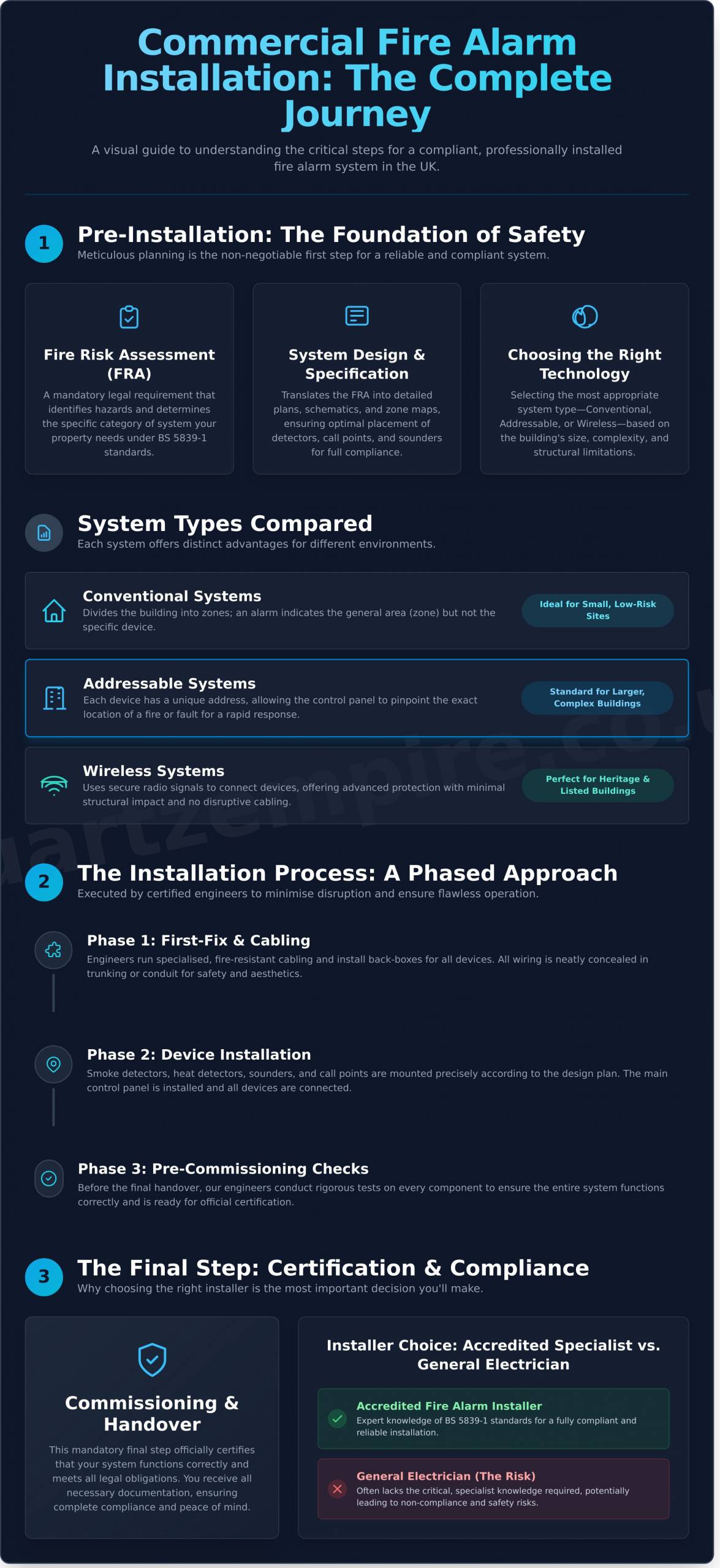
A successful fire alarm installation begins long before any wires are run or detectors are mounted. Meticulous planning is the foundation of a reliable and compliant system, designed with the fundamental goals of protecting life and property. The process starts not with choosing equipment, but with a thorough understanding of your building's unique risks. Factors such as the size of your premises, its day-to-day use, and the specific hazards present will all dictate the final system design. This is why an initial consultation with a certified fire safety company is an essential first step to ensure complete peace of mind.
The Role of the Fire Risk Assessment
Under UK law, a Fire Risk Assessment (FRA) is a mandatory requirement for all non-domestic premises. This crucial document, which must be carried out by a competent person, systematically identifies potential fire hazards and the people at risk. The FRA forms the official basis for your entire fire safety strategy. Its findings will specify the category of system your building requires under BS 5839-1 standards, such as an L1 system for maximum life protection or a P2 system focused on property protection.
System Design and Specification
Once the FRA is complete, its recommendations are translated into a detailed system design. Our certified engineers create comprehensive plans, including schematics and zone maps, to ensure optimal coverage and functionality. Selecting the right components for your Fire alarm system is vital, from sophisticated smoke and heat detectors to manual call points and audible sounders. Every element is chosen to meet the specific risks identified in the FRA, ensuring the final design is fully compliant with BS 5839-1 from the outset.
Choosing the Right Type of System
The design phase also involves selecting the most appropriate system technology for your premises. There are three primary types to consider, each with distinct advantages:
- Conventional Systems: Ideal for smaller, low-risk environments like shops or small offices. The building is divided into zones, and an activation will indicate the zone, but not the specific device.
- Addressable Systems: The standard for larger or more complex buildings. Each device has a unique address, allowing the control panel to pinpoint the exact location of a fault or fire, enabling a faster response.
- Wireless Systems: A perfect solution for listed buildings, heritage sites, or premises where disruptive cable installation is not feasible. They offer advanced, reliable protection with minimal structural impact.
The Fire Alarm Installation Process: A Step-by-Step Breakdown
A professional fire alarm installation is a meticulously planned process, executed by certified engineers to ensure complete compliance and reliability. At Quartz Empire, we understand that your business operations must continue. Our team works efficiently and cleanly, coordinating with other trades on-site to minimise disruption. For a typical small to medium-sized business, the physical installation can often be completed within a few days, depending on the system's complexity and the building's layout. The entire process is broken down into three distinct phases to guarantee a seamless and effective result.
Phase 1: First-Fix and Cabling
The first phase involves laying the system's essential groundwork. Our expert engineers run specialised, fire-resistant cabling throughout your premises, following the routes specified in the system design. We install back-boxes at the designated locations for all detectors, call points, and sounders. To protect the wiring and maintain the aesthetic of your building, all cables are neatly housed in appropriate containment, such as PVC trunking or steel conduit. This foundational work is critical for the long-term performance and safety of your fire alarm system.
Phase 2: Device Installation and Connection
Once the cabling is in place, the second-fix begins. This is where the system becomes visible, as we mount the devices that detect and alert to a fire. This includes smoke and heat detectors, sounders, beacons, and manual call points. Each device is positioned precisely according to the design plan to comply with British Standard BS 5839-1. Our engineers adhere to the highest industry benchmarks, which align with global best practices outlined in comprehensive guides like the NFPA 72 Code. Finally, the main control panel is installed in a secure, accessible location, and all devices are carefully connected to the system wiring.
Phase 3: System Testing and Pre-Commissioning Checks
Before the formal commissioning can take place, our engineers conduct a series of rigorous pre-commissioning checks. This vital stage of the fire alarm installation involves comprehensive electrical testing of all new cabling to identify any potential faults, such as short circuits or breaks in a line. We then test every single connected device-from the furthest detector to the nearest call point-to confirm it is communicating correctly with the control panel. This methodical verification ensures the system's integrity and provides complete peace of mind before it is officially handed over.
Post-Installation: Commissioning, Certification, and Handover
Completing the physical wiring and device fitting is a major milestone, but a professional fire alarm installation is not finished at this point. The next phase-commissioning, certification, and handover-is a legally required process that transforms a collection of components into a fully operational, compliant life safety system. This crucial stage provides the verification that your system works exactly as designed and gives you the documentation and training needed to manage it effectively.
What is Fire Alarm Commissioning?
Commissioning is a comprehensive and systematic test of the entire fire alarm system, performed by a competent and certified engineer. It goes far beyond a simple on-off switch test. The goal is to verify that every single element performs flawlessly according to the design specification and BS 5839-1 standards. This includes testing every detector and call point, verifying that sounder decibel levels are sufficient in all areas of the building, and ensuring all cause-and-effect programming-such as closing fire doors or shutting down ventilation-is correct.
Receiving Your Certification and Logbook
Upon successful commissioning, you will receive the essential documentation that forms a critical part of your fire safety record. The most important of these is the commissioning certificate, often from a BAFE-accredited provider, which serves as your official proof of a compliant installation. This certificate is vital for insurance purposes and for demonstrating due diligence to authorities. It confirms your system meets the stringent requirements outlined in the latest UK fire safety regulations. You will also be provided with:
- A fire alarm logbook to record all future weekly tests, maintenance visits, and activations.
- Detailed "as-fitted" drawings and a clear zone plan.
- Manufacturer's manuals and operating specifications.
User Training and System Handover
A fire alarm system is only effective if your personnel understand how to operate it. A thorough handover includes dedicated training for your designated ‘Responsible Person’ and other key staff. Our engineer will provide clear, practical instruction on how to manage the control panel, including how to correctly silence and reset the alarm after an activation. We also ensure your team can confidently identify different fault indicators and knows how to conduct the required daily and weekly user checks. A compliant fire alarm installation is the first step; ongoing diligence is crucial for long-term safety. Explore our maintenance plans to ensure your system remains fully operational and compliant.
Why You Must Use an Accredited Fire Alarm Installer
When it comes to protecting your people, property, and business, the choice of installer is critical. A commercial fire alarm installation is not a standard electrical task; it is a specialist, life-safety discipline governed by strict British Standards. A general electrician, while skilled in their own trade, may lack the specific, in-depth knowledge of BS 5839-1 required for a compliant and effective system design.
Choosing a non-accredited installer exposes your business to significant risks, from system failure to legal non-compliance. Accreditation is your only reliable assurance that a company has been independently audited and verified for its competence, quality of work, and adherence to the highest industry standards.
The Dangers of an Incorrect Installation
An improperly installed fire alarm system is not just ineffective-it's a liability. Poorly placed detectors can create dangerous blind spots, and incorrect wiring can lead to complete system failure during a real fire. This can have catastrophic consequences. Furthermore, frequent false alarms caused by a faulty installation waste emergency service resources and, more dangerously, lead to complacency among staff. For the business owner, the legal and financial penalties for non-compliance, which can include hefty fines and invalidated insurance, are severe.
What to Look For in an Installation Company
To ensure your system is fully compliant and reliable, your chosen installer must demonstrate proven expertise. Look for a company that can provide clear evidence of the following:
- Third-Party Accreditation: Certification from a UKAS-accredited body such as BAFE, the Fire Industry Association (FIA), or the National Security Inspectorate (NSI) is non-negotiable.
- Relevant Experience: They should have a portfolio of work in commercial properties similar to yours.
- Comprehensive Insurance: Ensure they hold adequate public liability and professional indemnity insurance.
- Full-Service Capability: A trusted partner should handle the entire lifecycle: system design, installation, commissioning, and ongoing maintenance.
The Value of a 'No Nonsense' Approach
A professional, accredited company operates with transparency and integrity. This 'no nonsense' approach means you receive clear, detailed quotations without hidden costs. Communication is proactive throughout the project, ensuring you are always informed. The ultimate focus is on providing a robust, compliant solution that delivers long-term safety and genuine peace of mind. By partnering with a certified expert for your fire alarm installation, you are making a crucial investment in the future of your business. To discuss your requirements with an accredited team, contact Quartz Empire Fire & Security Ltd today.
Your Trusted Partner in Commercial Fire Safety
As we have detailed, protecting your commercial property is a significant responsibility that hinges on two core principles: meticulous planning and professional execution. From initial design to final commissioning and certification, every step is critical for ensuring your system is fully compliant, reliable, and capable of safeguarding your people and assets when it matters most.
The most crucial decision in this process is choosing a certified expert. At Quartz Empire, we provide that essential expertise and peace of mind. As a BAFE Accredited company, our team specialises in designing and implementing compliant systems for business premises across Kent, London, and the South East. When you partner with us, you are choosing a no-nonsense approach to safety and regulatory adherence.
Ensure your property is protected by a trusted professional. Get a free, no-obligation quote for your fire alarm installation and take the decisive step towards securing your business today.
Frequently Asked Questions About Fire Alarm Installation
How much does a commercial fire alarm installation cost?
The cost of a commercial fire alarm installation in the UK varies significantly based on your premises. A small, simple system for a small office might start from £1,500 - £3,000. For larger or more complex buildings, the cost can be £10,000 or more. Key factors influencing the price include the size of the building, the type of system (e.g., addressable vs. conventional), and the number of detectors and call points required. We provide a detailed, bespoke quote after a thorough site survey.
How long does it take to install a fire alarm system in an office?
The installation timeline depends on the scale and complexity of the project. A straightforward installation in a small office could take as little as two to three days. For a larger, multi-storey building with intricate wiring requirements, the process could extend to several weeks. Our expert engineers provide a clear project schedule before work commences, ensuring you are fully informed. We always work efficiently to minimise any disruption to your business operations.
Do I need to close my business during the installation?
In most cases, you will not need to close your business. Our certified engineers are highly experienced in working within active commercial environments. We prioritise minimising disruption by scheduling work in phases, during off-peak hours, or over weekends where necessary. Our goal is to ensure your business remains operational and your staff remain safe while we complete the installation, providing you with complete peace of mind throughout the process.
What is the difference between a fire alarm installation and commissioning?
Installation is the physical process of fitting all system components, including the control panel, detectors, sounders, and wiring, according to the approved design. Commissioning is the critical final stage. A certified engineer tests every single device and function of the system to verify it operates correctly and fully complies with British Standard BS 5839-1. Only after successful commissioning is the system officially certified and handed over as operational.
Is a fire alarm installation a legal requirement for my business?
Yes, for almost all commercial premises in the UK, a suitable fire detection and alarm system is a legal requirement under the Regulatory Reform (Fire Safety) Order 2005. The specific type of system your business needs is determined by your mandatory Fire Risk Assessment. A compliant fire alarm installation is not just about ticking a box; it is a fundamental part of your duty to protect your staff, visitors, and property from the risk of fire.
Can a regular electrician install a commercial fire alarm system?
While a qualified electrician can run cables, a commercial fire alarm system must be designed, installed, and commissioned by a competent and certified specialist to be legally compliant. These systems are life-safety critical and must adhere to the strict standards of BS 5839-1. Using a BAFE-accredited or similarly certified company ensures your system is installed by trained experts who understand the complex requirements for detection, zoning, and certification.
What happens to my old fire alarm system?
As part of our comprehensive service, our engineers will safely decommission your old fire alarm system. Once it is disconnected and made safe, all components are carefully removed from your premises. We then ensure that all the old equipment is disposed of in an environmentally responsible manner, fully in accordance with the UK's WEEE (Waste Electrical and Electronic Equipment) regulations. This provides a seamless and compliant transition to your new, reliable system.